little confused

kay2301

Suspended / Banned
Messages
31
Name
kay
Edit My Images
No
Hi, i have on my photography course for 1 month now and we got to start taking pictures with our slr. then next week we are gonna develop our film. I took 4 shots tonight of the moon and i dont know if i have used the right settings. My settings i used were f22 @ 1/4. Would anyone know if i used the right setting or am i gonna have a bad picture when its developed. I thought that the slow speed being at 1/4 would take more light in from the moon.

Im really confused at the moment with aperture and shutter speeds and how to use them. Any advice would be greatly apperciated

thanks very much

kay
 
Buy and read Understanding Exposure.
It tell you everything about this subject...
 
You want a high shutter speed if your taking pictures of the moon, most people use 1/125.

If you use slow speeds then the light over takes the detail and your just left with a big white thing in the sky.

This is one I did 2 days ago,

3972055773_6c41a51a99.jpg


Here is the exif:

Camera: Canon EOS 40D
Exposure: 0.008 sec (1/125)
Aperture: f/5.6
Focal Length: 300 mm
ISO Speed: 100
Exposure Bias: -1 EV
 
f22 will give you a large depth of field, DOF. ie in a landscape shot the foreground to the horizon would be in focus. f4 the other end of the scale will give a narrow plane of focus, the opposite of f22. Now a low f number will give you a faster shutter speed, and vice versa, so f22 will give you a slow shutter speed. Now the moon isnt moving relative to photography, now if the shutter speed is to slow, you will increase the chance of a blurred image. Ideally you should have the camera on a tripod, use f8 and either use the self timer or a cable release to trip the shutter.
 
You want a high shutter speed if your taking pictures of the moon, most people use 1/125.

If you use slow speeds then the light over takes the detail and your just left with a big white thing in the sky.

This is one I did 2 days ago,

3972055773_6c41a51a99.jpg


Here is the exif:

Camera: Canon EOS 40D
Exposure: 0.008 sec (1/125)
Aperture: f/5.6
Focal Length: 300 mm
ISO Speed: 100
Exposure Bias: -1 EV

Lovely example:clap:
 
You want a high shutter speed if your taking pictures of the moon, most people use 1/125.

If you use slow speeds then the light over takes the detail and your just left with a big white thing in the sky.

1/125s is possibly the slowest you may get away with, more realistically 1/500s would give a sharper photo. Obviously the lens needs to be wide open (f/2.8 or f/4, f/5.6 depending on the budget) and an appropriate ISO setting.

The reason for the fast shutter speed is the movement of the moon across the sky (if the photograph was taken over several hours the moon would appear as a semicircle). 1/4 is way too slow. It is not so important with wide angle lenses.

Also at f22 the lens diffraction would become obvious and result in a very soft image (f/5.6-8 is generally the sharpest f-stop).
 
You don't say what lens you were using, but I took some a few weeks ago with a 300mm lens and had settings of f11 and 1/25 sec. Your settings may lead to underexposure, hopefully not. I wouldn't go too slow with the Moon as it is a moving object after all. ;)

A good site to learn a bit about exposure is http://www.photonhead.com/. Most people find the Simcam section particularly useful.

I found a very good online camera simulator last week which also has the benefit of simulating shutter speed on moving object. You can find it here at http://www.dslrsim.com/

Good luck with your course. :thumbs:
 
Now the moon isnt moving relative to photography.

WRONG :rules:

The moon moves very fast and results in a blurry image. Lookup some info from astronomy websites and if you still don't believe get a cable release, tripod and experiment with different speeds.
 
Hi, i have on my photography course for 1 month now and we got to start taking pictures with our slr. then next week we are gonna develop our film. I took 4 shots tonight of the moon and i dont know if i have used the right settings. My settings i used were f22 @ 1/4. Would anyone know if i used the right setting or am i gonna have a bad picture when its developed. I thought that the slow speed being at 1/4 would take more light in from the moon.

Im really confused at the moment with aperture and shutter speeds and how to use them. Any advice would be greatly apperciated

thanks very much

kay

Kay, when you are unsure about exposure, the thing to do is 'bracket' - that is, take several frames at settings above and below your best estimate, just to make sure.

This tutorial explains a lot of the basics about exposure, shutter speeds and lens apertures etc which should help get you started :) http://www.talkphotography.co.uk/forums/showthread.php?t=99841

WRONG :rules:

The moon moves very fast and results in a blurry image. Lookup some info from astronomy websites and if you still don't believe get a cable release, tripod and experiment with different speeds.

How far does the moon actually move in 1/4sec? Or in four seconds for that matter? Camera shake is the enemy with a long lens moon shot, not subject movement.
 
so if i were to try again with a setting of f8 @ 1/125 should that work better.

I have a 18-70mm minolta

its all so confusing at the moment. Am i right by saying that the higher the f stop the faster the shutter speed should be?
 
Over-exposure surely?
Maybe, but not relative to the settings I was using with such a small aperture.

It is surprising how fast the Moon moves. When I first got my new camera I used the LiveView to try and set the focus on the Moon, I zoomed so the Moon filled virtually the whole LCD, and you can see the Moon moving. :eek:
 
Am i right by saying that the higher the f stop the faster the shutter speed should be?
No. its the other way round the lower the F stop the bigger the opening so the higher the shutter speed

Cheers

Ron
 
so if i were to try again with a setting of f8 @ 1/125 should that work better.

I have a 18-70mm minolta

its all so confusing at the moment. Am i right by saying that the higher the f stop the faster the shutter speed should be?

Your not going to get much with a 70mm lens,

Is this the lens? http://www.dpchallenge.com/lens.php?LENS_ID=1227

If so use the f3.5.

Lower f number - faster shutter speed :thumbs:
 
I've read somewhere that the moon moves relative to us at about 1km/s so in a 1/4 sec it moves 250metres at the mo. The moon has an oliptical orbit and ranges from about 221,463 miles (356,334 kilometers) at perigee (closest approach to Earth) to 251,968 miles (405,503 kilometers) at apogee (farthest point). The average distance from the moon to the Earth is 238,857 miles (384,392 kilometers). (info from enotes)

How 250mtrs looks over such a large distance would be very hard to spot however 1/8th would be better as would 1/16th and so on... everything is relative ;)
 
does the same go for taking shots in darkness?

thanks

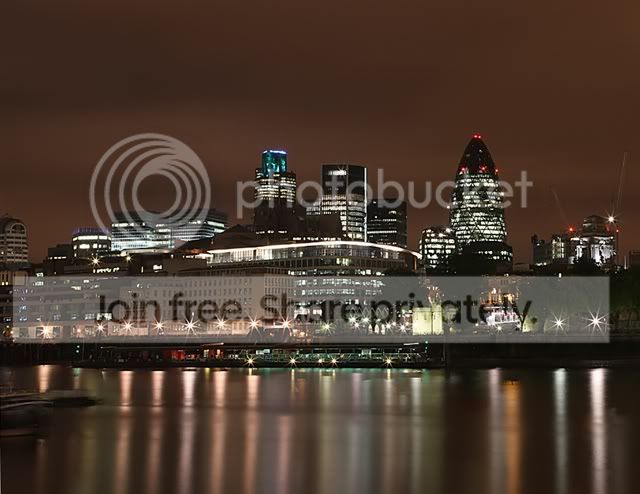
It does but shutter speeds will be slower. I recently took shots of london at night at F22 (small aperture / F stop) for 99 seconds (Long time)

I could have taken them at F5.6 (larger opening) for a shorter time but would not have got the effect I wanted.

See example below

Londonatnight.jpg


This was shot at F22 for 99 seconds. The long exposure smoothed the river and starred the lights

The star effect on the lights is caused by the aperture blades

Hope this helps and does not confuse you more.

Cheers

ron
 
so if i were to try again with a setting of f8 @ 1/125 should that work better.

I have a 18-70mm minolta

its all so confusing at the moment. Am i right by saying that the higher the f stop the faster the shutter speed should be?

You should read the link I posted above, but briefly, f/numbers have the same basic relationship as shutter speeds in terms of exposure - it just isn't so obvious. That is, each full f/stop is half or double to ones either side, eg f/5.6 is twice as bright as f/8, which is twice as bright as f/11 and so on (the relationship is the square root of 2, ie 1.414). In this way, for example 1/125sec at f/8 is the same amount of light on the film as 1/60sec at f/11, or 1/250sec at f/5.6 etc. A 'stop' is any halving or doubling of exposure, either by changing the shutter speed, the f/number, or the ISO.

So, no, the higher the f/number, the longer the shutter speed should be. Assuming that 1/125sec at f/8 is your best estimate of correct exposure (though that sounds like erring on under exposure to me, depending on your ISO) then to be sure of getting a good result I suggest you shoot frames at that setting, then bracket it with two additional frames of one stop and two stops under exposure, plus two more of over exposure. That way you are more or less guranteed a decent result.

Maybe, but not relative to the settings I was using with such a small aperture.

It is surprising how fast the Moon moves. When I first got my new camera I used the LiveView to try and set the focus on the Moon, I zoomed so the Moon filled virtually the whole LCD, and you can see the Moon moving. :eek:

In terms of the exposure time you need to shoot the moon, it is not moving anywhere significant.
 
I've read somewhere that the moon moves relative to us at about 1km/s so in a 1/4 sec it moves 250metres at the mo. The moon has an oliptical orbit and ranges from about 221,463 miles (356,334 kilometers) at perigee (closest approach to Earth) to 251,968 miles (405,503 kilometers) at apogee (farthest point). The average distance from the moon to the Earth is 238,857 miles (384,392 kilometers). (info from enotes)

How 250mtrs looks over such a large distance would be very hard to spot however 1/8th would be better as would 1/16th and so on... everything is relative ;)

read up carefully before writing :cuckoo:

Firstly the mean orbital speed of the moon is over 1000 km/s, and that translates to 0.5° /s. Telephoto lenses have an angle of view of just a few degrees, so this is an obvious problem.

At 70mm you are photographing landscape (or plenty of empty sky) that may include a small blob of the moon. 300mm is still very short, reasonable F would be around from 600-700mm, or just use a telescope.
 
My tutor once told me that you shoot the moon the same as you would shoot during the day, using the sunny 16 rule:

ISO 100
Shutter 100th
F16

obviously on a tripod with remote and mirror lockup.

Worked for me! :thumbs:
 
read up carefully before writing, oof I think I've been told off :razz:
 
...I think I've been told off :razz:

And I'm not sure why :shrug:

The movement of the moon at commonly used shutter speeds and even long lenses is insignificant. How far does it move in 1/125sec? I've got plenty of sharp pictures at much lower than that. Camera shake is the problem.

If it's really racing across the sky at such a rate, you could always try panning.
 
edit : thought better of it, long day, have a nice one :)
 
read up carefully before writing :cuckoo:

Firstly the mean orbital speed of the moon is over 1000 km/s, and that translates to 0.5° /s. Telephoto lenses have an angle of view of just a few degrees, so this is an obvious problem.

At 70mm you are photographing landscape (or plenty of empty sky) that may include a small blob of the moon. 300mm is still very short, reasonable F would be around from 600-700mm, or just use a telescope.

Where are you getting this information from ?

The mean orbital velocity of the moon around the earth, is just over 1km/s.
Not 1000! If it were 1000km/s, it would orbit the earth in 40 minutes!! When in reality it takes 27.3 days.

If it really moved across the sky at half a degree per second, it would be up and gone in 6 minutes.

You do not need fast exposure for the moon. Its relative position in the sky does not move quick enough for it to be an issue.
 
Where are you getting this information from ?

The mean orbital velocity of the moon around the earth, is just over 1km/s.
Not 1000! If it were 1000km/s, it would orbit the earth in 40 minutes!! When in reality it takes 27.3 days.

If it really moved across the sky at half a degree per second, it would be up and gone in 6 minutes.

You do not need fast exposure for the moon. Its relative position in the sky does not move quick enough for it to be an issue.

And back again six minutes later :eek:

Welcome to TP Nutty - quality debut ;)

PS It's not always like this :D
 
My head hurts... please someone tell me to go to bed :gag:
 
And I'm not sure why :shrug:

The movement of the moon at commonly used shutter speeds and even long lenses is insignificant. How far does it move in 1/125sec? I've got plenty of sharp pictures at much lower than that. Camera shake is the problem.

If it's really racing across the sky at such a rate, you could always try panning.[/QUOTE] :lol:

i can just see it now, two togs with cameras trying to get the moon picture ,,
"did you see that ? "
no what was it ?
i think it was the moon ,we missed it
dont matter it'll be back round in a few minutes

yeah ..............i'll keep my eyes open this time
 
Thanks HoppyUk :) Been a TP lurker for a few months now. About time I signed up :)
 
I got this one hand held, not sure if it's relevant or that good though?

3979332081_c8ef92c25e_o.jpg


Steve
 
The mooon does move quite fast, when looking through my telescope at the surface am constantly turning the wheel of the tripod head to keep up. If I don't move the tripod head it doesn't take long before am staring at a black sky.

Dave
 
the moon i understand is daylight settings
sunny f16 should do the job..and calling it cloudy bright
100 asa...1/100 sec f11

you will note my boy scout method as used to work out the width of a river..
 
The mooon does move quite fast, when looking through my telescope at the surface am constantly turning the wheel of the tripod head to keep up. If I don't move the tripod head it doesn't take long before am staring at a black sky.

Dave

i think we get that dave but how many mm is you,re telescope compared with a camera lens?
 
i think we get that dave but how many mm is you,re telescope compared with a camera lens?

It doesn't matter if it's a million mm. The moon moves very slowly. A lot slower than an average snail in fact.
 
The mooon does move quite fast, when looking through my telescope at the surface am constantly turning the wheel of the tripod head to keep up. If I don't move the tripod head it doesn't take long before am staring at a black sky.

Dave

It doesn't matter if it's a million mm. The moon moves very slowly. A lot slower than an average snail in fact.

so how come dave has to move his telescope to keep up with it and i don,t have to move my camera of course it matters:bang:
 
so how come dave has to move his telescope to keep up with it and i don,t have to move my camera of course it matters :bang:

Of course it moves! The point is how fast does it move in relation to the shutter speeds you need to photograph it successfully. We're not talking minutes here, we're talking fractions of a second. It is of no significance. It is the least of your problems in trying to photograph it successfully. On the other hand, camera movement can be very significant.
 
You do not need fast exposure for the moon. Its relative position in the sky does not move quick enough for it to be an issue.

It is an issue if you are using a really long lens (i.e. telescope). The movement as seen through something like that is enough to warrant using at least 1/125th.

Also movement of the air in our atmosphere is sufficient to give a soft image when using relatively slow shutter speeds.

To see all this in action, put a decent telephoto lens on your camera, switch on live view if your camera has it, and zoom in to 10x. You will be amazed at how the surface of the moon appears to boil as a result of atmospherics on our planet.
 
Back
Top