Lightmeter but where to start?

tikkathreebarrel

Suspended / Banned
Messages
2,150
Edit My Images
Yes
I spend a lot of time now with film cameras which either no longer have accurate built-in metering or simply never had it at all. I can't find a lightmeter app which works well on the HTC Desire HD either so rather than carry a DSLR around with me for metering purposes I'm considering investing in a pukka lightmeter.

Where's a chap to begin? Tooo many choices. Mostly I'll be outdoors and mostly I'll be on flowers/objects/machinery/landscapes. I think I need something that's small and light enough to go in a pocket or hang off the camera strap otherwise it'll be left at home more often than not.

I'm looking for recommendations based on experience guys... please?
 
Sekonic 308 is the one most people get, for flash and ambient. Works well, and is pretty cheap.

If you're into this shooting film thing, you might like to play with Zone metering and stuff, in which case a spot meter would be handy. Just look a bit further up the Sekonic range.

I'm less familiar with Gossen, the other big brand (there aren't many!) but they're good too.
 
HoppyUK thanks for your reply: in the ansence of conflicting advice (!) I'll have a look at the one you recommend.
 
yeh I use the 308.. it small thus no issue carrying while out doors, that cant be said for some of the more expensive sekonic meters they are way to bulky for my uses.

Use mine all the time for working out flash exposure/ratios out doors.
 
yeh I use the 308.. it small thus no issue carrying while out doors, that cant be said for some of the more expensive sekonic meters they are way to bulky for my uses.

Use mine all the time for working out flash exposure/ratios out doors.

That's #2 for the 308 then. :clap:
 
I'm not sure what your budget is or how much you are willing to spend, but my Leningrad 7 selenium plastic poorly built USSR light meter (which can't be worth more than a fiver) will spit out a reading which is similar, if not the same, as any high end Sekonic from the 21st century in any reasonable light scenarios. It often matches my D7000's ultra smart matrix meter. Especially if you are shooting B&W/colour negative, it doesn't have to be spot on due to exposure latitude anyway.

There's hundreds of meters to pick from.
 
I have a Weston Master V (with invercone). Was great when I used to use with my film cameras. Always some on ebay.
 
1. I'm not sure what your budget is or how much you are willing to spend, but my Leningrad 7 selenium plastic poorly built USSR light meter (which can't be worth more than a fiver)

2. There's hundreds of meters to pick from.

In answer to point 1 I'm not sure what my budget is but I slightly resent having to buy a meter and part of me thinks I should be able to work it out with eyeball and brain with an acceptable level of confidence.
Perhaps then I start low budget and simply use this to corroborate what I see for myself.:shrug:

As to point 2, I already know!:bonk:
 
I've just bought a Gossen Variosix F2 with spot attachment and am really pleased, nice and pocket sized and plenty of features (incident, reflective and spot, flash, multi flash etc).


Thank you MArk. Having looked at the price I'd jolly well want to be really pleased too!:eek:
 
I went for the Sekonic L-358 over the 308 for the extra features, but your not going to go wrong with any Sekonic
 
If you look at the L-358 (like I was).. don't look it up with OneStopDigital (like I did) or you might find yourself with a L-758D for not much more than the UK streetprice of the L-358 (having already budgetted that amount). The advantage of the 758 is the 1-degree spotmeter (which I'm still getting to grips with).

Personally, I'd recommend starting out with something cheap and cheerful like a Weston Master if you're shooting negative film, I have a Master II that does a good general purpose job and the Master V is always well recommended.

For a Mark I eyeball meter, the Ultimate Exposure Computer sounds like a waste of time, and some people do struggle with it, but once you get your head around it, it's almost as easy to use as a Weston Master and accurate enough for negative film. I "calibrated" mine against known scenes that I've repeatedly shot in the past on digital.
 
Last edited:
If you look at the L-358 (like I was).. don't look it up with OneStopDigital (like I did) or you might find yourself with a L-758D for not much more than the UK streetprice of the L-358 (having already budgetted that amount). The advantage of the 758 is the 1-degree spotmeter (which I'm still getting to grips with).

Personally, I'd recommend starting out with something cheap and cheerful like a Weston Master if you're shooting negative film, I have a Master II that does a good general purpose job and the Master V is always well recommended.

For a Mark I eyeball meter, the Ultimate Exposure Computer sounds like a waste of time, and some people do struggle with it, but once you get your head around it, it's almost as easy to use as a Weston Master and accurate enough for negative film. I "calibrated" mine against known scenes that I've repeatedly shot in the past on digital.


Honest, experience-based advice is aleays really useful, thank you.
 
For a Mark I eyeball meter, the Ultimate Exposure Computer sounds like a waste of time, and some people do struggle with it, but once you get your head around it, it's almost as easy to use as a Weston Master and accurate enough for negative film. I "calibrated" mine against known scenes that I've repeatedly shot in the past on digital.
I printed out the PDFs on this page on thin card stock and carry the smaller one with my in my wallet. It's the size of a credit card and does the job nicely.
 
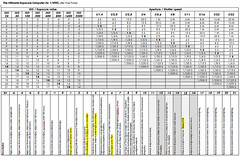
I use this one (click through for original size) printed A4, laminated and folded to slot into my bag..


It's based on the original Fred Parker version, but I've been selective on the data I include to keep it relevant to me, and I've been adjusting the descriptions. The next version will have an aide memoire to the zone system on the reverse.

And because I always get asked, "Why does it only go to 1/500?", it's because none of my manual film cameras shoots faster than this. The yellow highlighted text are scenes that I have shot repeatedly and "calibrated" the decsription against the EXIF from digital shots - the live version of the document gets new yellow text added when I remmeber. This helps me relate a new scene in front of me to something I already know.

And it does work, it works very well. It's very useful for lowlight situations when something like the Weston Master has long since decided it's past bedtime and hasn't got the sensitivity to meter the scene.
 
Gossen Digipro F is also a good meter - nice and lightweight, fits in a pocket. Around £150.
 
Just to let you know I've gone for a Weston Master V to learn on: please don't start telling me that's the very one NOT to go for....
 
Just to let you know I've gone for a Weston Master V to learn on: please don't start telling me that's the very one NOT to go for....

Haha, it should be fine. They're not great in low light (selenium) and down there 1/10th of a mm movement on the needle is a shift of about ten stops ;) but if you spend a few minutes checking it against something of known accuracy, it'll be good.
 
Back
Top