Lighting shiny cylinders

juggler

Suspended / Banned
Messages
5,059
Name
Simon
Edit My Images
No
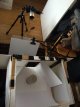
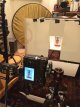
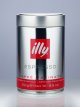
I came across this battered coffee tin and thought it would be a proper challenge. It was. This is lit by a gridded standard reflector from behind, bounced off 3 cards with various flags.

This is SOOC but for squaring up and removing a couple of spots. What's a good way of lighting this kind of thing which won't produce the black line down the front (which is purely the absence of light, not a feature of the tin). I know I can reduce it by using larger bounce cards and getting them further away from the tin but there will still be something left.

All I can think of is constructing a large semi-circular white bounce card around the can and poking the lens through a hole, trying to position it so that it's reflection is hidden in the 'Illy' logo. Or perhaps similar, using a view camera.

I even tried putting the tin in a softbox, lighting from the front and shooting through the rear. It gave a more 'accurate' image but it utterly lacked contrast and had lots of unpleasant reflections.

I also tried lighting from the side and making a feature of the dark areas but that was somewhat unsatifactory, too.

Any other suggestions?
SB210122 - small.jpg
 
have you tried firing the flash from above & behind it into a large reflector in front of the tin (between the tin and camera) that way you should be able to avoid the large shadow.... T
 
have you tried firing the flash from above & behind it into a large reflector in front of the tin (between the tin and camera) that way you should be able to avoid the large shadow.... T

Thanks for the input. That's kind of what I did. The extra reflector on the flexible boom arm helped a little, but there was a really ugly transition between that and the main bounce cards.

Photo 22-11-2015, 09 17 21.jpg

Photo 21-11-2015, 19 40 27.jpg
 
the problem is due to the light falloff hitting the centre bounce card - may be able to get past that with another light - just for the centre
 
could even try a shoot through....

Yup, tried both aiming a speedlite and the centre bounce card as well as through used some translucent Correx. Then it gets too bright - and I struggled to get it even from top to bottom. Lighting the top and bottom of the centre strip separately just made the uneveness more obvious.

I think the large semi-circular card-with-a-hole idea is probably the way forward.
 
Have you tried increasing the distance between subject and front cards to get a little spread (at the risk of a bit of light loss)?
 
This really is a challenging subject, in that although it's possible to get a variety of "interesting" or even "good" results that are very different from each other, it isn't easy to get results that look "natural". Well, actually that isn't true, you can easily get "natural" results simply by lighting it in whatever lighting situation it's already in, but it won't actually look natural because it will be full of small, hard specular highlights and other reflections that are actually there but which aren't normally noticed.

Your method, bouncing light off of reflective surfaces, is a good one, but the reflectors need to be very big, and all-encompassing, with no gaps between them, and they need to be lit very evenly, with a minimum of two flash heads lighting each part. The black bars at the edges then wouldn't appear (unless you introduced them deliberately) and the black bar in the centre could be avoided just by having a white reflector there, but unless you have a monorail camera and use plenty of side shift, you'll get a reflection of the camera in shot (although of course it's simple to clone that out). That would give you an "accurate" sort of shot, but it would looke pretty boring... Years ago I photographed thousands of very shiny saucepans etc for a major manufacturer, and basically used this method, but deliberately introduced consistent black reflections on them, to make them look more interesting, and used black boards to do that.

Another method, which IMO gives far more interesting results, is to deliberately create diffused specular highlights on the sides, this isn't difficult with large softboxes, but because of the convex shape they will need to be big'uns. I intended to release a new video tutorial on this type of lighting today, it didn't happen because of pressure of work, but will probably happen tomorrow. Meanwhile, here is a similar one, but as a written tutorial. The subject here starts off as black, but it doesn't make any real difference, the principle is identical..
 
This really is a challenging subject, in that although it's possible to get a variety of "interesting" or even "good" results that are very different from each other, it isn't easy to get results that look "natural". Well, actually that isn't true, you can easily get "natural" results simply by lighting it in whatever lighting situation it's already in, but it won't actually look natural because it will be full of small, hard specular highlights and other reflections that are actually there but which aren't normally noticed.

Your method, bouncing light off of reflective surfaces, is a good one, but the reflectors need to be very big, and all-encompassing, with no gaps between them, and they need to be lit very evenly, with a minimum of two flash heads lighting each part. The black bars at the edges then wouldn't appear (unless you introduced them deliberately) and the black bar in the centre could be avoided just by having a white reflector there, but unless you have a monorail camera and use plenty of side shift, you'll get a reflection of the camera in shot (although of course it's simple to clone that out). That would give you an "accurate" sort of shot, but it would looke pretty boring... Years ago I photographed thousands of very shiny saucepans etc for a major manufacturer, and basically used this method, but deliberately introduced consistent black reflections on them, to make them look more interesting, and used black boards to do that.

Another method, which IMO gives far more interesting results, is to deliberately create diffused specular highlights on the sides, this isn't difficult with large softboxes, but because of the convex shape they will need to be big'uns. I intended to release a new video tutorial on this type of lighting today, it didn't happen because of pressure of work, but will probably happen tomorrow. Meanwhile, here is a similar one, but as a written tutorial. The subject here starts off as black, but it doesn't make any real difference, the principle is identical..

Garry, thank you for the detailed reply. I like the black bars at the edges - though it would be better if they were more gradual - but I take the point about needing large reflectors with two lights each.

The tutorial is interesting. I did try one approach to create diffuse specular highlights but just ended up with very large non-diffuse highlights with a distinct edge. I suspect that the sheer shininess of the can was partly to blame. I think I could have done better if I'd spent more time positioning the softbox but tbh I was ready to pour a glass of red and only did it to see what the effect would be.
 
Well that is a conundrum for sure. I would have got well fed up trying this. Yet again I am gratefull to see the set up images I really do enjoy seeing the complete chaos that surrounds that little rectangle of life we see in the end product.

Gaz
 
Well that is a conundrum for sure. I would have got well frustrated trying this. Yet again I am very grateful for the pullback shots. I really do enjoy seeing the chaos that surrounds that rectangle of life we see in the end product.

Gaz
 
Back
Top