

You are using an out of date browser. It may not display this or other websites correctly.
You should upgrade or use an alternative browser.
You should upgrade or use an alternative browser.
Lighting for Film
- Thread starter Barney
- Start date
I'm not a pro but have some small experience of the studio workflow back in the day. The Polaroid seemed to me to be used not simply as an aid to the photographer, but also used for client agreement before going for the money shot. I've seen them used for signoff in that way, and kept as proof of that.

Garry Edwards
Moderator
- Messages
- 13,475
- Name
- Garry Edwards
- Edit My Images
- No
100% correct.I'm not a pro but have some small experience of the studio workflow back in the day. The Polaroid seemed to me to be used not simply as an aid to the photographer, but also used for client agreement before going for the money shot. I've seen them used for signoff in that way, and kept as proof of that.
There's another consideration too, although a secondary one, cost. As a % of the overall cost of a pro shoot, polaroids didn't matter at all. There were, in any event, just technical costs, - those essential extras that didn't form part of the agreed price, just like setbuilding, models, equipment hire, makeup artists, film, processing et al and charged to the client at not very much above cost.
And rhere was time saving too. Shoot a final polaroid before taking every LF shot and we KNEW that the shots would all be technically OK, which meant that we would order scans at the same time as processing, which saved the cost of an unnecessary extra trip to the pro lab.
This didn't apply to MF, used extensively for fashion shoots, where maybe 1 in 20 was a keeper.
OP

Barney
Suspended / Banned
- Messages
- 3,043
- Name
- Wayne
- Edit My Images
- No
Well I was brave enough to shoot a dozen shots on what was left of a roll, I ended up using the metered value but shot one image a stop over and one a shot under to be on the safe side - its almost as nerve wracking as the first roll of film you shoot. Ha Ha.
I just developed it and results look promising with visible tones, If I have managed to get any of the grain details in the light wooden background, instead of blowing it all out, I will be overjoyed.
I just developed it and results look promising with visible tones, If I have managed to get any of the grain details in the light wooden background, instead of blowing it all out, I will be overjoyed.
Garry Edwards
Moderator
- Messages
- 13,475
- Name
- Garry Edwards
- Edit My Images
- No
@Barney
You've done it, https://www.talkphotography.co.uk/t...ember-entries-still-life.771697/#post-9676879 and I think you've done a pretty good job in terms of exposure - not perfect but then it isn't easy, when shooting on film.
You haven't asked for critique, and maybe I shouldn't be offering it, so just ignore me if you wish.
1. You've lit from both sides, a lot of people do that but I don't believe that it produces the best results, there is after all, as previously discussed, only 1 sun.
2. Your camera is too high. I would have lowered it to the point where the join between base and background is covered by the subject. You can't go too low without losing subject depth, but you can go quite a bit lower than you have.
3. Your subject should be right at the front of the base, this would allow better light positioning - or, if that isn't possible, use a bigger bit of wallpaper for the base . . .
Can you visulise how this would look? Most of the join would now be covered by the subject, and the bit each side that still shows would be further out of focus because there would now be more distance between subject and the join,
4. Your key light can now be placed BEHIND the subject (and off to one side because of space restrictions). Up to a point, your key light is a bit behind, but I think that more would be better. Backlighting is more challenging but also more compelling, and there would be the bonus that the vertical negative strip would be backlit and would show some detail in the images.
5. As an alternative, ditch the background completely, and bounce the light off of a white wall or similar, creating strong backlighting - a completely different look, but worth trying. This would give you far more space for positioning your light, because you could move the subject much further away from the background.
6. Your key light here is to the right, with an almost equal "fill" to the left. Fill light should, for this type of shot (most in fact) be on axis with the camera lens, not off to one side, so although a fill light would be needed if you backlit it, it would probably just need to be a bit of white paper or board, where the camera is - perhaps directly in front of the camera, with a hole cut for the lens. My guess is that this would be enough, if I'm wrong about that then a low-powered flash could be used, in the same position.
So, there you go, an unrequested critique from someone who just can't help himself
You've done it, https://www.talkphotography.co.uk/t...ember-entries-still-life.771697/#post-9676879 and I think you've done a pretty good job in terms of exposure - not perfect but then it isn't easy, when shooting on film.
You haven't asked for critique, and maybe I shouldn't be offering it, so just ignore me if you wish.
1. You've lit from both sides, a lot of people do that but I don't believe that it produces the best results, there is after all, as previously discussed, only 1 sun.
2. Your camera is too high. I would have lowered it to the point where the join between base and background is covered by the subject. You can't go too low without losing subject depth, but you can go quite a bit lower than you have.
3. Your subject should be right at the front of the base, this would allow better light positioning - or, if that isn't possible, use a bigger bit of wallpaper for the base . . .
Can you visulise how this would look? Most of the join would now be covered by the subject, and the bit each side that still shows would be further out of focus because there would now be more distance between subject and the join,
4. Your key light can now be placed BEHIND the subject (and off to one side because of space restrictions). Up to a point, your key light is a bit behind, but I think that more would be better. Backlighting is more challenging but also more compelling, and there would be the bonus that the vertical negative strip would be backlit and would show some detail in the images.
5. As an alternative, ditch the background completely, and bounce the light off of a white wall or similar, creating strong backlighting - a completely different look, but worth trying. This would give you far more space for positioning your light, because you could move the subject much further away from the background.
6. Your key light here is to the right, with an almost equal "fill" to the left. Fill light should, for this type of shot (most in fact) be on axis with the camera lens, not off to one side, so although a fill light would be needed if you backlit it, it would probably just need to be a bit of white paper or board, where the camera is - perhaps directly in front of the camera, with a hole cut for the lens. My guess is that this would be enough, if I'm wrong about that then a low-powered flash could be used, in the same position.
So, there you go, an unrequested critique from someone who just can't help himself
OP
Barney
Suspended / Banned
- Messages
- 3,043
- Name
- Wayne
- Edit My Images
- No
Ha Ha Ha, cheers Garry, I hope that I have not upset you posting it there first after all the help you guys have given me on this thread. Thanks for your comments and advice, you really helped get me going with you help and encouragement.
here are a few snaps that show a bit more of whats going on.
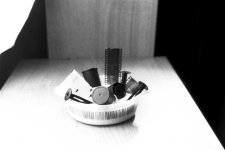
I tried everything with the softbox edge feathering from the in front and behind the subject,
at the right just peeping round the corner from that vertical piece of wood, is a gridded snoot. that was the most problematic "for me" as I particularly wanted to ensure that the film strip was illuminated so that the image became visible, I had to use really high power, far more than the light at the side and then mess about adjusting distance so that it was not blasting everything.
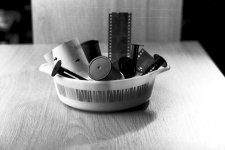
I know it could have been better, And I will be taking your advice and adjusting slightly, One super huge plus is that a couple of years ago I bought a backdrop frame for tenner, a nine foot one, she said why dont I get a backdrop cloth.
here are a few snaps that show a bit more of whats going on.
I tried everything with the softbox edge feathering from the in front and behind the subject,
at the right just peeping round the corner from that vertical piece of wood, is a gridded snoot. that was the most problematic "for me" as I particularly wanted to ensure that the film strip was illuminated so that the image became visible, I had to use really high power, far more than the light at the side and then mess about adjusting distance so that it was not blasting everything.
I know it could have been better, And I will be taking your advice and adjusting slightly, One super huge plus is that a couple of years ago I bought a backdrop frame for tenner, a nine foot one, she said why dont I get a backdrop cloth.
Last edited:
Garry Edwards
Moderator
- Messages
- 13,475
- Name
- Garry Edwards
- Edit My Images
- No
Frankly, gridded snoots don't impress me much, they are physically small but create very uneven light from holes that are far too large. If you can put up with me for 20 minutes, watching this video may help
I go on for far too long about my very special honeycomb, which isn't available, but also show a home-made honeycomb done with black straws, which are available free of charge from Weatherspoons or good pubs
Although the straw diameter is about the same or even larger than your grid, you can produce much more controlled results simply by having the straws much longer.
But, if you backlit the whole scene you wouldn't even need the snoot, which is at the wrong angle relative to the film strip anyway.
A final bit of unasked-for advice, if you decide to try my suggestions, shoot on digital, assuming that you don't have LF with polaroids, and then swap over to your film camera for the final shot.
I go on for far too long about my very special honeycomb, which isn't available, but also show a home-made honeycomb done with black straws, which are available free of charge from Weatherspoons or good pubs
Although the straw diameter is about the same or even larger than your grid, you can produce much more controlled results simply by having the straws much longer.
But, if you backlit the whole scene you wouldn't even need the snoot, which is at the wrong angle relative to the film strip anyway.
A final bit of unasked-for advice, if you decide to try my suggestions, shoot on digital, assuming that you don't have LF with polaroids, and then swap over to your film camera for the final shot.
OP
Barney
Suspended / Banned
- Messages
- 3,043
- Name
- Wayne
- Edit My Images
- No
Should I have shot lower and up for the film strip? I can imagine how the straws would be much better, kind of like the pattern of the hand in the wire things, does extending the straws soften or harden the light? Or re-direct and focus it?
I will do my errands and then settle down with a brew and watch the video!
I still laugh at one you first replies to me, "according to a recent survey................MUST HAVE THICK SKIN"
I will do my errands and then settle down with a brew and watch the video!
I still laugh at one you first replies to me, "according to a recent survey................MUST HAVE THICK SKIN"
Garry Edwards
Moderator
- Messages
- 13,475
- Name
- Garry Edwards
- Edit My Images
- No
I've already said why I think the camera should be lower, but that's about the general scene, not just the film strip.Should I have shot lower and up for the film strip?
Neither. but extending the straws allows the light to be further away without spreading the light to unwanted areas, and the further away it is, the harder the light. But, there's a limit, because the effect of the ISL means that a lot of the light will be lost over a longer distance.does extending the straws soften or harden the light?
YesOr re-direct and focus it?
OP
Barney
Suspended / Banned
- Messages
- 3,043
- Name
- Wayne
- Edit My Images
- No
No, the light to illuminate the film strip. lower and up rather than high and down.I've already said why I think the camera should be lower, but that's about the general scene, not just the film strip.
Garry Edwards
Moderator
- Messages
- 13,475
- Name
- Garry Edwards
- Edit My Images
- No
Well yes, but this would also affect the composition, because that light is so far off to the side, the film strip would need to be angled to suit the angle of the light.
Or, just backlight the whole scene and forget about the separate light on the film strip, which would then be redundant.
Or, just backlight the whole scene and forget about the separate light on the film strip, which would then be redundant.
OP
Barney
Suspended / Banned
- Messages
- 3,043
- Name
- Wayne
- Edit My Images
- No
Cracking video Garry I enjoyed that, I also watched the one you recommended in the clip.
He mentions high point and low point light but does not illustrate how just shows pictures with the difference in the effect, what are they and where do they go?
He mentions high point and low point light but does not illustrate how just shows pictures with the difference in the effect, what are they and where do they go?
Garry Edwards
Moderator
- Messages
- 13,475
- Name
- Garry Edwards
- Edit My Images
- No
I don't know, I'd have to watch the video again. But a couple of points, which are closely related.
1. He has a large studio, with plenty of space and gear, most of us haven't. I referenced that video simply because, unlike most of the videos, he tells the truth and knows his subject.
2. As I keep saying, keep it simple. Use what you already have and make it work in the space that you have, The only real tool that you need is a basic understanding of the principles, you can add complications as you progress on your lighting journey.
1. He has a large studio, with plenty of space and gear, most of us haven't. I referenced that video simply because, unlike most of the videos, he tells the truth and knows his subject.
2. As I keep saying, keep it simple. Use what you already have and make it work in the space that you have, The only real tool that you need is a basic understanding of the principles, you can add complications as you progress on your lighting journey.