Lighting for Film

Barney

Suspended / Banned
Messages
3,043
Name
Wayne
Edit My Images
No
I have a problem and I don't know where to start. Light is daunting for many photographers, including me, even with all the mod cons available at our disposal.
My ask is a bit bigger than that, There is a challenge in the FPOTY for next month and the theme is "Still Life".

I want to have a go but am up against some outstanding photographers who make it seem like still life studio lighting with film cameras is second nature. I have a few film cameras that I think have flash capability, but where do I start? Do I have to learn everything in the school of hard knocks or are there any fundamentals, I am thinking light output at a given distance etc, that I can use to get off to a good start and give me some decent images of my boring subjects.

I have F2, OM2, Bronica, Mamiya cameras available and Bowens, ellinchrom lights with soft boxes umbrellas and reflectors available, the ellinchrom has a trigger. I also have a continuous LED that I use when painting ceilings. All the gear in the world is not worth a carrot if I dont even know how to set it up to work with film. In digital i would bounce a flash to trigger the Bowens, I like that I get any shutter speed I want with that, i cant get the ellinchrom trigger to go faster than 1/200. I have no cables to run from these old cameras.

Any tips appreciated.
 
I've seen some of your film shots, you're good and you're careful, so you won't have any really difficult challenges. Let's reduce it to the basics.

Using flash with film is pretty much the same as with digital. The only real differences are that:
1. With film, your iso is very limited, you can't just up the iso setting to reduce the amount of light needed, which means that more powerful lighting may be needed - especially of course with MF, which typically requires smaller f/ numbers.
2. There's no lcd screen to look at, to check exposure or anything else. That's why I always used a flash meter with film, it was pretty indispensable. But maybe you have a digital camera that you can use alongside your film camera? Or maybe you can borrow one? Anything will do, provided that it has some means of synching with the flash. "Film purists" may not like that idea, but it's the obvious tool for the job.

Moving on to the practicalities, you have an Elinchrom with a flash trigger. That flash trigger will work perfectly well with any reasonably modern film camera, just plug it into the hotshoe. This will fire the Elinchrom flash. Fit that flash with a softbox, so it produces a broad light, some spare light from that will activate the slave cells on whatever other lights you use, job done.

Shutter speed is all but irrelevant, I suggest 1/125th or thereabouts; this will be short enough to reduce any unwanted ambient light to the point where it makes no difference.

Starting point. As @Phil V is about to tell you :) There's only 1 sun, so use just one light if you possibly can. This is the main or key light that does at least 80% of the work.

Real starting point, and sequence, which is especially easy with still life subjects, but which applies to all subjects:
1. Compose your subject.
2. Position your camera to suit, and stick it on a solid tripod. That's angle, height, distance.
3. Position your Elinchrom light - angle, height and distance - to achieve the effect you want. You need to create light for the exposure, but the real objective is to create the right shadows in the right places. Your flash has a modelling lamp, its sole purpose is to indicate the shadows. Make sure that it's set to full power, but be aware that unless the room is in TOTAL darkness, the visual effect of the modelling lamp will be weakened by the ambient light, so your actual shots will show much stronger, darker shadows than the modelling lamp indicates.
4. If you simply cannot avoid it, add another light to illuminate any important bits of the subject not lit by the key light, or to fill in shadows that are too harsh.
5. Rinse and repeat, but each additional light will make the whole process far more complicated, and the light from any additional lights generally need to be subtle, and not conflict with the effect of the key light.

Take a look at the various lighting challenges in this forum, all of which used just a single light, see how the positioning of the light, and its distance from the subject has, in each case, created a useful look. https://www.talkphotography.co.uk/threads/list-of-lighting-challenges.763636/

I've also written a few articles that may be helpful, in the Resources section.
 
You are a star Garry,

Thank you for the noddy guide and encouragement, it really is appreciated. I am not afraid to use the digital as a helping hand until I get the feel for distance and light strength. Also thanks for the links.
 
I like that I get any shutter speed I want with that, i cant get the ellinchrom trigger to go faster than 1/200.
This is really not true. But also really unimportant.

When flash is your primary light source, you need to use flash sync speed or lower, and that doesn’t hold you back.

Shooting film, you’ll want an ISO of 200 (set by the film) and a shutter speed of 1/200 (set by camera sync speed) and your min aperture is dependent on the power of your flash. That’s the usable ‘exposure triangle’ when using flash, it’s really just aperture v ISO.

Embrace it, it’s a strength for your still life cos it means you don’t have to worry about the ambient light affecting your still life image if you’re shooting indoors in the winter.
 
Last edited:
Everyone new to flash has to primarily understand that with an image using flash you need to balance 2 exposures; the flash and the ambient.

In a studio situation that usually means that the ambient isn’t affecting the image due to the power of the flash.
 
This is really not true. But also really unimportant.

When flash is your primary light source, you need to use flash sync speed or lower, and that doesn’t hold you back.

Shooting film, you’ll want an ISO of 200 (set by the film) and a shutter speed of 1/200 (set by camera sync speed) and your min aperture is dependent on the power of your flash. That’s the usable ‘exposure triangle’ when using flash, it’s really just aperture v ISO.

Embrace it, it’s a strength for your still life cos it means you don’t have to worry about the ambient light affecting your still life image if you’re shooting indoors in the winter.
Thanks for the advice Phil,

just to avoid confusion I can get any speed I want if I use a speedlight on my D800, for instance, and then bounce the flash to the main light, I get high speed sync up 1/8000. The bowens lights keep up perfectly to freeze motion etc at any speed, I use flash power output to control the exposure alongside the F number. (Have I got that wrong?) In testing the Bowens exposed perfectly at 1/8000. I will re check that tomorrow just to be sure my memory is not tricking me.

the 1/200 maximum is using the matched trigger for the Elinchrom lights, (only tested with Digital camera)

I think that the F2 has sync speed of 1/80th but the Bronica and Mamiya are leaf shutter which "supposedly" can sync the flash to any shutter speed selected.

I will do as you and Garry suggest 125/200, 200 and see if I can get anywhere near with digital camera on the flash to start with. Flash are 500ws but incrementally controlled 1-6 I could link two or three via the light sensors if they prove to be under powered.

Thanks again for taking the time and trouble to assist! I appreciate you both must have said the same things dozens of times.
 
I might have to use F2 as, I have just thought, no flash shoes for the other two AND they might not even work!
 
Thanks for the advice Phil,

just to avoid confusion I can get any speed I want if I use a speedlight on my D800, for instance, and then bounce the flash to the main light, I get high speed sync up 1/8000. The bowens lights keep up perfectly to freeze motion etc at any speed, I use flash power output to control the exposure alongside the F number. (Have I got that wrong?) In testing the Bowens exposed perfectly at 1/8000. I will re check that tomorrow just to be sure my memory is not tricking me.

the 1/200 maximum is using the matched trigger for the Elinchrom lights, (only tested with Digital camera)

I think that the F2 has sync speed of 1/80th but the Bronica and Mamiya are leaf shutter which "supposedly" can sync the flash to any shutter speed selected.

I will do as you and Garry suggest 125/200, 200 and see if I can get anywhere near with digital camera on the flash to start with. Flash are 500ws but incrementally controlled 1-6 I could link two or three via the light sensors if they prove to be under powered.

Thanks again for taking the time and trouble to assist! I appreciate you both must have said the same things dozens of times.
You really need to understand what sync speed and high speed sync mean

It’s too much for me to type whilst a bottle of wine in, but it’s essential knowledge.

The outcome of which is, unless you really want to overpower the sun, HSS is irrelevant, it just reduces your flash power for no gain
 
Nikon F2 . . . fine, but limited to 35mm quality. MF would obviously be better. I don't know anything about your MF cameras, but if they don't have a hotshoe then they will have a sync socket, so you can hard-wire between camera and a flash. This cable has a specific fitting that may or may not suit any of your flash heads, and it's coming from China anyway, but others are readily available, and so are audio adapters to suit the size on your flash head https://www.ebay.co.uk/itm/126349589356?_skw=pc+flash+sync+cable&itmmeta=01KB68CR1XE5T1ESV3J62NVPFP&hash=item1d6b05bb6c:g:Q34AAMXQrNtRzULR&itmprp=enc:AQAKAAAA8FkggFvd1GGDu0w3yXCmi1cRsK215aOZS39StEMZ+vV17Nt5tAwyv25rRXXS4lrrJeRvXE1VPe6Jr7o3+w+dfoW065+R0XXpTkq7Hu7OmdQOmA98UaHtsCZlJbFLoW10ipUrR61slXzcIFjAai2e9UVisZPMO+FFnZqT8cPs9tnj+qpyBdMg9xtpEePFLVlwlDVt/0BAMxdO1c/8t/cCVjBkY7086y9xJlvnl/OZ3xyx5J3gHI61iDcTgrshIevX2D6C58koMAoXZ2F4REJZguP3iVnc5iGKGl6XvvQaSdOx5CyKCN31SAdjSC8DH7vCcA==|tkp:Bk9SR5iBs8jZZg

Forget about HSS, as Phil says, it won't help you in this situation (or probably in any other) Basically it's just a large number of low-powered flashes coming so thick and fast that the flash becomes a continuous light that allows a focal plane shutter to be used at any stated speed, basically a bullet point in the marketing spiel, just about as useful as a chocolate fireguard.

With respect, don't overthink this, just play with your light with your digital camera, you don't need a physics degree, you just need to do some test shots to get a basic understanding of how light works, that's a good way of learning.

As for not having enough power, on these two shots
I ran into a power problem, I had too much! These shots were, in fact, very similar to each other - small size, close lighting, and your own still life will be basically similar. you won't have too little power.
 
Last edited:
@Garry Edwards

Nice one Garry, I found a genuine elinchrom flash lead for 12 quid with the right end, will need an adapter for bowens but that is no biggie.

I am excited about using flash without bouncing about everywhere!

Thanks for all you guys encouragement and advice, really appreciated!
 
I have a problem and I don't know where to start. Light is daunting for many photographers,

I'm in the same boat. Don't own any lighting equipment other than an old flashgun that I've never used. I'd like to learn but for the time being, for still life images I use one or two desk lamps with flexible stems that can be pointed in any direction.
 
  • Like
Reactions: zx9
I'm in the same boat. Don't own any lighting equipment other than an old flashgun that I've never used. I'd like to learn but for the time being, for still life images I use one or two desk lamps with flexible stems that can be pointed in any direction.
And you utilize them to stunning effect Kevin.
 
My Flash lead is here,.......Yipeeeeeeee

The Mrs is off today so do not know how much time I will get to play around but tonight definitely..

I appreciate in advance your tolerance for my stupid questions........

And your brilliant and comprehensive explanations.
 
Be brave... ask her to sit for you ;)
I have tried that a thousand times, but she is ugly and she knows it......... :ROFLMAO: :ROFLMAO: :ROFLMAO:
 
I have tried that a thousand times, but she is ugly and she knows it......... :ROFLMAO: :ROFLMAO: :ROFLMAO:
I was just wondering whether she has your login details . . .
:exit:
 
I was just wondering whether she has your login details . . .
:exit:
No, thank fully,

I would not be taking any photos if she saw that for sure...............? :)

I tried to explain once why i needed a four foot beauty dish............but she did not get it. :ROFLMAO:
 
I am trying to get some simple gear together for some indoor/tabletop photography. Many years ago, I had a go with two simple flashes and whatever other lights I could gather around the dining table. I found that the bare flashes gave pretty harsh lighting. They needed a soft box "thing". I didn't go as far as getting set up with a soft box, but I did buy one of those white cube tents. My first was around 800x800x800mm. With flashes positioned outside of the cube, the light was diffused and really quite nice. The sort of light that can be useful for product photography.
I'm been looking for it for a couple of days. I have a smaller on that I might press into service in the meantime. They made it all possible for my indoor photography, now trying the same to get more into my digital kit.
 
I am trying to get some simple gear together for some indoor/tabletop photography. Many years ago, I had a go with two simple flashes and whatever other lights I could gather around the dining table. I found that the bare flashes gave pretty harsh lighting. They needed a soft box "thing". I didn't go as far as getting set up with a soft box, but I did buy one of those white cube tents. My first was around 800x800x800mm. With flashes positioned outside of the cube, the light was diffused and really quite nice. The sort of light that can be useful for product photography.
I'm been looking for it for a couple of days. I have a smaller on that I might press into service in the meantime. They made it all possible for my indoor photography, now trying the same to get more into my digital kit.
Not your fault, but entirely the wrong approach. Gear has some relevance, but very little. False marketing pressurises people into believing that gear solves problems and creates solutions, it doesn't.

Solutions follow, and relate to, challenges. Firstly, we need to identify the challenge or, to put it another way, identify the lighting effect that we want to achieve. We then use an incredibly powerful computer - our brain - to work out how to achieve that effect. Sometimes, lack of fancy gear forces us to modify our approach or even to recognise that a particular shot can't be done well, but usually all that's needed is a basic understanding of how light behaves.

For example, you "found that the bare flashes gave pretty harsh lighting. They needed a soft box "thing"." No. YOU needed to understand how the inverse square law works, it's the absolute basic law of physics when it comes to all lighting. The light was harsh because it was too far away from the subject and too small, relative to the size of the subject. You didn't need a softbox thingy, you just needed to think about why the light was so harsh, and if you'd done that you would have found a bit of white paper or whatever, and bounced the light from the flashgun on to that reflector so that the subject was lit by the large reflector instead of the tiny flashgun. Or you could have bounced the light off of the ceiling or a white wall instead.

"I did buy one of those white cube tents. My first was around 800x800x800mm. With flashes positioned outside of the cube, the light was diffused and really quite nice. The sort of light that can be useful for product photography. " The only problem that light cubes solve is the sales problem that sellers have. They're junk, and you don't need them.

Reading through the various threads in this forum (about solving lighting problems, not about which bit of expensive gear is best) should get you on the right track, and ask questions too, we have quite a few very good lighting people on this forum, and they're all pretty helpful.
 
.......................................needed a soft box "thing"." No. YOU needed to understand how the inverse square law works, it's the absolute basic law of physics when it comes to all lighting. . .............................................They're junk, and you don't need them...........
I guess that you might be having a bad day, or maybe my apparent stupidity triggered you, but, either way, I did get a lot out of using the cube thing. Thanks for the info anyway, perhaps it didn't need the capitalised "you", but everyone will understand your frustration with the learners.
I will ask the studio users that I know about the inverse square law. From seeing the number of soft boxes they use, I guess that they do not understand.
 
Last edited:
I guess that you might be having a bad day, or maybe my apparent stupidity triggered you, but, either way, I did get a lot out of using the cube thing. Thanks for the info anyway, perhaps it didn't need the capitalised "you", but everyone will understand your frustration with the learners.
I will ask the studio users that I know about the inverse square law. From seeing the number of soft boxes they use, I guess that do not understand.
I'm sorry if I've offended you, I certainly don't want to do that and no, I'm not having a bad day, I'm genuinely trying to help you to "see the light":)
And I don't think you're stupid either, I'm just assuming, perhaps wrongly, that you're one of the very large number of people who don't realise that knowledge trumps gear.

Sadly, very few studio users actually understand the ISL, they either don't get it at all or they assume that it works in linear terms, which it doesn't because real-world shooting conditions never closely mimic the theoretical conditions set out by Newton. It really is this simple https://www.talkphotography.co.uk/tutorials/the-magic-of-distance-aka-the-inverse-square-law.164/

Its fissics innit? If you want to ignore the physics, just bypass that bit completely and just look at the example photos:)
 
I guess that you might be having a bad day, or maybe my apparent stupidity triggered you, but, either way, I did get a lot out of using the cube thing. Thanks for the info anyway, perhaps it didn't need the capitalised "you", but everyone will understand your frustration with the learners.
I will ask the studio users that I know about the inverse square law. From seeing the number of soft boxes they use, I guess that they do not understand.
A softbox is a quite different bit of kit to a light tent, and is used to create a larger light source to illuminate a subject in a controlled manner - while a light tent is designed to just bathe the subject in light from every direction.
While this appears (and arguably is) 'better' than simply pointing an unmodified flash at the subject, what it's doing is switching from very harsh lighting to lighting with very little shadow, (effectively going from one extreme to the other) - what gives the 'best' results is when you are somewhere in the middle - where you have some shadow, to give form and depth to the image - and it's the use of tools such as softboxes and other modifiers which allow you to control those shadows - how 'hard' or 'soft their edges, etc.
 
Tried a couple of shots in an attempt to get lighting somewhere near and to check out the flash meter- meter works but have yet to check the accuracy, the exposure is un adjusted SOC - does it look about right? On the histogram everything is pretty well centered, If I push exposure slider to get the level near to the right then highlights starts to blow.

WWF.jpg
 
So, you were worried about possible exposure problems, and you now know that there's nothing to worry about. That's a win:)
 
YES!

I can start and have a proper mess about tomorrow...........I am so excited, I don't know if I will get to sleep. My brain is bursting with ideas.

hope I am not disturbing your evening! (y)
 
A couple more shot direct off meter reading. Getting more confident. Raw file output.

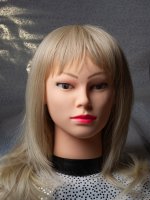
Tina.jpg


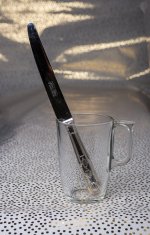
Knife-2.jpg
 
Its not a dear do is it? To take those first few fumbling steps into a studio type set up.

£50 light, softbox and stand
£10 flash meter
£12 quid cable
99p Christmas wrapping paper for background

And its mostly pro/enthusiast gear.
 
Thats a nice composition Fraser, I can see how that won!

I am about ready for that set up after all this p***ing about.

Mine will be a rolly and a single malt. :)
 
Last edited:
Its not a dear do is it? To take those first few fumbling steps into a studio type set up.

£50 light, softbox and stand
£10 flash meter
£12 quid cable
99p Christmas wrapping paper for background

And its mostly pro/enthusiast gear.
And you don't even need the flash meter, your digital camera does a better job:)
The flash cable may or may not turn out OK, Elinchrom is a trusted brand but that unique flash cable fitting of theirs was unreliable.

As for backgrounds and gear in general, the mantra of pro commercial photographers is, and always has been, to make do and mend, i.e. find something that works, don't waste money on expensive 'professional' solutions. I splashed out nearly a tenner on a set of 14 printed vinyl backgrounds from Temu, several of which are OK, ideal for small subjects.

I think that you now get it that lighting is about following the correct process and understanding the objective - creating the right shadows in the right places, which is about nothing more than arranging a light in the place that produces the required effect. A lot of forum members have proved this for themselves, the results achieved by a lot of people who had zero previous experience (or gear) before they took on the Lighting Challenges is inspiring.

Lighting is just basic physics. Sadly, the word 'physics' seems to put some people off, but when we remember that we can't even cross the road safely, or sit in a chair, without a basic understanding of physics puts the 'challenge' into perspective.
 
And you don't even need the flash meter, your digital camera does a better job:)

Ha ha ha, thanks there Garry, my objective initially was to shoot flash with film so using digital is cheating. :)

The digital cross checks have enabled me to be confident the light meter reading that I get will be faithfully reproduced, on film, in the capture before I balls it up in development and scanning. Its so much fun though that I want to have a go at every daft idea that pops into my head. When I looked at the images I got they were so flat and lifeless I thought to myself I really must get a grip on Garry's challenges to give a better form, outline and depth to the photo's. And I will.
 
Just messing about

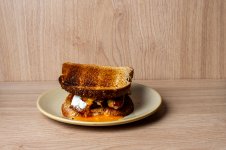
Sausage and egg butty

Sausage and Egg Sandwich.jpg
 
Good start, but mess about differently. . .
Try moving the light further away, and to one side, perhaps slighly behind as well, and probably on the right, this will create much better definition because it will create stronger shadows and will reveal the texture in the bread.

You will almost certainly need a reflector on the other side, but as always, add that later, once the need is proven. The ISL tells us that the closer the reflector is, the greater the effect.
 
I had not read this before I took the finished article, my breakfast will be cold at this rate. :)

Sausage and Egg Sandwich-2.jpg
 
I've seen some of your film shots, you're good and you're careful, so you won't have any really difficult challenges. Let's reduce it to the basics.

Using flash with film is pretty much the same as with digital. The only real differences are that:
1. With film, your iso is very limited, you can't just up the iso setting to reduce the amount of light needed, which means that more powerful lighting may be needed - especially of course with MF, which typically requires smaller f/ numbers.
2. There's no lcd screen to look at, to check exposure or anything else. That's why I always used a flash meter with film, it was pretty indispensable. But maybe you have a digital camera that you can use alongside your film camera? Or maybe you can borrow one? Anything will do, provided that it has some means of synching with the flash. "Film purists" may not like that idea, but it's the obvious tool for the job.

Moving on to the practicalities, you have an Elinchrom with a flash trigger. That flash trigger will work perfectly well with any reasonably modern film camera, just plug it into the hotshoe. This will fire the Elinchrom flash. Fit that flash with a softbox, so it produces a broad light, some spare light from that will activate the slave cells on whatever other lights you use, job done.

Shutter speed is all but irrelevant, I suggest 1/125th or thereabouts; this will be short enough to reduce any unwanted ambient light to the point where it makes no difference.

Starting point. As @Phil V is about to tell you :) There's only 1 sun, so use just one light if you possibly can. This is the main or key light that does at least 80% of the work.

Real starting point, and sequence, which is especially easy with still life subjects, but which applies to all subjects:
1. Compose your subject.
2. Position your camera to suit, and stick it on a solid tripod. That's angle, height, distance.
3. Position your Elinchrom light - angle, height and distance - to achieve the effect you want. You need to create light for the exposure, but the real objective is to create the right shadows in the right places. Your flash has a modelling lamp, its sole purpose is to indicate the shadows. Make sure that it's set to full power, but be aware that unless the room is in TOTAL darkness, the visual effect of the modelling lamp will be weakened by the ambient light, so your actual shots will show much stronger, darker shadows than the modelling lamp indicates.
4. If you simply cannot avoid it, add another light to illuminate any important bits of the subject not lit by the key light, or to fill in shadows that are too harsh.
5. Rinse and repeat, but each additional light will make the whole process far more complicated, and the light from any additional lights generally need to be subtle, and not conflict with the effect of the key light.

Take a look at the various lighting challenges in this forum, all of which used just a single light, see how the positioning of the light, and its distance from the subject has, in each case, created a useful look. https://www.talkphotography.co.uk/threads/list-of-lighting-challenges.763636/

I've also written a few articles that may be helpful, in the Resources section.
As a film purist, I absolutely agree with using a digital camera in parallel with the analogue process. I use it to "prototype" some of my shots on film.
 
my objective initially was to shoot flash with film so using digital is cheating. :)
Using digital to set up is definitely not cheating.
As @Garry Edwards will come back to tell you, back in the day, the method for checking your lights were doing the job properly was to shoot a Polaroid before committing the project to film.

So by checking with digital you’re just saving the cost of a sheet of Polaroid ;)
 
Using digital to set up is definitely not cheating.
As @Garry Edwards will come back to tell you, back in the day, the method for checking your lights were doing the job properly was to shoot a Polaroid before committing the project to film.

So by checking with digital you’re just saving the cost of a sheet of Polaroid ;)
Surely they pre-visualized the shots and identified the lighting requirement before the shot was taken. I would have thought that they knew it would be right before pressing the button.
I did not imagine it was so ad hoc.
 
No, most of us would always use the technology we had to give ourselves a fighting chance.

Pre-visualise yes, but with an LF camera we just had a dim, back to front and upside down image to view.

Lighting, OK if it was safe, boring and bland, but that's not what clients pay for. Push the boundaries a bit - backlighting, very strong sidelighting, risk of flare, and a polaroid would always be essential.

Then there's exposure, and the dreaded lighting ratio differentials, which can only be guaranteed to work with polaroids. Tranny film doesn't have a great dynamic range and things get even more critical when the shot goes to magazine print.

And, of course, dof.

With 5"x4" I would never take a studio shot without at least 1 polaroid, 5 wouldn't be unusual/
With 10"x8", far more costly and also a slow, messy process with separate development, there would usually just be 1 final 10"x8" polaroid, the earlier ones would be 5"x4" polaroids/

I nearly always shot polaroids with my MF RZ67 too, although the image was on the small side.

When I first started out we didn't even have polaroids, so we used a sheet of bromide paper instead, same difference except of course for the exposure, because the sensitivity was only about 0.5 asa from memory, and of course what we ended up with was a paper negative, but it worked.

Photography is so easy now:)
 
Surely they pre-visualized the shots and identified the lighting requirement before the shot was taken. I would have thought that they knew it would be right before pressing the button.
I did not imagine it was so ad hoc.
There’s only so much you can know for absolute certain.
And when you need your shadows to be millimetre precise, you can’t possibly guess or calculate that.

So as a working portrait photographer in the early 90’s I would set up short lighting and meter before committing to film, with some clues from modelling lights but they weren’t proportional, so not 100% accurate. However it’s just short lighting so I know well enough what I’m doing.

In the world of commercial photography where loads of money was spent on sets and people, a reshoot was expensive, so why take a chance, why wouldn’t you check exactly what you’d get before committing to film.
 
Back
Top