Lighting Diagrams

donkeymusic

Suspended / Banned
Messages
2,524
Name
Carlo
Edit My Images
Yes
Hi,

Just wondered if anyone knew anyone to get lighting diagrams for studios?

I imagine they would be available in some form, what i was thinking was simple diagrams to show how different setups are lit and a break down of lighting settings.

Anyone any ideas?

Thanks
 
There are loads around, but they're totally useless.

Working to any kind of a formulae is just like painting by numbers - bland and totally lacking in creativity. And, as light is 3 dimensional, looking at a 2 dimensional diagram makes a very simple process look very complicated.
 
There are loads around, but they're totally useless.

Working to any kind of a formulae is just like painting by numbers - bland and totally lacking in creativity. And, as light is 3 dimensional, looking at a 2 dimensional diagram makes a very simple process look very complicated.


I don't think they are useless but they do at least give some general info to a newbie to how to create a shot......and to show how much work actually goes into setting up the high end shoots.
 
I take your point but...

1. IMO lighting diagrams make a simple job look complicated. When I teach lighting people are always surprised at how simple it actually is.
2. Lighting diagrams per se may have some use, but only if people use them only as a very rough guide. Problem is, people seem to regard them as some kind of magic forumulae, not as a guide.
3. Anyone can get outstanding results simply by thinking
a. What type of lighting effect am I looking for?
b. Where does ONE LIGHT need to be to create that effect?
c. Experimenting until it's perfect, then adding one or more extra lights if and when needed, to create fill or effects.

I've tried using lighting diagrams, I've tried creating them for my lighting tutorials, I've even tried to show lighting positions with video - none of it works
 
But Garry you are thinking like a seasoned pro not newbie, that is your biggest fault but I am sure you do not do it on purpose, it is natural for you to think like a pro.

All good points you put across, but point b. surely carries the case for a diagram.
 
Sorry, but this lighting diagram absolutely proves my point - not that I'm even trying to make a point, I'm just warning people that lighting diagrams won't necessarily help them.
That 'lighting diagram' is supposedly of the knife and fork shown on this page http://strobox.com/photos but there are a couple of things that are very wrong here.
Firstly, as I've pointed out before, lighting diagrams are 2 dimensional and actual lighting is 3 dimensional. The softbox in the diagram doesn't show it's height, and it would be very high.

Secondly, there is absolutely no way whatsoever that a softbox could have been used for that shot. It's total nonsense.

So, if someone wanted to create that shot, instead of getting a very small light source behind and well above the subject (to get those hard shadow transfer edges) they'd follow the diagram and stick a softbox pointing towards the lens from behind (never mind the lens flare that that would create) and wonder why it didn't work:)

Edit: I didn't click on any of the other pics, they may or may not be lit as shown. One was more than enough.
So how was that shot really lit? Well, if I was doing it I'd use a small, hard light source (standard reflector, possibly with a honeycomb) above it and at the angle that created those hard shadow transfer edges. Then I'd put a large softbox right behind it, to light the whole area evenly. The softbox light would be on very low power compared to the key light. All is explained and shown (although not with a diagram:) ) here

My guess is that whoever created that useless diagram forgot to include the key light - either that or someone other than the photographer, who knows very little about lighting, created the diagram. Either way, the diagram is misleading and useless.

 
Last edited:
Sorry, but this lighting diagram absolutely proves my point - not that I'm even trying to make a point, I'm just warning people that lighting diagrams won't necessarily help them.
That 'lighting diagram' is supposedly of the knife and fork shown on this page http://strobox.com/photos but there are a couple of things that are very wrong here.
Firstly, as I've pointed out before, lighting diagrams are 2 dimensional and actual lighting is 3 dimensional. The softbox in the diagram doesn't show it's height, and it would be very high.

Secondly, there is absolutely no way whatsoever that a softbox could have been used for that shot. It's total nonsense.

So, if someone wanted to create that shot, instead of getting a very small light source behind and well above the subject (to get those hard shadow transfer edges) they'd follow the diagram and stick a softbox pointing towards the lens from behind (never mind the lens flare that that would create) and wonder why it didn't work:)

Edit: I didn't click on any of the other pics, they may or may not be lit as shown. One was more than enough.
So how was that shot really lit? Well, if I was doing it I'd use a small, hard light source (standard reflector, possibly with a honeycomb) above it and at the angle that created those hard shadow transfer edges. Then I'd put a large softbox right behind it, to light the whole area evenly. The softbox light would be on very low power compared to the key light. All is explained and shown (although not with a diagram:) ) here

My guess is that whoever created that useless diagram forgot to include the key light - either that or someone other than the photographer, who knows very little about lighting, created the diagram. Either way, the diagram is misleading and useless.


Surely the hard shadows you refer to are in fact the knife and fork reflections in the glass on black background?

Sam-D
 
Surely the hard shadows you refer to are in fact the knife and fork reflections in the glass on black background?

Sam-D
Ah, I now see that it mentions that it's a blackglass reflection in the note - but it doesn't show the black glass surface in the diagram - so the diagram is still misleading.

Here's the acid test I think... if you wanted to create that same shot, would the diagram show you how to do it?

And the same question related to a different image Would the info in that diagram help anyone to actually produce that shot?
 
To be fair, there is an explanation of where the soft box was within the description

"Additional notes

Milk knife and fork on a black mirror. Softbox with speedlite 45 degree down from behind."

However to also be doubly fair, the image doesn't quite match the description, the reflection comment is relevant, but to my eye, a lot of PP has been done to this image (the quality of the tones seem mismatched)

The give away is the shadows on the "milk" and the shadow from the lower RHS of the knife, and lack of on the LHS of the fork. Had the shot been lit as indicated, these shadows would pretty match each other
 
And the same question related to a different image Would the info in that diagram help anyone to actually produce that shot?

Not really. But the fact that some diagrams are incomplete, misleading or need a degree of understanding of light to follow doesn't render them all useless.

After all, people still quote aperture, shutter speed and ISO on web images like it helped ;)
 
Not really. But the fact that some diagrams are incomplete, misleading or need a degree of understanding of light to follow doesn't render them all useless.

After all, people still quote aperture, shutter speed and ISO on web images like it helped ;)
I'm guessing that giving details of useless capture info on web pages is a spin-off from photography magazines. They think that their readers think it's important, so every photo supplied for publication has to have this info. Pre-digital exif data, I never had a clue of course, so just made it up, 'e.g. Nikon F100, shot on Velvia, 1/60th at f/11'

Of course, if I forgot to include this 'information' then the mag would just make it up.

In fact, that info was just as useless as lighting diagrams:lol::lol::lol:
 
Not really. But the fact that some diagrams are incomplete, misleading or need a degree of understanding of light to follow doesn't render them all useless.

After all, people still quote aperture, shutter speed and ISO on web images like it helped ;)

I'm guessing that giving details of useless capture info on web pages is a spin-off from photography magazines. They think that their readers think it's important, so every photo supplied for publication has to have this info. Pre-digital exif data, I never had a clue of course, so just made it up, 'e.g. Nikon F100, shot on Velvia, 1/60th at f/11'

Of course, if I forgot to include this 'information' then the mag would just make it up.

In fact, that info was just as useless as lighting diagrams:lol::lol::lol:

Ahhh!

So what you two are saying is that the only way to learn about lighting is to go on a Garry Edwards lighting course? ;)
 
I never had a clue of course, so just made it up, 'e.g. Nikon F100, shot on Velvia, 1/60th at f/11'

So that's why it never worked when I tried to copy pictures out of AP ;)

So what you two are saying is that the only way to learn about lighting is to go on a Garry Edwards lighting course? ;)

Not at all. Other courses are available. Like mine for instance ;)

Joking apart, learning lighting from diagrams is pretty much like learning cookery from watching Masterchef. No doubt you'll pick up some ideas and some cool techniques but you'll learn a lot more by getting hold of some ingredients and seeing what works. Especially if you're struggling with boiling eggs.
 
Personally, I have found them a "good starting place". Add to that "looking at the light" and "looking at the shadows, and appreciating that my subject is different to the one in diagram, they are very useful

Like all diagrams, say for example the ones we did in Physics, or Chemistry, the results of the experiment or lighting also rely on some skill of the operator, and often the quality of the ancillary instructions

What the diagrams dont explain is "why"
- why does the light need to be 10' away, or the other side of the studio
- why is a grid used or not
etc.

There is a difference between
- diagrams
- instructions
- all the knowledge that produced the methodology in the first place
- looking at your subject that you are shooting and deciding on the fine tuning

But in the absence of having someone physically show you, they are probably a good tool to get people learning, or for one professional to convey information to another
 
So that's

Joking apart, learning lighting from diagrams is pretty much like learning cookery from watching Masterchef. No doubt you'll pick up some ideas and some cool techniques but you'll learn a lot more by getting hold of some ingredients and seeing what works.
Good example

I adore cookery, I am very good at it. However I never had a formal lesson in my life, and I learnt shed loads from cookery programs

The key part is the doing

If the lighting diagrams get people using the lights, and pointed in the right direction, they must be a good thing

There are so many resources
- youtube video's
- websites
- diagrams & images
- Books like "Light science and magic" (which uses diagrams)
- courses

etc.. If a photographer is using all of the resources, then whilst one resource may have a weak point collectively the message may be driven home
 
Good example

I adore cookery, I am very good at it. However I never had a formal lesson in my life, and I learnt shed loads from cookery programs

The key part is the doing

If the lighting diagrams get people using the lights, and pointed in the right direction, they must be a good thing

There are so many resources
- youtube video's
- websites
- diagrams & images
- Books like "Light science and magic" (which uses diagrams)
- courses

etc.. If a photographer is using all of the resources, then whilst one resource may have a weak point collectively the message may be driven home

+1

If there are no diagrams or examples how are we to learn there is only so much you can learn from doing you can also learn faster from diagrams or watching videos or reading books.

Not everyone can afford a tutorial day in lighting and even then you don't come out as the gods gift to lighting.
 
+1

If there are no diagrams or examples how are we to learn there is only so much you can learn from doing you can also learn faster from diagrams or watching videos or reading books.

Not everyone can afford a tutorial day in lighting and even then you don't come out as the gods gift to lighting.

Examples are good - anyone can very easily learn how to deconstruct them and work out how they are lit.

Books and video have their place, as long as their authors know their subject - unfortunately many of them don't.

Training courses again have their place, but again there are people who are teaching lighting who are really lost sheep masquerading as sheepdogs...

All teaching methods are valid - my reservations re diagrams is that, without detailed explanations, they can be misleading and unhelpful.
 
Just a thought on lighting diagrams , in this day and age with 3D rendering why doesn't anyone create 3D diagrams that you can move around on so that you can see the height of the lights , size / type of modifiers etc .
 
I've just invested n Scott Kelby's new book - 'Light It Shoot It Retouch It' rather different in that each studio set is explained & photographed and then the shot is processed with full explanation. Check it out,it's great.
 
The thing is that in other fields of work standardised diagrams are the norm

i.e. Optics, Chemistry, Physics, Electronics, Marquee planning, Kitchen fitting etc..

The advantage of standardised diagrams is that one person - professional / teacher etc. Can convey specific technical detail to another, in a way where a job or task or set-up can be replicated

The issue with photography is that subjects and light are three dimensional. This is dealt with with ease by the other professions, even in 2 dimensional media

Yes each subject is different, and sometimes moving a light through a couple of degrees can make or break some shots, but if the diagrams point the person replicating or being taught in broadly the right direction, can they be a bad thing?

I agree you cant teach instinct, that is something that is acquired with practice, but a boot in the right direction is often a real help

Whatever way you think about it, if you are teaching lighting, or doing lighting, or learning lighting, there will be systems & definitions - we either define the subject, or the lighting or both

I.E. For your standard classical female 3/4 portrait your key light goes here, and your fill light goes there, and the hair light goes there etc.

I feel the issue here is not about diagrams at all, but the "why"... Lighting diagrams don't teach you "why", they attempt to show you "how". The diagram is produced by he person who knows "how"

The thing with something like lighting is that the "why" is a bunch of ideas and concepts, some of which you have to "know" i.e. the inverse square law, and other concepts you need to "see" and then learn by doing, and other concepts that rely on measurement
 
The thing is that in other fields of work standardised diagrams are the norm

i.e. Optics, Chemistry, Physics, Electronics, Marquee planning, Kitchen fitting etc..

The advantage of standardised diagrams is that one person - professional / teacher etc. Can convey specific technical detail to another, in a way where a job or task or set-up can be replicated

The issue with photography is that subjects and light are three dimensional. This is dealt with with ease by the other professions, even in 2 dimensional media

Yes each subject is different, and sometimes moving a light through a couple of degrees can make or break some shots, but if the diagrams point the person replicating or being taught in broadly the right direction, can they be a bad thing?

I agree you cant teach instinct, that is something that is acquired with practice, but a boot in the right direction is often a real help

Whatever way you think about it, if you are teaching lighting, or doing lighting, or learning lighting, there will be systems & definitions - we either define the subject, or the lighting or both

I.E. For your standard classical female 3/4 portrait your key light goes here, and your fill light goes there, and the hair light goes there etc.

I feel the issue here is not about diagrams at all, but the "why"... Lighting diagrams don't teach you "why", they attempt to show you "how". The diagram is produced by he person who knows "how"

The thing with something like lighting is that the "why" is a bunch of ideas and concepts, some of which you have to "know" i.e. the inverse square law, and other concepts you need to "see" and then learn by doing, and other concepts that rely on measurement
That's the whole point - there is no such thing as a classical female 3/4 portrait - or anything else. Which type of modifiers should be used, at which height, at which angle, at which distance, and how many lights, all depends on
a. The subject
b. The effect we want to achieve.

Relying on lighting diagrams - even as just a starting point - is just about as creative as painting by numbers.
J
ust a thought on lighting diagrams , in this day and age with 3D rendering why doesn't anyone create 3D diagrams that you can move around on so that you can see the height of the lights , size / type of modifiers etc .
Excellent idea! If we had 3 dimensions to work in we'd still have the problem of 'set piece' lighting and would have to hope that people would experiment to see whether it suited their needs instead of following it blindly, but it would have meaning - which 2 dimensional diagrams don't.
 
Just a thought on lighting diagrams , in this day and age with 3D rendering why doesn't anyone create 3D diagrams that you can move around on so that you can see the height of the lights , size / type of modifiers etc .

There are a couple of iPhone apps already that do something similar, to be fair they're **** but the idea is good, and is actively being worked on. The functionality of the current offerings is poor, but you can put a model there, pose them, light them, add modifiers etc.

For anyone willing to bother, and in my opinion you should, there's a massive thread on modelmayhem about lighting, it's huge, and some great photographers have put some techniques up there worth trying.

Check out Neil Snape's blog, he puts stuff up there occasionally
 
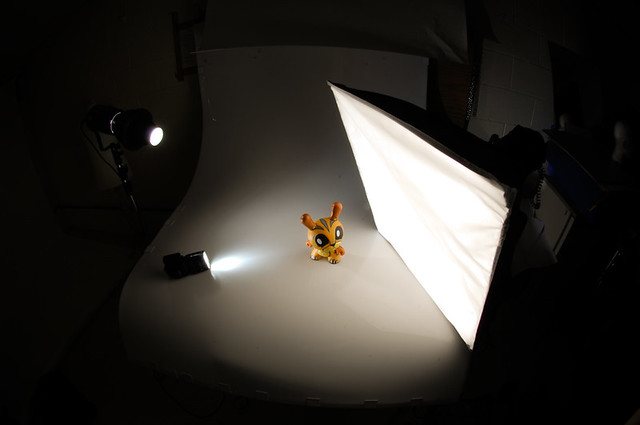
photographs of the light set-up work better IMO - they gives you a 'realworld' view of it. If you look in the strobist flickr pool you find loads of lighting shots that are quite helpful to see more detail.

I don't do as much of these as I should, but they help me see what i could ahve done better or different and if they help someone do something then fair play:


Robot Cat (set-up) by Pat MacInnes, on Flickr
 
Last edited:
Back
Top