Sorry, but
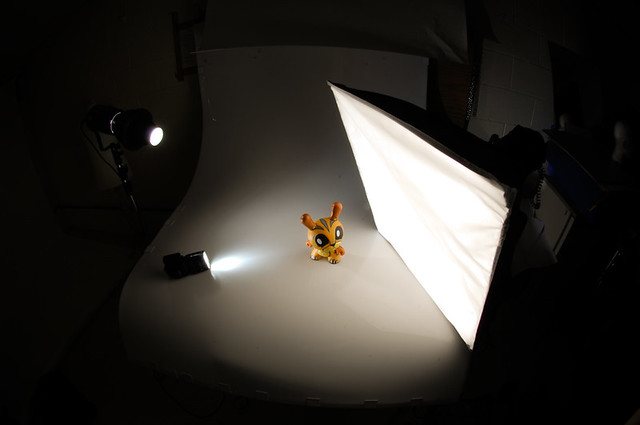
this lighting diagram absolutely proves my point - not that I'm even trying to make a point, I'm just warning people that lighting diagrams won't necessarily help them.
That 'lighting diagram' is supposedly of the knife and fork shown on this page
http://strobox.com/photos but there are a couple of things that are very wrong here.
Firstly, as I've pointed out before, lighting diagrams are 2 dimensional and actual lighting is 3 dimensional. The softbox in the diagram doesn't show it's height, and it would be very high.
Secondly, there is absolutely no way whatsoever that a softbox could have been used for that shot. It's total nonsense.
So, if someone wanted to create that shot, instead of getting a very small light source behind and well above the subject (to get those hard shadow transfer edges) they'd follow the diagram and stick a softbox pointing towards the lens from behind (never mind the lens flare that that would create) and wonder why it didn't work

Edit: I didn't click on any of the other pics, they may or may not be lit as shown. One was more than enough.
So how was that shot really lit? Well, if I was doing it I'd use a small, hard light source (standard reflector, possibly with a honeycomb) above it and at the angle that created those hard shadow transfer edges. Then I'd put a
large softbox right behind it, to light the whole area evenly. The softbox light would be on very low power compared to the key light. All is explained and shown (although not with a diagram
)
here
My guess is that whoever created that useless diagram forgot to include the key light - either that or someone other than the photographer, who knows very little about lighting, created the diagram. Either way, the diagram is misleading and useless.