Lighting Challenges discussion thread

Since we're fully in 'asides' mode now.. I'd like to see much more discussion (and use) of things like diffusers & cosmetic gels. You started in the challenge 7 thread with a diffuser over a standard reflector but it'd be nice to deep-dive into more exotic things.. tough spun, frosts, cosmetic peach gels and so on. I haven't made the time to do side-by-side comparisons but I will one day.
Good point.
In fact, the diffuser that I used over the standard reflector in that shot wasn't a "normal" diffuser, it was the inner diffuser from the beauty dish/softbox, and is about treble the normal thickness in the circular area in the centre, making it more efficient. I should have mentioned that, but didn't.

But although I agree with you, I'm trying to make these challenges accessible to everyone, and because of this (so far) I've avoided using any equipment that only a minority of people are likely to have.
 
Maybe I shouldn`t have been the first to post in the latest challenge. I may have scared everyone away :ROFLMAO:
 
Not scary
"If you see this man DO NOT APPROACH HIM. Telephone 999 and ask for police":)
Not scary but very good. I'm not getting anything as good.
He's annoyingly good, but don't worry about it, it's about the physics, the process and the learning experience, not the results.
 
Not scary but very good. I'm not getting anything as good.
Thanks, but I got lucky. But seriously test the angles with a torch. It really helped me (y)
 
I’ve had one of my really stupid ideas, which I’m trying to convince myself is actually a bright idea – re-visiting the lighting challenges with the help of videos.

The idea behind it is of course to hopefully get more participation, and my thinking is that I can show the processes better using video.

So, I’ve started with the first technique, Brightfield Lighting, partly because it’s the first and partly because it’s the simplest to do. I’ve now posted it.

Some things definitely haven’t worked as planned, but these are probably due to my incompetence with the video shooting and editing process, and hopefully I’ll be able to improve with practice.

The whole idea is to have a rostrum camera to replace stepback shots, it’s a cheap camcorder with limited image quality, it sort of works but I found that although it works well enough outdoors, the indoor quality is poor and future videos will need to be shot on manual settings, auto-everything underexposes, but it’s what it is. The poor quality makes me look old:) The sound quality is also disappointing , but I should be able to improve on that.

The idea is/was that the camera used to take the still shots can also shoot video. It can, but my idea of zooming in for the actual shot and zooming out to show a wider view simply doesn’t work, because the zoom range is too small.

So, to cut to the chase, is this worth doing or not?

If so, what should I be doing differently?

All comments and discussion in this thread please.
 
I’ve had one of my really stupid ideas, which I’m trying to convince myself is actually a bright idea – re-visiting the lighting challenges with the help of videos.

The idea behind it is of course to hopefully get more participation, and my thinking is that I can show the processes better using video.

So, I’ve started with the first technique, Brightfield Lighting, partly because it’s the first and partly because it’s the simplest to do. I’ve now posted it.

Some things definitely haven’t worked as planned, but these are probably due to my incompetence with the video shooting and editing process, and hopefully I’ll be able to improve with practice.

The whole idea is to have a rostrum camera to replace stepback shots, it’s a cheap camcorder with limited image quality, it sort of works but I found that although it works well enough outdoors, the indoor quality is poor and future videos will need to be shot on manual settings, auto-everything underexposes, but it’s what it is. The poor quality makes me look old:) The sound quality is also disappointing , but I should be able to improve on that.

The idea is/was that the camera used to take the still shots can also shoot video. It can, but my idea of zooming in for the actual shot and zooming out to show a wider view simply doesn’t work, because the zoom range is too small.

So, to cut to the chase, is this worth doing or not?

If so, what should I be doing differently?

All comments and discussion in this thread please.
Sounds like a great idea - videos are typically much more engaging for this kind of thing. Have you posted a video that you’d like feedback on? I wasn’t sure so sorry for the dumb question.
 
Sounds like a great idea - videos are typically much more engaging for this kind of thing. Have you posted a video that you’d like feedback on? I wasn’t sure so sorry for the dumb question.
I have, here, https://www.talkphotography.co.uk/threads/lighting-challenge-1-coffee-cup.759315/page-2 and all comments welcome,

But I know it's crap, my question in this thread is more about whether the video is good enough from a content POV, i.e. are there other things that I should do or is the process explained adequately for my target audience?

As a presenter, I'm hopeless - presenters need to be young, fast-talking and with a constant smile, not me . . .

One of my problems is that I'm a bit like Gerald Ford, can't chew gum and walk in a straight line at the same time, and trying to be both the presenter and the video technician is a bit of a challenge. When I made videos for Lencarta other people did the behind-camera and editing work, using a couple of full-frame Canon cameras. I'm using a cropped-frame Nikon camera that seems to be very capable in terms of image quality, but my zoom lens is only 35-70, I really need a greater zoom range to both show the subject properly and to zoom out to show the setup, but I'm not going to spend that kind of money just for TP videos:(
That camera is probably fine, I just need to improve my video skills. I've started using it for eBay listing videos, see here https://www.ebay.co.uk/itm/285578803706 - just the video, the product photos and description aren't mine . . . That video was shot at about 1/4 of the normal sewing machine speed, to avoid the clip jumping about too much, and then speeded up in PP, to show it at something like the real speed, which seems to have worked.
Most of the video though was shot on a cheap camcorder, tiny sensor. It has the advantage of a massive zoom range, and can just be set up and left to run for hours, but although the quality is OK for outdoor use, the light from my large picture window just wasn't enough. I may have to buy a LED video light, but again that involves cost and also needs space, I'll find a way round that one, and it's also become obvious that I need to use it on manual settings to get the exposure right, full auto is hopeless.

On the editing side, I'm using Premier Pro, and I need to learn it better and get more practice. In a couple of places the camera seemed to be changing height, it wasn't, I must have accidentally pressed something . . .

As long as the concept works, i.e. as long as it encourages enough people to join in and contribute to these lighting challenges, I'll keep going and hopefully will improve the technical side of things.
 
Last edited:
Personally I think it's a great idea. That combined with your set up stills, and some general settings.
I do think that maybe some people might be a little put off with the science of lighting (scary sh*t), and like me, just want to dive in head first ;)
 
The "Science of lighting" is fundamental, and without that understanding, we have to rely on trial and error - all I'm trying to do is to explain what can and can't work and why. It's basically just very simple physics, and although you think it's scary your own results tell me that you get it:)

I actually dumb it down quite a bit, to avoid avoid confusing people. What do I need to do to improve?

There are some very basic things that I don't bother to show in the video, for example I don't need to show my test shot for exposure, it's obvious that the exposure was either metered or guessed at and then corrected. Maybe, with experience, and relying on the (very soft) science, it's easier for me, in every case I know what cannot work and I never need to take more than 1 shot of anything, once the exposure is nailed. Less experience may require more experimentation, but that doesn't affect the final result.
 
@Garry Edwards thank you so much for taking the time to do this! For me, it was great to hear and see you in person, regardless of the quality of the audio, video, or editing; you got your points across very well. Of course you'll get better with practice. I understand why you read out the intro, but I felt your audio was more engaging when you were speaking without notes later on in the video. Suggestions for improvement? I'd put audio as first priority and then picture quality. For audio, try a cheap wired lav mic, either to your camcorder or phone. For picture quality, probably you need more light, but I wouldn't worry about that for now. Hope this helps and thanks again for taking the trouble to make the video.
 
@Garry Edwards Thanks for taking the time to set up these challenges, and the new video.
Just one comment on the video - at the end, you show the option of the mirror to solve the label problem, but don't give a sample shot showing the result of doing so.
 
@Garry Edwards thank you so much for taking the time to do this! For me, it was great to hear and see you in person, regardless of the quality of the audio, video, or editing; you got your points across very well. Of course you'll get better with practice. I understand why you read out the intro, but I felt your audio was more engaging when you were speaking without notes later on in the video. Suggestions for improvement? I'd put audio as first priority and then picture quality. For audio, try a cheap wired lav mic, either to your camcorder or phone. For picture quality, probably you need more light, but I wouldn't worry about that for now. Hope this helps and thanks again for taking the trouble to make the video.

Thanks. I 100% agree about the audio, it's in hand. I bought a separate mic online, it arrived faulty, I'm waiting for the replacement and hopefully that will do the trick. But unfortunately it will only work with the Nikon, the camcorder doesn't have a mic socket.

If push comes to shove, I may have to go back to using my D3 or D700 for taking the still shots, which will free up the D7200 for use as the main video camera, and just use the HMX-F80 camcorder as a second video, vision only.

I may be able to get around the lighting problem easily, time will tell. The flash used has an LED modelling lamp, my other flashes only have tungsten modelling lamps, and I can't have vastly different colour temperatures. But, if I can find a E27 LED replacement that's bright enough it should work. Otherwise I'll pop into Lencarta and see whether they have a second-hand video light that's OK:)
@Garry Edwards Thanks for taking the time to set up these challenges, and the new video.
Just one comment on the video - at the end, you show the option of the mirror to solve the label problem, but don't give a sample shot showing the result of doing so.
Good point. I forgot to take that shot.
 
I'm unusual (!) but I generally prefer text & images to video for tuition. Far easier to take at your my pace, rewind, skip past the non-essential bits, cross reference text with images and so on.
Ideally I'd like both - read the text to understand the steps / sequence, then watch the video to see everything in action.
EG: In the text you can describe how to position a light to create a particular effect, then in the video show moving the light to position and seeing the effect 'appear'.
 
In video you can see how even small changes in light placement change the appearance of the subject.
Such as changes in tone, contrast , mood, modeling and texture.
 
In video you can see how even small changes in light placement change the appearance of the subject.
Such as changes in tone, contrast , mood, modeling and texture.
This is how my mind is working, If I can do it well, people should be able to see the effects of even the smallest changes clearly. Lighting is just basic physics, but a lot of people shy away from technicalities. A lot of years ago, a friend took me out on his boat and showed me how to navigate, it's actually a fairly simple process, I couldn't understand it just by reading about it, but I immediately got it when he showed me.

I think that the same principles apply to lighting as to navigation - despite GPS technology (which can fail) navigators still need to be able to use the traditional methods, and camera technology (high iso, auto everything) doesn't replace the need for understanding lighting.
 
So, despite there being zero more contributions in this thread https://www.talkphotography.co.uk/threads/lighting-challenge-1-coffee-cup.759315/page-2 so far, I’ve done another video, this time for the Darkfield Lighting thread https://www.talkphotography.co.uk/threads/lighting-challenge-4-darkfield-lighting.762380/

I’m still struggling with the quality – video is complex and I’m a bit old to learn new skills easily:)

I now have a LED video light on loan (Thanks Lencarta) bounced off the ceiling, which helps a bit, and I now have a lapel mic, incredibly cheap but a massive improvement over the camera mike (thanks Tim Hughes) and I’ve created a sound preset, this has helped but there’s still a long way to go.

And I’ve changed my approach, basically now just shooting the video and later doing a voice-over to match, and editing to the sound rather than to the video.

I’m also struggling a bit with combining the output from two very different cameras, they are both set to the same frame shape but it isn’t working out that way, something else I need to learn.

In video you can see how even small changes in light placement change the appearance of the subject.
Such as changes in tone, contrast , mood, modeling and texture.

Ideally I'd like both - read the text to understand the steps / sequence, then watch the video to see everything in action.
EG: In the text you can describe how to position a light to create a particular effect, then in the video show moving the light to position and seeing the effect 'appear'.

These are excellent points, which I incorporated as an afterthought. Two technical issues, firstly the autofocus is hopeless on my camera for video, and as I did it on my own I couldn’t keep the subject in focus when the subject was moving, and I should also have used a bit of cotton to move the subject backwards and forwards instead of my hand, because my hand/body got in the way of some of the light, but hopefully changes to the lighting effect are still clear enough.


Enough about my inadequacies, which I should be able to sort out with practice. My question is this – does the idea work for you? Does the video explain the lighting principles better than the written word? Is there anything that I should be doing differently? All comments, positive or negative, will be a big help.
 
@TimHughes kindly took my awful audio track, improved it and taught me how to do it, which is a big help.

But, the technical issues, although important, are secondary - I'll improve with practice.

What I really need from everyone is your input on my approach and content - am I more or less on the right lines? Do the videos really help people to understand how to do these types of lighting? What can I do to make future ones better?

These videos are partly motivated by the plethora of dodgy YouTube videos, mainly but not exclusively designed to sell junk gear, which provide false info. I'm trying to be honest and tell it as it is, as a genuine educational tool rather than a sales pitch that masquerades as something else. But, I have a lifetime of experience in lighting, pretty much everything is instinctive and my physics approach stops me from trying things that can't work - but this is probably the worst possible background, I need to see things from a user perspective.

That's why I need YOUR advice, criticism and suggestions for improvement.
 
I thought it was very informative, and liked your attempt at the light (I have an idea ;))... (y)

Although on the technical side, which I know you`re still working on. I did fine the switching of aspect ratios distracting.
 
It's great to see that more people are now contributing to these threads, I thought that they had died the death:)

But there's a limit to what I can personally do, so it would be great if other people could step up and mount their own challenges. What I have in mind would be one on outdoor shots using fill flash, a combination of my age, health and lifestyle makes this difficult for me, and anyway nearly everyone has more experience of outdoor photography than I do . . .

Just get in touch via PM and we'll go from there:)
 
Hoping someone might be able to give me some pointers, as I am getting a bit confused. I could just plough on, but I might end up buying the wrong thing.

I wrote previously in the Shiny Surface challenge that I don't have a softbox, so I improvised. Having been impressed with the result, my resolve to avoid spending money is inevitably crumbling, and I would like a softbox. But what to buy, there seems to be quite a lot out there.

I have a few flashguns, which have the little plastic foot thingy. I also have a couple of tripods with the Arca Swiss clamps. So, attaching a flash to a tripod is a bit of a mess, it needs an Arca Swiss plate screwed into the plastic thread of the foot - it works, but is clearly far from ideal.

When I look at softboxes most seem to be mounted onto Bowens lights (or similar) so they are no use to me. But I have seen a few that pop open like an umbrella, with a flash inside, The descriptions say that you simply mount the shaft of the "umbrella" onto the tripod with your umbrella connector. Err, what's that then?

But then, I see some of you use lighting stands, which seem to have some kind of spigot on the top. But what fits onto the spigot?

Can anyone offer any advice on how I move from where I am, with several flashguns which work just fine, to a working and secure softbox?

Thanks!
 
But then, I see some of you use lighting stands, which seem to have some kind of spigot on the top. But what fits onto the spigot?
Most have a 1/4" screw on top of the tripod stand but it also allows either a studio strobe or something like the Godox s2 clamp to be attached. The S2 would allow you to mount a speedlight/ flashgun and use bowens S type light modifiers. It also has a place to attach an umbrella.
 
Last edited:
Hoping someone might be able to give me some pointers, as I am getting a bit confused. I could just plough on, but I might end up buying the wrong thing.

I wrote previously in the Shiny Surface challenge that I don't have a softbox, so I improvised. Having been impressed with the result, my resolve to avoid spending money is inevitably crumbling, and I would like a softbox. But what to buy, there seems to be quite a lot out there.

I have a few flashguns, which have the little plastic foot thingy. I also have a couple of tripods with the Arca Swiss clamps. So, attaching a flash to a tripod is a bit of a mess, it needs an Arca Swiss plate screwed into the plastic thread of the foot - it works, but is clearly far from ideal.

When I look at softboxes most seem to be mounted onto Bowens lights (or similar) so they are no use to me. But I have seen a few that pop open like an umbrella, with a flash inside, The descriptions say that you simply mount the shaft of the "umbrella" onto the tripod with your umbrella connector. Err, what's that then?

But then, I see some of you use lighting stands, which seem to have some kind of spigot on the top. But what fits onto the spigot?

Can anyone offer any advice on how I move from where I am, with several flashguns which work just fine, to a working and secure softbox?

Thanks!

Hello Paul,

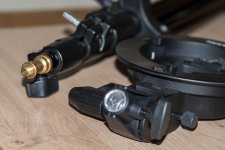
This might help, the top of a light stand has a threaded section but also a shaft section, The light sits on top of that and tightens down with a screw to hold it in place.

Flash Stand.jpg


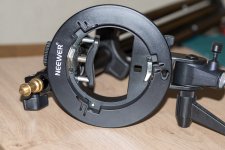
The adapter in the following photo holds a speedlight in position and then sits atop the light stand, other brands are available.


Flash Stand-2.jpg


If you look at the outer edge of the speedlight holder you see lugs where the softbox is fitted, Here you should take care as there are various attachment methods, My lights and modifiers are mostly BOWENS so the adapter ring above is a bowens type. Essentially you need to select a system you are going to stick with.

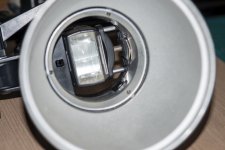
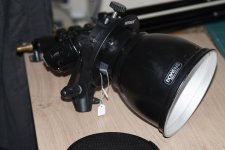
SB800 speed light mounted in holder and attached 7" reflector

Flash Stand-3.jpg

Flash Stand-4.jpg

Generic speedlight holders are about twenty odd quid and the reflectors are as little as a tenner. With the light stands don.t make the mistake I did and get 12 ft tall ones, they do not go low enough for indoor table top use. The Lencarta air damped ones are very good, and very cheap if you go on the bay rather than the store - and they will haggle to offers.
 
This is what I've bought Godox 60*60cm 24*24inch Flash Folding Softbox with S-Type Bracket Bowens Mount (copy paste the wording if the link doesn't work as it's an ebay link and I did a best offer got it posted to me for £25

I've previously bought a pair of godox 3ft octagon umbrella style softboxs for about £40 but I hate them as they weren't S mount. Therefore your flash was on top of your lightstand, but in the core of the softbox so you had to reach in if you wanted to adjust the flashgun, hope that makes sense.
 
Most have a 1/4" screw on top of the tripod stand but it also allows either a studio strobe or something like the Godox s2 clamp to be attached. The S2 would allow you to mount a speedlight/ flashgun and use bowens S type light modifiers. It also has a place to attach an umbrella.

Hello Paul,

This might help, the top of a light stand has a threaded section but also a shaft section, The light sits on top of that and tightens down with a screw to hold it in place.

View attachment 473958


The adapter in the following photo holds a speedlight in position and then sits atop the light stand, other brands are available.


View attachment 473959


If you look at the outer edge of the speedlight holder you see lugs where the softbox is fitted, Here you should take care as there are various attachment methods, My lights and modifiers are mostly BOWENS so the adapter ring above is a bowens type. Essentially you need to select a system you are going to stick with.

SB800 speed light mounted in holder and attached 7" reflector

View attachment 473960

View attachment 473961

Generic speedlight holders are about twenty odd quid and the reflectors are as little as a tenner. With the light stands don.t make the mistake I did and get 12 ft tall ones, they do not go low enough for indoor table top use. The Lencarta air damped ones are very good, and very cheap if you go on the bay rather than the store - and they will haggle to offers.

This is what I've bought Godox 60*60cm 24*24inch Flash Folding Softbox with S-Type Bracket Bowens Mount (copy paste the wording if the link doesn't work as it's an ebay link and I did a best offer got it posted to me for £25

I've previously bought a pair of godox 3ft octagon umbrella style softboxs for about £40 but I hate them as they weren't S mount. Therefore your flash was on top of your lightstand, but in the core of the softbox so you had to reach in if you wanted to adjust the flashgun, hope that makes sense.

Thanks all! That's starting to make a lot more sense now.
 
But I have seen a few that pop open like an umbrella, with a flash inside, The descriptions say that you simply mount the shaft of the "umbrella" onto the tripod with your umbrella connector. Err, what's that then?
They do a very good job of creating fairly even lighting. The ones I've seen don't appear to be well-made, but they do work.

Some very good points, above, and it's certainly easier/more secure to fit a flashgun to a S-fit adapter, mount the whole thing on a decent light stand and know that it won't fall over.
Generic speedlight holders are about twenty odd quid and the reflectors are as little as a tenner. With the light stands don.t make the mistake I did and get 12 ft tall ones, they do not go low enough for indoor table top use. The Lencarta air damped ones are very good, and very cheap if you go on the bay rather than the store - and they will haggle to offers.
The S-fit adapters are half the cost on Temu . . . I've also just bought one of the Lencarta low-level stands, from eBay, and yes it was a lot cheaper than the website price and they accepted my offer too, £24 post free:) https://www.ebay.co.uk/itm/336080957139 Nearly all other low-level light stands are flimsy and unusable, this one is perfect.

Using an S-fit adapter with a flashgun is the obvious answer, but flashguns, although incredibly useful, are NOT a replacement for a studio flash. The main problem is the built-in, fixed reflector, which pushes the light forward and severely limits the spread of the light within the softbox. They more or less work OK with small softboxes, but cannot create even lighting in large ones. Studio flashes have far more power, the light is far more controllable, they don't need to have incredibly complicated menu systems and they cost less:) I have a good flashgun but never actually use it indoors, because of this.

This may help, https://www.talkphotography.co.uk/tutorials/which-is-the-right-softbox-for-you.154/ a bit out of date now with some of the softboxes now discontinued, but the principles hold good, get one with a recessed front panel, avoid the cheapest, and get one that folds up and down.
 
They do a very good job of creating fairly even lighting. The ones I've seen don't appear to be well-made, but they do work.

Some very good points, above, and it's certainly easier/more secure to fit a flashgun to a S-fit adapter, mount the whole thing on a decent light stand and know that it won't fall over.

The S-fit adapters are half the cost on Temu . . . I've also just bought one of the Lencarta low-level stands, from eBay, and yes it was a lot cheaper than the website price and they accepted my offer too, £24 post free:) https://www.ebay.co.uk/itm/336080957139 Nearly all other low-level light stands are flimsy and unusable, this one is perfect.

Using an S-fit adapter with a flashgun is the obvious answer, but flashguns, although incredibly useful, are NOT a replacement for a studio flash. The main problem is the built-in, fixed reflector, which pushes the light forward and severely limits the spread of the light within the softbox. They more or less work OK with small softboxes, but cannot create even lighting in large ones. Studio flashes have far more power, the light is far more controllable, they don't need to have incredibly complicated menu systems and they cost less:) I have a good flashgun but never actually use it indoors, because of this.

This may help, https://www.talkphotography.co.uk/tutorials/which-is-the-right-softbox-for-you.154/ a bit out of date now with some of the softboxes now discontinued, but the principles hold good, get one with a recessed front panel, avoid the cheapest, and get one that folds up and down.

Thanks Garry! Some good thoughts, and some more reading matter.
 
I know you don't actually need a lot of space/equipment to accomplish some fairly advanced pictures; but I also know it takes a fair bit of time/effort to do it well. I'm also better at responding to a challenge (client brief) as opposed to actual creativity on my own.

Maybe a "client brief" type of challenge would be interesting?
I'm replying to this suggestion in this thread, to avoid taking the Lighting Challenge 8 too far off-topic.

It's an interesting idea, but maybe too difficult for many people? Please let me know what you think.

Here's a fairly basic/simple brief
"

Photographer Brief​


Product: Toilet Roll Holder
Shoot Type: Commercial Product Photography


1. Overview​


You are commissioned to photograph a toilet roll holder for commercial advertising use. The objective is to create refined, high-end product imagery that elevates a functional bathroom accessory into a design-led object.


The photography should demonstrate strong technical control, particularly through the intentional use of both hard and soft lighting to shape form, define materials, and create depth without compromising clarity or realism.


2. Creative Intent​


The imagery should feel modern, clean, and premium. The product must be the clear hero, with an emphasis on craftsmanship, material quality, and precise design.


We are looking for confident, considered compositions rather than lifestyle-driven scenes. The work should sit comfortably in a commercial advertising context, with enough visual interest to hold attention while remaining timeless.


3. Lighting Direction​


Lighting is central to the brief and should be approached with clear intent.


  • Soft Light:
    • Use as the primary illumination to establish overall exposure and tonal balance
    • Should reveal surface quality and curvature while maintaining a smooth, controlled fall-off
    • Avoid flat lighting; volume and shape must remain apparent
  • Hard Light:
    • Introduce selectively to add contrast, structure, and visual tension
    • Use to define edges, accent key design features, and create deliberate highlights or shadows
    • Hard light should enhance the product, not dominate or distract

The final images should clearly reflect a deliberate balance between softness and definition, demonstrating technical precision rather than stylised drama.


4. Composition & Angles​


  • Produce a mix of hero images and supporting detail shots
  • Preferred angles are straight-on and three-quarter views
  • Detail images should isolate key elements such as fixings, edges, or finish transitions
  • Composition should be confident, uncluttered, and product-led

5. Background & Set​


  • Use neutral or subtly textured backgrounds (e.g. matte stone, plaster, soft tonal gradients)
  • Backgrounds should provide separation and contrast without pulling focus from the product
  • Keep styling minimal; any additional elements must feel intentional and restrained

6. Product Presentation​


  • The holder may be photographed wall-mounted or floating, depending on design and practicality
  • Ensure alignment, symmetry, and clean geometry
  • Avoid distortion; maintain accurate proportions

7. Finish & Colour Accuracy​


  • Accurate colour and finish representation is essential
  • Control reflections carefully, especially on metallic or high-gloss surfaces
  • Avoid excessive retouching; the product should remain credible and true to life

8. Technical Expectations​


  • Capture at high resolution suitable for large-format print and digital use
  • Maintain consistent lighting, exposure, and colour across the full image set
  • Clean, professional post-production with natural tonal balance

9. Deliverables​


  • A cohesive set of final retouched images (final quantity to be agreed)
  • A combination of hero shots and close-detail images
  • Landscape and portrait options where possible

10. Usage Context​


Images will be used across:


  • Advertising (print and digital)
  • Website and e-commerce
  • Brand and trade materials

The photography should therefore be flexible, timeless, and commercially robust."

 
I'm replying to this suggestion in this thread, to avoid taking the Lighting Challenge 8 too far off-topic.

It's an interesting idea, but maybe too difficult for many people? Please let me know what you think.

Here's a fairly basic/simple brief
"

Photographer Brief​


Product: Toilet Roll Holder
Shoot Type: Commercial Product Photography


1. Overview​


You are commissioned to photograph a toilet roll holder for commercial advertising use. The objective is to create refined, high-end product imagery that elevates a functional bathroom accessory into a design-led object.


The photography should demonstrate strong technical control, particularly through the intentional use of both hard and soft lighting to shape form, define materials, and create depth without compromising clarity or realism.


2. Creative Intent​


The imagery should feel modern, clean, and premium. The product must be the clear hero, with an emphasis on craftsmanship, material quality, and precise design.


We are looking for confident, considered compositions rather than lifestyle-driven scenes. The work should sit comfortably in a commercial advertising context, with enough visual interest to hold attention while remaining timeless.


3. Lighting Direction​


Lighting is central to the brief and should be approached with clear intent.


  • Soft Light:
    • Use as the primary illumination to establish overall exposure and tonal balance
    • Should reveal surface quality and curvature while maintaining a smooth, controlled fall-off
    • Avoid flat lighting; volume and shape must remain apparent
  • Hard Light:
    • Introduce selectively to add contrast, structure, and visual tension
    • Use to define edges, accent key design features, and create deliberate highlights or shadows
    • Hard light should enhance the product, not dominate or distract

The final images should clearly reflect a deliberate balance between softness and definition, demonstrating technical precision rather than stylised drama.


4. Composition & Angles​


  • Produce a mix of hero images and supporting detail shots
  • Preferred angles are straight-on and three-quarter views
  • Detail images should isolate key elements such as fixings, edges, or finish transitions
  • Composition should be confident, uncluttered, and product-led

5. Background & Set​


  • Use neutral or subtly textured backgrounds (e.g. matte stone, plaster, soft tonal gradients)
  • Backgrounds should provide separation and contrast without pulling focus from the product
  • Keep styling minimal; any additional elements must feel intentional and restrained

6. Product Presentation​


  • The holder may be photographed wall-mounted or floating, depending on design and practicality
  • Ensure alignment, symmetry, and clean geometry
  • Avoid distortion; maintain accurate proportions

7. Finish & Colour Accuracy​


  • Accurate colour and finish representation is essential
  • Control reflections carefully, especially on metallic or high-gloss surfaces
  • Avoid excessive retouching; the product should remain credible and true to life

8. Technical Expectations​


  • Capture at high resolution suitable for large-format print and digital use
  • Maintain consistent lighting, exposure, and colour across the full image set
  • Clean, professional post-production with natural tonal balance

9. Deliverables​


  • A cohesive set of final retouched images (final quantity to be agreed)
  • A combination of hero shots and close-detail images
  • Landscape and portrait options where possible

10. Usage Context​


Images will be used across:


  • Advertising (print and digital)
  • Website and e-commerce
  • Brand and trade materials

The photography should therefore be flexible, timeless, and commercially robust."

Personally I think it's a great idea. But my only issue is said product. I would think most toilet roll holders are in semi confined spaces, and a bit of a bitch to shoot.
So maybe something that is easier to get hold of? Kitchen roll holder comes to mind, but that's only because I'm sitting next to my one.
But a product that will be common to most people, I think would help.
 
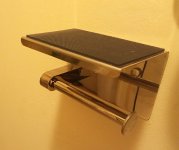
You're right of course, but please don't take me too literally - I'm just giving an example of a brief, not suggesting that this is the right type of subject. I thought that a toilet roll holder would be a versatile subject in the sense that they vary a lot in design and quality, for all I know Donald Trump may have solid gold ones, £ shops may have very basic plastic ones and some of the toilets I've been to on farms have a bit of bail band or a breeze block on the floor:) This is mine, phone pic taken under what is supposed to be the white lighting of my shower room, and as you can see it's chrome plated, made from steel with complex reflective surfaces and a roof, presumably for a phone.
1000001230.jpg
Photographing that would involve either removing it from the wall or, to do it properly, buying a new one so that it's perfect, and I wouldn't be happy doing either.

A brief for photographing this subject would have to be more detailed, all that I did was to take one of my old briefs and put it into Chat GPT.

What I assume @sk66 to be getting at is that he would prefer challenges that tell us what sort of result is required, rather than having me (or someone else if anyone else ever volunteers) :) being didactic and dictatorial, telling people exactly how they should light it.

If we try this idea - which may be a good one - the brief would probably be something like "photograph a pair of supermarket garlic and herb baguettes to emphasise the texture and contrast". Good commercial photographers who work for good clients/agencies do work from briefs, I just don't know how the membership feels about this, hence the question.
 
Well I would certainly be up for giving it a go. I agree with you that a subject that only costs a couple of quid (and can be eaten) is good.
I guess we'll have to wait and see what the consensus is for this one.

As for you being dictatorial, as you put it. Imho has helped immensely with my lighting journey. Sometimes we need to be told/shown how to do things.
 
Last edited:
Well I would certainly be up for giving it a go. I agree with you that a subject that only costs a couple of quid (and can be eaten) is good.
I guess we'll have to wait and see what the consensus is for this one.

As for you being dictatorial, as you put it. Imho has helped immensely with my lighting journey. Sometimes we need to be told/shown how to do things.
I would agree, seeing the required end result is a big help at the end of the "how to do" instructions to be honest.
 
What I assume @sk66 to be getting at is that he would prefer challenges that tell us what sort of result is required, rather than having me (or someone else if anyone else ever volunteers) :) being didactic and dictatorial, telling people exactly how they should light it.

If we try this idea - which may be a good one - the brief would probably be something like "photograph a pair of supermarket garlic and herb baguettes to emphasise the texture and contrast". Good commercial photographers who work for good clients/agencies do work from briefs, I just don't know how the membership feels about this, hence the question.
You said the example brief was pretty basic, but I found it quite involved/detailed. TBH, I never worked with terribly high end clients, and a brief like that would have been beneficial as it covers most everything that is actually involved (but not always spelled out).

Anyway, I was thinking much simpler briefs like the garlic and herb baguette example. Others I have existing examples for which I can share are a camera lens (the challenge being reflections in the objective elements), a camera lens on black with reflection (the challenge being creating separation and controlled reflection), watches (standard/diffusion dome), beer, etc. I can think of other lighting challenges that I don't have examples for such as a suede product illuminated to show emphasize texture/suppleness (doesn't have to be suede). Ice cream with syrup to communicate luxury/sexy. Etc.

On one hand I think not providing an example image promotes a more creative approach/thinking, but that could also be more of a challenge making it a step too far; I'm not sure. Also, not providing an example image means I can participate/help without having to put in the effort myself; LOL!
 
Fascinating . . .
I've clicked "like" because I like most of your post, just not the last bit where you say that you don't want to set a challenge:)

Briefs can vary a lot here, from half a sheet of paper to a book, and when the agency really hates a photographer they send along a failed photographer creative director to supervise, demand the impossible and get in the way, so there are wide variations.

I worked in a top Manhattan studio a lifetime ago, this of course was a long time before Trump and I wanted to stay, but apparently there was an unemployed wedding photographer somewhere in the USA, so they wouldn't give a green card to a foreigner. :( I have no idea about the current state of commercial photography in the USA.

You said the example brief was pretty basic, but I found it quite involved/detailed. TBH, I never worked with terribly high end clients, and a brief like that would have been beneficial as it covers most everything that is actually involved (but not always spelled out).

Anyway, I was thinking much simpler briefs like the garlic and herb baguette example. Others I have existing examples for which I can share are a camera lens (the challenge being reflections in the objective elements), a camera lens on black with reflection (the challenge being creating separation and controlled reflection), watches (standard/diffusion dome), beer, etc. I can think of other lighting challenges that I don't have examples for such as a suede product illuminated to show emphasize texture/suppleness (doesn't have to be suede). Ice cream with syrup to communicate luxury/sexy. Etc.

On one hand I think not providing an example image promotes a more creative approach/thinking, but that could also be more of a challenge making it a step too far; I'm not sure. Also, not providing an example image means I can participate/help without having to put in the effort myself; LOL!
(My bold) This is demanding, high-end stuff, all credit to you. I've been there myself, normally using (in part) an unevenly-lit silk to create graduated specular highlights.

This appeals to me personally, but I think it may be a bit too demanding for many people; the whole idea of these lighting challenges is to teach the basic physics of lighting, creating tools that can benefit everyone who applies care and thought (and who actually reads my blurb) regardless of whether or not they have any level of previous experience, and without even having to have much if anything in the way of either space or gear. And, after a slow and disappointing start, I think that it's now working well, Many people have achieved great things:) The problem for me is to keep it going, which is why I keep asking for help.
 
Maybe I shouldn`t have been the first to post in the latest challenge. I may have scared everyone away :ROFLMAO:
I think you will find you were a distant second in that the latest thread. :)
 
The brief looks a lazy generic one to my eye that could apply to a multitude of subjects,

Main take aways for me were

Hero subject
No fancy dramatic lighting
Soft and hard light
Wall mounted or floating subject
 
It is, deliberately, I didn't say that it was made of chrome-plated steel and so highly reflective with complex shapes, it was just a simple example.
 
Back
Top