

You are using an out of date browser. It may not display this or other websites correctly.
You should upgrade or use an alternative browser.
You should upgrade or use an alternative browser.
Lighting challenge 4, Darkfield Lighting
- Thread starter Garry Edwards
- Start date

Donnie
Suspended / Banned
- Messages
- 7,027
- Name
- Paul
- Edit My Images
- No
My attempt and found this quite difficult, partly due to the space available but also my range of a suitable subject were very limited.
Here's the BTS shot and you can see I used Garry's idea re using black trousers and a black blouse of the wifes.

IMG_9427 by Donnie Canning, on Flickr
Then my first attempt was with this near empty bottle of Harris Gin (the only gin I actually like as Im a whisky/whiskey man) The issue is it's a very patterned bottle AND due to the space was difficult to capture due to the tall size, I used the round white lid you see on the table in the BTS to reflect a little light back onto the label, not sure it's enough for a straight out of camera shot, perhaps I should have used a mirror instead.

DFHarrisgin by Donnie Canning, on Flickr
Having reservations about that shot the only other (smaller) suitable subject was a bottle of the wife's perfume resulting in this but I got the reflector too far in the shot which can be edited out of course.

DFJoMalone by Donnie Canning, on Flickr
Again though I have reservations as not sure we can use a relfector for this challenge in this way as it does make the light a little one sided, much more obvious in the perfume bottle of course due to the chrome lid?
Here's the BTS shot and you can see I used Garry's idea re using black trousers and a black blouse of the wifes.
IMG_9427 by Donnie Canning, on Flickr
Then my first attempt was with this near empty bottle of Harris Gin (the only gin I actually like as Im a whisky/whiskey man) The issue is it's a very patterned bottle AND due to the space was difficult to capture due to the tall size, I used the round white lid you see on the table in the BTS to reflect a little light back onto the label, not sure it's enough for a straight out of camera shot, perhaps I should have used a mirror instead.
DFHarrisgin by Donnie Canning, on Flickr
Having reservations about that shot the only other (smaller) suitable subject was a bottle of the wife's perfume resulting in this but I got the reflector too far in the shot which can be edited out of course.
DFJoMalone by Donnie Canning, on Flickr
Again though I have reservations as not sure we can use a relfector for this challenge in this way as it does make the light a little one sided, much more obvious in the perfume bottle of course due to the chrome lid?
A good start, but then the face side of the bottle needs more light. You can add additional lights, but just a couple of pieces of white foam core, or white matte board with a small A-Clamp attached at the bottom to act as a foot to keep the card standing on the table, and angled to reflect some of the Soft box light back at the facing side of the bottle will help. Position these just out of camera view between the bottle and camera position and angled so the soft box light reflects back at the bottle. Lens flare, from the soft box pointed directly at the camera lens can then be solved by making a hole in a piece of black foam core or matte board large enough and in the position needed for the lens to look through, but small enough so the camera lens and the soft box can't see each other will do the job of blocking the lens flare and the black background will be much blacker in appearance. You can use a couple more small A-Clamps, or even spring type clothes pins on their side for the feet support of this black panel with the hole in it to make it stand on the table on it's own too. This is called an "Aperture Mask" and minor adjustments can be made tord the bottle or toward the camera lens to keep it from being seen by the camera, yet block all of the soft box light from directly hitting the camera lens.
You are half way there. Don't give up yet.
I use this same technique or similar, for many shots of small items, not just bottles, but the rim light created by this soft box pointed toward the camera produces great rim light and is a very handy trick to have. Black is the common background of choice, but I have used other colors too. Mirrors instead of the small white cards produces a much brighter reflected soft box light. I keep a couple of small rectangular mirrors in my studio for this and use the Small A-clamps on their side as feet to hold the mirrors too. Larger spring clothes pins work, if large enough, but the small or medium A-Clamps work best. I frequently use a square of black felt or black velvet, or sometimes colored versions as the background. It just needs to be very opaque and have no light coming through it, but if you want to light the bottle you can cut a small notch in the bottom center of this background to let some of the soft box light through to light the inside of the bottle. I frequently hang the background fabric from a 1/2 or 5/8" wooden dowel with one end attached to a light stand with a small magic clamp screwed onto the 1/4-20 male thread at the top of the light stand to hold it. I position this dowel so it crosses in front of the soft box and attach the top of this background to it.
Just my way of doing it. You are doing fine, so far.
Another way, for larger back lighting is to use larger pieces of foam core, or other white reflective material and position strobe lights at each side of a bigger backdrop with them pointed toward the larger reflective pieces to reflect light back at the front of the subject (it doesn't need to be a soft box for the back light. I have done this for larger objects that are too large for my existing soft boxes. I even have some 4' X 7' panels of insulation boards with one side painted flat white and the back side painted flat black with two plywood stands that have a slot in the top of them to hold the panels. Again, with them off to each side of the camera view and angled to reflect light from flashes placed on each side of the subject pointed to reflect their light back at the front of the subject, I have even done similar lighting for live portrait type photo shoots.
Learning how lighting works and how to make it work for you is the key to this. Scaling it up for larger and down for smaller can produce the same results no matter what size the subject of your photography is, but it's cheaper to do if you keep it small and table size. Let us know with this new information how your next step in this photo shoot works for you. I will come back to check on your progress. Again, you are doing fine, so far.
Charley
You are half way there. Don't give up yet.
I use this same technique or similar, for many shots of small items, not just bottles, but the rim light created by this soft box pointed toward the camera produces great rim light and is a very handy trick to have. Black is the common background of choice, but I have used other colors too. Mirrors instead of the small white cards produces a much brighter reflected soft box light. I keep a couple of small rectangular mirrors in my studio for this and use the Small A-clamps on their side as feet to hold the mirrors too. Larger spring clothes pins work, if large enough, but the small or medium A-Clamps work best. I frequently use a square of black felt or black velvet, or sometimes colored versions as the background. It just needs to be very opaque and have no light coming through it, but if you want to light the bottle you can cut a small notch in the bottom center of this background to let some of the soft box light through to light the inside of the bottle. I frequently hang the background fabric from a 1/2 or 5/8" wooden dowel with one end attached to a light stand with a small magic clamp screwed onto the 1/4-20 male thread at the top of the light stand to hold it. I position this dowel so it crosses in front of the soft box and attach the top of this background to it.
Just my way of doing it. You are doing fine, so far.
Another way, for larger back lighting is to use larger pieces of foam core, or other white reflective material and position strobe lights at each side of a bigger backdrop with them pointed toward the larger reflective pieces to reflect light back at the front of the subject (it doesn't need to be a soft box for the back light. I have done this for larger objects that are too large for my existing soft boxes. I even have some 4' X 7' panels of insulation boards with one side painted flat white and the back side painted flat black with two plywood stands that have a slot in the top of them to hold the panels. Again, with them off to each side of the camera view and angled to reflect light from flashes placed on each side of the subject pointed to reflect their light back at the front of the subject, I have even done similar lighting for live portrait type photo shoots.
Learning how lighting works and how to make it work for you is the key to this. Scaling it up for larger and down for smaller can produce the same results no matter what size the subject of your photography is, but it's cheaper to do if you keep it small and table size. Let us know with this new information how your next step in this photo shoot works for you. I will come back to check on your progress. Again, you are doing fine, so far.
Charley
OP

Garry Edwards
Moderator
- Messages
- 13,475
- Name
- Garry Edwards
- Edit My Images
- No
Some very good points. Please bear in mind that, for this challenge, we're limiting ouselves to just one light.
I have a roll of plastic mirror, from eBay, I just cut off a small bit when needed, fix it to a bit of card or similar with spray glue to keep it flat, perfect. https://www.ebay.co.uk/itm/264401016427?var=564029547681
I think (hope) that we all understand that reflected light is always at a much lower level than the direct light, due to the effect of the inverse square law, so sometimes yes, we do need a brighter reflected light. Mirrors are perfect because, in theory at least, they reflect back ALL of the light that reaches them, even the purest white reflector can only manage about 70%.Mirrors instead of the small white cards produces a much brighter reflected soft box light.
Charley
I have a roll of plastic mirror, from eBay, I just cut off a small bit when needed, fix it to a bit of card or similar with spray glue to keep it flat, perfect. https://www.ebay.co.uk/itm/264401016427?var=564029547681
I was rather looking forward to this challenge, but as other participants have commented, it was a bit harder than one might have expected. Once again, some good learning in this challenge and lots of thinking to get it to work.
My first attempts yesterday were no good. In the absence of a softbox (still work in progress) I bounced my flashgun off a white wall. Whilst the idea did work, my flashgun lacked sufficient power, so everything was rather dark - retrievable in post, but that's not the idea.
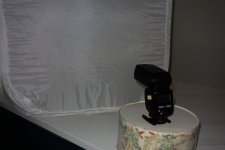
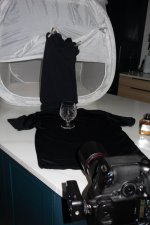
So, I binned that lot and pondered. I thought of the Inverse Square Law discussed previously in these pages, and thought if the flash doesn't have enough power, then doing everything on a smaller scale should help. I remembered that I bought a light tent years ago. I was always disappointed with this; it's nasty and cheap, it barely stays together, let alone upright. But it might provide me with a way of generating a soft light, tunnelled towards my subject, but around the darkfield. A couple of black T-shirts completed the make do and mend equipment.
Here are the behind the scenes shots (I couldn't really get it all into one shot). At the back:
And at the front:
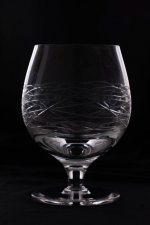
First subject:
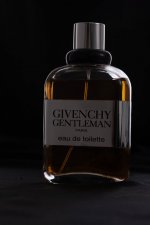
Second subject (surprisingly difficult, that label is highly reflective, and far from flat):
My final efforts were with smoke (you wouldn't believe how many shots I took of the smoke!):
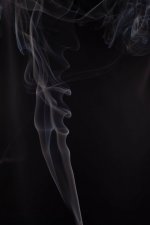
No post-processing at all, though they would all benefit from it.
My first attempts yesterday were no good. In the absence of a softbox (still work in progress) I bounced my flashgun off a white wall. Whilst the idea did work, my flashgun lacked sufficient power, so everything was rather dark - retrievable in post, but that's not the idea.
So, I binned that lot and pondered. I thought of the Inverse Square Law discussed previously in these pages, and thought if the flash doesn't have enough power, then doing everything on a smaller scale should help. I remembered that I bought a light tent years ago. I was always disappointed with this; it's nasty and cheap, it barely stays together, let alone upright. But it might provide me with a way of generating a soft light, tunnelled towards my subject, but around the darkfield. A couple of black T-shirts completed the make do and mend equipment.
Here are the behind the scenes shots (I couldn't really get it all into one shot). At the back:
And at the front:
First subject:
Second subject (surprisingly difficult, that label is highly reflective, and far from flat):
My final efforts were with smoke (you wouldn't believe how many shots I took of the smoke!):
No post-processing at all, though they would all benefit from it.
OP
Garry Edwards
Moderator
- Messages
- 13,475
- Name
- Garry Edwards
- Edit My Images
- No
10/10 for thinking about your light tent, my personal views on light tents (and even worse, light cubes) are unprintable. But, although the results are pretty good, a softbox would make life much easier for you.
Thanks Garry! I'm working up to the softbox purchase.10/10 for thinking about your light tent, my personal views on light tents (and even worse, light cubes) are unprintable. But, although the results are pretty good, a softbox would make life much easier for you.

Scooter
Suspended / Banned
- Messages
- 625
- Name
- Owen
- Edit My Images
- No
I went with a long tube made from rolled up matt black card stock over the end of my lens. You can see it on the camera in this write up of a darkfield shot of a smoking bulb I did ten years agoHello Garry,
I was thinking more of a piece black card with a hole cut into it say four inches diameter and then placed a few inches in front of the lens so that the lens only gets light from the darkfield and not the extraneous light from the un-flagged light of the softbox.
If that makes sense
https://owenlloydphotography.com/smoke-part-2-smoking-bulbs/
OP
Garry Edwards
Moderator
- Messages
- 13,475
- Name
- Garry Edwards
- Edit My Images
- No
That's a great post. You should set some lighting challengesI went with a long tube made from rolled up matt black card stock over the end of my lens. You can see it on the camera in this write up of a darkfield shot of a smoking bulb I did ten years ago
https://owenlloydphotography.com/smoke-part-2-smoking-bulbs/

Scooter
Suspended / Banned
- Messages
- 625
- Name
- Owen
- Edit My Images
- No
hmmmThat's a great post. You should set some lighting challenges
 I'll have a think. You've covered quite a bit of ground! Maybe something alone the lines of combining ambient light and flash..
OP
Garry Edwards
Moderator
- Messages
- 13,475
- Name
- Garry Edwards
- Edit My Images
- No
That will be perfect, thanks for volunteeringhmmm