Lens Maximum Aperture Question

Zarch

Suspended / Banned
Messages
1,005
Name
Mick
Edit My Images
Yes
I'm trying to understand why the aperture capability of a lens makes it better.

4 Lenses for example
Nikon 35mm f1.8
Nikon 17-55 f2.8
Nikon 18-55 f3.5 - 5.6
Nikon 18-70 f3.5 - 4.5

So with the variable aperture rated lens, the maximum aperture drops as the focal length increases. So on the 18-70, you can't go any faster than 4.5 at 70mm and on the 18-55 at 55mm, 5.6 is the fastest. Which makes the 18-70 better in that sense?

And with the 17-55 f2.8, you can get f2.8 through the entire range and with the 35mm fixed, the fastest aperture 1.8.

Right so far? (although I apologise if i've got my fastest/maximums muddled up..... still struggle with that :bonk:)

Now my question is this..... if you were to put each of the 4 lens at 35mm with the aperture at f8.0 for a general type of shot does the better light capability of the lens make any difference? or is it now solely down to the glass where you see improvements?

Does my question make sense? :thinking:
 
Apart from the better glass making improvements there is another benefit to fast glass. The cameras autofocus system uses the lenses widest aperture, the lens isn't stopped down until just before the shutter opens, so more light = better/faster/more accurate focusing in low light.

the f5.6 lenses will take great pictures (if they are decent) all day long at f8 as long as there is plenty of light. But when conditions get difficult they will struggle. Have you noticed how fast lenses seem to find focus withouth much effort even in low light.
 
Apart from the better glass making improvements there is another benefit to fast glass. The cameras autofocus system uses the lenses widest aperture, the lens isn't stopped down until just before the shutter opens, so more light = better/faster/more accurate focusing in low light.

the f5.6 lenses will take great pictures (if they are decent) all day long at f8 as long as there is plenty of light. But when conditions get difficult they will struggle. Have you noticed how fast lenses seem to find focus withouth much effort even in low light.

Thanks for the reply Graham...... I undertstand that better glass is better glass and the IQ will always be better. hence you usually get what you pay for...... :thumbs:

But let me see if I get this bit right........ so even though you are shooting at f8.0, if you have a 2.8 lens you'll be getting benefit of having that 2.8 under the hood?
 
Thanks for the reply Graham...... I undertstand that better glass is better glass and the IQ will always be better. hence you usually get what you pay for...... :thumbs:

But let me see if I get this bit right........ so even though you are shooting at f8.0, if you have a 2.8 lens you'll be getting benefit of having that 2.8 under the hood?


Yeah, the camera is focusing using the light that 2.8 is letting in, the faster the lens, the more light thats available for focusing even if you are stopped down to f8.0 because the lens doesn't actually stop down until you press the shutter button all the way.
 
A F2.8 of faster lens will also focus with more precision when used on some camera bodies with cross type focus points
 
Yeah, the camera is focusing using the light that 2.8 is letting in, the faster the lens, the more light thats available for focusing even if you are stopped down to f8.0 because the lens doesn't actually stop down until you press the shutter button all the way.

Does shutter speed benefit from this extra light even when shooting at f8.0? Or is that just linked to the actual aperture of the shot when you press the shutter?
 
Last edited:
The shutter speed will have to be set for f8 no matter which lens you use as that is what it will be when you take the shot. the f1.8, or f2.8 etc is only open for focusing and as said will then close to f8 or whatever you have set when the release is pressed.
 
Your camera and the picture will appreciate the fast glass in all sorts of ways. Your wallet will not !
 
an interesting thread for sure. thanks for asking the question...
 
Does shutter speed benefit from this extra light even when shooting at f8.0? Or is that just linked to the actual aperture of the shot when you press the shutter?

Two lenses set at the same aperture should always give the same shutter speed for the same exposure. In reality there is variation because of different light transition characteristics, but this is not to do with the maximum aperture.
 
Does shutter speed benefit from this extra light even when shooting at f8.0? Or is that just linked to the actual aperture of the shot when you press the shutter?

Two lenses set at the same aperture should always give the same shutter speed for the same exposure. In reality there is variation because of different light transition characteristics, but this is not to do with the maximum aperture.

Thanks Adam, that makes sense. All to do with the Exposure Triangle I suppose? If you put the same numbers in (Shutter/Aperture), there can be only one outcome?

So where does a better camera help? If you are using the same lens, same aperture, same shutter speed?

My D3100 is DX format with I imagine a smallish/entry level sensor? Would having a larger/better sensor affect the triangle on the ISO side?

It can't effect the aperture as that is fixed on the lens, but can it help with shutter speeds?

I know this is taking the thread away from its origins, but I think it would be useful to understand this.
 
Thanks for the reply Graham...... I undertstand that better glass is better glass and the IQ will always be better. hence you usually get what you pay for...... :thumbs:

Not quite true - the Canon 50mm f1.8 has IQ better than many "L" glass lenses at a fraction of the cost - which is why it is a favourite of many Canon owners:

Check it here:

http://www.the-digital-picture.com/...CameraComp=0&SampleComp=0&FLIComp=0&APIComp=0

From f2.8 onwards it is stunningly sharp and very useable even at f1.8.

.
 
Best to get the lens you need at the price you can afford.

Maximum aperture gives you the benefit of more light through the lens but doesn't necessarily mean sharper images...

The nikon 55-200mm at £250 is just about as sharp as the 70-200mm VR 2 but you pay for the lower F number & a couple of other perks.

It's nice to be able to have the lower apertures if you can aford it, if not then just check out the lenses for quality and boost ISO a stop or two to get the same light...or spend shed loads on a lens that lets in a stop more light...
 
Going back to this thread about expensive 2.8 lenses and the suchlike.

We revealed earlier in the thread that a when a 2.8 lens is set at 5.6, it shoots 5.6 the same way as a lens that is 5.6 by design. (a 3.5-5.6 for example)

So would this comment be true about these "fast" 2.8 lenses...... In a way, you are forced to open the lens right up to get more light and in doing so you are tied to a shallow depth of field?

Yes, you can open them up and take sharper/lower ISO pictures in darker conditions but you'll have more Bokeh than you can shake a stick at?

The reason I ask that I have a 1.8 35mm for my D3100 and when shooting at 1.8 and other wide open apertures, the DOF can be that shallow that parts of peoples faces can be out of focus whilst the rest not, so I try to use 3.5+ etc to ensure this doesn't happen.

But if you are paying top dollar for a 2.8 lens, how do you take advantage of the 2.8, but don't end up with very shallow DOF?

Yeah, I think thats what i'm getting at! :thumbs:
Hope it makes sense?
 
Zarch said:
Going back to this thread about expensive 2.8 lenses and the suchlike.

We revealed earlier in the thread that a when a 2.8 lens is set at 5.6, it shoots 5.6 the same way as a lens that is 5.6 by design. (a 3.5-5.6 for example)

So would this comment be true about these "fast" 2.8 lenses...... In a way, you are forced to open the lens right up to get more light and in doing so you are tied to a shallow depth of field?

Yes, you can open them up and take sharper/lower ISO pictures in darker conditions but you'll have more Bokeh than you can shake a stick at?

The reason I ask that I have a 1.8 35mm for my D3100 and when shooting at 1.8 and other wide open apertures, the DOF can be that shallow that parts of peoples faces can be out of focus whilst the rest not, so I try to use 3.5+ etc to ensure this doesn't happen.

But if you are paying top dollar for a 2.8 lens, how do you take advantage of the 2.8, but don't end up with very shallow DOF?

Yeah, I think thats what i'm getting at! :thumbs:
Hope it makes sense?


Well the shallow DOF is a feature that is often coveted by photographers, also most lenses are at their sharpest and best IQ when stopped down a couple of stops so a 2.8 lens will often produce better IQ AT 5.6 than a 5.6 lens wide open. Not always but usually.

Then there is the better autofocus capabilities in low light of a faster lens regardless of aperture you choose to take the photo.

The DOF will be the same for both lenses at the same aperture, the faster ones often have more blades in the iris and produce smoother bokeh, whether its better is subjective but I prefer it usually.

And yes there's always a trade off in photography, larger aperture let's in more light but the DOF will be reduced.
 
Last edited:
If bokeh is that much of a problem when achieving the lowest apertures then you don't zoom so much and stay further away from your subject.

Unfortunatley, thats not always an option with a 1.8 35mm prime.

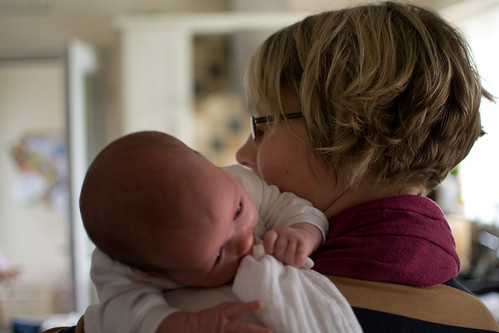
Check one of the first pictures I took with my 35mm at 1.8....... how much better would this have been with both of them in focus? (I think I was a bit addicted to "wide open" back then) :lol:

But if i'd have closed the aperture i'd have ended up a much noisier handheld indoor/crap light picture....... as is mentioned, there is always a compromise. :'(


DSC_0636 by Zarch1972, on Flickr


So I think this is my point. In the above example, if i'd have closed the aperture and shot 3.5, then I could have just used my 18-70 as that does 3.5, so where is the benefit of having a 1.8 lens?

I suppose the above picture could suit at 1.8 if there was only one person it rather than two as DOF is less of an issue?
 
Zarch said:
Unfortunatley, thats not always an option with a 1.8 35mm prime.

Check one of the first pictures I took with my 35mm at 1.8....... how much better would this have been with both of them in focus? (I think I was a bit addicted to "wide open" back then) :lol:

But if i'd have closed the aperture i'd have ended up a much noisier handheld indoor/crap light picture....... as is mentioned, there is always a compromise. :'(

http://www.flickr.com/photos/mickwall/5668725954/
DSC_0636 by Zarch1972, on Flickr

So I think this is my point. In the above example, if i'd have closed the aperture and shot 3.5, then I could have just used my 18-70 as that does 3.5, so where is the benefit of having a 1.8 lens?

I suppose the above picture could suit at 1.8 if there was only one person it rather than two as DOF is less of an issue?

So to get them both in focus next time wide open, stand further back & then crop in post. You'll have the benefits of more light and in focus but compromise on print size.
 
Yeah, the camera is focusing using the light that 2.8 is letting in, the faster the lens, the more light thats available for focusing even if you are stopped down to f8.0 because the lens doesn't actually stop down until you press the shutter button all the way.

Can I go back to this comment for just a minute.

If this is true, that the lens doesn't stop down to the chosen aperture until the shutter button is fully depressed, does that mean that the image displayed in the viewfinder is not an accurate depiction of what the final image will be?

I'm thinking in terms of DoF here. For instance in the example given an aperture of f/2.8 will have a fairly short DoF but if the lens doesn't stop down until the instant that the shutter button is fully pressed then the image that you see in the viewfinder, at f/8 will have a relatively large DoF.

Does that make sense?
 
Can I go back to this comment for just a minute.

If this is true, that the lens doesn't stop down to the chosen aperture until the shutter button is fully depressed, does that mean that the image displayed in the viewfinder is not an accurate depiction of what the final image will be?

I'm thinking in terms of DoF here. For instance in the example given an aperture of f/2.8 will have a fairly short DoF but if the lens doesn't stop down until the instant that the shutter button is fully pressed then the image that you see in the viewfinder, at f/8 will have a relatively large DoF.

Does that make sense?

It is true and thats why some bodies have a DOF preview button
 
My D3100 is DX format with I imagine a smallish/entry level sensor? Would having a larger/better sensor affect the triangle on the ISO side?

It can't effect the aperture as that is fixed on the lens, but can it help with shutter speeds?

I know this is taking the thread away from its origins, but I think it would be useful to understand this.

'better' cameras dont affect the triangle per se - but you usually find that the more expensive models handle high iso shots better with less noise (ie random blobs of colour pixels) and may also have a wider iso range (ie an entry level camera might offer ISO 100- 1600 whereas a more expensive model might offer 50-6400 - or even higher )

Also some top end models have better autofocus modules so they can autofocus better in dim lights - for example if you put a lens with a max apperture of less than 5.6 on most canon dslrs (e.g a70-300 f5.6 with a 1.4 converter giving a max app of f8) they are going to struggle except in very bright light - however the top end 1 series models AF down to F8 (which allows pros t put a 2xtc onto say a 500mm f4 for those long range shots )

The bottom line on cameras is that buying a better model wont automatically make you a better photographer (in the same way that buying an electric guitar doesnt automatically make you an axe god) but as you become a better photographer through experence you may start to want a higher spec DSLR

However if you have to choose betweenspending out a body and spending out on lenses its usually better to have good glass on a basic body, than it is to blow the wedge on a top end body then put a bog standard lens on it.

HTH
 
So I think this is my point. In the above example, if i'd have closed the aperture and shot 3.5, then I could have just used my 18-70 as that does 3.5, so where is the benefit of having a 1.8 lens?

the point is that in crap light your 18-70 might have struggled to focus at all so you might have wound up with them both blurred

also i think you will find that the 18-70 is a variable apperture lens f3.5-f5.6 and it only really offer the wider apperture at the wide end so at 35mm you might only have been able to go down to f4 or 4.5 anyway - which might have given too large a dof and a distracting background

Incidentally in that picture if the mother isnt that far out of focus, you might be able to rescue it in PP by selectively applying some unsharpmask

also you were always going to struggle in this shot because the two subjects arent in the same plane - if the mother had been holding the baby in her arms instead of over her shoulder this might not have been the case - the sensor would have been parralel to the main subject and thus the sweet spot of DOF at f1.8 would have encompassed both subjects
 
Apart from the better glass making improvements there is another benefit to fast glass. The cameras autofocus system uses the lenses widest aperture, the lens isn't stopped down until just before the shutter opens, so more light = better/faster/more accurate focusing in low light.

That's not actually true, the AF module only 'sees' f5.6 regardless of the lens attached, the real benefit of fast glass when autofocusing is the brighter viewfinder image.
 
That's not actually true, the AF module only 'sees' f5.6 regardless of the lens attached, the real benefit of fast glass when autofocusing is the brighter viewfinder image.

not always true some bodies have focus points optimised for fast glass (2.8 or faster) which yield a higer accuracy.
 
Dogfish_magnet said:
not always true some bodies have focus points optimised for fast glass (2.8 or faster) which yield a higer accuracy.


Yeah this is a bone of contention with some people. The idea being that the autofocus sensor doesn't have focus points outside the 5.6 area, but canon state that some of their bodies have points that can take advantage of faster glass and my feeling current nikon bodies can too. I am prepared to be corrected in the case of nikon but my feeling is this is the case because I could swear my fast glass doesn't hunt for focus like my slower lenses do in low light.
 
Back
Top