Lens Image coverage

Barney

Suspended / Banned
Messages
3,043
Name
Wayne
Edit My Images
No
I have been reading books, blame Stephen, and all the daft questions are starting to cross my mind.

WHY, when lens designers go to extreme lengths to ensure that we have full image coverage on the film do we then chuck away a fair bit of the capability of the lens,

Eg. lens coverage to 35mm yet in one direction there is only 24mm covered

Why is the coverage of the lens not maximised to 35mm square?
 
Physics.

Optical lenses project a circular image in a cone shape, so the image circle needs to be large enough to cover the longest edge of the format.

And to add to this, so your lens will cover enough for a 36mm circle, yes but then if the film was the same height, you have a much bigger film (50% higher) and therefore a much bigger camera. The 35mm still camera was a way to repurpose cine film into a smaller photographic format, regarded as miniature at the time.

If you want to talk about physics and design in lenses, look at the Hasselblad Xpan/Fuji TX-1. S tiny lens (albeit f/4) that covers a 65mm circle!
 
I have been reading books, blame Stephen, and all the daft questions are starting to cross my mind.

WHY, when lens designers go to extreme lengths to ensure that we have full image coverage on the film do we then chuck away a fair bit of the capability of the lens,

Eg. lens coverage to 35mm yet in one direction there is only 24mm covered

Why is the coverage of the lens not maximised to 35mm square?

When you mention chucking away a fair bit of the capability of the lens, what do you mean exactly?

In your example, are you simply referring to the non-square format of most sensors? If so, as Steve said, lenses produce a circular projected image by nature of the fact that the lenses (in this use case) are themselves circularly symmetric i.e. they have the same curvature profile along any line which passes through the geometric centre. The wastage as you put it is just a by-product of engineering the lens to cover the diagonal dimension of the sensor.

Regarding your last question, remember that in order to maximise coverage for a square sensor shape (and therefore achieve acceptable sharpness within that square sensor), this requires a larger image circle than for a rectangular sensor (with the same horizontal axis dimension) because the diagonal dimension is longer.
 
Last edited:
The film wasnt made for the camera. The 35mm camera came about as a means of using motion picture film. The film was reasonably cheap and easy to obtain. Had the film been wider the format may well have been made square, or at least closer to a square.
The convenience of more shots per roll was the selling point.
 
And to add to this, so your lens will cover enough for a 36mm circle, yes but then if the film was the same height, you have a much bigger film (50% higher) and therefore a much bigger camera. The 35mm still camera was a way to repurpose cine film into a smaller photographic format, regarded as miniature at the time.

If you want to talk about physics and design in lenses, look at the Hasselblad Xpan/Fuji TX-1. S tiny lens (albeit f/4) that covers a 65mm circle!
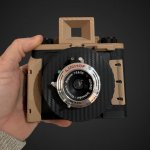
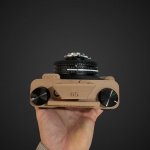
Medium/large format lenses can be even more compact than the Xpan lenses (and have a shutter integrated between the optical blocks), whilst covering 6x6/6x9 formats. I’ve just fired a test roll through my Six6 with a customers’ tiny Schneider 65/6.8;

Photoroom_000_20260112_104405.jpegPhotoroom_001_20260112_104405.jpeg

Some seriously clever people involved in optical design, way above my pay grade!
 
Right I think I get it, the film came first and everything else was made to fit around the manufacture of film!
 
The convenience of more shots per roll was the selling point.
This was undoubtedly the case.
Right I think I get it, the film came first and everything else was made to fit around the manufacture of film!
Yes.

The technology for handling perforated film was well understood by 1900 and a whole slew of cameras employing it came on the market. The Tourist Multiple, released in 1913, was what we would now call a "half frame" camera and provided a whopping 750 exposures per load. The first "full frame" camera was the 1914 Simplex, that could switch from half frame to full frame. These were both American products. To place these in context, the first Leica went on sale in 1925 so the use of cinema film was well established before the appearance of what we would now call a modern film camera.
 
And additionally, 35mm is the width of the film, and the sprocket holes limit one dimension to 24mm. At least one camera was made to produce 24mm square negatives on 35mm film.

As to physical lens sizes, I have a 450mm lens which is about the same size as my 50mm f/1.8 OM lens and has an image circle that will cover an 11"x14" sheet of film. There are sound reasons why lenses are designed to cover more than the bare minimum - think about shift lenses, designed to let you go off axis to make image corrections.
 
Those lenses with really extravagant image circle dimensions must be fantastic for tilting and shifting.
 
While we're on the subject, it has always niggled me that Bronica have different lenses for the 6x6 SQ range and the 6x4.5 ETRS range. Surely if the lens covers the 6 side, it must do so whether the other is 6 or 4.5? :thinking:
 
Diagonals, Peter. I haven't checked the exact figures, but 6x6 will have a larger diagonal.

Though I can't see why the ETRS couldn't have been designed to take the 6x6 lenses, unless the lens throat needed to be much larger to accommodate the 6x6 lenses.
 
Last edited:
Diagonals, Peter. I haven't checked the exact figures, but 6x6 will have a larger diagonal.
Ah, I hadn't considered that Stephen. Thanks for the quick response.
 
Diagonals, Peter. I haven't checked the exact figures, but 6x6 will have a larger diagonal.

Though I can't see why the ETRS couldn't have been designed to take the 6x6 lenses, unless the lens throat needed to be much larger to accommodate the 6x6 lenses.

As well as everything that goes with it like mirror, shutter, etc. Deffo needs a bigger hole for that.
As to physical lens sizes, I have a 450mm lens which is about the same size as my 50mm f/1.8 OM lens and has an image circle that will cover an 11"x14" sheet of film. There are sound reasons why lenses are designed to cover more than the bare minimum - think about shift lenses, designed to let you go off axis to make image corrections.
8x10 is as large as I am currently working. Would love to try bigger one day but can't see it happening.

Those lenses with really extravagant image circle dimensions must be fantastic for tilting and shifting.

Yes, as Stephen says, rise, fall, tilt, shift on view cameras mean the image circle is bigger than the film (some more than others)

Here is a link to Nikkor large format lenses and their image circles in relation to various film sizes.

 
I'd just been calculating the format covered by my Fujinon 450mm lens (486 mm) so diagonals were at the front of my mind.

In passing, I found a diagonals calculator that let me enter the length and width in inches and returned the answer in mm, very useful for checking large format lens coverage.
 
While we're on the subject, it has always niggled me that Bronica have different lenses for the 6x6 SQ range and the 6x4.5 ETRS range. Surely if the lens covers the 6 side, it must do so whether the other is 6 or 4.5? :thinking:
It might depend on which came first (eg also the Mamiya 6 and Mamiya 7)? Also, it might simply be that they would like to sell you completely new set of lenses, thanks very much!
 
While we're on the subject, it has always niggled me that Bronica have different lenses for the 6x6 SQ range and the 6x4.5 ETRS range. Surely if the lens covers the 6 side, it must do so whether the other is 6 or 4.5? :thinking:

The ETR cameras came out first in 1976, they need diagonal coverage of 75mm, the SQ came out 4 years later, and need 84.9mm diagonal of coverage.

So they couldn't use the same lens mount for the SQ as the ETR, because ETR lenses wouldn't cover the 6x6 frame of the SQ. They could have taken an approach similar to the Canon EOS where EF lenses fit all EOS cameras including the crop frame models, But then the budget EF-S lenses for the crop frame cameras won't fit the full frame cameras.

Ian
 
Back
Top