

You are using an out of date browser. It may not display this or other websites correctly.
You should upgrade or use an alternative browser.
You should upgrade or use an alternative browser.
Lens Identification
- Thread starter Barney
- Start date
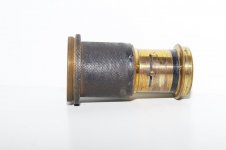
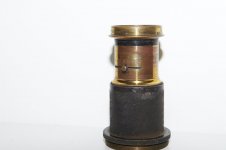
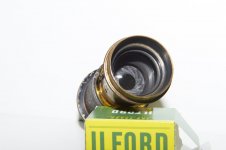

Mozziephotography
Suspended / Banned
- Messages
- 1,850
- Name
- Stephen
- Edit My Images
- Yes
Maybe have a look through these. https://www.ebay.co.uk/b/bn_7022671774


Petrochemist
Suspended / Banned
- Messages
- 1,352
- Name
- Mike
- Edit My Images
- Yes
Unlikely, projector lenses rarely have an iris.Possibly for a projector.
I think a large format lens is far more likely, especially as f64 is common in LF.
From it's appearance I suspect it;s around 100 to 130 years old. (The current f-stop scale wasn't in regular use until after 1895, but by 1925 LF lenses would usually have shutters built in)
You can get a fair estimate of it's focal length by using it to project a distant scene onto a wall or paper, the distance from lens to surface when infinity is sharp will be the focal length (I'd guess between 100 & 300mm) The diameter of the image it creates will also help identify it.
Last edited:
OP

Barney
Suspended / Banned
- Messages
- 3,043
- Name
- Wayne
- Edit My Images
- No
The lens came as part of the purchase of a 7x5 large format camera, A "Royal Ruby"
The lens does not seem to fit the front panel, the end with the knurled section painted black is 2 1/4", the brass part is 1 1/2" where it screws into the black knurled section.
Thanks for advice and information so far.
The lens does not seem to fit the front panel, the end with the knurled section painted black is 2 1/4", the brass part is 1 1/2" where it screws into the black knurled section.
Thanks for advice and information so far.

G.K.Jnr.
Suspended / Banned
- Messages
- 34,213
- Name
- George.
- Edit My Images
- No
It's almost certainly a "Long Focus" (not telephoto) lens used for an old reflex studio camera with a wind up focal plain shutter. A studio I used to work for many moons ago had one of those cameras, it only had two shutter speeds these being "Rapid" & "Extra Rapid" the difference being the size of the slit in the cloth focal plain shutter. It was an old quarter plate camera that used glass plates and of course it would not synchronise with flash etc. We would use it occasionally for snapping old period style portraits if a client wanted that sort of look, personally I loved that style of portrait. The lens we had on ours was made by "Taylor Hobson" although your sample probably is not made by that manufacturer. Hope all this helps.

- Messages
- 5,607
- Name
- Stephen
- Edit My Images
- Yes
The camera was introduced in 1902. A catalogue listing lenses for it can be found here
 apenasimagens.com
If you get a copy of "The lens collector's vade mecum" ( auto correct made THAT piece of Latin obscene!) you may be able to identify it.
Royal Ruby Triple Extension | Thornton Pickard – only images
apenasimagens.com
If you get a copy of "The lens collector's vade mecum" ( auto correct made THAT piece of Latin obscene!) you may be able to identify it.
- Messages
- 5,607
- Name
- Stephen
- Edit My Images
- Yes
Half plate and 5x7 accept the same film holders- if the camera has a standard back. I don't actually know that your Thornton Pickard takes standard holders. Just in passing, 13x18 holders also fit - I have holders in all three sizes for my 5x7 cameras.

- Messages
- 12,294
- Name
- Brian
- Edit My Images
- Yes
Well a bit off topic:- One of my hobbies is now and then shots and find the view taken with these old LF lenses is difficult to match (the same view) with a variety of 35mm lenses, and often thought if it was possible to fit and old LF lens to a 35mm camera with some sort of adapter. Mind you have no idea if a LF lens could be fitted to a 35mm camera, what the view would look like in the viewfinder.
Projector lenses don't usually have a variable diaphragmPossibly for a projector.
the_accidental
Suspended / Banned
- Messages
- 501
- Edit My Images
- No
Almost certainly, if you mean modern mirrorless. They focus/expose at working aperture automatically, and have much much shorter flange/sensor distances than anything old, so you’d just need to fabricate a spacer/adapter. Or mount the modern camera on an adapter on the back of the LF camera.have no idea if a LF lens could be fitted to a 35mm camera, what the view would look like in the viewfinder.
The view would look like whatever that focal length normally looked like. So if you have a 150mm LF lens it’ll look like… 150mm

- Messages
- 12,294
- Name
- Brian
- Edit My Images
- Yes
Oh well it wouldn't work then as say a 150mm lens on a LF camera would be wide angle and standing in the same position with 150mm lens on 35mm (for the same view) would be telescopic, and even if I moved back say 50 yards (to try for the same view) everything in the shot would be compressed (with a 150mm lens on a 35mm camera).The view would look like whatever that focal length normally looked like. So if you have a 150mm LF lens it’ll look like… 150mm
Last edited:
Petrochemist
Suspended / Banned
- Messages
- 1,352
- Name
- Mike
- Edit My Images
- Yes
The field of view will indeed be similar, but the look may differ considerably. It won't be as sharp as a modern lens instead showing more characterAlmost certainly, if you mean modern mirrorless. They focus/expose at working aperture automatically, and have much much shorter flange/sensor distances than anything old, so you’d just need to fabricate a spacer/adapter. Or mount the modern camera on an adapter on the back of the LF camera.
The view would look like whatever that focal length normally looked like. So if you have a 150mm LF lens it’ll look like… 150mm

Terrywoodenpic
Suspended / Banned
- Messages
- 8,172
- Name
- Terry
- Edit My Images
- Yes
Clearly a camera lens.
Are there any lens elements in the darker lower portion of the lens.
If not it could be an adaptor made for a specific use. You can easily measure the focal length but projecting a distance subject on to a white surface.
If you measure it to the aperture you will be near enough.
Rather unusual to have no markings at all, lenses of that obvious age were not cheap when fitted with a diaphragm aperture.
Are there any lens elements in the darker lower portion of the lens.
If not it could be an adaptor made for a specific use. You can easily measure the focal length but projecting a distance subject on to a white surface.
If you measure it to the aperture you will be near enough.
Rather unusual to have no markings at all, lenses of that obvious age were not cheap when fitted with a diaphragm aperture.
OP
Barney
Suspended / Banned
- Messages
- 3,043
- Name
- Wayne
- Edit My Images
- No
hello terryClearly a camera lens.
Are there any lens elements in the darker lower portion of the lens.
If not it could be an adaptor made for a specific use. You can easily measure the focal length but projecting a distance subject on to a white surface.
If you measure it to the aperture you will be near enough.
Rather unusual to have no markings at all, lenses of that obvious age were not cheap when fitted with a diaphragm aperture.
There are no elements in the black section which appears to be some kind of spacer,
There are two elements in the lens1 either side of the diaphragm at each end. Each lens appear to be a single piece of glass.
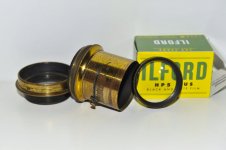
I have looked closely inside and out but cannot find any manufacturers mark.
the Fonts look like they could be distinct.
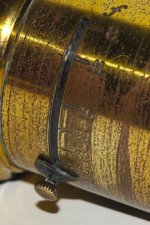
PS>
I cannot make it fit the shutter board in any configuration.
Diaphragm is 12 leaf.
Last edited:
- Messages
- 5,607
- Name
- Stephen
- Edit My Images
- Yes
So 4 elements in 4 groups, symmetrical about the diaphragm. That reduces the numbers somewhat. Now, are the elements meniscus, convex, concave? The first possibility (which the question could rule out) is a dialyte design, the Goertz Celor.
Petrochemist
Suspended / Banned
- Messages
- 1,352
- Name
- Mike
- Edit My Images
- Yes
If the two groups are similar, then it's likely they are actually bonded doublets & the lens is a rapid rectilinear. It looks right for that configuration.hello terry
There are no elements in the black section which appears to be some kind of spacer,
There are two elements in the lens1 either side of the diaphragm at each end. Each lens appear to be a single piece of glass.
View attachment 449770
I have looked closely inside and out but cannot find any manufacturers mark.
the Fonts look like they could be distinct.
View attachment 449771
PS>
I cannot make it fit the shutter board in any configuration.
Diaphragm is 12 leaf.
OP
Barney
Suspended / Banned
- Messages
- 3,043
- Name
- Wayne
- Edit My Images
- No
sorry for not expressing myself clearly enough.
A picture is worth a thousand words and all that.
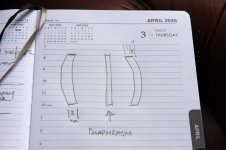
Looking closely at the edge where mounted they appear to be single pieces of glass maybe upto 4mm but not 5 or six thick.
There is a nice ground edge where mounted but cannot see a join as if two pieces of glass.
A picture is worth a thousand words and all that.
Looking closely at the edge where mounted they appear to be single pieces of glass maybe upto 4mm but not 5 or six thick.
There is a nice ground edge where mounted but cannot see a join as if two pieces of glass.
- Messages
- 5,607
- Name
- Stephen
- Edit My Images
- Yes
Based on that diagram, I'll go with rapid rectilinear as well. There are about 30 different maker's names, depending on the company. It dates from 1866 as a design, and was made for about 60 years, so quite common...
- Messages
- 12,294
- Name
- Brian
- Edit My Images
- Yes
Well I suppose if I want perfection would do what some digi guys do and use say a 50mm lens and take multiple shots of the scene, and use Photoshop and stitch them all together and crop out the bits I don't need to match the scene that was originally taken with a LF camera and lens.The field of view will indeed be similar, but the look may differ considerably. It won't be as sharp as a modern lens instead showing more character
Last edited:
Terrywoodenpic
Suspended / Banned
- Messages
- 8,172
- Name
- Terry
- Edit My Images
- Yes
sorry for not expressing myself clearly enough.
A picture is worth a thousand words and all that.
View attachment 449772
Looking closely at the edge where mounted they appear to be single pieces of glass maybe upto 4mm but not 5 or six thick.
There is a nice ground edge where mounted but cannot see a join as if two pieces of glass.
If the lenses are not cemented doublets it is a simple cheap form of rapid rectilinear lens
However it is a later lens than one might think as it has the modern aperture range 8, 11, 16, 22, 32
This did not come into general use till the 1930's
it would have been mounted on a simple roller blind , wooden, shutter to the front of the camera bellows.
The back section adapter would have been added to suit the particular camera.
Last edited:

PeterSpencer
Suspended / Banned
- Messages
- 1,661
- Name
- Peter
- Edit My Images
- Yes
Try posting the question at https://5x4.co.uk/, there is a bloke there, Ian Grant, who could very well know the answer.
OP
Barney
Suspended / Banned
- Messages
- 3,043
- Name
- Wayne
- Edit My Images
- No
Try posting the question at https://5x4.co.uk/, there is a bloke there, Ian Grant, who could very well know the answer.
Thanks for posting that link, I have tried to join.
That is not to decry the excellent help and advice I have received here in this forum and this thread.
Terrywoodenpic
Suspended / Banned
- Messages
- 8,172
- Name
- Terry
- Edit My Images
- Yes
On a rapid rectilinear you are unlikely to be able to tell that the two elements are doublets as the second element hardly shows an edge at all.
Lens Genealogy Part 1
In which I begin to answer the question "Why Do You Put the Lens Diagrams on Your Website?" Where do new lens designs come from? I knew that today's lenses are all designed using computer programs, but I was surprised to find new lenses aren't designed from scratch. Designers start with an...
www.lensrentals.com
There was a point raised early on in this topic that the owner had no information about the lens including the actual focal length. There is a way that this can be determined however I cannot recall the exact method, nor can I trace it from books or the web, but if a lens is pointed at an object at infinity from a darkened room, with the front element open to a view in daylight, and behind the lens is a screen on which to focus the view, the distance from the optical centre of the lens to the focused image should be close enough to the focal length. It will almost certainly have a small amount of error unless you can accurately place the optical centre.
PeterSpencer
Suspended / Banned
- Messages
- 1,661
- Name
- Peter
- Edit My Images
- Yes
You are right the two fora (note correct pluralThanks for posting that link, I have tried to join.
That is not to decry the excellent help and advice I have received here in this forum and this thread.
 ), 5x4 and TP, are not mutually exclusive. TP F&C has a broader spectrum of topics, for example.