

Large Format photography group - From "zero to hero!"

re Cottage in the trees. About a third of the way up from the bottom and a quarter of the way in from the right hand side is a large black dog wearing a blue transparent rain cape. Now I know that large black dogs of evil omen inhabit all our wild and lonely places (the most famous being the infamous (is that a phrasal oxymoron?) hound of the Baskervilles) :D but what actually is this mystery object?
 
re Cottage in the trees. About a third of the way up from the bottom and a quarter of the way in from the right hand side is a large black dog wearing a blue transparent rain cape. Now I know that large black dogs of evil omen inhabit all our wild and lonely places (the most famous being the infamous (is that a phrasal oxymoron?) hound of the Baskervilles) :D but what actually is this mystery object?

It is as you suggest Stephen, a hound of evil omen wearing waterproofs. It is the Lake District after all, renowned for its rain, later that day I spotted a cat of terrible portent wearing a cagoule and a vole (I failed to establish its intent vis-à-vis the future) under a tiny umbrella. :)

Actually it is a small bit of wet road which loops up hill and round the large tree.

Andy
 
Shane, I may be the man you seek. :D Cant do anything this weekend but we can organise a meet up if you want to have a play with lf. I am by no means an expert but i'm happy to give you the benefit of my very limited experience.

Andy


Hi Andy,

That's great - many thanks :)

I can do whenever, just let me know when it suits you.

Much appreciated.

Ta,
Shane :)
 
Despite the fact that if I had one, I'd never really use it on account of having a couple of 5x4 cameras already, I really do admire those guys and the camera they've created. I almost want to buy one just to support them!

Also, I'm not sure why I didn't comment on this near the time that @ChrisR posted it up, but there we are :D
 
I noticed on the Intrepid Facebook page yesterday that they're working on an 8x10 camera now built in the same way as their 4x5.
 
An 8x10 you say...? ORLY.

I should check whether any of my lenses can project a large enough image circle :D Though, thinking about it, I don't have: any 8x10 film holders, 8x10 film, a dev tank large enough, a scanner capable of scanning 8x10 frames, or space in my camera bag. In the space of about 30 seconds, this went from an "ooo, I could affordably get into 8x10", to "damn" :(
 
An 8x10 you say...? ORLY.

I should check whether any of my lenses can project a large enough image circle :D Though, thinking about it, I don't have: any 8x10 film holders, 8x10 film, a dev tank large enough, a scanner capable of scanning 8x10 frames, or space in my camera bag. In the space of about 30 seconds, this went from an "ooo, I could affordably get into 8x10", to "damn" :(
Go for it and get yourself an 8X10 that will be totally unusable due to lack of accesories but just think how much drooling you could do over it:D:D
 
An 8x10 you say...? ORLY.

I should check whether any of my lenses can project a large enough image circle :D Though, thinking about it, I don't have: any 8x10 film holders, 8x10 film, a dev tank large enough, a scanner capable of scanning 8x10 frames, or space in my camera bag. In the space of about 30 seconds, this went from an "ooo, I could affordably get into 8x10", to "damn" :(

The only one of your objections that's significant is the scanner, and you could trade in your current scanner against that, or perhaps get scans done with processing?

On second thoughts a box of 8*10 film might perhaps cost more than a scanner???
 
A box of 20 sheets of Velvia 50 in 10x8 from Japan is about £370 + VAT + delivery. :(

Flippin 'eck :runaway:......I'd prefer to stay with 4X5 and put that amount of money into another lens tbh

Does the processing cost for 10 x 8 increase massively too?
 
Well, for Peak, 1 frame of E6 or C41 goes from £3.20 per frame to £4.70. So while not a *massive* increase, you'd still feel it in the wallet.
 
It's a long time ago that I purchased some " whole plate" sized sheet film from Ilford. In fact I don't know how long it has been ood tbh,..... years without a doubt!

I can't recall the exact size but looking at the camera (Marion tailboard from c.1888) as I type it won,t be much different from 10 x 8

The film, FP4, was not cheap, about 80 quid iirc, the only consolation being that I develoedp it myself by making a taco and placing it inside a large Patterson tank. thus there no additional lab fees

Worked out just fine for the handful of frames that I've shot.

The bummer is as mentioned already, the scanning......stitching files was the only sensible financial option as the labs wanted £20 upwards to scan one neg and save it to a usb key
 
An 8x10 you say...? ORLY.

I should check whether any of my lenses can project a large enough image circle :D Though, thinking about it, I don't have: any 8x10 film holders, 8x10 film, a dev tank large enough, a scanner capable of scanning 8x10 frames, or space in my camera bag. In the space of about 30 seconds, this went from an "ooo, I could affordably get into 8x10", to "damn" :(

Well, currently you have 0 out of 5 necessary items to shoot 8x10, but if you buy an intrepid camera then you're 20% of the way there! :D

I'd be tempted to get one just to shoot 8x10 paper, then develop, scan and invert it. Won't get the full quality obviously, but imagine the fun you could have with those 8x10 movements and teeny tiny DOF!
 
Well, currently you have 0 out of 5 necessary items to shoot 8x10, but if you buy an intrepid camera then you're 20% of the way there! :D

I'd be tempted to get one just to shoot 8x10 paper, then develop, scan and invert it. Won't get the full quality obviously, but imagine the fun you could have with those 8x10 movements and teeny tiny DOF!

20% is better than 0% for sure in this instance :D

I've been giving this some more thought and I really like the idea of shooting direct positive paper and framing the results. This wins on two fronts, in that the cost per frame to buy in the first place is reduced, and a new scanner capable of 10x8 is no longer required. The issue then becomes a lack of dark room / dev tank large enough and I still need to check if any of my lenses would even cover 10x8.

A more general question about direct positive paper - Would I be correct in assuming that this paper is red sensitive and hence needs to be developed in total darkness rather than under safe light?
 
20% is better than 0% for sure in this instance :D

I've been giving this some more thought and I really like the idea of shooting direct positive paper and framing the results. This wins on two fronts, in that the cost per frame to buy in the first place is reduced, and a new scanner capable of 10x8 is no longer required. The issue then becomes a lack of dark room / dev tank large enough and I still need to check if any of my lenses would even cover 10x8.

A more general question about direct positive paper - Would I be correct in assuming that this paper is red sensitive and hence needs to be developed in total darkness rather than under safe light?

I like your thinking there @Woodsy Don't let mere details and facts get in the way of buying some new gear. You're a credit to the F&C section ;0)
 
I think it was Richard Branson that said "If somebody offers you an amazing opportunity but you are not sure you can do it, say yes then learn how to do it later"

In F&C we've modified it a bit to "If you have the opportunity to buy a camera you don't have a need for, say yes and then find a need for it later"
 
I like your thinking there @Woodsy Don't let mere details and facts get in the way of buying some new gear. You're a credit to the F&C section ;0)

I think it was Richard Branson that said "If somebody offers you an amazing opportunity but you are not sure you can do it, say yes then learn how to do it later"

In F&C we've modified it a bit to "If you have the opportunity to buy a camera you don't have a need for, say yes and then find a need for it later"

...and? :D :D
 
http://www.ilfordphoto.com/Webfiles/2015631218381820.pdf

Bah.

*Must. Resist. Powerful urge to rant about how utterly useless that spectral sensitivity plot is*

You scientists and your need for accuracy :p It clearly shows that at some point between 550 and 570, the relative sensitivity of the film is an unknown amount higher than at somewhere around about 450. What more could you need to know? :D
 
You scientists and your need for accuracy :p It clearly shows that at some point between 550 and 570, the relative sensitivity of the film is an unknown amount higher than at somewhere around about 450. What more could you need to know? :D

Units? We don't need no stinkin' units!
 
20% is better than 0% for sure in this instance :D

I've been giving this some more thought and I really like the idea of shooting direct positive paper and framing the results. This wins on two fronts, in that the cost per frame to buy in the first place is reduced, and a new scanner capable of 10x8 is no longer required. The issue then becomes a lack of dark room / dev tank large enough and I still need to check if any of my lenses would even cover 10x8.

A more general question about direct positive paper - Would I be correct in assuming that this paper is red sensitive and hence needs to be developed in total darkness rather than under safe light?

Harman direct positive paper is ortho, for better or worse, and can be developed under a red safelight. I don't know if the standard brownish Ilford safelight I use for normal papers is safe, but I have an Ilford ortho one as well - bought from Arundel Photographica :D

On lenses, if you have modern lenses you may have more of a problem, as they tend to have well defined image circles. Older lenses were more forgiving. In his book on using old lenses, Paul Lippscombe shows a photo taken on 10x8 using a Schneider Symmar (plain Symmar not the modern versions) lens that won't officially cover the format; stopped right down, the vignetting at the corners could be seen, but was slight enough to be acceptable for many people.

You could always try to source one of the Paterson drums or orbital processors made to develop colour prints and use that as a daylight developing tank.

All problems have a solution if you look hard enough.

I quite fancy the Intredip 10x8 as well. The 5x4 looked magnificent with red bellows when I saw one in Hove (where they were made until recently when the production moved out of town into Brighton).
 
Went out to take a photo of an old derelict petrol station the other day, but it was p***ing down with rain. Ended up setting the camera up in the back of the van and pointing the lens out the side window. Best bit was that if you have the curtains shut it's dark enough inside that you don't need a dark cloth :D The photo turned out totally crap, but it was an interesting experiment anyway!
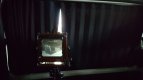
IMG_20170201_5279.jpg
 
OK so long exposures. I'm just reading g through Edward Westons daybook and he says he was shooting his peppers with 5 hour exposures! Apart from the mind boggling on his lighting setup which meant he needed a 5 hour exposure in the first place, is there actually any benefit to exposures of that length. I havnt found any mention yet of why he would do that.
 
Went out to take a photo of an old derelict petrol station the other day, but it was p***ing down with rain. Ended up setting the camera up in the back of the van and pointing the lens out the side window. Best bit was that if you have the curtains shut it's dark enough inside that you don't need a dark cloth :D The photo turned out totally crap, but it was an interesting experiment anyway!

Did you by any chance notice that all the passing traffic started driving at 1 MPH below the relevant speed limit shortly after you set the camera up? :whistle:
 
OK so long exposures. I'm just reading g through Edward Westons daybook and he says he was shooting his peppers with 5 hour exposures! Apart from the mind boggling on his lighting setup which meant he needed a 5 hour exposure in the first place, is there actually any benefit to exposures of that length. I havnt found any mention yet of why he would do that.

I've no knowledge at all of why he actually did it... but I guess film in those days was much lower ISO for fine-grained film, and may have had much wore reciprocity failure characteristics. Small aperture to get depth of field...
 
Went out to take a photo of an old derelict petrol station the other day, but it was p***ing down with rain. Ended up setting the camera up in the back of the van and pointing the lens out the side window. Best bit was that if you have the curtains shut it's dark enough inside that you don't need a dark cloth :D The photo turned out totally crap, but it was an interesting experiment anyway!

View attachment 95032

To me Carl,it is easily explained why the shot was carp,you had the camera upside down.:)
 
OK so long exposures. I'm just reading g through Edward Westons daybook and he says he was shooting his peppers with 5 hour exposures! Apart from the mind boggling on his lighting setup which meant he needed a 5 hour exposure in the first place, is there actually any benefit to exposures of that length. I havnt found any mention yet of why he would do that.

Indoors, very small aperture. The objective was to get everything as sharp as possible, which with a 10x8 camera means very small apertures. The standard focal length is 300mm which isn't noted for havinf great depth of field! The disadvantage of small apertures is that diffraction begins to become noticeable, and even though Edward Weston contact printed, one author I read who has seen some of the actual prints remarked that unsharpness due to diffraction was evident.

Where I'm sitting at the moment (and it is sunny outside) without the light on my meter (Lunasix) reads 11 on its scale, which translates to about 6 minutes at f/64 with 100 ISO film. Drop that to 25 ISO and it's 15 minutes. Reduce the light, or move further back in the room and the time would increase. I have a vague recollection that some of his photos were at even smaller stops. In any case, an exposure time in hours is quite feasible.

I recall that he kept people out of the room to avoid disturbing the pepper(s).
 
Last edited:
So I'm feeling the urge for a 10x8 mainly for internal shoots as I don't see me walking the hills with one on my shoulder. Anyone with one of the big boys, where do you source sensibly priced film from.
 
So I'm feeling the urge for a 10x8 mainly for internal shoots as I don't see me walking the hills with one on my shoulder. Anyone with one of the big boys, where do you source sensibly priced film from.

I suspect that there is no such thing as sensibly priced 10 x 8 film, which is the main reason I will be sticking to the still expensive but not crazily expensive 5 x 4. :)
 
I I will be sticking to the still expensive but not crazily expensive 5 x 4.

.......until I wish to try 10 x 8, at which point I will have mastered how to glue four sheets of 5x4 together without seams:D
 
The bummer, no doubt, as pointed out already is that I doubt there is any sensibly priced film for 10x8. Unless you mean proportionally more expensive than 5x4? It might be worth looking on places like the bay for OOD stock. Alternatively, you could perhaps look into shooting paper instead? This is no doubt a hell of a lot cheaper, and can indeed be scanned a fair bit more easily as well.

So, just having a look, you can get 20 sheets of Acros 100 in 10x8 format from Japan for £166.75 + del + import etc. Or from Maco Direct, the same thing for E249.00

Likewise, from Maco, 25 sheets of delta 100, E169.00, or some Foma Retropan 320, 50 sheets for E148, Fomapan 400, 50 sheets for E129. This last one is probably the best £/sheet ratio out there when bought new.


Personally, I've had the urge to go 10x8 before now, and I think if I ever do you down that route, I'll opt to shoot paper instead of film on account of not having to get either a new scanner or have each one scanned by a specialist. Indeed, the fact that most papers have an incredibly low ISO as compared with film is quite attractive for me as a landscape photographer. I suppose if the interior photos you intend to make do not involve any form of live subject, exposure time is less of a concern for you also?
 
Last edited:
The bummer, no doubt, as pointed out already is that I doubt there is any sensibly priced film for 10x8. Unless you mean proportionally more expensive than 5x4? It might be worth looking on places like the bay for OOD stock. Alternatively, you could perhaps look into shooting paper instead? This is no doubt a hell of a lot cheaper, and can indeed be scanned a fair bit more easily as well.

So, just having a look, you can get 20 sheets of Acros 100 in 10x8 format from Japan for £166.75 + del + import etc. Or from Maco Direct, the same thing for E249.00

Likewise, from Maco, 25 sheets of delta 100, E169.00, or some Foma Retropan 320, 50 sheets for E148, Fomapan 400, 50 sheets for E129. This last one is probably the best £/sheet ratio out there when bought new.


Personally, I've had the urge to go 10x8 before now, and I think if I ever do you down that route, I'll opt to shoot paper instead of film on account of not having to get either a new scanner or have each one scanned by a specialist. Indeed, the fact that most papers have an incredibly low ISO as compared with film is quite attractive for me as a landscape photographer. I suppose if the interior photos you intend to make do not involve any form of live subject, exposure time is less of a concern for you also?

Ive been thinking about trying to shoot some 5 x 4 paper. What kind of quality do you get image wise compared to film?
 
well i did see fomapan at £98 per 50 sheets earlier which isnt too bad. Colour would be far too expensive. The only other worry is developing the stuff, i dont have tanks that big so would probably have to go to tray development. The papaer idea sounds fun though, i will do some googling as ive never used paper to shoot on before!
 
Back
Top