

Large Format photography group - From "zero to hero!"

I'm in the process of starting a new project at the moment. having seen a Polaroid 110A for a good price I was originally going to graft on a polaroid 100 back so I could use Fuji FP100C in it. However, looking at some of the other conversaions already done it looks pretty bulky. As a result, I've started looking at 4x5 conversions instead but trying to find a Graflex back for reasonable money is a challenge!

I'm never one to give up on a plan though and have seen these conversaions instead where the DDS is mounted directly to the body using clips so, as well as saving loads of weight/depth, it's also condiserably cheaper to make.
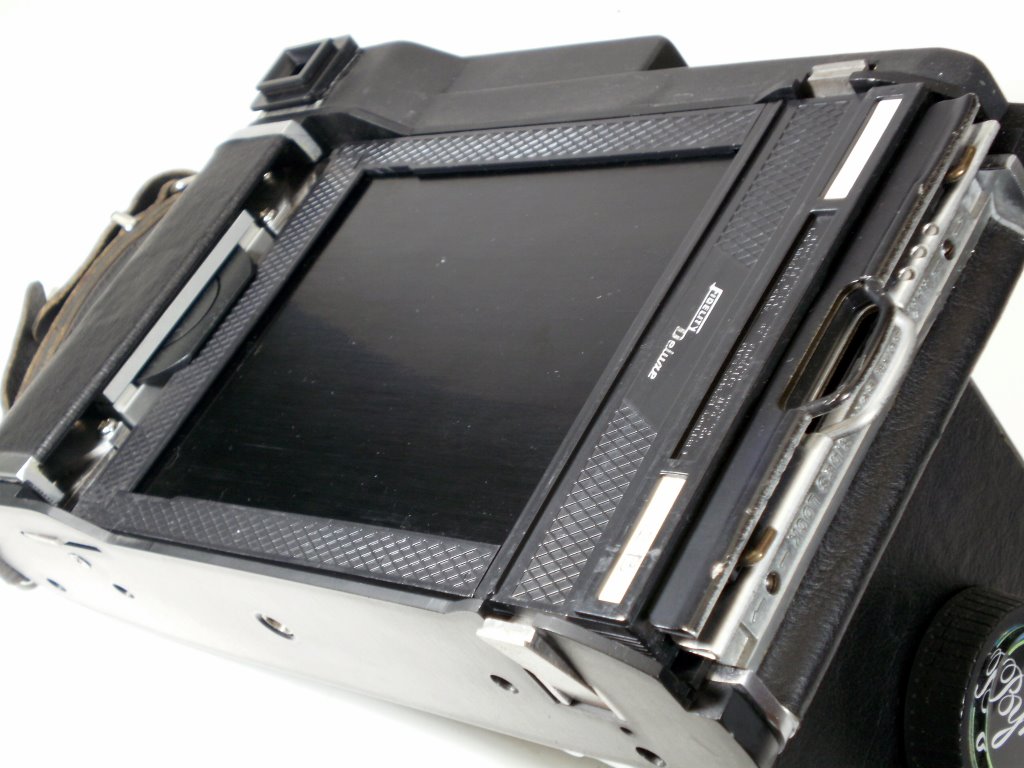
P2131294.JPG


I'll probably use a similar clipped setup as this and make an acrylic ground 'glass' screen which can be locked into the same clips for framing/focussing then just swap it for the DDS to shoot. I was originally planning to hinge the ground glass but this will be much simpler to machine. I should have the 110A in the post today so I'll start measuring up :0)
 
MPP MkVII 5x4 Field Camera
I've been looking at these recently, I rather like the look of them, seem to fold down nicely and have a reasonable range of movements for a reasonable price.
Anyone used one, got any thoughts about them?

Andy

looking at the descriptions of these on ebay, they dont seem to mention a tilt, just shift and swing. There doesnt seem to be an obvious pivot point either. So if thats the case then i wouldnt bother. You need the tilt to get the front to back focus right.

According to this they've got some tilt, not much but likely enough for landscapes. Looks like you put the camera on its side and use what would be swing.
 
Tilt can be used to give greater DOF if you're wanting the ground in focus as well as the skyline; switch to architecture from landscape and you may need the near and far parts of a wall to the side in focus - that's when swing will help. From memory, either Canon or Nikon made (makes?) a tilt/shift lens that only works for either tilt or swing, requiring a workshop modification to convert from one to the other. I always put that down to the assumption that people either photographed landscapes or architecture, but never both.
 
I think I need to be patient. I really want a Shen Hao or similar but I want it now and I don't have the money so I keep looking at cheaper ways of doing it... Patience, that's the keyword here.
 
looking at the descriptions of these on ebay, they dont seem to mention a tilt, just shift and swing. There doesnt seem to be an obvious pivot point either. So if thats the case then i wouldnt bother. You need the tilt to get the front to back focus right.

You could turn it on its side and use the swing for tilt.
 
You can also use rear tilt on most of them I believe, they have little tightening knobs that allow you to move the rear standard independently on all 4 corners. It makes it hard not to introduce a very tiny smidge of swing as well, but in reality it does the job no problems, it's what I used to do with mine more often than flip it on it's side
 
Due to an unexpected turn of events I should be in possession of an MPP Mk vii in the near future. :banana:

Now, talk to me of lens panels... What are the different sizes all about, do I need many different sizes, do different cameras have different types and many more things I haven't yet thought of? (y)
 
A lens panel has two variants - its physical size and the size of the hole in it. Different cameras use different size panels, but there are more camera than panel sizes! For example, my Wista and Walker both take the same panel; my Canham needs a different size. The size of the hole you need depends on the lens, or more precisely the shutter in the lens. It's easy to swap a lens from one panel to another if you need to - just a little matter of unsrewing and rescrewing.
 
A lens panel has two variants - its physical size and the size of the hole in it. Different cameras use different size panels, but there are more camera than panel sizes! For example, my Wista and Walker both take the same panel; my Canham needs a different size. The size of the hole you need depends on the lens, or more precisely the shutter in the lens. It's easy to swap a lens from one panel to another if you need to - just a little matter of unsrewing and rescrewing.

So, for example, a Copal 0 lens panel would fit a Copal 0 shuttered lens but only if it is for your specific camera?
 
So, for example, a Copal 0 lens panel would fit a Copal 0 shuttered lens but only if it is for your specific camera?

Yes. I ended up making an adaptor from my very bulky 171mm lens boards to the defacto standard wista style which are much smaller and cheaper.
 
I'm after some help from the LF experts please :0). I'm putting together the ground glass for my Polaroid 110 and wondering if anyone's used Acrylic rather than glass to make their own? I've read a few different articles suggesting acrylic works almost as well as glass but real world feedback would be better.

Cheers
 
So, for example, a Copal 0 lens panel would fit a Copal 0 shuttered lens but only if it is for your specific camera?

Exactly that.

I'm after some help from the LF experts please :0). I'm putting together the ground glass for my Polaroid 110 and wondering if anyone's used Acrylic rather than glass to make their own? I've read a few different articles suggesting acrylic works almost as well as glass but real world feedback would be better.

Cheers

Acrylic probably has better mechanical properties than glass in terms of shatter resistance, etc, but I've no idea whether there is any advantage optically. Certainly lighter (weight).
 
Last edited:
I've got an acrlyic GG is much lighter and brighter than my glass GG but my glass GG is original and ancient.
 
Thanks guys. As I need to buy/build a GG anyway I might try acrylic first. Worst case I lose a few ££ versus £15-£20 for a glass screen.

Cheers
Steve
 
OK, next question.

What film should I buy for trial porpoises? I'm thinking Fomapan 200, £35 for 50 sheets from Silverprint?
 
Allright smart*rse, I didn't see that for some reason. :banghead:
 
How are you going to process the film?
 
How are you going to process the film?

Carefully.

Actually that leads us on to the next question(s). How am I going to develop the film? I'm assuming that the normal Patterson tanks won't be suitable, do I need a Mod 54 (is that correct?) Do these fit into a Patterson tank?
 
... do I need a Mod 54 (is that correct?) Do these fit into a Patterson tank?

Probably the simplest solution and yes. You can buy a Mod 54 with a suitable tank, otherwise you need one that'll hold 3 standard reels if you only buy the holder.
 
I tend to use the incredibly high tech solution that is the elastic band. If the sheet is curled up so that as a column it is 4" tall, not 5", you can fit 4 around the light sealing column in the dev tank easily, 5 at a push. Just make sure to rinse quick vigorously before developing to remove the anti-halation layer, and make doubly sure the emulsion layer is on the inside of the roll. Also, be sure to use elastic bands of such a circumference that the edges of the film do not fully meet otherwise you risk scratching the emulsion off.
 
Last edited:
Probably the simplest solution and yes. You can buy a Mod 54 with a suitable tank, otherwise you need one that'll hold 3 standard reels if you only buy the holder.

I have the bigger tank that holds 3 reels so I just need the insert. Ta.

I tend to use the incredibly high tech solution that is the elastic band. If the sheet is curled up so that as a column it is 4" tall, not 5", you can fit 4 around the light sealing column in the dev tank easily, 5 at a push. Just make sure to rinse quick vigorously before developing to remove the anti-halation layer, and make doubly sure the emulsion layer is on the inside of the roll. Also, be sure to use elastic bands of such a circumference that the edges of the film do not fully meet otherwise you risk scratching the emulsion off.

This might be how I start off and we'll see how she goes. Do you rinse with tap water or does it need to be the temp of the chemicals?
 
I tried the method woodsy described but I'm too cack handed a small scratched the negatives. I've got a jobo tank and 2509n reel which I'm still getting the hang of. The up shot of the jobo is very low chemical volume requirements.
 
I tried the method woodsy described but I'm too cack handed a small scratched the negatives. I've got a jobo tank and 2509n reel which I'm still getting the hang of. The up shot of the jobo is very low chemical volume requirements.

Cor blimey 'eck, that's expensive. Mind you so's the Mod 54 gubbins.
 
Carefully.

Actually that leads us on to the next question(s). How am I going to develop the film? I'm assuming that the normal Patterson tanks won't be suitable, do I need a Mod 54 (is that correct?) Do these fit into a Patterson tank?

Taco!

As Woodsy suggests.

Ensure the emulsion side is on the inside when you "fold" the film over and put the elastic band over the non emulsion side, drop it in your patterson tank ...you can actually fit four at a time.

Occasionally the band may come adrift during development and you may find the sheet unfolded when you open the tank but it never caused me a problem with 4x5, quarter, half or even whole plate sheet film.....the film was alwayss devd correctly ....tbh the band probably came adrift in the latter stages of the process such as during rinse.

The only hiccup i came across a couple of times was the dye from the band etched onto the film a couple of times ( stupid to use coloured bands i guess!) but even that with gentle rubbing with a finger and water came away with no damage to the film.

Since then, I've purchased one of those 54 thingies which are pretty cool but the taco works equally well and if i shoot any sheet other the 4x5 then taco it has to be!
 
And another nube question.

I currently have a V500 and as I'm sure we all know it won't scan 5x4 in one pass. So, do I stick with and stitch them in PP or sell it and get one that will. I don't think I can stretch to a V700 etc but the older 4870 does 5x4. Has anyone got one/used one have an opinion on one?

Cheers
 
I've been making do with a V500 and stitching with MS ICE tool but I'm currently trying to work out if I can convince it to accept a large LED panel instead of its narrow cfd as the top light source.
 
I've been making do with a V500 and stitching with MS ICE tool but I'm currently trying to work out if I can convince it to accept a large LED panel instead of its narrow cfd as the top light source.

Interesting, I shall await the results like an expectant father.
 
And another nube question.

I currently have a V500 and as I'm sure we all know it won't scan 5x4 in one pass. So, do I stick with and stitch them in PP or sell it and get one that will. I don't think I can stretch to a V700 etc but the older 4870 does 5x4. Has anyone got one/used one have an opinion on one?

Cheers

I've used Epson flatbeds for scanning 5x4 for years. I think I started with a 3200 or something like that. Certainly the model before the 4xxx I replaced it with. I was satisfied that they were fine for me, and moved up more to get the best I could than because I was hitting a limit. I must have some scans from earlier Epsons if you'd like me to try and find them.
 
I've used Epson flatbeds for scanning 5x4 for years. I think I started with a 3200 or something like that. Certainly the model before the 4xxx I replaced it with. I was satisfied that they were fine for me, and moved up more to get the best I could than because I was hitting a limit. I must have some scans from earlier Epsons if you'd like me to try and find them.

If you could Stephen that would be very helpful. I've been looking at a few reviews of the 4870 with some examples of scans and it does look to be of a similar quality to the V500.
 
Try here.

The scan date is 7th Sept 2007; I just looked at the pdf info file on the Epson 4490 and that had a copyright date of 2007. It would seem likely that that was the scanner used for this scan. I was trying different scanning resolutions at the time, and as each scan took four hours (Windows 2000, 512 kb (or do I mean mb?) RAM) I trended to do a lot of one offs. This scan is 229,954kB; I have others from around the same date that are one quarter that size, so my best guess is that this one is maximum scan size.

I chose it for the size and the level of fine detail that should give some idea of what I could achieve. The software used was probably VueScan.

I'm just adding a scan from the Plustek 120 scanner of a 6x7 colour negative. Obviously, you can ignore this one!
 
Last edited:
Still a picture of a black cat in a coal cellar for me :(
 
Still a picture of a black cat in a coal cellar for me :(

Was that referring to my post? Apologies for being self centred if it wasn't :)
 
Was that referring to my post? Apologies for being self centred if it wasn't :)
Yes Steve, I can't see anything the page just comes up blank, even if I click on the slideshow option it just shows me black.
 
Does this work? Two of the files won't show a thumbnail as they are too large and you'll have to download them.

It seemed to work for me - I agree about the severe underexposure first time :D

I've edited the first post to agree with this one now.
 
Last edited:
Back
Top