Large Format Macro exposure query

AshleyC

Suspended / Banned
Messages
2,956
Name
...
Edit My Images
No
I wanted to do some macro shots with my 5x4 but was reading somewhere or other that by extending the bellows quite a way you have to compensate with the exposure due to lack of light getting back to the film? Just seemed a bit odd, light is light after all and its not going to get dimmer just because it has to travel an extra 20 cms down a bellows, so if anyone has done some before is this true and if so how much did you have to adjust exposures by?
 
its probably true, as your using less of the image circle, so its light intensity drops?
 
Actually it makes a huge difference. Just like anything that originates from a point source (light from a lens is not far from this, effectively) and spreads out spherically, the intensity as a function of distance falls as one over the square of the distance. I.E, the inverse square law. As such, you need to compensate for the fall in intensity by increasing the exposure time.

You can work this out simply. With the camera focused at infinity, measure the distance from the focal plane of the lens to the film plane - This will be the focal length of the lens. Call this D1. Then, with your macro shot composed and focused (which we shall assume in this case requires the extension of the lens past the infinity focus distance) measure the distance between the same points on the camera and lens again and call this D2. Now, the exposure compensation FACTOR, F, is (D2/D1)^2. You must keep the units the same otherwise it wont work. Best to work in mm. The final exposure is simply the metered reading times this factor. Obviously, be sure to meter the subject from as near to the camera position as possible.

A few quick examples show the validty:

D1=D2, then (D2/D1) = 1, -> 1^2 = 1, and hence no compensation.
D1=150mm, D2=200mm ie, a 50mm extension past infinity, F= 1.77 x Metered reading.
D1=150mm, D2=300mm, (300/150)^2 = (2)^2 F= 4 x metered reading. And hence the inverse square nature of it is revealed. :)

Be careful to only apply this to the exposure time - unless you know how to convert to stops - as non-integer numbers squared give awkward values in terms of aperture stops. In other words, for F=2,4,8, opening the aperture by 1,2,3 stops respectively is an adequate compensation, but F=1.77? This can be accomplished using logs or natural logs if you so desire. Obviously this will affect your DoF. Remember also to take into account reciprocity if the exposure time extends too far.

HTH!

 
Last edited:
So Woodsy, what you are saying is....blah de blah x blurg = waffle and pish. Have I understood correctly? :D
 
Andy can do science too!
 
Yep, I'm a geek I am....:geek:
 
i used to do this for fun you know! whats all this number thing?

Soooo using my 90mm lens with the camera extended out to 300mm means

300 / 90 = 3.333

so 3.333 ^ 2 = 11.111, call it 11

so that would be how many stops more exposure?
 
If that's 11 times the exposure, and 1 stop is twice the exposure, then we have 2, 4, 8, 16... so roughly 3 1/2 stops? Does that make sense?
 
yeah sounds feasable :) i'll find out tomorrow! Thanks for the replies :)
 
Soooo using my 90mm lens with the camera extended out to 300mm means

Would that be a super Angulon alike ?

Ordinary large format taking lenses are not corrected for macro use and the wide angles can be particularilly disapointing it really is a much better bet to try a dedicated macro lens or a process lens you will often be told they are only for flat field objects but they do ok on three dimentional ones.

I did occassionally try a Super Anulon for close ups and was always disapointed with the results.

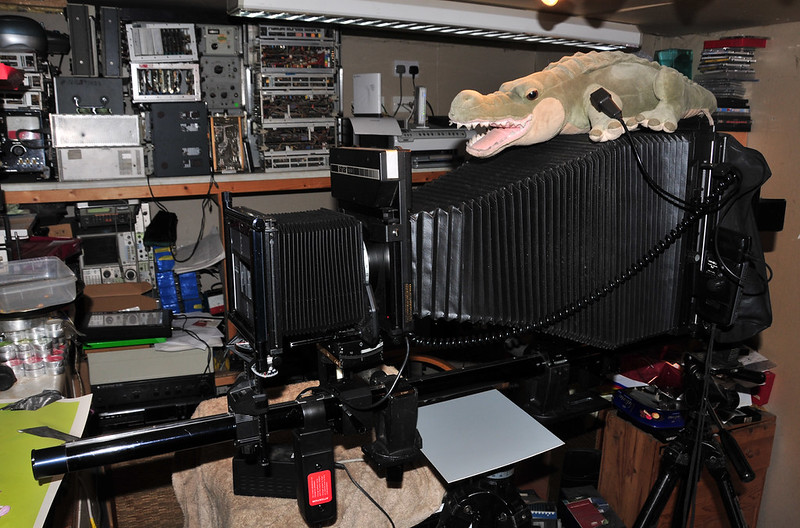
Macro on large format is always a bit of a challange, which camera do you have ? The Sinar system certainly has lots of advantages for macro working the film plane netering set ups allow you to ignore all the complications of bellows and filters factors and just take readings.

8024258985_6f9edc5b5e_c.jpg
 
yeah its a 90mm super angulon. Ive got a 150 but the focus distance is still around a meter with that so no good at all, the 90 lets me focus on something pretty close so thats all i got. Im not too bothered what it will look like, im just curious :)
 
Last edited:
Back
Top