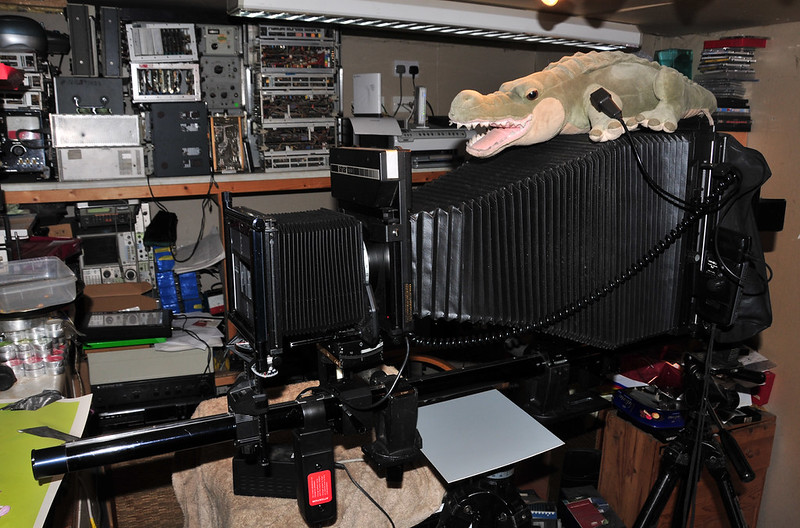
Actually it makes a huge difference. Just like anything that originates from a point source (light from a lens is not far from this, effectively) and spreads out spherically, the intensity as a function of distance falls as one over the square of the distance. I.E, the inverse square law. As such, you need to compensate for the fall in intensity by increasing the exposure time.
You can work this out simply. With the camera focused at infinity, measure the distance from the focal plane of the lens to the film plane - This will be the focal length of the lens. Call this D1. Then, with your macro shot composed and focused (which we shall assume in this case requires the extension of the lens past the infinity focus distance) measure the distance between the same points on the camera and lens again and call this D2. Now, the exposure compensation FACTOR, F, is (D2/D1)^2. You must keep the units the same otherwise it wont work. Best to work in mm. The final exposure is simply the metered reading times this factor. Obviously, be sure to meter the subject from as near to the camera position as possible.
A few quick examples show the validty:
D1=D2, then (D2/D1) = 1, -> 1^2 = 1, and hence no compensation.
D1=150mm, D2=200mm ie, a 50mm extension past infinity, F= 1.77 x Metered reading.
D1=150mm, D2=300mm, (300/150)^2 = (2)^2 F= 4 x metered reading. And hence the inverse square nature of it is revealed.

Be careful to only apply this to the exposure time - unless you know how to convert to stops - as non-integer numbers squared give awkward values in terms of aperture stops. In other words, for F=2,4,8, opening the aperture by 1,2,3 stops respectively is an adequate compensation, but F=1.77? This can be accomplished using logs or natural logs if you so desire. Obviously this will affect your DoF. Remember also to take into account reciprocity if the exposure time extends too far.
HTH!