Large Format Lens For.... ...A Fiver

Nomad Z

Suspended / Banned
Messages
549
Edit My Images
Yes
A few years ago, I fancied a roll film folder to mess about with, trawled eBay, and picked up a 6x9 Adox for 5 quid. When it arrived, it was clear that it wasn't in the best of condition - part of the frame gubbins that extends the lens when it's opened was irretrievably damaged. I went a-trawling again, and found a much nicer one for a bit more, and decided that I'll pull the duffer apart and use the body and transport as the basis for a pinhole camera (which hasn't happened yet), and the lens got stuck in a drawer.

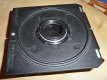
I've recently been musing on the possibility of making a large format wooden sliding box camera of some sort, and was thinking about a possible lens, when I found the lens from the Adox in the drawer, having completely forgotten about it. After a bit of fiddling with a small torch a bit of paper, I reckoned it might have coverage for 5x4, so I measured the diameter of the mounting thread at the back to see what size of hole I'd have to cut in the lens board. I found that it was just under 35mm, which was good because I could cut a 35mm hole with a forstner bit. Then I wondered if it might fit the Shen Hao, so I went looking at Copal sizes, and found that the Adox lens just happens to fit a Copal No0 hole (34.6mm). I just happened to have a spare lens board...
Adox Lens 01.jpg

Having determine that it fitted okay, I gave it a bit of a clean and judiciously applied a drop or two of oil on bits that looked like they might need it (the glass was grubby, and the slow speeds were a bit sluggish). I stuck it back onto the board and mounted it to the camera...

Adox Lens 02.jpg

The lever at the bottom triggers the shutter (it was pushed by another bit of metal in the original camera), and the red thing at the top-right is for the self timer. As you can see, it can take a cable release, which makes this workable because it doesn't have a T setting, but does have B. It also has a decent range of shutter speeds, from 1s to 1/250, and goes from f4.5 to f22...

Adox Lens 03.jpg

The silver bit sticking out at the left is he lever for cocking the shutter, and the bit at the top is for flash sync (which I'm not interested in). The aperture adjustment is on the left side of the barrel viewed from this direction (ie, it's on the right when standing behind the camera).

The lens is a Steinheil Cassar, which I know nothing about, other than it's f4.5, 105mm. It was originally focussed by turning the dial in the middle of the lens, and this moves the front element/group in and out. On the 5x4, the plan is to keep it set to infinity and use unitary focussing via the camera. Some initial peeking through it suggests it will focus fine on nearer subjects, although I can't say yet how things will be towards the edges and corners.

Usage is pretty much the same as normal large format lenses, except that you set it to B and use a locking cable release to keep the lens open while composing and focussing. Then release, re-cock the shutter, and set the desired speed and aperture ready for the shot.

No pictures yet, but I hope to give it a try at the weekend.
 
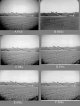
Here's some shots to indicate the coverage, using a little LED lamp...

Centre
Adox Lens Coverage Centre.jpg

Bottom Left
Adox Lens Coverage Btm Left.jpg

Top Right
Adox Lens Coverage Top Right.jpg

What I don't know yet is how much it will vignette. I suspect there may be a little bit of masking right at the corners, although it shouldn't be too bad. What I'm hoping is that it will smoothly vignette, vintage style, and maybe soften a bit as well. The centre certainly seemed to focus quite sharp on venetian blinds, and rotating the camera around on the tripod without changing the focus setting left me feeling that things softened towards the edges.
 
Last edited:
Thats an excellent use of an old lens. I look forward to seeing the results so I can nick the idea if it works. :D
 
It just struck me that I might not have had it focussed on infinity when I tried the test with the lamp, which would mean that the projected image circle was larger. I just tried it again, focussed on some distant lights through the window, and it still looks like it will just about work - maybe a few mm of radius lost at the extreme corners. Both tests were with the lens wide open, incidentally.

Feel free to nick the idea (I didn't post about it here to keep it secret :) ). I'm pretty confident it will work just fine - lens handling and focussing all look good. The only thing to watch out for if giving it a try is image circle if you want more-or-less full frame coverage. I don't know if the old folders deliberately had a bigger circle to get reduced vignetting in the desired frame size, or maybe whether the lenses were a design throwback to larger formats like quarter plate. If not, there could be an element of uncertainty with that.
 
I've been searching in vain for any definitive information on the lens; the best I could find is here. I'm now wondering whether a better starting point for my searching might be the camera is was attached to IFF it came out in a year for which I have a BJP Almanac.
 
I suddenly remembered that it can be a heck of a lot simpler to just stand up and reach for a book than search the internet; and the book that stands out in my mind as having the best description of actual lenses (and much more) is Arthur Cox's Photographic Optics. Unusually, I even knew where it was without searching (about three feet outside my reach unless I stood up and walked round the desk).

In the reference section on lenses, in the subsection on "Cooke triplet lenses and allied types" there's an entry for Steinheil Cassar lenses. In focal lengths from 36mm to 105mm and apertures from f/2.8 to f/6.3, they all have a stated coverage of 52 degrees. Converting that to an image circle I leave as an exercise for the reader :). Although if necessary, I'll work it out (it's simple trigonometry).
 
52° for all focal lengths sounds a bit odd if they're for the same format. At 105mm, it would equate to an image circle of 102.4mm, but at 36mm, it's 35.1mm. As it happens, the diagonal of the frame opening on my Adox 6x9 folder is a smidge under 102mm, so maybe that has something to do with the 52°?

Anyway, the negs are drying, and there is certainly some vignetting and some evidence of hard masking at the corners. Unfortunately, I duffed up the test a bit by adding some fall to the lens without thinking about what I was supposed to be doing. (I also forgot to lock the rear standard and it moved longitudinally a bit while I was taking pictures, resulting in some unsharpness in some.) I did shots covering the full range of f-stops. Taking a quick measurement from a neg with very little vignetting, the hard masking seems to be about 145 to 150mm in diameter.
 
52° for all focal lengths sounds a bit odd if they're for the same format. At 105mm, it would equate to an image circle of 102.4mm, but at 36mm, it's 35.1mm. As it happens, the diagonal of the frame opening on my Adox 6x9 folder is a smidge under 102mm, so maybe that has something to do with the 52°?

It didn't strike me as odd at all. We know (famous last words of confident assertion) that the angle of view of a lens changes according to the size of the frame it's being used to cover. An 80mm lens will have a smaller angle of view than normal for the format when used on 35mm, and impossibly wide on 10x8. Optics dictates for a given focal length how far from the film the lens will be to focus on infinity (i.e. one focal length); and simple geometry dictates in this case that if we know the angle of the triangle's apex we know all the angles; and therefore we know the length of the base which is in this case the diameter of the circle of coverage.

Scale up the focal length to double and we double all the distances, and hence the circle of coverage. But the angle remains the same.
 
Last edited:
I just did the calculation. 52 degrees and a focal length of 105mm gives a circle of coverage of 102.42mm - an impossibly precise figure, but one which indicates clearly that it covers the Adox.

Older lenses often didn't have as precise a cut off of cover as modern designs, and coverage tended to increase as you stopped down. I have seen a photo on 10x8 made with a Schneider Symmar 150mm lens designed for 5x4 that stopped right down covered the frame with acceptable (for many purposes) vignetting.

Edit to add: and the foregoing calculation explanation also shows that as you focus closer, the covering circle will increase.
 
Last edited:
It didn't strike me as odd at all. We know (famous last words of confident assertion) that the angle of view of a lens changes according to the size of the frame it's being used to cover.

That's the field of view of the camera - the combination of lens and frame size. The properties of the lens don't change if the frame size changes. If the lens in question had a FoV of 52°, giving an image circle of 102mm at 105mm focal length and focused on infinity, then I would have a circular image around that diameter on my 5x4" film, but I don't.

Were it otherwise, and if the 36mm lens also has a 52° FoV (coverage?), then it begs the question: what format is it for with an image circle of 35mm diameter?
 
No, they don't; but unless I've slipped up in my reasoning and maths, my calculation is correct. If you take half a dozen lenses with the same angle of coverage and different focal lengths, then because the focal length determines the scale of the diagram, the coverage in mm will be different.That you did get a greater covering circle (presumably stopped down?) is according to my suggestion, that the lens' actual coverage will be greater than the wide open figure. The difference between older and modern lenses is that the makers tend to prevent people using the very off axis parts of the image by a hard stop, whereas in olden days, with gradually deteriorating image quality it was left to the user where to draw the line.

Again, according to my calculations, the 36mm lens with a 52 degree coverage will cover 35mm - or to be strictly accurate, about 1.5mm less than the nominal frame size of 36mm. But the 52 degrees is probably itself an approximation, albeit a close one.
 
A 35mm image circle on a standard 36x24mm frame would look like this...

Image Circle + Frame.jpg
 
Results...

Cassar Test.jpg

Film was expired Adox CHS 25. For some reason, negative B was very thin (looks underexposed, although the aperture appears to have been set okay). I had to fiddle a bit in Photoshop to bring it up and the shadow density is poor in comparison to the others. In all shots, the image circle is offset due to the aforementioned front fall, but I think there's enough there to get an idea of how it would look if the lens was centred. It's worth noting that there is detail in the dark bottom corners in the later images - given that the top corners are clear, it's a fair bet that there would be very little encroachment of the image circle edge when stopped well down and the lens is centred.

Also of note is the fact that the image circle is larger than the width of the frame (real width about 122mm) at all settings, although not by much when wide open. There is significant fall-off when wide open, which reduces as it's stopped down, but still evident, and this is what I was hoping for - it has the potential to offer a 'vintage' look.

I found that the aperture control moves quite a bit past the indicated minimum of f/22 (which is why image F is f/min rather than f22 with another half stop). Next time I feel like taking it apart, I'll measure the diameters to see how accurate the scale is, and whether it stops down further than f/22.

Good enough to be going on with, I think.
 
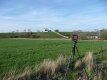
A couple of gratuitous pictures...

Exciting Shen Hao action shot
Shen Hao + View.jpg

There's a dark diagonal line running bottom left to middle right - it's the edge of the field between the cultivated part and the border at the side. That's what was showing in the bottom-right corner in the later B&W images with shadow detail. The dark bottom left corner would appear to be vignetting, proper, since there's nothing in the foreground in the colour shot that would account for that.

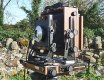
Shen Hao strikes a dynamic pose
Shen Hao + 5-quid lens.jpg

According to the scale, I've got 7-8mm of fall. The lens is pretty small, and I've found that the camera can close with it fitted. However, the front ring of the lens wants to hit the round nameplate that's fitted to the middle of the base, which would no doubt result in scratching. The front tilt bars can be nipped up to hold it clear, but the grip isn't very good (too much leverage in the folded arrangement). If I wanted to keep it fitted (eg, if only going out with this lens), then I'd want to add something to pad/protect.

Something else I found while using it is that the aperture adjuster sticky-outy thingy-bit is awkward to use for stops wider than about f/8 because the cable release gets in the way. Next time I use it, I'll see if the hook disgorger bit on my Swiss Army Knife makes that easier.
 
Back
Top