Landscape lighting question?

The goblin

<span class="poty">POTY Winner 2015</span></br>
Suspended / Banned
Messages
4,407
Name
Marsha
Edit My Images
Yes
Hi, thought I'd post here as my knowledge of landscapes is VERY basic!

I'm really just needing some tips please on how to capture the beautiful colours of a sunrise or sunset. What I see and what I photograph are not always the same! Is it such that some of the great shots I see have all been attacked with HDR or is there a technique I'm lacking! I've tried HDR and don't seem to get it right in PP! But doing the photographer of the year comp I saw some beautiful shots that had no PP, any tips on how to capture the lighting in the most natural way is greatly appreciated.

I do use a circular polariser and have a variable ND that I have no clue on how to use!

Any advice greatly appreciated.
 
Hi, First go to the library and find a book on Landscape photography if only to get some tips from it.
Try Youtube for Landscape Photography http://www.youtube.com/results?sear...s+and+techniques&filters=year,+long&lclk=long

IMO, you really will find it difficult to get a sunrise/set with just one exposure remembering the sky even at these time of day is a lot brighter than the land, try exposing for the sky and take your shot then one for the land and blend together in PP.
Of course the other option is graduated filters but that means more expense and sometimes some fiddling about outside on a cold windy morning/evening.
Again youtube is a great resource to find out http://www.youtube.com/results?filt...filters+in+landscape+photography&lclk=rm:long
All is of course JMO and sure someone else will come up with more suggestions .
Russ
 
Graduated tilters are recommended, but you can get a single exposure sunset with good technique and an eye for the image (you don't always need to obsess about having all of the frame perfectly exposed).

Charlie Waite has a book called The Making Of Landscape Photographs that I recommend - about a pound second hand from Amazon (it's been out of print for years). There's also a good one called Transient Light by Ian Cameron I quite like.
 
For myself and the guys I sometimes shoot landscapes with it is.

#1 Be there during the right time of day
That means for dawn shoots be on site, ready to shoot at least 1/2 hour before first light (about an hour before sunrise) and usually finish shooting about 20 min after sunrise.

#2 Almost everybody uses ND grads and ocassioanally ND's as well (most are coastal shoots)

#3 Shoot RAW as it gives you more control when PPing.

They also use The Photographers Ephermis when planning and if there a some clouds about even better (if there are no clouds about some photographers won't even get out of bed).
 
Last edited:
Richard has summed it up for me, right time, right place, planning, preparation and the use of grads, for sunrises and sunsets, particularly coastal ones, the Hitech reverse grad is really useful.

Also don't forget a sunrise or sunset doesn't need to have the sun in the frame, have a look around, where the light is hitting, rather than where it is coming from, is often a better image.
 
Also don't forget a sunrise or sunset doesn't need to have the sun in the frame, have a look around, where the light is hitting, rather than where it is coming from, is often a better image.

Good point Mark, I more often find myself pointing the camera away from the sunrise/sunset than I do at it, the subtle light and shadows it casts on the mountains/coastline can be more impressive than the "sun shot" itself

Simon
 
Hi, many apologies for taking so long to reply.

Hi, First go to the library and find a book on Landscape photography if only to get some tips from it.
Try Youtube for Landscape Photography http://www.youtube.com/results?sear...s+and+techniques&filters=year,+long&lclk=long
Excellent link, thanks Russ and a lot of videos for me to start watching :thumbs: I understand what you're saying about the lighting with the sky being too bright. I had a VERY quick shoot last night and took three shots of each to work on.

Of course the other option is graduated filters but that means more expense and sometimes some fiddling about outside on a cold windy morning/evening.
Ok, so when I posted yesterday I failed to mention that I am currently in Cyprus, temperature here is not really an issue! I fly back tomorrow but will be moving out here in November for a few years so hoping the 'cold' winter mornings here won't be anywhere near as cold as back home!

Personally I use a Hitech reverse NDgrad, this article explains it well..

http://theuklandscape.wordpress.com...ch-nd-grad-filters-for-landscape-photography/
Thanks Simon, I do need to investigate filters more.

Graduated tilters are recommended, but you can get a single exposure sunset with good technique and an eye for the image (you don't always need to obsess about having all of the frame perfectly exposed).

Charlie Waite has a book called The Making Of Landscape Photographs that I recommend - about a pound second hand from Amazon (it's been out of print for years). There's also a good one called Transient Light by Ian Cameron I quite like.
Thanks I shall look for that book.

For myself and the guys I sometimes shoot landscapes with it is.

#1 Be there during the right time of day
That means for dawn shoots be on site, ready to shoot at least 1/2 hour before first light (about an hour before sunrise) and usually finish shooting about 20 min after sunrise.

#2 Almost everybody uses ND grads and ocassioanally ND's as well (most are coastal shoots)

#3 Shoot RAW as it gives you more control when PPing.

They also use The Photographers Ephermis when planning and if there a some clouds about even better (if there are no clouds about some photographers won't even get out of bed).
Clouds, mmmm! There are currently no clouds in Cyprus :bonk: I saw one yesterday up Troodos that vanished as soon as it appeared! But I know from previous experience out here, when they do get coulds they're the big, impressive thundery types!
Many thanks for the tips.

Richard has summed it up for me, right time, right place, planning, preparation and the use of grads, for sunrises and sunsets, particularly coastal ones, the Hitech reverse grad is really useful.

Also don't forget a sunrise or sunset doesn't need to have the sun in the frame, have a look around, where the light is hitting, rather than where it is coming from, is often a better image.
Planning :lol: We drove back from a restaurant last night and saw the sun vanishing, so grabbed camera and tripod and ran up the cliffs! I shall post the shots sometime next week. But when I'm back out here for good I shall be out more often and with a lot more time so can do a proper recce of sunrise and sunset locations. There are also some shipwrecks around here that apparently look amazing with the setting sunlight on them.

Good point Mark, I more often find myself pointing the camera away from the sunrise/sunset than I do at it, the subtle light and shadows it casts on the mountains/coastline can be more impressive than the "sun shot" itself
I shall remember thism thank you.

@ Marsha

Just be carefull when looking at photographs and thinking they have had no PPing.
With digital that is shot in RAW they have all been post processed and if it is done well most people will not notice it.
Thanks Richard. I know for the TP POTY lanscape shot PP wasn't allowed, everything else is fair game!

Cheers Gents, all tips appreciated. I have two months sans kids back in the UK so plenty of time to study before a long Cypriot holiday :thumbs:
 
Ah Cyprus, never been:D
But as you can see I do live in Greece and the two thing I found are there really are no seasons as in the UK, no Autumn colour like the UK (well not here on Rhodes anyways) second during the summer months July to end of September, there are no or very few clouds, the temperature is also a consideration in those months 100C plus is just to hot to go out even early morning or late evening can be a struggle.
Lastly during those months (and no offense to anyone) there are to many tourists many who have never driven on the right side and many who have but find looking out the window to see what the wife or girlfriend is pointing to is more interesting than the traffic around them:shake:
Oh yes make sure you bring the important stuff with you as finding photography equipment can be very frustrating, (No Jessops etc:'()
Russ
 
Nonsense. People have been doing it successfully for years.


Steve.

In fact if you switch to old technology , i.e. print film, you'll find it really easy, meter for the foreground, sky falls into place all on it's own.
 
In fact if you switch to old technology , i.e. print film, you'll find it really easy, meter for the foreground, sky falls into place all on it's own.
I like that idea, alas I sold my old film SLR! Although annoyingly I had it with me last time I was in Cyprus and wasn't into photography as much then:bonk:
 
Ah Cyprus, never been:D
But as you can see I do live in Greece and the two thing I found are there really are no seasons as in the UK, no Autumn colour like the UK (well not here on Rhodes anyways) second during the summer months July to end of September, there are no or very few clouds, the temperature is also a consideration in those months 100C plus is just to hot to go out even early morning or late evening can be a struggle.
Lastly during those months (and no offense to anyone) there are to many tourists many who have never driven on the right side and many who have but find looking out the window to see what the wife or girlfriend is pointing to is more interesting than the traffic around them:
shake:
Oh yes make sure you bring the important stuff with you as finding photographyequipment can be very frustrating, (No Jessops etc:'()
Russ
Russ I never spotted you were in Greece, the rubbish Android app doesn't share useful information like that!
I will be in the UK for autumn, but I get what you're saying. I actually missed the cold and amazing colours we get back home.
Check on the heat! I took a bike ride along the cliffs yesterday at 9ish and it was hot. Then it hit 33c and I think I melted. Even Troodos and Mount Olympus only went down to 27c! Saying that, 13c back home is not appealing right now!
Oh and the mosquitos, OMG! Up the cliffs last night I thought I was hearing birds far away, only to realise it was in fact the noisiest mosi's practically in my ear!
Not had much to do with tourists yet but the Cyp driving hasn't changed. They still stop and turn without indicating and do the traffic light creep (crawl across while they're still red) it's great to be back!!!!

I shall be stocking up before I fly out full time. I've got to treat myself to some leaving the RAF celebratory toys. Some filters may be on that list :)
 
Last edited:
Hi, In reply to Steve's quote of "Nonsense" would like an expansion on the procedure when using digital capture as I was not really into photography up until about 5 years ago after I retired so never used film very much.

Richard, Why with the technology no how of todays photographic industry would I spend money to turn back to the film era? I understand that photographers who have enjoyed the film days of photography still get a buzz out of that final photograph in the dark room, in saying that I do use a hand held meter because I find it more satisfying and feel the meters on digital cameras are at this time not as accurate as the hand held meter, to many people IMO rely on the histogram of the camera also.
Thanks
Russ
 
In fact if you switch to old technology , i.e. print film, you'll find it really easy, meter for the foreground, sky falls into place all on it's own.

For sunrise and sunset images with the sun in the frame, film's greater dynamic range handles the light better than digital.

Most digital images of the sun (when not covered by cloud) show it as a white circle with a yellow outline. The centre is white because all three colours have saturated to maximum.

As the light around it reduces, the blue comes out of its saturation point quickly, leaving the red and green at maximum level which combine to give yellow.

Why with the technology no how of todays photographic industry would I spend money to turn back to the film era?

For some of us, it is still the film era.


Steve.
 
Last edited:
@ Russel.
Re the sunset with just one exposure.
All you need is just a bit of cloud around to kill some of the sun, shoot RAW and careful PPing.
A ND grad may also help in some cases.
I can post an example or two if you like.

--------------------------

@ Marsha
Re shooting in hot climates (and I do live in Sydney, Australia)
For the summer sunrises, sunrise is around 6am (we will be on daylight saving) and I will be back home well and truely before the day reallly heats up.

Re sunrises/sunset straight out of camera - why not try varying the white balance when shooting - on some P&S cameras you will see the image change, on the screen, as you are changing the settings before pressing the shutter button.
 
Last edited:
Richard sunrise here is 0630 just now. We went for a cycle along the cliffs and it was about 0830, we were only up there for about an hour and the breeze helped cool things down. The rest of the day was rather grim at about 33c with high humidity! Next year I'll be done before it gets too hot!
 
Richard sunrise here is 0630 just now. We went for a cycle along the cliffs and it was about 0830, we were only up there for about an hour and the breeze helped cool things down. The rest of the day was rather grim at about 33c with high humidity! Next year I'll be done before it gets too hot!

Hi, Only 33c wish it would come down to that here here now;)
Richard, Thanks for the tip on clouds but my problem with that from end of May through to middle September they just don't exist we just have this big white ball in a blue/white coloured sky and it does get frustrating at times. Would certainly love to see some of your photographs and I was actually toying with the idea of investing in a film camera (just to see if I can get good results with the Hand held meter and my brain;)) What would you suggest as far as a camera 35mm or ???
Thank You
Russ
 
It has been years since I seriously shot with film. It was mostly famly stuff from 1972 (when I discoverd girls) 'till 2006 when I purchased my first DSLR

From cameras I have owned.

#1 Pentax Spotmatic (C1964) They were great - my second slr - the first was a Pentax - SV (C1962) and not as good a Penax spotmatic.-
#2 Minolta SR-T 101 (C late 1960's inherited from my dad) -another good camera
#3 Mamiya twins lens reflex (purchased in the early 1960's) (6x6cm or 2/14 square) Super IQ that killed 35mm, however I much preferred to use a slr
#3 Canon EOS 1000 - Purchased around 1991 - very similar body to the Canon 350D (and upwards) which I purchased in 2006 (it was like comming back home).

I never owned a dark room and I would not consider going back to film ever.
I feel is a lot easier to get the "correct" exposure (and focus) with a modern DSLR, not to mention the great high ISO performance and having a histogram.
Also keep in mind when shooting sunrises, with film, and with no clouds it may be more than just a blown sun, it will mean little round holes in your transparencies (this is also from personal experience).

Nowdays I mostly shoot with a Canon 5D and 40D

Re sunsets and all my pics are shot in RAW and from just a single exposure. Larger pics are on my flickr stream.
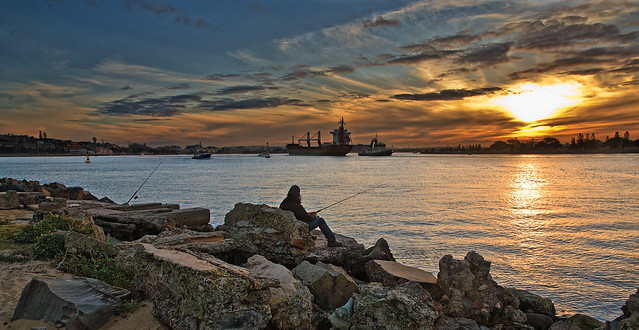
#1 Late may (almost winter) hand held and no ND filters . Although the sun is overexposed it I feel it still works.


Sunset at Newcastle (1) by dicktay2000, on Flickr

#2 Again in May but a sunrise. Hand Held with a single exposure, however lots of PPing.


Sunrise shoot (3) by dicktay2000, on Flickr

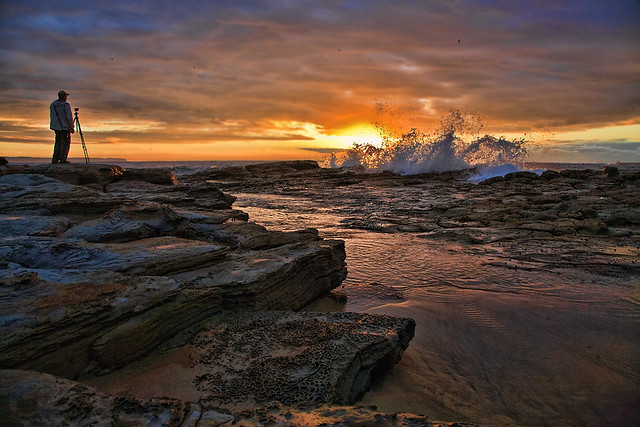
#3 January (mid summer) a tripod and ND grad would have been used for this sunrise.

The photographer by dicktay2000, on Flickr

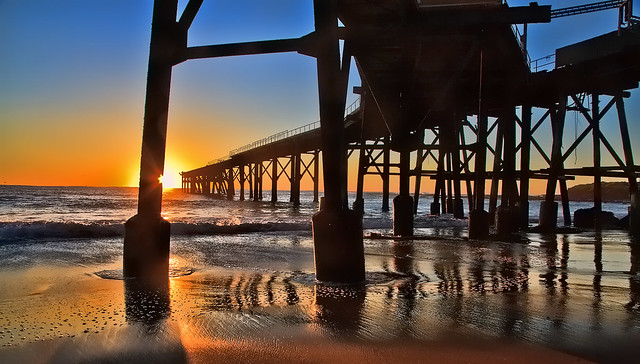
#4 Another sunrise - This is in midwinter (july) and no clouds has had a lot of PPing (a bit too much I think) even to get this. (probably had a ND grad on).

Early morning gold (2) by dicktay2000, on Flickr

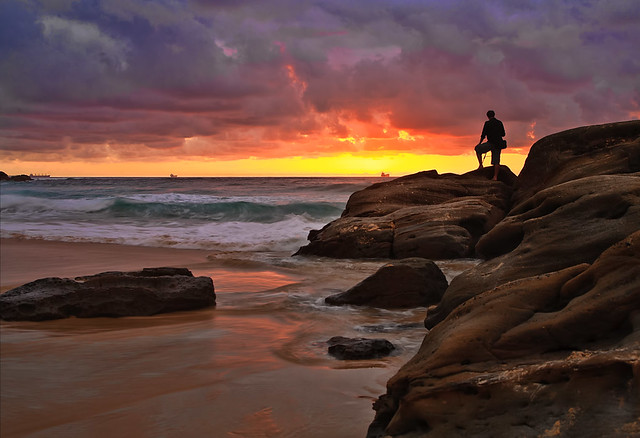
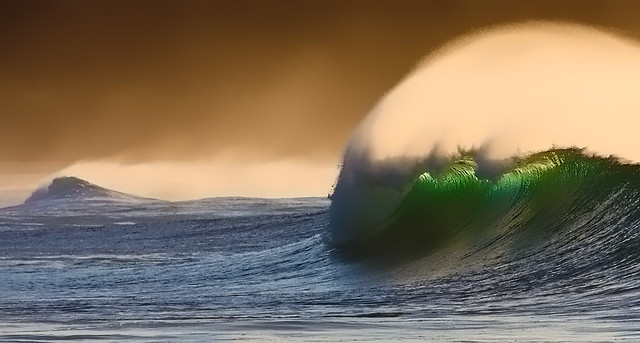
#5 looks what happens when you look in a different direction. Shot approx 10 minutes latter, than pic #4 at the same location but now looking more north instead of straight into the sun. No ND grad and shot hand held. The darkness in the background is a shaded headland. On some shoots I sometimes I have two bodies with very different lenses on them.


Winter waves by dicktay2000, on Flickr

Hoperfully this helps. I think without any clouds about try shooting in the "blue" hours and see how that goes.
 
Last edited:
It has been years since I seriously shot with film. It was mostly famly stuff from 1972 (when I discoverd girls) 'till 2006 when I purchased my first DSLR

From cameras I have owned.

#1 Pentax Spotmatic (C1964) They were great - my second slr - the first was a Pentax - SV (C1962) and not as good a Penax spotmatic.-
#2 Minolta SR-T 101 (C late 1960's inherited from my dad) -another good camera
#3 Mamiya twins lens reflex (purchased in the early 1960's) (6x6cm or 2/14 square) Super IQ that killed 35mm, however I much preferred to use a slr
#3 Canon EOS 1000 - Purchased around 1991 - very similar body to the Canon 350D (and upwards) which I purchased in 2006 (it was like comming back home).

I never owned a dark room and I would not consider going back to film ever.
I feel is a lot easier to get the "correct" exposure (and focus) with a modern DSLR, not to mention the great high ISO performance and having a histogram.
Also keep in mind when shooting sunrises, with film, and with no clouds it may be more than just a blown sun, it will mean little round holes in your transparencies (this is also from personal experience).

Nowdays I mostly shoot with a Canon 5D and 40D

Re sunsets and all my pics are shot in RAW and from just a single exposure. Larger pics are on my flickr stream.
#1 Late may (almost winter) hand held and no ND filters . Although the sun is overexposed it I feel it still works.


Sunset at Newcastle (1) by dicktay2000, on Flickr

#2 Again in May but a sunrise. Hand Held with a single exposure, however lots of PPing.


Sunrise shoot (3) by dicktay2000, on Flickr

#3 January (mid summer) a tripod and ND grad would have been used for this sunrise.

The photographer by dicktay2000, on Flickr

#4 Another sunrise - This is in midwinter (july) and no clouds has had a lot of PPing (a bit too much I think) even to get this. (probably had a ND grad on).

Early morning gold (2) by dicktay2000, on Flickr

#5 looks what happens when you look in a different direction. Shot approx 10 minutes latter, than pic #4 at the same location but now looking more north instead of straight into the sun. No ND grad and shot hand held. The darkness in the background is a shaded headland. On some shoots I sometimes I have two bodies with very different lenses on them.


Winter waves by dicktay2000, on Flickr

Hopefully this helps. I think without any clouds about try shooting in the "blue" hours and see how that goes.

Hi, Thank you for the input. I do like the last two, the wave is really good IMO.
I note that all are taken during the onset of winter time and after, this is the problem here also, as I said above the temp is like 33 to 37 c for six months.
The other thing I note in your photos is that you are not afraid to include people and maybe I should take that stance as I walk around looking for people-less areas.
Thanks Again
Russ
 
Thanks very much.

Re shooting in hot climates.
I shoot motor racing all year round, and in most locations there is no shade. Some summer days it will around 38-40c maximum and even with the right clothes and lots of of water (Lowepro lens cases make good frozen water bottle holders) as one photographer said "this is not fun anymore" but we still do it.
 
Last edited:
Back
Top