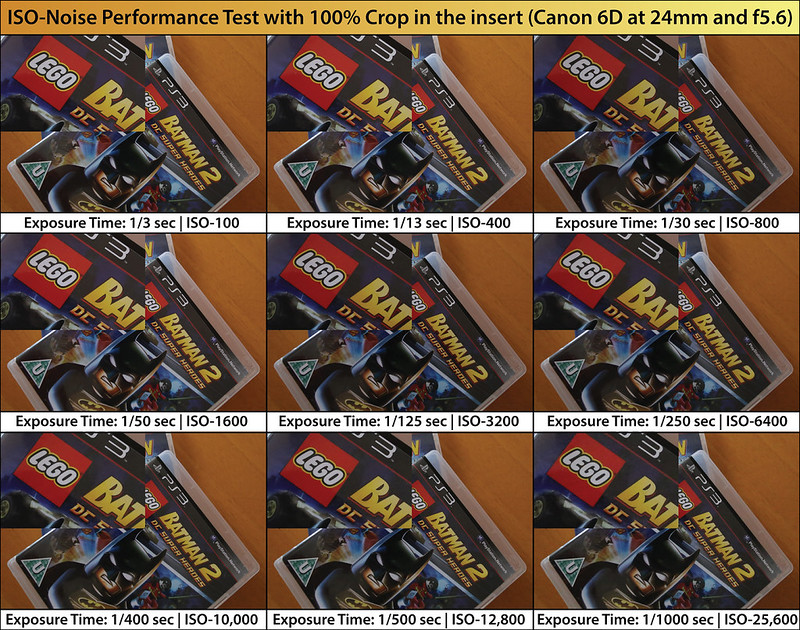
I've had a PM debate with Tim on this, and frankly I'm unmoved, but in the interests of clarity, if you want to say that raising ISO does not increase noise, that must be coupled with the qualification 'without changing anything else'.
But in reality, because changing one corner of the exposure triangle also affects the others, you cannot do that and the direct result of raising ISO must mean that exposure has to be reduced by other means or, fairly obviously, the result will be over-exposure.
So, if you raise ISO, then to maintain correct exposure you must adjust shutter speed and/or aperture to suit. This reduces total photon capture, and that increases noise. They're two halves of the same coin. I see no point in trying to separate them, it's certainly confusing, and goes against everything else you will see and read about it.
Unfortunately, Richard, I too am unmoved. I don't want to turn this into a pi55ing contest, and I'm writing this not to challenge you, but to try to clear things up for the other readers of this thread, because if we're trying to enlighten people it would help if we were factually correct and unambiguous in the messages we leave.
Firstly, we do both agree that getting as much signal to the sensor as possible (short of highlight clipping at least) is a good thing and will be the best solution to reducing noise. Beyond that we seem to have a bit of a different take on things. Our disagreement appears to revolve around two main points of contention, and a third supplementary one:
1) You say that raising ISO increases noise, while I say that it doesn't.
2) You say that you can't raise ISO without affecting some other part of the exposure triangle, while I say you can.
3) You also say that I need to add qualifiers to the things I've said, while I believe the opposite to be true. You've added yours, but I still don't fully agree with what you've said.
For point 1 and 2 I will provide examples to justify my claims later.
As to point 3, and also point 2, in my original post, everything I've described indicates use of manual exposure, although it is not explicitly stated. The steps I've outlined in that post simply cannot be applied when using any other exposure mode. I do not know how this advice could be misinterpreted.....
So, set your shutter speed and aperture first to suit your requirements for motion control and DOF. Then adjust the ISO until the picture is suitably bright.
That screams out to me - MANUAL, MANUAL, MANUAL. It also makes it abundantly clear that, having locked in my shutter speed and aperture, I am at liberty to select any ISO value I care to and it will have no impact on the other exposure triangle parameters. On that basis I fail to see why I need provide any further qualification to my statements in that post. It's all right there. So when I go on to say....
Raising the ISO does not increase the noise. Noise is created when you under saturate the sensor and have to rely on raising the ISO to help you out. If you want less noise then get more light onto the sensor. If you can't do it with shutter speed and aperture alone then consider adding supplementary lighting, such as flash.
that is also factually accurate within the context of that original post, absent of any additional qualification. This I will demonstrate.
Regarding points 1 and 2, first it is important to explain my mindset for all this, because this is key to understanding why I've said the things I have and the way in which I've said them. So, please read on.
There are many different flavours of "exposure". You can have a "correct" exposure, although its definition might be open to differing opinions. You can have an exposure based on middle grey tones, or a light meter, which while technically correct (to some) may not deliver the aesthetic vision you desire. You can have what I would call an "optimal" exposure, where you adjust your exposure settings to extract the maximum performance from your camera sensor and electronics, by capturing important highlight details just shy of clipping point. It is my preference to aim for an optimal exposure. It may not look great SOOC, but it will yield the most information rich and cleanest (least noisy) file I can hope for any given shooting scenario. Once I have that optimal file saved, even if it looks quite horrid to begin with, I'll have the best set of image data possible from which to craft my final picture.
My approach to getting that optimal file is to ETTR (expose to the right) first and foremost, with my choice of shutter speed and aperture. Then I will ITTR (ISO to the right) in order to make the image as bright as possible - HTTR (histogram to the right) - without clipping important highlights, if I have headroom to spare. If I don't have spare headroom there is no earthly point in raising the ISO. This is a completely standard and commonplace approach for digital photography, which has been practiced for many years. This is more or less the approach I began to describe in my original post, although for the Talk Basics forum I did not want to elaborate on the finer points of all this.
Anyway, to demonstrate how easy it is to vary ISO without adjusting anything else, and how noise absolutely does not increase as ISO is raised, I have some examples.
Here are four raw files, loaded straight into Lightroom and without edits. The first exposure was set manually according to an incident light meter, at 1/200, f/4.5 and 200 ISO. The image brightness looks OK - actually a bit dark for my tastes - but that's what the meter recommended, so that's the exposure I used. The remaining three photographs were taken with the ISO value raised manually to 400, 800 and 1600, while everything else stayed the same. As you can see, and apologies for stating the obvious, but as the ISO increased so the brightness increased too. What is not so obvious, but is very important where noise is concerned, is that by using manual exposure and fixing my shutter speed and aperture the sensor continued to capture the same amount of light for each and every shot. I accidentally left the camera white balance on auto, which did yield varying colour balance, so I equalised the white balance in Lightroom as the only edit step for these pictures.

Now, visually I think the shot at 400 ISO almost looks better than the one at 200 ISO - certainly cheerier and more uplifting, and IMHO a better starting point for any editing - but in truth I think somewhere in between would be perfect. Still, we have what we have.
Within Lightroom I was able to apply a simple adjustment to the exposure setting (-1 for the 400 ISO shot, -2 for the 800 ISO shot and -3 for the 1600 ISO shot) to reduce the brighter examples back down to the level of the original photo. Let's see how they look after adjustment....
At a glance they all look pretty close. I'll admit that the shot at 1600 ISO and pulled back 3 stops does look a little suspicious, and rightly so, but it's not far from the ballpark in the mid tones, although the highlights are shot. It's not a file I would ever expect to use. It's also fair to say that this is a very simplistic edit, and not one designed to make the shots look absolutely identical - just close enough for a simple illustration.
Now, having larked about with ISO, let's take a closer look at the files at 100% and see how they compare for noise, detail, colour and anything else.
200 ISO vs 400 ISO and -1 stop pull :
Well apologies for any bias, but if there is any winner here I would have to give it to the shot at 400 ISO with the 1 stop pull.
Let's see how we fair at 200 ISO vs 800 ISO and a 2 stop pull :
Well again, apologies for any bias, but I think the high ISO shot looks cleaner, especially in the background. The 200 ISO shot looks a little gritty, while the 800 ISO shot looks as smooth as a baby's bum.
I'll include the example at 1600 ISO as well, even though that is a step (stop?) too far, which resulted in quite problematic highlight clipping in crucial areas, colour shift and an unsalvageable image. Even so, if you look at the background area where the mid tones are I think you would be hard pressed to see more noise at 1600 ISO than at 200. I think there is less.
It is unfortunate that I did not take a shot at 100 ISO as well, and the push that up by a stop to see how that compared, but I highly doubt that lowering ISO "in the pursuit of less noise" would have accomplished anything of the sort. The higher ISOs have already shown that they deliver cleaner results.
So, with all that out of the way, I am not sure why we are in disagreement. On the face of it some of the things I've said may jar with common opinion, but that does not make them wrong. Compared to the film days this might be a new way of thinking, but for the digital era these techniques have been known for many years. ETTR has been around for at least 10 years, having reached mass market awareness in 2003 if not before. ITTR may (or may not) be a more recent addition, but it's been doing the rounds for several years at least. These are good techniques and when I see people writing advice in a way that appears to undermine them, like saying that "raising ISO
always increases noise", and what could be more offputting than hearing that, I don't see how that is helpful to anyone, especially when it's anything but true.
EDIT : Sorry. I should add that this is far from the only way to approach setting exposure. It's one way which I commonly use, and well suited to shooting fast action in less than perfect lighting. When it comes to easier subjects I may vary my approach and I'm not at all averse to using the (semi-)automatic exposure modes if appropriate. That doesn't alter anything I've said above and I still stand by the statements I made at the beginning.




 Normally ISO is the last thing I will change, always aim to keep the iso as low as possible to keep the noise down.
 .
.