ISO settings

ammasaah

Suspended / Banned
Messages
5
Edit My Images
No
Hi,
I have been doing some reading around ISO setting and It is not very clear to me. I have read the low ISO settings are better for indoors shots and higher ISO numbers are better for outdoors. If a faster sensitivity (i.e. higher ISO numbers) to light = a faster gathering of light, shouldn't higher ISO numbers be more suitable to indoors? I say this because indoors tends to be dark thus, more light would be required, no?

Thank you for reading.
 
Hi,
I have been doing some reading around ISO setting and It is not very clear to me. I have read the low ISO settings are better for indoors shots and higher ISO numbers are better for outdoors. If a faster sensitivity (i.e. higher ISO numbers) to light = a faster gathering of light, shouldn't higher ISO numbers be more suitable to indoors? I say this because indoors tends to be dark thus, more light would be required, no?

Thank you for reading.

Use Iso 100 in bright light outdoors and Iso1600 when it is dark and you are using ambient light.

Iso1600 will more grainy/noisy that Iso100.
 
Higher ISO's allow you to take pictures in low light conditions, (so possibly indoors), or in conditions that require a higher shutter speed than the light would otherwise allow.
A low ISO e.g. 100 is always better where it can be used but it is often a luxury than available light does not allow.
 
Shutter speed and aperture settings govern how much light reaches the sensor. The longer the shutter is open the more light can flood in. The bigger the aperture the faster it can flow in.

The ISO acts like a brightness control for the resulting image. So, set your shutter speed and aperture first to suit your requirements for motion control and DOF. Then adjust the ISO until the picture is suitably bright.

Sometimes the ISO adjustment alone may not be sufficient to cater for all conditions, so be prepared to compromise on shutter speed and/or aperture if you have to.

The ideal situation is to capture enough light at the sensor that you do not need to raise the ISO much, if at all. In dim conditions or when needing high shutter speeds and/or small apertures you may find you have no choice.

Raising the ISO does not increase the noise. Noise is created when you under saturate the sensor and have to rely on raising the ISO to help you out. If you want less noise then get more light onto the sensor. If you can't do it with shutter speed and aperture alone then consider adding supplementary lighting, such as flash.


If we consider an actual example, say I'm shooting indoors by tungsten lighting alone. I have a 50mm lens on a full frame camera. I am not using flash (for this example). I know I want a shutter speed of at least 1/50 to minimise visible camera shake, but as I have live subjects I prefer to go higher, perhaps 1/80 to help reduce subject blur. Now I consider my aperture. For DOF purposes and to reduce risk of focus misses spoiling results I want an aperture of f/2.8. f/4 might be more forgiving, but I also know I want to grab as much light as I can so I settle for f/2.8. With those two parameters fixed I now need to determine the ISO I need for a "correct" exposure overall. I can't tell you what it needs to be because that depends on the light levels available. So I meter part of the scene (or the whole scene) to determine the ISO required. For my living room exposing the walls at +1 seems about right, and here is the result.....

20130611_225053_.JPG


Of course, I could have guessed at 1600 ISO first, or maybe 3200 or 800 or something else, and then tried to work backwards to suitable values for shutter speed and aperture, but to my mind that is like the tail wagging the dog. You can do it that way round if you want to, but it's an odd way to approach the problem if you ask me. ISO is the least important element of the exposure triangle. It only has one influence on the outcome of the photo and that is how bright it appears. Aperture and shutter speed both have additional creative and technical influences on the outcome beyond how bright it looks.


Another example - I'm shooting sports or birds in flight with a crop body and 100-400mm lens. I'm going to be at the long end of the zoom and need a high shutter speed to control camera shake and subject blur. IS won't be of any use as I need to follow random patterns of movement and IS won't freeze the subject. I want at least 1/800 for the shutter speed. More would be better, but I also know that I want as much light on the sensor as I can get (without saturating it) so I go for a realistic figure to achieve that. I also know from experience that the lens is a little soft wide open at f/5.6 and it sharpens up a bit if I stop down even just 1/3 to f/6.3. Once again I have established the two most significant elements of my exposure and other technical/creative control. Now I just need to set the ISO to suit the available light. On a bright, sunny day, with dazzling white in my subjects I'll probably find 100 ISO to be about perfect. If my subject and scene is of more neutral tone I could afford to bump ISO to 200 without the risk of blown highlights. If it began to cloud over I might need to raise the ISO by another one, two or even three stops, but really I don't have much leeway to change my shutter speed and aperture to adjust to the conditions. The ISO is the floating variable I need to move up and down with the varying lighting.
 
Last edited:
Hi,

If a faster sensitivity (i.e. higher ISO numbers) to light = a faster gathering of light, shouldn't higher ISO numbers be more suitable to indoors? I say this because indoors tends to be dark thus, more light would be required, no?

You're on the right track. You seems to be learning well.


Point of note: Although a higher ISO setting is needed for indoors because indoors often have low light levels, don't forget that it depends on the building and windows, as well as the time of the day, sometimes there may be a big windows or even a skylight in the celling, and facing the sun, so sometimes during summer, there is strong sunlight coming into the room, so a normal ISO setting, like ISO 200 or so can be good enough.

And sometimes higher ISO can be used outdoors, it is not because of light levels, sometimes you want a higher ISO to get a higher shutter speed, or it may be that you are too deep within the woods.

But yeah, in general and as a general rule of a thumb, you're just about right, higher ISO for indoors and lower ISO for outdoors, but remember it's just a general rule of a thumb.
 
<snip>

The ideal situation is to capture enough light at the sensor that you do not need to raise the ISO much, if at all. In dim conditions or when needing high shutter speeds and/or small apertures you may find you have no choice.

Raising the ISO does not increase the noise. Noise is created when you under saturate the sensor and have to rely on raising the ISO to help you out. If you want less noise then get more light onto the sensor. If you can't do it with shutter speed and aperture alone then consider adding supplementary lighting, such as flash.

This sounds like semantics Tim. The end result of raising ISO is always to increase noise. And reduce dynamic range, and sharpness. Why else would you not want to raise it, as you've said?

<snip>

ISO is the least important element of the exposure triangle. It only has one influence on the outcome of the photo and that is how bright it appears. Aperture and shutter speed both have additional creative and technical influences on the outcome beyond how bright it looks.

<snip>

You could just as easily argue the opposite - that ISO is the most important element of the exposure triangle, because it allows you to set the shutter speed and aperture you want.

Either way, because all three corners of the exposure triangle affect the other two, they all require equal consideration.
 
Hi,
I have been doing some reading around ISO setting and It is not very clear to me. I have read the low ISO settings are better for indoors shots and higher ISO numbers are better for outdoors. If a faster sensitivity (i.e. higher ISO numbers) to light = a faster gathering of light, shouldn't higher ISO numbers be more suitable to indoors? I say this because indoors tends to be dark thus, more light would be required, no?

Thank you for reading.

Should be the opposite : high iso settings are better for indoors and low iso are better for outdoors. ;) Normally ISO is the last thing I will change, always aim to keep the iso as low as possible to keep the noise down.
 
... Normally ISO is the last thing I will change, always aim to keep the iso as low as possible to keep the noise down.

I don't know if it's because I started with film, and if it's comon for all old fogeys:

But ISO is the first thing I set, when I take the camera out of the bag, the question in my head is 'what's the appropriate film speed for the light level?' I set the ISO there and then, Obviously with changes of conditions I will alter it:).

I think though that a lot of digital shooters tend to get hung up on the whole 'exposure triangle' issue. Making it much more complicated than it needs to be. I can't imagine a time I'd really be thinking 'I need f5.6 and a shutter speed of 1/500sec, what's that give me as an ISO?:nuts:

Generally I'd be shooting at my chosen ISO (as above) and using aperture priority, when the shutter speed becomes unacceptable (either direction) I change the ISO. Likewise if I'm shooting Shutter priority or Manual (even when shooting M I'll have an idea of either the SS or aperture I'd like to use).
 
I think though that a lot of digital shooters tend to get hung up on the whole 'exposure triangle' issue.

Generally I'd be shooting at my chosen ISO (as above) and using aperture priority, when the shutter speed becomes unacceptable (either direction) I change the ISO. Likewise if I'm shooting Shutter priority or Manual (even when shooting M I'll have an idea of either the SS or aperture I'd like to use).

Totally agree and well put. Don't fear the exposure triangle.
 
This sounds like semantics Tim. The end result of raising ISO is always to increase noise. ......, and sharpness. Why else would you not want to raise it, as you've said?

Not necessarily. You can increase ISO much more when there is good light (to allow smaller aperture/higher SS/etc) than you can when the light is poor.

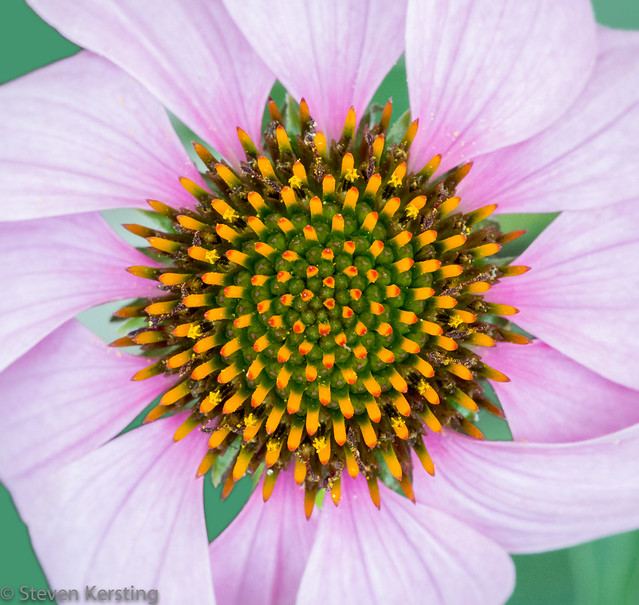
This was shot at 12,800 (just messing around). Granted, this camera does amazingly well w/ high ISO's; but I can promise you it doesn't perform anywhere as well with low light levels.


Purple Coneflower by skersting66, on Flickr


The thing I think people need to understand is that digital cameras do not have variable ISO. The sensor only has one sensitivity to light, just like film. A digital camera has variable amplification/processing *after* the light is captured. This does always at least cost you DR and color sensitivity. It *can* also cost you in noise/sharpness.

In fact, once you've hit the signal floor it is actually better to underexpose and recover in post than it is to increase the ISO further. At least this way you retain more DR/color sensitivity, and you have more control over where/how much noise is added.
 
Last edited:
The amount of noise may be lesser with higher ISO in good light versus dark light but there is still more noise at higher ISO in the same situation which was the point I believe.
 
The amount of noise may be lesser with higher ISO in good light versus dark light but there is still more noise at higher ISO in the same situation which was the point I believe.

Yes, exactly. And making a hypothetical point about the nature of ISO being nothing more than signal amplification is not helpful, especially in the basics forum.

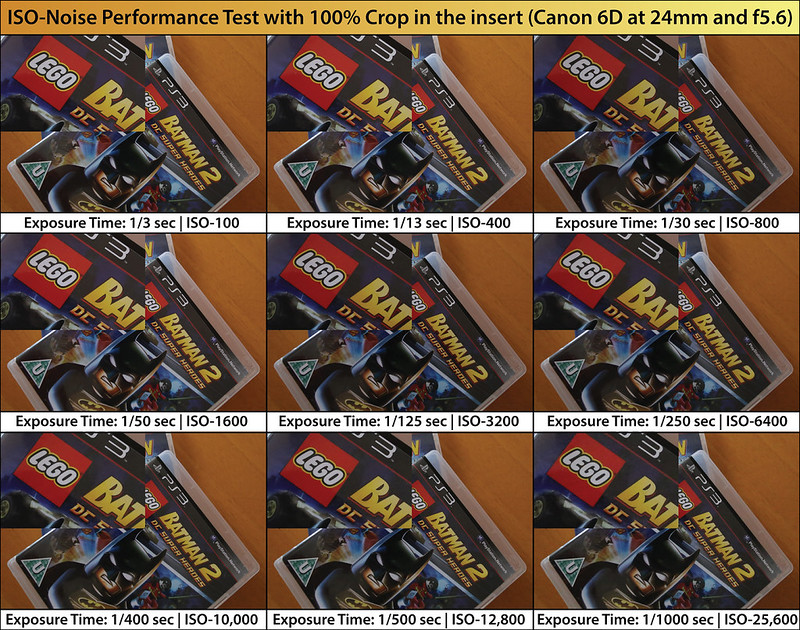
It is an unfailing truth that as ISO is raised, noise increases. Take it further and tone separation in the shadows is reduced and colours become muted. Push further still and shadow detail is lost completely as dynamic range is cut, and sharpness is badly hit too.

The reason higher ISO performance is worse in lower light is because, with few exceptions, the colour of the light also gets warmer and the blue channel needs a lot more amplification (ie noise) than it normally does in brighter light.
 
Yes, exactly. And making a hypothetical point about the nature of ISO being nothing more than signal amplification is not helpful, especially in the basics forum.

It's not "hypothetical." And it is possible to increase ISO without an increase in noise. Particularly in bright light situations (due to high SNR of the light source), but also in very low light and long exposures (due to lower read noise/leakage/heat/etc).

I am not a proponent of "always use the lowest ISO possible or your image will suffer," nor am I a proponent of "just use whatever ISO you want." (although it is always the first thing I will compromise on)

As far as "basics" go I think Tim said it best with: "The ISO acts like a brightness control for the resulting image."
 
It's not "hypothetical." And it is possible to increase ISO without an increase in noise. Particularly in bright light situations (due to high SNR of the light source), but also in very low light and long exposures (due to lower read noise/leakage/heat/etc).

I am not a proponent of "always use the lowest ISO possible or your image will suffer," nor am I a proponent of "just use whatever ISO you want." (although it is always the first thing I will compromise on)

As far as "basics" go I think Tim said it best with: "The ISO acts like a brightness control for the resulting image."

I've had a PM debate with Tim on this, and frankly I'm unmoved, but in the interests of clarity, if you want to say that raising ISO does not increase noise, that must be coupled with the qualification 'without changing anything else'.

But in reality, because changing one corner of the exposure triangle also affects the others, you cannot do that and the direct result of raising ISO must mean that exposure has to be reduced by other means or, fairly obviously, the result will be over-exposure.

So, if you raise ISO, then to maintain correct exposure you must adjust shutter speed and/or aperture to suit. This reduces total photon capture, and that increases noise. They're two halves of the same coin. I see no point in trying to separate them, it's certainly confusing, and goes against everything else you will see and read about it.
 
Last edited:
ISO comes first for me with film as I have an idea what it is I'm going out to shoot that day.

With digital though, the ISO comes last for me.

I know what aperture I want for depth of field and I know what shutter speed will suit my subject.

If I can have both of those at ISO100-400 in the available light then great.

If I have to sacrifice my desired shutter speed to maintain my chosen aperture - or sacrifice my desired aperture to maintain my chosen shutter speed then I adjust the ISO.

An hour or two sat waiting for wildlife will see me with aperture and shutter speed fixed, doing nothing but continually testing and adjusting ISO for the correct exposure.

Showing off silly high ISO in good light or for stationary subjects makes me laugh.

Using relatively high ISO in very poor light to maintain respectable shutter speeds is a much more realistic challenge.
 
Last edited:
I've had a PM debate with Tim on this, and frankly I'm unmoved, but in the interests of clarity, if you want to say that raising ISO does not increase noise, that must be coupled with the qualification 'without changing anything else'.

But in reality, because changing one corner of the exposure triangle also affects the others, you cannot do that and the direct result of raising ISO must mean that exposure has to be reduced by other means or, fairly obviously, the result will be over-exposure.

So, if you raise ISO, then to maintain correct exposure you must adjust shutter speed and/or aperture to suit. This reduces total photon capture, and that increases noise. They're two halves of the same coin. I see no point in trying to separate them, it's certainly confusing, and goes against everything else you will see and read about it.
Unfortunately, Richard, I too am unmoved. I don't want to turn this into a pi55ing contest, and I'm writing this not to challenge you, but to try to clear things up for the other readers of this thread, because if we're trying to enlighten people it would help if we were factually correct and unambiguous in the messages we leave.

Firstly, we do both agree that getting as much signal to the sensor as possible (short of highlight clipping at least) is a good thing and will be the best solution to reducing noise. Beyond that we seem to have a bit of a different take on things. Our disagreement appears to revolve around two main points of contention, and a third supplementary one:

1) You say that raising ISO increases noise, while I say that it doesn't.
2) You say that you can't raise ISO without affecting some other part of the exposure triangle, while I say you can.
3) You also say that I need to add qualifiers to the things I've said, while I believe the opposite to be true. You've added yours, but I still don't fully agree with what you've said.

For point 1 and 2 I will provide examples to justify my claims later.

As to point 3, and also point 2, in my original post, everything I've described indicates use of manual exposure, although it is not explicitly stated. The steps I've outlined in that post simply cannot be applied when using any other exposure mode. I do not know how this advice could be misinterpreted.....

So, set your shutter speed and aperture first to suit your requirements for motion control and DOF. Then adjust the ISO until the picture is suitably bright.

That screams out to me - MANUAL, MANUAL, MANUAL. It also makes it abundantly clear that, having locked in my shutter speed and aperture, I am at liberty to select any ISO value I care to and it will have no impact on the other exposure triangle parameters. On that basis I fail to see why I need provide any further qualification to my statements in that post. It's all right there. So when I go on to say....

Raising the ISO does not increase the noise. Noise is created when you under saturate the sensor and have to rely on raising the ISO to help you out. If you want less noise then get more light onto the sensor. If you can't do it with shutter speed and aperture alone then consider adding supplementary lighting, such as flash.

that is also factually accurate within the context of that original post, absent of any additional qualification. This I will demonstrate.

Regarding points 1 and 2, first it is important to explain my mindset for all this, because this is key to understanding why I've said the things I have and the way in which I've said them. So, please read on.

There are many different flavours of "exposure". You can have a "correct" exposure, although its definition might be open to differing opinions. You can have an exposure based on middle grey tones, or a light meter, which while technically correct (to some) may not deliver the aesthetic vision you desire. You can have what I would call an "optimal" exposure, where you adjust your exposure settings to extract the maximum performance from your camera sensor and electronics, by capturing important highlight details just shy of clipping point. It is my preference to aim for an optimal exposure. It may not look great SOOC, but it will yield the most information rich and cleanest (least noisy) file I can hope for any given shooting scenario. Once I have that optimal file saved, even if it looks quite horrid to begin with, I'll have the best set of image data possible from which to craft my final picture.

My approach to getting that optimal file is to ETTR (expose to the right) first and foremost, with my choice of shutter speed and aperture. Then I will ITTR (ISO to the right) in order to make the image as bright as possible - HTTR (histogram to the right) - without clipping important highlights, if I have headroom to spare. If I don't have spare headroom there is no earthly point in raising the ISO. This is a completely standard and commonplace approach for digital photography, which has been practiced for many years. This is more or less the approach I began to describe in my original post, although for the Talk Basics forum I did not want to elaborate on the finer points of all this.

Anyway, to demonstrate how easy it is to vary ISO without adjusting anything else, and how noise absolutely does not increase as ISO is raised, I have some examples.

Here are four raw files, loaded straight into Lightroom and without edits. The first exposure was set manually according to an incident light meter, at 1/200, f/4.5 and 200 ISO. The image brightness looks OK - actually a bit dark for my tastes - but that's what the meter recommended, so that's the exposure I used. The remaining three photographs were taken with the ISO value raised manually to 400, 800 and 1600, while everything else stayed the same. As you can see, and apologies for stating the obvious, but as the ISO increased so the brightness increased too. What is not so obvious, but is very important where noise is concerned, is that by using manual exposure and fixing my shutter speed and aperture the sensor continued to capture the same amount of light for each and every shot. I accidentally left the camera white balance on auto, which did yield varying colour balance, so I equalised the white balance in Lightroom as the only edit step for these pictures.

20130614_130256_.JPG


Now, visually I think the shot at 400 ISO almost looks better than the one at 200 ISO - certainly cheerier and more uplifting, and IMHO a better starting point for any editing - but in truth I think somewhere in between would be perfect. Still, we have what we have.

Within Lightroom I was able to apply a simple adjustment to the exposure setting (-1 for the 400 ISO shot, -2 for the 800 ISO shot and -3 for the 1600 ISO shot) to reduce the brighter examples back down to the level of the original photo. Let's see how they look after adjustment....

20130614_131008_.JPG


At a glance they all look pretty close. I'll admit that the shot at 1600 ISO and pulled back 3 stops does look a little suspicious, and rightly so, but it's not far from the ballpark in the mid tones, although the highlights are shot. It's not a file I would ever expect to use. It's also fair to say that this is a very simplistic edit, and not one designed to make the shots look absolutely identical - just close enough for a simple illustration.

Now, having larked about with ISO, let's take a closer look at the files at 100% and see how they compare for noise, detail, colour and anything else.

200 ISO vs 400 ISO and -1 stop pull :

20130614_131743_.JPG


Well apologies for any bias, but if there is any winner here I would have to give it to the shot at 400 ISO with the 1 stop pull.

Let's see how we fair at 200 ISO vs 800 ISO and a 2 stop pull :

20130614_131959_.JPG


Well again, apologies for any bias, but I think the high ISO shot looks cleaner, especially in the background. The 200 ISO shot looks a little gritty, while the 800 ISO shot looks as smooth as a baby's bum.

I'll include the example at 1600 ISO as well, even though that is a step (stop?) too far, which resulted in quite problematic highlight clipping in crucial areas, colour shift and an unsalvageable image. Even so, if you look at the background area where the mid tones are I think you would be hard pressed to see more noise at 1600 ISO than at 200. I think there is less.

20130614_133402_.JPG


It is unfortunate that I did not take a shot at 100 ISO as well, and the push that up by a stop to see how that compared, but I highly doubt that lowering ISO "in the pursuit of less noise" would have accomplished anything of the sort. The higher ISOs have already shown that they deliver cleaner results.


So, with all that out of the way, I am not sure why we are in disagreement. On the face of it some of the things I've said may jar with common opinion, but that does not make them wrong. Compared to the film days this might be a new way of thinking, but for the digital era these techniques have been known for many years. ETTR has been around for at least 10 years, having reached mass market awareness in 2003 if not before. ITTR may (or may not) be a more recent addition, but it's been doing the rounds for several years at least. These are good techniques and when I see people writing advice in a way that appears to undermine them, like saying that "raising ISO always increases noise", and what could be more offputting than hearing that, I don't see how that is helpful to anyone, especially when it's anything but true.


EDIT : Sorry. I should add that this is far from the only way to approach setting exposure. It's one way which I commonly use, and well suited to shooting fast action in less than perfect lighting. When it comes to easier subjects I may vary my approach and I'm not at all averse to using the (semi-)automatic exposure modes if appropriate. That doesn't alter anything I've said above and I still stand by the statements I made at the beginning.

 
Last edited:
I've had a PM debate with Tim on this, and frankly I'm unmoved, but in the interests of clarity, if you want to say that raising ISO does not increase noise, that must be coupled with the qualification 'without changing anything else'.

Not entirely. Particularly in the case of very long exposures the increase of ISO is specifically to shorten the exposure time. In this case you are really trading "types" of noise in order to get a more usable/less noisy image.

Additionally, the ISO noise increase is largely due to the SNR of the source, or "evenness" of sensor fill (there are certainly other factors).
Low light is like trying to catch raindrops; they fall randomly and it takes time to catch enough of them. Bright light is like filling a cup from a bucket. An underexposed low light image will have photosites with less exposure than others due to the randomness of fill. A similarly underexposed bright light image will have a more even fill and thus increasing ISO will cause less of an increase in noise. In bright light you can increase ISO and reduce exposure time/amount without notable increase in noise as long as the fill is adequate enough and even enough. You will also be reducing the DR/color sensitivity of the sensor as you increase ISO but you may not need all of it's capabilities or it might be a worthwhile trade.

The converse of this is that once you hit the signal floor for your camera you may be better off underexposing and recovering in post than you would be by increasing the ISO further for a "correct" exposure. At that ISO and above the ISO is doing nothing of much benefit; but it's adding noise at an exponential rate while simultaneously reducing DR and color sensitivity.

If you instead allow the image to underexpose and recover in post it will still be "noisy," but probably less so. You will have more control over where/how the noise is added. And you will (probably) also have more DR in the resulting image with better color.
 
Tim, as I said in post #6, this is a debate about semantics - or perhaps more about what is not said by way of qualification and clarity. From what we've now both stated and explained, there is no difference of opinion on the fundamental facts.

My starting however, is different. And that is, a realistic and relevant comparsion can only be made on the basis of 'correct' exposure, ie with mid-grey tones in the subject recorded as mid-grey on the sensor. That is what every exposure meter attempts to achieve and makes a good and entirely logical foundation. It's certainly the basic assumption used for every camera ISO test I've seen and I would respectfully suggest that in any debate of this nature, it's a given - accepted (or at least understood ;)) by everybody.

With that said, take two shots of a 'normal' subject with a range of tones from bright highlights to dark shadows (ie very different to your example above, which I'll come to). When correctly exposed, the highlights will be just below the clipping point on the right of the histogram, the mid-tones will sit in the middle where they should be, and the shadows will fall to the left. In this normal situation, there is no option to raise ISO as that will immediately result in over-exposure with clipped highlights lost for ever. So if you do raise ISO in that situation, you must adjust either shutter speed or aperture and as a direct result you will incur more noise. This is an inevitable consequence, and not in question here.

Turning to your illustrations, you have chosen an 'abnormal' subject that is extremely benign in terms of potential exposure. There are no bright highlights at all, and therefore several stops of headroom to the right of the histogram when 'correct' metered exposure is applied.

Then you have shifted the goal posts by introducing ETTR to the debate, which was absent from your initial post. Your chosen subject is perfect for ETTR technique, and I think you know I'm a fan of that, so here you have chosen to exploit the ETTR opportunity by raising ISO (with very little benefit that I can see) but have passed over the more prudent option, if best image quality is the objective, which would be to lengthen the shutter speed while leaving ISO unchanged. That would result in more light capture, more photons, and significantly less noise than any of your illustrations. This is not in question either.

Question: if raising ISO does not increase noise, why do all cameras have a high ISO noise reduction feature?
 
This willy waggling I don't mind as it not bitchy and is interesting.
 
Richard, pulling apart the minutiae is getting tiring and it's helpful to nobody else. We can put mid tone metering, ETTR, benign scenarios and all that behind us. There really is only one argument that needs to be straightened out, so I'd just like to provide a quick reminder of a couple of important and contradictory statements made by the pair of us and then raise a simple question (OK, a pair) to try to put this to bed.

Tim : "Raising the ISO does not increase the noise. Noise is created when you under saturate the sensor and have to rely on raising the ISO to help you out."

Richard : "The end result of raising ISO is always to increase noise."
Richard : "It is an unfailing truth that as ISO is raised, noise increases."

An "unfailing truth"! Wow! Those are some pretty powerful words, and yet the examples I posted appear to demonstrate the exact opposite.

Do your own eyes not tell you that you are mistaken? Am I the only one seeing this?


Oh, and in answer to your question....

Question: if raising ISO does not increase noise, why do all cameras have a high ISO noise reduction feature?

I'll give you three options....

1) It is named wrongly, probably for convenience, because what it really is is "low (sensor) saturation noise reduction".

2) It is so called because it is short and sweet and high ISO is usually used in situations where sensor saturation is low and noise is likely to be a problem, regardless of the actual root cause. High ISO just ends up with the blame. Sadly this is the myth that seems to be continually perpetuated, by you for example, and the one which I am trying in this thread to correct.

3) It is a legacy carried over from the days of film, when shooting at high ASA ratings led to grainy images. As I've demonstrated earlier, that does not necessarily follow through into the digital world, because a 1600 ISO shot can look as clean as a whistle - if you have enough sensor saturation to begin with. As a raw shooter I don't use it in any case. Its presence is not relevant. It is not needed or desired (by me).

Either way, it should be understood that high ISO is not the reason for the noise. It is the cure for it - as far as it is able. If it was not beneficial then there would really be no point in having it at all. We might as well shoot everything at 100 ISO, preserving masses of headroom and fix it in post. And yet we don't. Funny, that. For the raw shooters amongst us I wonder why. (joking)
 
Last edited:
I bet the OP is glad they only posted the question in Talk Basics otherwise they could have been left really confused with the replies.
 
This willy waggling I don't mind as it not bitchy and is interesting.

The willy waggling would not be necessary if Hoppy would just agree with me. :D

More seriously, I am trying to share a concept with people which does break away from the old school way of thinking, and the oft repeated mantra that "shooting at high ISO increases noise". There are situations where that can be true, if you allow it to be so (this is Hoppy's school of thought), but if you take more control over your exposure settings the opposite is true, as my earlier examples demonstrate, I hope. The latter view is my school of thought.

For me, this all started when I read a discussion on POTN, started by Daniel Browning, I think, which was a bit of a jaw dropper with its bold claims about ISO and noise. I read it and struggled to believe at first, but slowly the light bulb began to glow. I can no longer find that thread, but here's a more recent one which pulls it all together without getting too technical. It's a bit of a clumsy read to begin with, but hopefully if you can get through the first 6-7 pages the pattern should emerge.

http://photography-on-the.net/forum/showthread.php?t=744235

I hate the term "HAMSTTR", but look past that and try to understand the concepts behind it. They aren't hard to grasp, but until you know them you can't put them into practice - unless you have a natural instinct for this stuff and do it anyway.

If I can summarise the nuts and bolts of it, for lowest noise and most tonal detail in your image files do the following. Please note that the instructions provided below assume you have your camera in manual exposure mode....

1) At 100 ISO, set shutter speed and aperture values to allow the sensor to collect as much light as you are able, without clipping the highlights. This technique is known as ETTR - Expose to the right.

This will be very easy to do when you have bright light, little in the way of fast action, modest needs for DOF and have camera shake under control. In such situations you can leave the camera at 100 ISO and fill up that sensor. However, you may have constraints of lighting, shutter speed or aperture which mean you cannot fill the sensor all the way. In that case proceed to step 2.

2) If at 100 ISO your image is visibly too dim and/or you have surplus highlight headroom to the right of the histogram then raise your ISO value until you have closed the gap. This is known as ITTR - ISO to the right. As you raise the ISO do not allow this to alter your shutter speed and aperture values. If you do so you will be undoing your ETTR efforts from step 1. In manual exposure mode this is very straightforward. In other exposure modes it is a little more complicated because you must increase your EC to match your increased ISO.

For Canon cameras (I can't speak for other brands) use only full stop ISO values and feel free to raise the ISO as far as you are able, up to 1600 ISO, whilst avoiding clipping important highlights. Beyond 1600 ISO the benefits reduce and the penalties (there may be some) increase.


I told you it was simple. It also happens to work well too. :thumbs:
 
Last edited:
I bet the OP is glad they only posted the question in Talk Basics otherwise they could have been left really confused with the replies.

It's the problem with Talk Basics, people think their question is simple, but it isn't always.

Photography can either be really simple or really complicated, or any point in between.

Maybe there should be guidance for answering questions in each section*, and even asking them**. But we know most people wouldn't read them.:(

*If your reply goes to more than 3 paragraphs, it's not Basic.

** If you have a question regarding a commercial venture and it fits in Talk Basics - turn down the job;)
 
I bet the OP is glad they only posted the question in Talk Basics otherwise they could have been left really confused with the replies.

It could have remained simple too, had not someone come in arguing the toss. If I was wrong then I would graciously bow down and admit my error. But nothing I said was untrue or misleading. Nonetheless I needed to defend (actually to explain) my point of view because, while it may be a break from traditional thinking for some, it is a valuable technique that I think is worth sharing, and if people don't get it the first time I'm willing to put in the effort to try again.

Anyway, I now feel very much like :bang: with one individual and I agree that the thread has gone beyond the basics, so I'll say no more.
 
*If your reply goes to more than 3 paragraphs, it's not Basic.

I try to apply that rule to all my posts, in fact 2 paragraphs is pushing it for me. At that point I am even starting to bore myself!

Quick, basic replies with a bit of tongue in cheek is my style. :)
 
It could have remained simple too, had not someone come in arguing the toss. If I was wrong then I would graciously bow down and admit my error. But nothing I said was untrue or misleading. Nonetheless I needed to defend (actually to explain) my point of view because, while it may be a break from traditional thinking for some, it is a valuable technique that I think is worth sharing, and if people don't get it the first time I'm willing to put in the effort to try again.

Anyway, I now feel very much like :bang: with one individual and I agree that the thread has gone beyond the basics, so I'll say no more.

Hi Tim. I for one have found it very very useful. I consider myself just out of the "basics" area, but often come here and pick up tips I'd not seen before.

Maybe an ETTR/ITTR tutorial on here would be a good idea? I for one would love to read it :)
 
Hi Tim. I for one have found it very very useful. I consider myself just out of the "basics" area, but often come here and pick up tips I'd not seen before.

Maybe an ETTR/ITTR tutorial on here would be a good idea? I for one would love to read it :)

That's a good idea, and I can't think of anyone better to do that than Tim. Though it appears he and I are at odds here, actually we are as one on the fundamentals of optimum exposure setting that underpin the whole debate - also supported by Daniel Browning and others on the POTN thread that Tim linked above.

That is, lowest noise is achieved when the maximum amount of light (photons) is collected by the sensor. This is controlled only by shutter speed and aperture, and it is the next bit, the application of ISO, where we differ.

Tim uses the example of a hypothetical situation, or at least an unusual one, where both shutter speed and aperture are fixed for creative reasons so the only option for correct exposure is to adjust ISO. And when that is raised accordingly, noise does not increase (in fact the opposite, compared to leaving the shot under-exposed and restoring brightness in post). I have no issue with that, but it was not clearly explained in the initial post I responded to.

But what Tim is doing there, is comparing an under-exposed shot with a correctly exposed one - so of course the correctly exposed shot at higher ISO wins. What I am saying is, the only basis for fair comparison is to start with two correctly exposed images - in which case, the one with highest ISO will always show more noise. That, it seems to me, is the only difference between us.

And that's fine, I have the utmost respect for Tim's views, as they have now been fully explained in his usual and always interesting style - and always in good humour too :) So if you like, we are both right, depending on how you approach the subject.
 
I have been having a quick poke about to see if there is anything off the shelf to save me writing a tutorial on ETTR/ITTR. To be honest I'm not sure that there is much to add to what I've already said in this thread, other than to package it more tightly and reshape it a bit, perhaps with some histograms thrown in for good measure. Mind you, ETTR has been done to death on the internet, and some ETTR tutorials/articles may well cover ITTR as well in any case. I just need to find the right one if I can.

However, in my search I found a rather nice, beginner friendly guide to exposure theory and the exposure triangle, which until today I had not encountered before. It covers considerations for shutter speed, aperture and ISO selection with real world examples and nice, clear images to demonstrate. The approach described is very much out of the "Hoppy school of thinking", where changing one thing in the triangle does affect another. If it helps to get the basics established, I'm perfectly OK with that.

What it doesn't do is to cover the topic of ETTR/ITTR at all. However, once you have a good grasp of the exposure basics I don't think it is a giant leap at all to explore ETTR/ITTR as nothing more than a slight modification to "normal" practice.

http://photo.tutsplus.com/tutorials...-ultimate-beginners-introduction-to-exposure/
 
Sorry to have kinda lumbered you with that tutorial idea Tim. The more I think about it, the more I agree that there is indeed lots about it on the web, and a proper job is not the work of five minutes.

The theory behind it is easy enough - simply that in many scenes where 'technically correct' exposure is applied, there is often some headroom above the highlights (to the right of the histogram) that can be exploited. By adding more exposure, basically over-exposing in the technical sense, you can load the sensor with a lot more light, more photons, to advantage. You then darken the image back down to its correct values in post processing, but with the retained benefit of making better use of the bright end on the sensor's recording capability, which is far more efficient, and while also pulling everything up so more light is also recorded in the shadows. It's at the shadow end where ETTR really scores, where photon capture is dramatically less, delivering much better tone separation, less noise and cleaner colours.

But it has to be said that detailed shadows are perhaps not a major consideration for a lot of folks, ie you might not notice much in a typical portrait for example, while landscapers will relish it. There is also a drawback in a practical sense in that the end result is usually longer shutter speeds, that may not be feasible.

The other thing is it's quite tricky to do well. ETTR needs a good understanding of exposure theory, and an experienced eye on the histogram and blinkies (highlight over-exposure warning) because you have to know exactly how much headroom you've actually got on the Raw file (established by experiment) and how far you can push it - usually making a decision to let some highlights blow deliberately if they're unimportant. Get it wrong and important highlights will be lost; play it too safe and the benefits will be minimal. And every scene is different.

In other words, it's a lot of work with numerous illustrations and examples, histograms, before and after shots etc. Then ending with the message that all cameras are different, all post processing regimes are different, so at the end of the day the best way is to go and suck it and see :D
 
I don't actually see a better section for this discussion unless you consider ISO a "specialty" topic.

Since this has gotten into ETTR/ITTR it should be noted that "ideally" you should push the exposure using SS/Aperture while using the native ISO (sensitivity) for the sensor because anytime you are not using the native sensor sensitivity you are paying a penalty. (but as noted previously, what you are giving up may be of no consequence).

It should probably also be noted that the ISO/exposure/histogram are all, in effect, lying to you. This is because "proper exposure" is determined arbitrarily (the recommended exposure index/"REI"), the ISO is always overstated (reported as more "sensitive" than it actually is), and the histogram/preview is showing a jpeg conversion and not raw data. This is done primarily to bias exposures away from the harsh highlight clipping characteristic of digital sensors.

That said, I don't use ETTR/ITTR specifically because I'd rather have the highlight protection as I don't often shoot in "controlled" situations. For me, the minor penalties I pay are worth it.
 
Back
Top