Is using flash acceptable with wildlife?

I was really just asking the question for my own info because i would'nt want to try the flash if it was going to affect the subject that i was taking (looks like ive still a lot to learn)

I wasn't aiming it at you mate, or anyone, in fact it's good that we consider these issues, but the fact is pro wildlife togs use flash a lot, and that diving Kingfisher shot in the other thread couldn't have been taken that sharp without flash. It's the short flash duration which has frozen the action that well.

I say just try it yourself mebbe with garden birds and it will put a lot of misgivings to roost ( (roost :D) Just always approach each situation with a goodly dollop of common sense.
 
I wasn't aiming it at you mate, or anyone, in fact it's good that we consider these issues, but the fact is pro wildlife togs use flash a lot, and that diving Kingfisher shot in the other thread couldn't have been taken that sharp without flash. It's the short flash duration which has frozen the action that well.

I say just try it yourself mebbe with garden birds and it will put a lot of misgivings to roost ( (roost :D) Just always approach each situation with a goodly dollop of common sense.

Thanks for your response always respect your comments mate :thumbs:
 
At night, Is the flash likely to hurt there eyes? make them move to another home? or just make them b****r off for a bit?

Trev, perhaps consider how it would affect you?.............:shrug:
 
Badger sets are commonly photographed at night with infra red light so I'd think Otters would be a similar situation.

I'd be cautious if in doubt - put it that way.
 
On the DVD set i have it shows Badgers being photographed at night using 3 flash guns, this is from a well respected pro tog, obviously the flashes arent set within inches of the Badgers, but about 10 feet away. They use torches to activate the AF on the camera.
 
I must confess that I use fill in light a lot for foxes............;)
 
Should I ask the school photographer not to use flash incase it damages my boys eyes?

That is a silly analogy Trev. The events leading to this discussion are hardly taking place in a school hall..........:lol:
 
I already posted that link Trev, but you'll find loads of similar ones all with much the same point of view.

There's nothing wrong with flash per say, it's a matter of time, place, species and common sense.;)

ive changed my mind after reading up on this and agree with what youve said

ime new here but i dont think it was fair for someone to hijack his photo thread or have a go at him he wasnt hunting baby seals was he?
 
you asked if it would bother me?
I am asking about shooting wildlife, so Im not being silly mate, I answered your question.
Lets not get personal eh?
 
On the DVD set i have it shows Badgers being photographed at night using 3 flash guns, this is from a well respected pro tog, obviously the flashes arent set within inches of the Badgers, but about 10 feet away. They use torches to activate the AF on the camera.

Probably set on full power for the badgers as you dont need to freeze movement. 1/16 power gives a VERY short flash duration possible in the region of 1/10000-1/12000 of a second, and will only cover a very short distance.
 
If you want to comply with Health And Safety though....

2935481581_c059bb0384_o.jpg


:D
 
Well if someone shoved a flash three feet infront of my eyes, I wouldn't be pleased about it.
But if it bothered me I wouldn't stick around for it to happen again.

Is there any evidence / schools of thought that subscribe to the notion that birds have 'feelings' and get annoyed or actually give two hoots anyway, (pun intended) beyond their basic survival / animal instincts?
 
you asked if it would bother me?
I am asking about shooting wildlife, so Im not being silly mate, I answered your question.
Lets not get personal eh?

It was meant to be humurous Trev, none intended.........:thumbs:
 
/\ Just makes it look a bit of a flashy tit to me TBH :D
 
i cant seem to find them but there was some amazing photos of a tiger and elephants taken using slave flashes, i think it was a commision for national geographic. they were amazing! and apprently they didnt notice the flashes at all.

if anyone can find them that would be amazing, ive searched to no avail
 
I've certainly used flash a number of times on animals. The main one is fill flash on a bright day, when I really don't think it has an impact. It can be necessary to remove the harsh shadows you get in bright light.

I've not done the flash to capture movement like the OP in the kingfisher thread but the fact the bird kept coming back says it all to me. Really freezing movement needs flash or very high ISO. There's a set of pictures I've seen of insects in flight that uses a whole series of flashguns to freeze motion. They are truly stunning.

The final case for flash is at night to take pictures of nocturnals. I've done a bit of this as well. I've unsuccessfully tried bat photography but plan to have another go sometime with an automated trap near a roost. I've also used flash quite a lot in Africa where it also polarises thinking! Taking advice from working professional photographers and local wildlife specialists has allowed me to draw my own conclusions and guidelines.

1. I would never flash an elephant after dark as they don't like it and may kill me.
2. I would never flash baby animals (such as lion cubs)
3. I wouldn't flash heavily diurnal creatures with sensitive eyes such as cheetah
4. Lions, leopards, badgers, wild cats, porcupines, hyenas are all fair game and don't even seem to notice.

To fracster's question about otters. Would I flash them? No. If I was baiting them so they associated an area a bit away from their holt with good food and got used to that, then I would probably consider gently introducing flash in that area. But at their home, no.

But of course, this opens up a whole debate about baiting, which I'm sure there will also be strong opinions on...
 
Like anything in photography it's purely up to the photographer in my eyes.

If the image benefits from flash then use it*–*I'm sure the macro peeps would give you a whole load of reasons why you should use it. Yeah, you don't really hear that much about the photographers who shoot larger animals using flash but it's a case of using your judgement to get the right shot.

Personally, I think I'd like to see a bit more flash work in nature photography*–*would make a change from seeing all the ghastly over-egged HDR/Photomatix shots...
 
Flash does have a place in wildlife photography, in my opinion.
I use it a lot, although I have never used it at night and mostly on reduced or GREATLY reduced power.
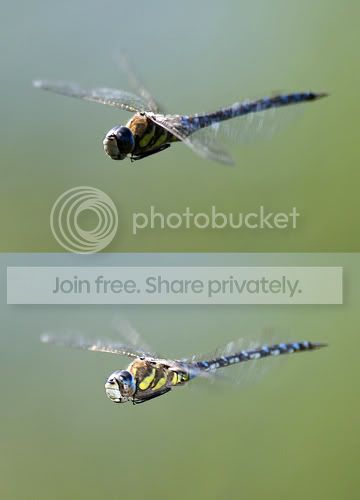
This example demonstrates how flash can help. The dragonfly was back lit by the sun and so I used fill in flash to add detail. The shot without flash is due to the flashgun running out of steam while firing a burst of shots.
RE using flash on birds (including Kingfishers) check out the RSPB image site, I think you will find their Kingfisher diving shots were made with flash. I would like to believe that they know right from wrong.

dragons.jpg
 
I thought that wildlife 'togs used flash, but as a catch light in the eyes of the animal in capture...

I am however, a flash n00b, so i may be terribly mistaken.
 
ime realy bad with flash i much prefer natural

but each to there own
 
I've not read this thread yet, and will be back to do so once I have finished reading the thread that caused this thread .. :thinking: If that makes sense.

This part I am posting is the rest of my reply to the other thread, that I didn't want to post there in fear of causing more argument on an image thread :thinking: Again, if that makes sense...

A FYI about using flash with Kingfishers. I called the Natural England office (I forgot the name, so that might be wrong, it's the guys that issue the licences) a little while ago after seeing some other photos taken with flash, of Kingfishers near a nest hole... in the breeding season. Once the guys got back to me after reviewing the pics, they told me that the licence holder had not broken any rules, and in fact using flash was perfectly acceptable.

However some of the other rules in force with the issuing of such licences, are keeping disturbance levels to a minimum. I for one can't imagine that being the case for even a minute when 5 flash units were being used that close (a 40mm shot :eek:). The fact that the OP says they didn't mind and kept coming back to fish (forget the exact words) tells me the opposite. If it kept on coming back, maybe that was because the poor thing was temporarily blinded on entering the water, so it then missed its prey, and had to fish over and over. Of course I could be 100% wrong there. I also personally think that the rules surrounding the issuing of licences need to be rethunk, to include a ban of flash on protected species.


I'll be back in a mo to finish off, and no doubt change my mind, as I normally do after hearing others opinions :lol:

OK, I'm back ...

Having read all posts on both I stand by my opinion.

+ If you see a protected species, in poor light. Why not return another day when there is better light (but only if you hold the correct licence or are on a reserve of course ;) ) Does it really matter more to you, to get the shot than to risk potential harm, whether temporary or permanent to the species you are photographing? Doesn't not doing so totally undo the whole purpose of licencing and a species being protected?

If you can seriously say you have no problems using flash for your photography of schedule 1 protected species. Then TBH you (IMO) should not have been granted a licence, as that looks to me like you are more concerned with getting the shot, then you are upholding a licence aimed at protecting a living creature (who has to do a whole lot more then order their groceries in from Tesco online to survive).

Another example. Peregrine Falcons eat and spend the energy gained in eating at a fast rate (I learned that from a talk at Banham Zoo ;)) and when in the wild, if they don't eat they run out of energy to find another meal .. then die. Are you telling me that you would get in the way of a Peregrine hunting, to get a shot using flash? What if the meal it was trying to get, was its last chance before it ran out of energy, and you standing there, suddenly triggering a flash put it off catching its meal? I don't know if that would happen, but I don't think anyone really does TBH. I do know that I wouldn't take the risk, as my love for animals is stronger than my love for photography :)

The other thing is that I believe NE and the RSPB may be a little slow on learning the true effects of flash being used. At the end of the day without extensive research, I don't think they can possibly know for sure that it doesn't effect the species. Considering Kingfishers are still in rapid decline (they were last time I checked anyway) I would have thought that it's best to put a stop to any activities with which they are not 100% sure of its effects. ** of course I could be wrong there again, and they have indeed done extensive, undoubtable research **

I really didn't mean to ramble so much :$
 
You don't know how close the flash was, just the remote camera that captured the image. To freeze motion, you often use flashes on reduced power to back the burst time short. I have never seen a reaction from an animal when flashed in daylight.

To get a shot like that in the original thread probably needed flash (i.e. it would not be possible to get that shot without). Therefore, minimum disturbance levels to get that shot were probably adhered to.

I don't know the OP but I do know the lengths you have to go to to get a Schedule 1 licence and so am sure he is an experienced and competant bird photographer (as also demonstrated by his images)

Part of the application is to demonstrate a track record of taking pictures and so I am sure the work was judged on that.

I think your line about reporting a previous set of pictures to English Nature and them deeming them to be ok is all the evidence we need. The people who's job it is to protect the widlife are happy with the approach and yet you then call for the rules to be changed. Are you a qualified field zoologist?

I think there is an awful lot of opinion on this thread but thanks for providing facts. The authorities are happy. Job done...
 
Oh dear... oh dear.

The NE and RSPB employ their own photographers, who obviously look at this issue wearing two hats - photographer and conservationist, so I don't think either organisation is short of information on which they're basing their judgement. :shrug:
 
Considering Kingfishers are still in rapid decline (they were last time I checked anyway)

Not according to the BTO...

The Kingfisher declined along linear waterways (its principal habitat) until the mid 1980s, since when it seems to have made a complete recovery. The decline was associated with a contraction of range in England (Gibbons et al. 1993). Kingfishers suffer severe mortality during harsh winters but, with up to three broods in a season, and up to six chicks in a brood, their potential for rapid recovery is unusually high.

and

Long-term trend
UK: fluctuating, with no long-term trend

and research showing a bounce back from the bad times they faced 20 years ago.

wbsalllkingf.gif


Hope that helps

Paul
 
Oh dear... oh dear.

The NE and RSPB employ their own photographers, who obviously look at this issue wearing two hats - photographer and conservationist, so I don't think either organisation is short of information on which they're basing their judgement. :shrug:

I think Cedric, you've summed up what I was trying to say but in your normal, diplomatic way!
 
Back
Top