Is there a difference between image making and photography?

It's probably not a weakness, but lack of experience. There's something very physically involving about hand printing IF you manipulate the image (if you don't then after a while it's just a bit of a drag). A bit like playing an instrumet instead of programming the music by midi, it requires you to get involved.

I suspect I wasn't clear in what I meant. What I don't understand at all is why people are so obsessed with the means used to achieve an end, rather than the end itself. It seems to particularly surface with an insistence that you have to "get it right in camera" and if you don't, you're cheating, being lazy, or it's simply not photography but pixel shifting. I can understand the effort (and the satisfaction) of achieving a predetermined result, whether in the darkroom (I got my first enlarger in 1961) or in Photoshop. What I can't understand is why anyone should worry about how the final image was obtained. That's my weakness - an inability to understand the mindset.

It reminds me of an encounter with another photographer whose working method was to get the image on the screen on the back of his camera exactly how he wanted it. He then, in front of his computer, took the raw file and adjusted it to exactly match the image on the back of his camera (which he had displayed in front of him while he worked). The final image had to match exactly; and he even admitted that my comment on one of his prints that if a certain area were slightly less bright, the image would be better, was true. But since that wasn't how it appeared in the jpg, he wouldn't do it. Purity triumphs over art. I still don't get it.

As to the level of skill needed to produce a Photoshopped image, if it were really all down to the skill of the proogrammer rather than the retoucher, then there wouldn't be professional retouchers who were paid to do the work. Rather as writing owes (I assume) rather more to the skill of the writer than the skill of the programmers who created the word processor used.
 
Last edited:
It may be true that everything that is done in photoshop could be done in the darkroom.

But don't pretend the same skill level is required. Manipulations that would require a huge skill level in the darkroom can be done easily in photoshop. A simple alt and click and I can clone anything unwanted out of my photo. Takes seconds to do, no skill to learn and is untraceable. Try doing that as easily in the darkroom.
 
It may be true that everything that is done in photoshop could be done in the darkroom.

But don't pretend the same skill level is required. Manipulations that would require a huge skill level in the darkroom can be done easily in photoshop. A simple alt and click and I can clone anything unwanted out of my photo. Takes seconds to do, no skill to learn and is untraceable. Try doing that as easily in the darkroom.

I disagree.

It's not as easy skill to master but it's achievable through patience and practice. Retouching, composites, burning, dodging, masking and grading, inter-negatives were all bread and butter techniques that we used to use back in the day and it was all taught in Technical Colleges up and down the country.

I know there is a passion for some people to experience photography pre-digitalisation, and that is also evident from the emerging number of retro cameras. Having been there and done that professionally I have no desires to return to the 80s. We have moved on and I prefer the new technology. I still struggle with some of the functions in Photoshop. My view is that the darkroom was easier. You know what you know, for me the darkroom was easy, photoshop is far more complex !
 
Last edited:
It's a different skill set Steve. I certainly don't have the skills to do things in the darkroom that can be done in photoshop.

I also don't have the skills to do the things in photoshop that some achieve. So I'm buggered really.

I'm largely with Stephen. The final image is what counts for me, and I don't care how it was achieved.

Actually, I don't care how anyone does anything. It's entirely up to them.

I'll admit to not understanding why some people choose to self impose restrictions, like the OP seems to. More power to them, but I don't understand it.

I understand exercises such as, today I'll shoot only jpegs and upload them with no processing, or today I'll only use a 35mm lens. All good exercises which I do myself, but to impose restrictions as a matter of course, I don't get. But, I have absolutely no objection to it. Everyone to their own. Whatever floats your boat.

What I do object to is people like the OP declaring their narrow, self restricted method of working and then inferring, or in the case of the OP more than inferring, that other methods of working are inferior.

It is arrogance beyond belief and, IMO misguided to the point of ignorance.

As for processing, I tend to agree with pookeyhead. It is often overdone, but only when it's for the wrong reasons.

If I was to take a standard landscape shot then, in post, block out the shadows and introduce a load of noise and blur, I might say "I was attempting to understand the scene through the eyes of my partially sighted partner." Totally valid IMO.

I might even say "I made the sky purple because I like purple and I wish the sky was that colour." Again, totally valid. People might not like it, but that's a different matter.

However, If I was to present the same image as the usual chocolate box pretty landscape with blocky shadows and noise from attempting to lift the dark areas, I should not be surprised to be criticised for it.

In short, do whatever the hell you like to achieve what you want. Listen to criticism because you might not be achieving what you thought you were. But don't worry if people like it or not.

As for the OP - I'm happy if your happy, but don't tell me what's right and what's wrong. I'll decide that for myself thanks very much.
 
I disagree.

It's not as easy skill to master but it's achievable through patience and practice. Retouching, composites, burning, dodging, masking and grading, inter-negatives were all bread and butter techniques that we used to use back in the day and it was all taught in Technical Colleges up and down the country.

I know there is a passion for some people to experience photography pre-digitalisation, and that is also evident from the emerging number of retro cameras. Having been there and done that professionally I have no desires to return to the 80s. We have moved on and I prefer the new technology. I still struggle with some of the functions in Photoshop. My view is that the darkroom was easier. You know what you know, for me the darkroom was easy, photoshop is far more complex !

Umm.... you disagree?

and then say it's not as easy skill to master but it's achievable through patience and practice.

All I'm saying is you can quickly and easily perform complex darkroom functions such as cloning with no skill, and no patience and no practice in photoshop

But what I think we can agree on as Simon says.... why does anyone care how an image is created... do what you want to get the image you want
 
Last edited:
i started in the "dark room" - a small bike store in Amstelveen in 1970 ?, and to some I'm still in a "dark room"

digital is far more creative by a country mile
 
Last edited:
Umm.... you disagree?

and then say it's not as easy skill to master but it's achievable through patience and practice.

All I'm saying is you can quickly and easily perform complex darkroom functions such as cloning with no skill, and no patience and no practice in photoshop

But what I think we can agree on as Simon says.... why does anyone care how an image is created... do what you want to get the image you want

What I disagree with was your comment about the darkroom being harder than Photoshop, for me it's the other way around. I have already commented that it doesn't matter which route you choose. It's the final image that's important in an earlier post this evening.
 
digital is far more creative by a country mile

Digital has more creative possibilities, I agree.

I'm reminded of the scene in Bill and Ted where Mozart is let loose on a modern electronic organ.

What would Dali do with a digital camera and photoshop?:eek:
 
Thinking of Dali. Film still has enormous creative possibilities. There was that picture he made with buckets of water and flying cats.

dali
by simon ess on Talk Photography

There's also the fact that the photos of Scott's, or was it Shackleton's, arctic expedition, were mostly composites. So, I still agree that digital probably has the edge for creative possibilities, I'm not so sure it's by a country mile.
 
Last edited:
That's cool, you're happy to use a software program created by somebody else to adjust your '0's and '1's.
I'll use chemistry to create my original printed images


I use Gimp. And I contributed to the development. I also use command line filters I wrote myself. Did you mine the elements that are in your developer stock?
 
All I'm saying is you can quickly and easily perform complex darkroom functions such as cloning with no skill, and no patience and no practice in photoshop

That's why Photoshop was invented. ;)
 
Thinking of Dali. Film still has enormous creative possibilities. There was that picture he made with buckets of water and flying cats.

dali
by simon ess on Talk Photography

There's also the fact that the photos of Scott's, or was it Shackleton's, arctic expedition, were mostly composites. So, I still agree that digital probably has the edge for creative possibilities, I'm not so sure it's by a country mile.


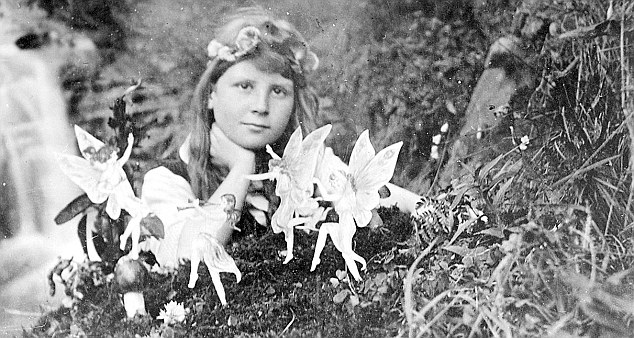
Fairies at the bottom of the garden?
article-0-06533BCB000005DC-539_634x338.jpg


Photography history is awash with composites, fake images etc.
 
What I don't understand at all is why people are so obsessed with the means used to achieve an end, rather than the end itself.

We have easy access to a wide range of digital images, and social media has become our way of communicating both our thoughts and visual references. Our need to create instant mementos and showcase them immediately almost to verify our very existence, shows that imagery and memory are now inextricably intertwined – we seem not to be able to free them from each other. If we don't have the images we haven't experienced the event, be it a concert, a meal at a restaurant or visiting a much photographed tourist attraction. Equally our earliest memories are often linked to a photograph. - Jillian Edelstein

An obvious example of this is the selfie the world leaders took at Mandela's memorial.

That's the difference with most people these days. It's image taking rather than image making.
 
It may be true that everything that is done in photoshop could be done in the darkroom.

But don't pretend the same skill level is required.


Whilst Photoshop actions originally copied darkroom techniques, they can go much further than you can do it in the darkroom. Plus there are things Photoshop can do which a darkroom can't

Whilst people have always manipulated images in the darkroom, the extent to which it is done and the availability to the general public is much higher with digital editing than it is with darkroom printing.

So yes, people did and still do manipulate in the darkroom but I don't recall seeing darkroom prints so far manipulated that they look like a home for unicorns!

Fairies at the bottom of the garden?

Perhaps that one then!!!


Steve.
 
Last edited:
Thinking of Dali. Film still has enormous creative possibilities. There was that picture he made with buckets of water and flying cats.

But that picture wasn't a composite, it was 'live' and took a lot of goes before they got it right. There is a website somewhere which shows the other takes.

There's also the fact that the photos of Scott's, or was it Shackleton's, arctic expedition, were mostly composites. So, I still agree that digital probably has the edge for creative possibilities, I'm not so sure it's by a country mile.

That was Frank Hurley, photographer for Ernest Shackleton's antarctic expedition. Previously he was a war photographer and would regularly print in more dramatic skies and stage dramatic scenes - something which is frowned upon in reportage today.

Episode_after_Battle_of_Zonnebeke_1918_Hurley.jpg


http://sploid.gizmodo.com/this-composite-photograph-from-wwi-is-better-than-most-1458519043

The difference is that before digital editing, these things were carried out by a small minority. Now it's the majority.


Steve.
 
Last edited:
But that picture wasn't a composite, it was 'live' and took a lot of goes before they got it right. There is a website somewhere which shows the other takes.

Wow! I didn't realise that. Thanks


The difference is that before digital editing, these things were carried out by a small minorito. Now it's the majority.


Steve.

Without a doubt.
 
Reportage and 'street' photography is supposed to be factual, real events depicted as they happen. Yet they're often in black & white, for extra authenticity, yet that is perhaps the biggest single distortion of reality.
 
Just to return to the very first point made:

Digital image making seems often, though not always, to be dominated by a significant amount of post processing.

I do find myself in agreement with this. I've read (and given) critique on other forums where the starting point is very often "how would you improve this in Photoshop?". Or, perhaps worse, without the last clause - it's just assumed to be there - and everyone chips in with processing suggestions and I find myself sitting in front of my screen screaming (silently :)) "NO, no, no. You should have moved to your right and fixed the composition" or something similar. I've even made comments that a change of viewpoint would have improved the result (and given reasons) only to find that what they want to know is how to do it in Photoshop.

I finally concluded that there is a significant number of people whose real hobby is digital manipulation. Fine, if that's what they like. I can appreciate digital art myself. But this isn't digital art. It's making a pigskin purse out of a sow's ear. And it passes in many circles as photography.

Note that this isn't a comment on the amount of post processing done - it's the reason for it - an end in itself almost.
 
Last edited:
And the chemistry is also an art to be harnessed. All the equivalent skill in Photoshop was done by a computer developer for you. No skill by you.
This morning I opened a photo in photoshop, after an hour there was no change.

I booked a call with Adobe support as it seems their programmers are failing to do anything with my image. The response was that apparently I have to choose which options to use, and which buttons to press, they're trying to tell me that I'm supposed to take responsibility for my own output using their software.

The question is, have I been ripped off? You're suggesting that it should be doing the work for me, and they're insisting I have to do it myself.

Later I'm going to shoot a roll of film. I chose it for it's colour palettes and latitude. When I've used it, I'll send it to a lab, where a machine will process it, then another machine will analyse the negatives and produce me a set of colour balanced and exposure corrected prints (all done in software). Can I be happy that the images will all be the product of my skill and not that of the film manufacturer or software developers or machine operators?
 
Last edited:
Reportage and 'street' photography is supposed to be factual, real events depicted as they happen. Yet they're often in black & white, for extra authenticity, yet that is perhaps the biggest single distortion of reality.

Yes & No nowadays most Reportage is shot in color,and a fair bit of street is,but in the early days their was not much color film about,and what was about was not fast enough for many years.
Also you could get some shots i:e wars with a lot of blood in the paper that maybe wouldn't get publish in color,i think people still shoot b/w white theses days because they feel it suit the subject :confused: to as why,i always shoot my street stuff & any photojournalism i did in the past in color :)
 
Colour!

(and from someone with a colour in his profile name too!!!).


Steve.
 
Last edited:
Volkswagen makes cars, how you drive them is up to you. Some are old cars that are harder to drive and newer cars have power steering and ABS but the idea is still to drive them from A to B. Bad drivers will always be bad drivers no matter what car they're in.

Personally i prefer to drive cars than talk about driving them, if you know what i mean.
 
  • Like
Reactions: PMN
Wet processing and darkroom processing is dependent on the skill of the artisan, not the programmer.
So is good photoshop work. You seem to have the wrong idea about what it is for. It is merely a tool not a cure for bad photography. As the saying goes "you can't polish a turd" a bad photograph is a bad photograph regardless of any amount of post processing. However, good photography and I mean in the technical sense is no substitute for vision and creativity. There are people who take perfectly exposed and focused photographs that are frankly rubbish. Without creativity you are simply a craftsman but with it you can be an artist. That's the difference and like it or not post processing is now and always has been a part of that creative process.
 
Fairies at the bottom of the garden?


Photography history is awash with composites, fake images etc.

Perhaps that one then!!!


Steve.


Lol.......nope, cardboard cutouts, the picture hasn't been altered, it is exactly what it looks like, a kid in a garden with cardboard fairies, I'm sure it looked magical to those viewing it a hundred years ago.
Sooner or later somebody's bound to come up with a genuine fake........a genuine fake.. ?? lol
What is it about PS that is the problem, I can't figure out from the thread if significant PS alteration or the proliferation of it, is the big hoo ha.....or both I dunno.
 
Whilst Photoshop actions originally copied darkroom techniques, they can go much further than you can do it in the darkroom. Plus there are things Photoshop can do which a darkroom can't

Whilst people have always manipulated images in the darkroom, the extent to which it is done and the availability to the general public is much higher with digital editing than it is with darkroom printing.

So yes, people did and still do manipulate in the darkroom but I don't recall seeing darkroom prints so far manipulated that they look like a home for unicorns!


Perhaps that one then!!!


Steve.

Exactly what I was trying to say but much better explained.

It doesn't devalue photoshop just because it is easier and I enjoy messing around with photoshop just as much as messing around in the darkroom. Sure there are incredibly talented digital artists who are skilled and create wonders way beyond my capability. But it's great that we have such powerful and easy digital editing for everyone to enjoy that is accessible and cheap.
 
All I'm saying is you can quickly and easily perform complex darkroom functions such as cloning with no skill, and no patience and no practice in photoshop

but you can't perform them seamlessly and well so they are indistinguishable with no practice and no skill - just as someone could read a book about darkroom techniques and then bodge about and produce half arsed attempts. but to do it well in either lightroom or darkroom takes practice and a certain aptitude
 
but you can't perform them seamlessly and well so they are indistinguishable with no practice and no skill - just as someone could read a book about darkroom techniques and then bodge about and produce half arsed attempts. but to do it well in either lightroom or darkroom takes practice and a certain aptitude

nah....unless they are an incompetent who doesn't know how to use a mouse anyone can be cloning well in PS in 10 minutes.
 
Wow! I didn't realise that. Thanks

It's Philippe Halsman, and yes.. one take.


i started in the "dark room" - a small bike store in Amstelveen in 1970 ?, and to some I'm still in a "dark room"

digital is far more creative by a country mile

Digital is neither creative, nor uncreative. I think you'll find it's the person using it that's either creative or not.
 
I honestly can't believe people are even arguing about this. Formats don't take photos, Photoshop and darkrooms don't make photos, the people using them do. If you feel film is more 'true' and works best for what you want to do then fine, don't use digital, but don't sit there in some kind of analogue ivory tower looking down on digital shooters like they're playing at being photographers but somehow missing the point. All you're doing is proving how little you actually understand photography.
 
Last edited:
I honestly can't believe people are even arguing about this. Formats don't take photos, Photoshop and darkrooms don't make photos, the people using them do. If you feel film is more 'true' and works best for what you want to do then fine, don't use digital, but don't sit there in some kind of analogue ivory tower looking down on digital shooters like they're playing at being photographers but somehow missing the point. All you're doing is proving how little you actually understand photography.

Bit of a leap from the comments in this thread to sitting in analogue towers and looking down on digital shooters. Not sure how you reach that interpretation.

I love what I can achieve in PS and how I can easily and creatively achieve results I could not dream of doing in a darkroom. Yes I'm saying PS is easier than darkroom (imo). But that's a good thing. Makes it more accessible and increases the scope of our vision.
 
Bit of a leap from the comments in this thread to sitting in analogue towers and looking down on digital shooters. Not sure how you reach that interpretation.

I love what I can achieve in PS and how I can easily and creatively achieve results I could not dream of doing in a darkroom. Yes I'm saying PS is easier than darkroom (imo). But that's a good thing. Makes it more accessible and increases the scope of our vision.

And likewise, I'm not sure why you're having such difficulty understanding my comment. We have someone implying those using digital have no skill and that all the work has been done by someone other than the photographer, to me that's a pretty damn big ivory tower.
 
Back
Top