IR conversions - insulation evaluation

who?

Suspended / Banned
Messages
1,608
Name
Mark
Edit My Images
Yes
There is a thread running on another forum I use about the possibility of using a digital IR image to evaluate the effectivness of insulation in a building.

Apparently the cameras being sold for this purpose come in around £4000. I've seen various pics on here which have been taken with IR converted cameras.

I dont know what the range of the conversions are (in K)

So the question is - can anyone provide me with a couple of IR pics of a house - taken at night so no solar radiation.

Thanks
 
An IR converted camera is different to the technology that you want. This IR used in thermal infrared imaging, or thermography, has a different wavelength, different sensors, and this long wavelength IR won't pass through the glass in our camera lenses.
 
Ahhhh.

Fair enough, thanks. I thought there ought to be a good reason for the price differential. I've never used an IR converted camera so I didnt know if I could take the intensity of the image as a temp guide. Obviously not.

thanks
 
I think it's also worth noting that IR conversions work better on older cameras. Apparently if the sensor picks up too much from the IR wavelength it can make photographs a bit soft so with every new generation of camera the IR sensitivity goes down by quite a bit. A lot of people into IR seem to use the Nikon D70 which seems to work particularly well (you can even get IR photographs without a conversions and just using a lens filter).
 
as an aside how do you do an IR conversion? it has always intrigued me as an idea, but i only have one body and can't afford another so its probably not viable
 
Puddleduck had some success with an unconverted Nikon D100 and an IR filter. IIRC he could use it without a tripod. Composition must have been a real challenge though.

To convert a camera, you remove the low pass filter (which filters out UV and IR) which sits over the sensor and replace it with one transparent to IR and opaque to visible light. Theres plenty of info on the Life Pixel website.
 
I think it's also worth noting that IR conversions work better on older cameras. Apparently if the sensor picks up too much from the IR wavelength it can make photographs a bit soft so with every new generation of camera the IR sensitivity goes down by quite a bit. A lot of people into IR seem to use the Nikon D70 which seems to work particularly well (you can even get IR photographs without a conversions and just using a lens filter).

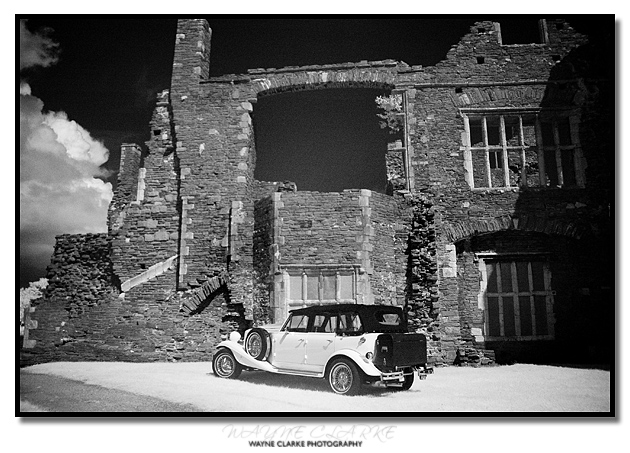
Yep I can testify to this, sadly I don't have access to the camera any more, but it worked a treat. Unmodified D70 with Kodak IR filter.
3199828032_8e5618ae14_o.jpg
Wayne
 
I'm sure I've seen converted bridge cameras on fleabay as well.
 
By all means try the IR filter route, however bear in mind that the heat radiation you may be trying to capture maybe outside the range of the chip you are using.
 
Heat radation? I missed that bit, ordnary digital cameras can't record that even with filters, you need a thermal imaging camera for that, totally different animal, and a LOT more expensive sadly. Wayne
 
Back
Top