Interesting new rules on pension auto enrolement coming out

Mr Bump

From under the bridge
Suspended / Banned
Messages
10,944
Name
Sophia aka Paul
Edit My Images
Yes
Individuals will continue to have the option to opt out of auto-enrolment if they wish, although in doing so they will not receive their employers’ contribution to their workplace pension.


The total minimum contribution for auto-enrolment is 2% of earnings – of which at least 1% must come from employers, 0.8% from employees and 0.2% from Government tax relief. The minimum contribution figures are set to increase both in April 2018 and April 2019 respectively:

From April 2018 – Minimum contribution for auto-enrolment will rise to 5% of earnings (of which a minimum of 2% must come from employers).

From April 2019 – Minimum contribution for auto-enrolment will rise to 8% of earnings – 3% from employers, 4% from employees and 1% from Government tax relief.
 
So which are the "new" rules?
 
Not "forced" you can always opt out. Look at it another way the more you put into a pension the bigger your pot will be. Could be you end up like me able to retire at 56.
 
Minimum of 8%?

So, if somebody doesn't opt out then at least 8% of their earnings goes into their pension? And employee's "contribution" will quadruple? Yeah, the pension system is broken.

I genuinely start to worry about all the self employed people who don't have any sort of pension - cos the state ain't going to pay for that golfing cruise lifestyle in Marbella.
 
Just to clarify, the increases in contributions in April 2018 and April 2019 aren't new. They've been on the table for at least a year. Maybe even longer, I wouldn't know. (I started my company's workplace pension scheme a year ago, and the phased increased in contributions was part of the initial briefing material.)
 
Minimum of 8%?

So, if somebody doesn't opt out then at least 8% of their earnings goes into their pension? And employee's "contribution" will quadruple?
Basically, yes. The amount that goes into the pension pot from 2019 is 8% of earnings, though only half of that comes directly from the employee. Obviously employers may decide to give lower annual pay rises on account of the increased contributions, so the employer's contribution may end up effectively coming from the employee too.
 
Not "forced" you can always opt out. Look at it another way the more you put into a pension the bigger your pot will be. Could be you end up like me able to retire at 56.

O I am already ahead of that mate I am a company director with a well and truly growing private pension.
I was more highlighting the element relating to how much the employers are now having to put in.
 
I've been conned by this bull in the last job. They made opting out almost impossible - only theoretically if you go on a bureaucratic crusade - and at the end of it I will have something like £100 pa. That's if the scheme provider doesn't go bankrupt. Final salary provision and every other perk seems to be long gone now.
 
I've been conned by this bull in the last job. They made opting out almost impossible - only theoretically if you go on a bureaucratic crusade...
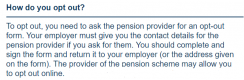
That's impressive work on behalf of your employers. Firstly because it makes no sense for them to make it difficult for you to opt out - if you're in they have to pay contributions and if you're out they don't. And secondly because opting out is supposed to be really easy - here's what the Pensions Advisory service says - and I think it would take a rare degree of bureaucratic skill to make this hard.
upload_2018-1-3_14-15-5.png
 
Basically, yes. The amount that goes into the pension pot from 2019 is 8% of earnings, though only half of that comes directly from the employee. Obviously employers may decide to give lower annual pay rises on account of the increased contributions, so the employer's contribution may end up effectively coming from the employee too.

Yes exactly. So....employee contrib quintuples (0.8% -> 4% - I mistakenly thought it was 0.8 ->3) and the employer's costs go from 1% -> 3%.

As you point out, that employer's extra could come from many sources but it's likely to come out of the bucket called "stuff we pay to staff", i.e. next year's payrise :D

The likely effect of this for most people will be a 5ish % pay cut (both actual and in decreased pay rise) which will hopefully pay for a future pension.

Again, I worry about the self employed who will either see a 5.2% pay cut or you know, just not bother with a pension.......
 
I am self employed and have been for 15 years so it all comes out of my pot but hey ho
 
I put 15% of my salary into my pension. It comes out before I get taxed, so works for me. With the rules requiring employer contributions we saw the usual rate of living increase scaled back to 1% last year when inflation was 3%, so I suspect they've taken the pension contributions into account.

I've been conned by this bull in the last job. They made opting out almost impossible - only theoretically if you go on a bureaucratic crusade - and at the end of it I will have something like £100 pa. That's if the scheme provider doesn't go bankrupt. Final salary provision and every other perk seems to be long gone now.

How little are you putting in for that amount?

Final salary pensions are unsustainable as people live longer. The one I have is seeing the pot get smaller and smaller before I ever get near to claiming.

I have a number of frozen pensions, both private and from previous jobs, plus the one I'm currently paying into.
 
@Byker28i Just a thought but we also had old pensions kicking around that were frozen, but you can have the value transferred to a new pension and merge old pension if it is beneficial.
Me and the wife did this for a few old ones and were surprised at how well it came out, they are now with much better providers doing well.
 
@Byker28i Just a thought but we also had old pensions kicking around that were frozen, but you can have the value transferred to a new pension and merge old pension if it is beneficial.
Me and the wife did this for a few old ones and were surprised at how well it came out, they are now with much better providers doing well.
Yeah I have a very good financial advisor (although I'm sure over the years I've paid for his Maseratti. I've commuted some and left others, juggled savings. My main worry is the amount of interest my main pot is earning, it seems too good to be true, although is lower than some I've seen.
I've turned into a low risk taker, so have several pots of proposed income.
 
I've been conned by this bull in the last job. They made opting out almost impossible - only theoretically if you go on a bureaucratic crusade - and at the end of it I will have something like £100 pa. That's if the scheme provider doesn't go bankrupt. Final salary provision and every other perk seems to be long gone now.
If you look at annuity rates of return they are criminal.
Basically whatever your "pot" is worth is divided by approx 21 years and that's how much you get per annum. So for example you have £10,000 and buy an annuity at age 66/67/68 or whatever age you retire, then they assume you're going to die at about 86 for a man in good health etc, divide the amount by the age difference, say 20 years and you get an annuity of £500pa. So basically if you meet expectations and live 20 years you get your money back, no interest paid to you that they have earnt on your pot, very little if any rise (unless you build it in) in annual payments and nothing for your partner/spouse and no guarantee of minimum payment (the last 3 can be added but all reduce the annual payment), conversely if you're overweight, ill or smoke like a chimney you might get a bit more pa.
Not a terrific return on investment is it, and they wonder why most people grab their pot and invest for themselves via draw-down.
Oh and dont forget you WILL be taxed on your payments at your then notional rate of income tax.

Matt
 
Assuming £20k a year income required for a comfortable standard of living for a couple, thats a £400k pot required. You can see why they say start saving for your pension early.
 
Assuming £20k a year income required for a comfortable standard of living for a couple, thats a £400k pot required. You can see why they say start saving for your pension early.
Is that on top of the state pension, currently the new pension might provide apprx £7500 pa assuming you have worked and paid NI contributions for sufficient years (contracted out years will affect this of course) to qualify for the full pension. Many people approaching state pensionable age will not qualify for a full pension. I worked from age 16 I'm 63 and despite never being out of work I dont qualify for a full pension (yet) as I havent worked enough years - I had 6 or so years contracted out. According to the Govt website I should have enough years already but my personal statement doesnt back that up, I need to work at least another 3 years or I can "buy" the missing years if I so wish (at £750 for each year).
Bear in mind also if you have an income of £20K you will pay tax on anything over the current personal allowance for a pensioner i.e. approx £10500 (I think) so £9500 will be taxed at 20% (assuming we are talking about an individual and not a couple).

Start saving! (Lots)
 
£159.55 a week on the current state pension, so nearly £8300 a year, payable for me when I reach 67. I'd like to retire at 60 but don't know if I'll make that
 
At present state pension is entirely separate.
One of the main reasons for me moving out of the company scheme was that under that scheme if I die my wife would only get half of my pension. Now having been through cancer twice and having had a heart attack, the likelihood is I will go before the wife does. That was also the reason I have decided to retire early, so I can make the most of whatever time I have left. The intention is to "live off the grid" for 18 months then start to drawn down on the pension. We won't be going on round the world cruises, but I reckon we will have enough to live on.
 
All sounds great Save for your Penstion but goverment's Move the Age around look what has happened to all the women that have lost thousands .
Rob.
 
All sounds great Save for your Penstion but goverment's Move the Age around look what has happened to all the women that have lost thousands .
Rob.
My wife was caught in that particular Govt backed scam, due to retire at 60, last year but now has to retire at 66 (we think) although in fairness she "retired" 3 years ago from her school job but is still employed and paying NI/Tax by my Ltd Co. so will have enough qualifying years next year but cant claim for another 4 years.
 
Is that on top of the state pension, currently the new pension might provide apprx £7500 pa assuming you have worked and paid NI contributions for sufficient years (contracted out years will affect this of course) to qualify for the full pension. Many people approaching state pensionable age will not qualify for a full pension. I worked from age 16 I'm 63 and despite never being out of work I dont qualify for a full pension (yet) as I havent worked enough years - I had 6 or so years contracted out. According to the Govt website I should have enough years already but my personal statement doesnt back that up, I need to work at least another 3 years or I can "buy" the missing years if I so wish (at £750 for each year).
Bear in mind also if you have an income of £20K you will pay tax on anything over the current personal allowance for a pensioner i.e. approx £10500 (I think) so £9500 will be taxed at 20% (assuming we are talking about an individual and not a couple).

Start saving! (Lots)

Yes, you get taxed on the income. But, you didn't get taxed on the money when you saved it. So it's not like you're taxed on it twice.
 
Do salary sacrifice on pension contributions, no tax payable on that and it effectively means you earn less, which has pros and cons. Good if you're near the change in tax rate, not good if you need to apply for a loan/mortgage maybe.
 
Yes, you get taxed on the income. But, you didn't get taxed on the money when you saved it. So it's not like you're taxed on it twice.
True :)
 
Do salary sacrifice on pension contributions, no tax payable on that and it effectively means you earn less, which has pros and cons. Good if you're near the change in tax rate, not good if you need to apply for a loan/mortgage maybe.
You don't need to do a salary sacrifice though. Just pay into your pension pot and claim the tax back when you do your self-assessment tax return. All the pros and none of the cons.
 
You don't need to do a salary sacrifice though. Just pay into your pension pot and claim the tax back when you do your self-assessment tax return. All the pros and none of the cons.
I don't do self assessment, although my wife does it that way
 
You don't need to do a salary sacrifice though. Just pay into your pension pot and claim the tax back when you do your self-assessment tax return. All the pros and none of the cons.
Only issue with this is will you not have paid NI on the pension contributions which you will not get back from the self assessment?
 
Only issue with this is will you not have paid NI on the pension contributions which you will not get back from the self assessment?
Oh yes, good point, I forgot about that.
 
£159.55 a week on the current state pension, so nearly £8300 a year, payable for me when I reach 67. I'd like to retire at 60 but don't know if I'll make that

I'd rather buy some bitcoin and something else and yet something else (a mixed bag of investments) for that money rather than rely on this. That's what the pension companies do. If they go bust you will get nothing, so you may as well take the risk yourself.
 
Do salary sacrifice on pension contributions, no tax payable on that and it effectively means you earn less, which has pros and cons. Good if you're near the change in tax rate, not good if you need to apply for a loan/mortgage maybe.
Wouldn't have thought it would matter too much as they usually ask how much disposable income you have.
 
I'd rather buy some bitcoin and something else and yet something else (a mixed bag of investments) for that money rather than rely on this. That's what the pension companies do. If they go bust you will get nothing, so you may as well take the risk yourself.
My employer basically is the pension company. It invests most of the money in itself. Any shortfall in the pension scheme it tops up itself too.
If I decide to retire early I will take a maximum untaxable lump sum. Then I will have an enhanced monthly payment which would include my state pension if I were getting it. When my state pension starts, my monthly company pension payment will be reduced accordingly.
 
Wouldn't have thought it would matter too much as they usually ask how much disposable income you have.

If you are a regular employee this could probably mean a difference between a nicer camera or a better holiday package. As someone also self-employed you can use the money as a lot better (or worse for that reason) investment.
 
If you are a regular employee this could probably mean a difference between a nicer camera or a better holiday package. As someone also self-employed you can use the money as a lot better (or worse for that reason) investment.
Wouldn't make any difference to me really I don't tend to borrow money. I just do a bit of overtime and use that added to my basic surplus income. Back in September was the first time I borrowed any money in about 20yrs.


Just worked out my pension contributions and it works out at around 9% of my basic wage. It's probably 8% If I don't include shift allowances on my basic pay.
 
Last edited:
I'd rather buy some bitcoin and something else and yet something else (a mixed bag of investments) for that money rather than rely on this. That's what the pension companies do. If they go bust you will get nothing, so you may as well take the risk yourself.
1) bitcoin is going to seriously crash soon as it has no underlying value to support the price.

2) if any pension provider goes bust, the pension fund is taken over by the pension industry and you lose little if anything. Happened to my Golden Wonder pension which is currently doing quite well.
 
My wife was caught in that particular Govt backed scam, due to retire at 60, last year but now has to retire at 66 (we think) although in fairness she "retired" 3 years ago from her school job but is still employed and paying NI/Tax by my Ltd Co. so will have enough qualifying years next year but cant claim for another 4 years.

Wasn't it widely publicised in the 1990s that pension equality was happening? I was a child back then and I remember it.
 
I worked from age 16 I'm 63 and despite never being out of work I dont qualify for a full pension (yet) as I havent worked enough years - I had 6 or so years contracted out.

Isn't it 30 yrs needed to qualify for a full pension? Seems strange your statement says you're short if you've got nearly 40 yrs in.
 
Wasn't it widely publicised in the 1990s that pension equality was happening? I was a child back then and I remember it.
Can't recall exactly when but it was caused by feminists demanding equal status for men and women and they hoped it would mean both retired at 63 instead it was raised to 65 and then raised again for both depending on when you were born and of course again since then. Bear in mind that many women had started their working lives expecting to retire at 60 and now for those women it has been raised 6 or 7 years whereas for the men only 1 or 2 years, is that fair?
 
Isn't it 30 yrs needed to qualify for a full pension? Seems strange your statement says you're short if you've got nearly 40 yrs in.
35 to qualify for a full new pension when it comes in. I had a few years contracted out and a couple of years where they have lost my contributions but as they are so long ago I cannot now challenge their decision as to what years don't qualify despite I have the facts for my contracted out years, they say 9 I say and I can prove it's only 6 and I can't prove the years they say I didn't pay enough but as I said it's now too long ago to appeal. If you don't have a minimum of 10 years contributions you get nothing.
 
Last edited:
Can't recall exactly when but it was caused by feminists demanding equal status for men and women and they hoped it would mean both retired at 63 instead it was raised to 65 and then raised again for both depending on when you were born and of course again since then. Bear in mind that many women had started their working lives expecting to retire at 60 and now for those women it has been raised 6 or 7 years whereas for the men only 1 or 2 years, is that fair?

Sounds fair to me.
 
Back
Top