Image Stabilisation - your thoughts on it?

Soulman

Suspended / Banned
Messages
1,070
Name
Des
Edit My Images
Yes
Ok, I'm a Canon user so any IS has to be lens based and this comes with quite a price premium (£500 on the the 70-200's) and this has made me think of how much people use/rely on it to help get shots...

None of my lenses feature it and I personally wouldn't spend the extra on the 70-200 for IS, my reasoning, I'm pretty steady and can get shots consistently at 1/2 the focal length in terms of shutter speed (1/30th at 70mm) and if I'm using the longer focal lengths in poor light I'll boost ISO or put it on a tripod/monopod. As for a standard lens I once again would rather have a cheaper 24-105 without IS and stick it on a support or steady myself at slower speeds.

What makes it essential for those who rely/use it a lot? I'm not trolling or looking to stir up trouble, I'm genuinely interested in the reasons for kit choice and the way that people use technology and IS is one I don't get but see it used a lot so other people do.
 
Ok, I'm a Canon user so any IS has to be lens based and this comes with quite a price premium (£500 on the the 70-200's) and this has made me think of how much people use/rely on it to help get shots...

None of my lenses feature it and I personally wouldn't spend the extra on the 70-200 for IS, my reasoning, I'm pretty steady and can get shots consistently at 1/2 the focal length in terms of shutter speed (1/30th at 70mm) and if I'm using the longer focal lengths in poor light I'll boost ISO or put it on a tripod/monopod. As for a standard lens I once again would rather have a cheaper 24-105 without IS and stick it on a support or steady myself at slower speeds.

What makes it essential for those who rely/use it a lot? I'm not trolling or looking to stir up trouble, I'm genuinely interested in the reasons for kit choice and the way that people use technology and IS is one I don't get but see it used a lot so other people do.


I think its more of a safety net. You know if you have IS and a decent AF you can pretty much get the shot you want most of the time even handheld at high shutter speeds.

I'm on the fence with this oone to be honest as i have had IS and now i'm playing with old manual lenses with no is. I also mentioned in a previous thread debate that before IS people still got the shot they needed.

Interesting though.
 
As someone with very shaky hands, it's quite useful. That said, daresay I could find a way around it.
 
One thing about IS that I think some people overlook is that sometimes you want a slow shutter speed and having IS allows you to get that shot at 1/2 second without messing about with a tripod. Its not perfect and I dont like how it takes a second to kick in before you take the shot sometimes but in most cases you can work around it.

Another thing is when using longer focal lengths for candid portraits you can set your shutter speed at 1/60 and then let the IS keep it still enough for you to get the shot, something that is harder to do on a lens without IS, especially when you are close to or at 200mm.

Is it worth an extra £500? Well that entirely depends on the type of pictures you take, for sports or fast action I would say no, but for low light pictures maybe, depending on circumstances. Its a decision you will have to make yourself, but if you have never used IS, I would say try it out before you completely dismiss it.
 
The extra dosh is not just for IS. Using the Canon 70-200mm f4 as an example in the link below you will see there is more glass in the IS version making it an arguably sharper lens.

compare the 70-200mm f4
 
Sometimes you don't want to drag a tripod or monopod around (day out with the family or on holiday). Sometimes you aren't allowed to use a tripod at all (museum, busy streets). Sometimes you don't have time/opportunity to set up a tripod and must grab a hand held shot as quickly as you can (candids). Some people are less able than others to hold a camera steady. Sometimes you want to pan and you need freedom from restriction on movement, but with a bit of help to avoid unwanted shake. Sometimes you want to print large or crop hard and the "shutter speed >= 1 /(focal length x crop factor)" guideline won't cut it.

Maybe on a moderate telephoto or short lens there is less need for IS, but with a longer lens such as 70-200 and longer it could be a tremendous asset. I remember once going out for a walk with the family and taking my 1D3 and 70-200 to shoot some candids while taking the dog for a walk through the woods. To begin with I was getting terrible results, wondering what on earth was up with my focusing and/or my technique. It wasn't until 20 minutes or so into the walk that I discovered that my IS was turned off. Once I'd sorted that the keeper rate shot up.

I use IS when it's helpful. I turn it off when it is not. The tripod is reserved for occasions when IS alone is not the answer. Horses for courses.
 
Last edited:
I don't think that there's any serious doubt that you can hand hold with IS at much lower shutter speeds than you can without it.

To me IS can only be a benefit not only because it allows hand held shooting at lower shutter speeds but also because it gives the photographer more choice over hand holding or tripod shooting, shutter speed, ISO setting, aperture and depth of field.

I think that whatever is true for telephoto lenses is also true at least to an extent at all focal lengths. All that varies is the size and weight of the lens and the size of the image in the frame. Camera shake may be more obvious at 300mm but I disagree that IS is not needed at shorter focal lengths as at 50mm or even 10mm the problem of hand holding at low shutter speeds still exists but a degree of shake could be hidden by the size of the subject in the shot, the framing and the composition, zoom in though and it could well be there if the shutter speed is too low. Shorter focal length errors are perhaps particularly relevant for high mp count cameras if pixel peeping or cropping.

Anything that gives the photographer more control and more creative options has to be a good thing and if I had the choice all of my lenses would have IS. The sad fact is though that IS versions simply don't exist. Of course in body IS would be the answer for my existing non IS lenses.
 
Last edited:
I've got a steady hand (I'm a former international grade rifle shooter where it is important) but bought the 70-200 F4 IS (initially for the weather sealing which the non-IS models don't offer). I think it is a brilliant feature, I can get very very slow with IS on (handholding at 1/2 second) on shots where a tripod is not viable.
 
Thanks for the replies guys, I've owned IS lenses before (24-105 and 70-200) and left it on most of the time, the reason I posed the question was because I don't seem to get many less keepers than with.

Fair point about the cost being not just IS.

Looking at the replies part of it is the type of shooting I do, I can see the benefits sometimes but for the vast majority of my shooting I'm outside in good enough light, carry a beanbag or take a tripod for a particular shoot (when in the past I would turn IS off).

I like the idea of in body IS for some reason more than a lens based system, go figure!
 
I'd say I have pretty steady hands but I can still get slower shutter speeds with IS enabled and keep them sharp. Going from 4/3 to Nikon and Panasonic micro 4/3 I do miss the in body IS as I got used to thinking of shutter speed/focal lengths with IS enabled particularly on primes where there's no IS option available. I do find the lens based IS better for the long focal lengths as I find I can get surprisingly good shots from the Panasonic 100-300mm lens, I struggled at the longer end of those focal lengths with the E-3's in body IS. Of course technically it is possible with micro 4/3 to have both versions of IS available with an Olympus micro 4/3 body but on balance I prefer the Panasonic bodies even if it means losing on board IS.

John
 
Ok, I'm a Canon user so any IS has to be lens based and this comes with quite a price premium (£500 on the the 70-200's) and this has made me think of how much people use/rely on it to help get shots...

None of my lenses feature it and I personally wouldn't spend the extra on the 70-200 for IS, my reasoning, I'm pretty steady and can get shots consistently at 1/2 the focal length in terms of shutter speed (1/30th at 70mm) and if I'm using the longer focal lengths in poor light I'll boost ISO or put it on a tripod/monopod. As for a standard lens I once again would rather have a cheaper 24-105 without IS and stick it on a support or steady myself at slower speeds.

What makes it essential for those who rely/use it a lot? I'm not trolling or looking to stir up trouble, I'm genuinely interested in the reasons for kit choice and the way that people use technology and IS is one I don't get but see it used a lot so other people do.
We all shoot differently I guess.... When in a low lit church, try getting a sharp image at 1/30th with a 70-200 at 200mm....... IS allows that!
 
I think with the 70-200 2.8 the IS version is weather sealed as well as being sharper. Also the price difference between a s/h non-IS and the IS mk I version is only £200-£250 or so.
 
I feel lucky that I use a system with the IS built in to the body, I can stick on a 50mm made in 1974, I can dial in '50mm' in to the IS settings in a few seconds, and I'm good to go.

There are loads of shots I have taken where the IS has saved the shot, especially using a kit lens in low light, unless you want to bump the ISO up even more, the IS works brilliantly.

It can be turned off at the press of a button, my camera also has a panning mode so it only corrects vertical movement, allowing to get horizontal movement like a passing car, to be properly photographed.
 
For a long lens such as the 70-200 I would always go with the IS version.

IS isn't perfect and if you have shaky hands you will still get the odd blurred shot, but it's a decent safety net and allows much lower shutter speeds.
 
it depends what you shoot at the end of the day..

to be honest ive never missed it on any of the lenses ive had (50mm, 70-200mm, 120-300mm etc) but then i mainly shoot sports so wouldnt use it anyway.
 
I think its a very useful tool to have available to you. Especially at lengths above 70mm. You do need, as with any other tool, to understand its limitations, but certainly its useful to have. I think below 70mm its alot less useful
 
I only have it on my 150-500 but when hand holding it is superb. I mostly take photographs of wildlife with it and in a hand held situation it is invaluable. I always turn it off when the lens is supported though. Otherwise I never miss it in my other lenses and just make sure I keep the shutter speed up. IS can't help when the subject is causing the blur! ;)
 
I think its a very useful tool to have available to you. Especially at lengths above 70mm. You do need, as with any other tool, to understand its limitations, but certainly its useful to have. I think below 70mm its alot less useful

i disagree. Try handholding in a dark church at 1/30th sec using a 24-70..... It's tough.... The 24-105 IS will still get a sharp image (without subject movement) down to a stop or more less.... So even with the f4 max aperture it's still able to shoot in these tough conditions.

IS will help at any focal length although I appreciate the effect may be less at much wider focal lengths.
 
As in the posts above really it has it's uses and sometimes is the difference between a shot or missing it.

I do sometimes feel a bit narked as my FIL has it on the body, so any lens he uses can have the IS system applied to it.
 
i disagree. Try handholding in a dark church at 1/30th sec using a 24-70..... It's tough.... The 24-105 IS will still get a sharp image (without subject movement) down to a stop or more less.... So even with the f4 max aperture it's still able to shoot in these tough conditions.

IS will help at any focal length although I appreciate the effect may be less at much wider focal lengths.

but if you're shooting in a dark church at 1/30 then you're going to lose a high % of shots due to subject movement which is one thing any sort of VR/IS can't help with. I'd venture that a higher % of you shots would be lost at that shutter speed, with a 24-70 then you'd gain by having IS.
 
Last edited:
but if you're shooting in a dark church at 1/30 then you're going to lose a high % of shots due to subject movement which is one thing any sort of VR/IS can't help with. I'd venture that a higher % of you shots would be lost at that shutter speed, with a 24-70 then you'd gain by having IS.

Agree with this generally. I guess where it becomes useful is weddings etc. where people are standing still (maybe shaking a bit too :lol:).
 
IS is clearly not the answer to everything and a nice fast prime can often get the job done in dim lighting particularly with moving subjects.

That said, I would NEVER consider a long FL lens again without IS.

Given the generally dreary weather recently I have been struggling to get shutter speeds up above 1/200th of a second at iso 1600 and at f5.6 for my wildlife shots using either a 1Ds2 or 60D. Also given that I'm not keen on tripods it would make my 600 plus TC combination fairly useless without the loveliness of IS.

OOI, I used a Sigma 500f4.5 for a couple of years and found it just was not practical to use due to motion blur in the images for many Winter days with their associated grey, dark, leaden skies. The added cost of IS is considerable on longer lenses but makes them soooo much more useable.

I also shoot a few gigs where the lighting is dim and would add that I have used 70-200f2.8 IS mark 1 and 2 lenses on ocassion and I personally think it is worth the added expense for the mark 2 version for the improved IS alone.

I would say that my hand is as steady as most.

Just my 2p worth.
 
It's very handy with a long lens when trying to shoot prop planes at slow shutter speeds. Here's a 100% crop at 400mm and 1/160....

20110309_134200_000.jpg


Given the size of a 5D2 image displayed at 100%, which on most monitors would be 40" across or greater, the recommended minimum speed for an acceptably sharp hand held shot at 400mm would be 1/1600. I think IS may have helped me out a little on this one. :)

Or there's this shot, hand held at 560mm (728mm FOV) and 1/80 on a 1D3. Not perfect (could be a little bit of focus error or subject shake/movement), but I'm pretty sure an improvement over the results without IS.

20110309_135853_000.jpg


As a 100% crop viewed on my monitor the recommended minimum hand held speed without IS would be faster than 1/2000, so at 1/80 the performance is kind of passable, I think.
 
but if you're shooting in a dark church at 1/30 then you're going to lose a high % of shots due to subject movement which is one thing any sort of VR/IS can't help with. I'd venture that a higher % of you shots would be lost at that shutter speed, with a 24-70 then you'd gain by having IS.

Not really - i didn't mention taking shots of people but even so, when the couple are standing at the alter it's surprising how little movement there is. Sure when they start walking I may need to change exposure a bit and add a bit of flash - but even the 24-70 may need to do that in such dark conditions too.... there is a fine line and both have good/bad points but IS is still very useful in low light at focal lengths at 70mm and lower.
 
Not really - i didn't mention taking shots of people but even so, when the couple are standing at the alter it's surprising how little movement there is. Sure when they start walking I may need to change exposure a bit and add a bit of flash - but even the 24-70 may need to do that in such dark conditions too.... there is a fine line and both have good/bad points but IS is still very useful in low light at focal lengths at 70mm and lower.

I made an assumption you were talking about people - but its not just the couple you shoot, the congregation, the kids in it etc etc........I'd still maintain that at 1/30 any sort of subject movement is an issue.

we'll politely agree to disagree how useful IS is at those short focal lengths
 
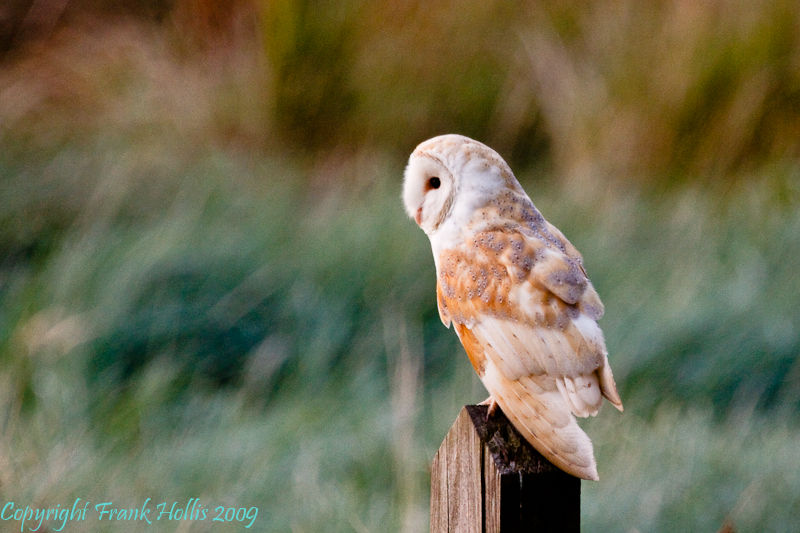
Here's my favourite example of IS. It was at a friend's house when her local Barn Owl perched on the garden fence. I had my 300 f2.8 with a 2xTC next to me so, not really expecting much, I grabbed a few shots before it flew off. I didn't have time to change anything, so it was at the same settings I'd been using earlier (ISO800, AV, wide-open). Now this is at 600mm. The rule of thumb suggests that I needed to shoot at 1/(600x1.6) which is around 1/1000s. I ended up 5 stops slower at 1/30s. A combination of luck, technique and IS meant I could get a shot that my friend thought was fantastic - her Barn Owl on her fence. All three of those factors were essential for the shot.

Barn%20Owl%2020090909%20001.jpg
 
I made an assumption you were talking about people - but its not just the couple you shoot, the congregation, the kids in it etc etc........I'd still maintain that at 1/30 any sort of subject movement is an issue.

we'll politely agree to disagree how useful IS is at those short focal lengths

I agree that subject movement is a consideration though. No problem having a difference of opnion - I'd say wider than 30mm the effects are much less. Shooting slow at anything over around 30mm and you will struggle to get sharp images without IS....
 
I made an assumption you were talking about people - but its not just the couple you shoot, the congregation, the kids in it etc etc........I'd still maintain that at 1/30 any sort of subject movement is an issue.

we'll politely agree to disagree how useful IS is at those short focal lengths

I agree that subject movement is a consideration though. No problem having a difference of opnion - I'd say wider than 30mm the effects are much less. Shooting slow at anything over around 30mm and you will struggle to get sharp images without IS.... This also depends on the camera you use as a crop camera will increase the effects of camera shake....
 
I see it as a nice bonus but not something I'd spend much extra on, nor would it likely sway my decision on a lens too much. However, I only shoot short focal lengths, and have a very steady hand as it is.

I would say it is very valuable in certain applications, and there ARE times I'd wished my 17-40 had IS, if alone for the ability to use a longer shutter speed and create movement effects, while the rest of the image stays sharp. You can't do that as well with high ISO (shutter speed goes up) or low aperture (too little DOF), and a tripod is not always practical to be carrying around.
 
Last edited:
The main benefit for me is panning shots. A smooth pan and IS to restrict vertical movement can give great results. A also use IS with my longest lenses on a tripod as it can help to steady wind vibrations.
 
Back
Top