
and please use their services
You are using an out of date browser. It may not display this or other websites correctly.
You should upgrade or use an alternative browser.
You should upgrade or use an alternative browser.
If I could turn back time ...
- Thread starter Cobra
- Start date

 on Saturday night as I have an extra hour to sleep it off. Rugby World Cup final on tele too, win, win.


garryknight
Suspended / Banned
- Messages
- 12,452
- Name
- Garry
- Edit My Images
- No
Somebody should notify Cher... 
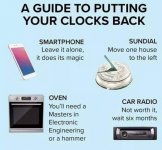
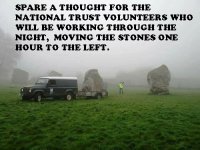

- Messages
- 5,988
- Name
- Heather
- Edit My Images
- Yes
I haven't worked out how to alter the cat yet. 

JohnC6
Suspended / Banned
- Messages
- 11,799
- Name
- John
- Edit My Images
- Yes
Oddly enough I was going to post about this and ask if anyone thinks we should leave it as it is. But first off...very important. Don't forget the car dashcam. If you have an incident recorded on it..eg a near-miss,reckless driving, traffic light incident etc.. it's important that the time is correct. We have a Nextbase..had it about three years and I thought it would auto change (GPS) but it doesn't.
Dated March 27th last year.
 www.express.co.uk
From the article " A poll taken by smart light company 4lite shows that 75.8 percent of British voters would like to see the practice scrapped, while only 11.6 percent wanted to keep the clock change, and 12.6 percent were undecided.
The Royal Society for the Preventioin of Accidents -RoSPA -say that more people are killed on the roads during GMT hours. So many people say that the days are longer (BST) or shorter GMT but, of course, it's just daylight hours.
From RoSPA..
On weekdays most accidents occur between 0800-1000 and 1500-1900.Road casualty rates increase with the arrival of darker evenings and worsening weather conditions. Every autumn when the clocks go back and sunset occurs earlier in the day, road casualties rise. The effects are worse for the most vulnerable road users like children, the elderly, cyclists and motorcyclists. According to 2019 casualty figures from the Department for Transport, pedestrian deaths increased slightly from 33 in September to 36 in October, rising to 54 in November, and 57 in December. This shows how as the evenings get darker, the risk of an RTC increases, especially for vulnerable road users. The casualty rate for all road users increased from 427 per billion vehicle miles in October to 479 per billion vehicle miles in November.
In addition: Motorists are more tired after a day's work and concentration levels drop. In the morning children go straight to school but after school tend to not go straight home thus exposing themselves to increased road danger. Adults tend to go shopping or visit friends after work, increasing their journey times and exposure to road dangers and people generally go out to socialise in the evenings.
Does anyone remember this ? In 1968, there was a three-year experiment when BST was retained all year round. The clocks were advanced in March 1968 and were not put back until October 1971. It provided an opportunity to evaluate the effect of discontinuing clock changes on road traffic casualties.
Results: It refers to British Standard Time. That was changed to British Summer Time in 1972...after the experiment.
Road casualty figures during the morning (7:00 am – 10:00 am) and afternoon (4:00 pm – 7:00 pm) for the period affected by time change in the two winters (1966/67 and 1967/68) before the experiment and in the first two winters (1968/69 and 1969/70) when BST was retained were analysed. The data showed that keeping British Standard time had resulted in an 11% reduction in casualties during the hours affected by the time change in England and Wales and a 17% reduction in Scotland. The overall reduction for Great Britain was 11.7%. Although casualties in the morning had increased, the decrease in casualties in the evening far outweighed this.
Overall, about 2,500 fewer people were killed and seriously injured during the first two winters of the experiment. However, it must be noted the 1968/71 experiment coincided with the introduction of roadside breath tests and the 70mph speed limit, which may have affected the casualty reduction figures.
Older people would benefit from year-round BST. Health and well-being would increase as peoople,especially the young, would be able to indulge in activities for longer. It would bring a boost to tourism, the Leisure and Hospitality industry.
Dated March 27th last year.
Britons vote keep Daylight Saving Time permanent
AS BRITS move into Daylight Saving Time this week, new research shows the UK public want annual clock changes to be scrapped, allowing more daylight hours during the winter months.
www.express.co.uk
From the article " A poll taken by smart light company 4lite shows that 75.8 percent of British voters would like to see the practice scrapped, while only 11.6 percent wanted to keep the clock change, and 12.6 percent were undecided.
The Royal Society for the Preventioin of Accidents -RoSPA -say that more people are killed on the roads during GMT hours. So many people say that the days are longer (BST) or shorter GMT but, of course, it's just daylight hours.
From RoSPA..
On weekdays most accidents occur between 0800-1000 and 1500-1900.Road casualty rates increase with the arrival of darker evenings and worsening weather conditions. Every autumn when the clocks go back and sunset occurs earlier in the day, road casualties rise. The effects are worse for the most vulnerable road users like children, the elderly, cyclists and motorcyclists. According to 2019 casualty figures from the Department for Transport, pedestrian deaths increased slightly from 33 in September to 36 in October, rising to 54 in November, and 57 in December. This shows how as the evenings get darker, the risk of an RTC increases, especially for vulnerable road users. The casualty rate for all road users increased from 427 per billion vehicle miles in October to 479 per billion vehicle miles in November.
In addition: Motorists are more tired after a day's work and concentration levels drop. In the morning children go straight to school but after school tend to not go straight home thus exposing themselves to increased road danger. Adults tend to go shopping or visit friends after work, increasing their journey times and exposure to road dangers and people generally go out to socialise in the evenings.
Does anyone remember this ? In 1968, there was a three-year experiment when BST was retained all year round. The clocks were advanced in March 1968 and were not put back until October 1971. It provided an opportunity to evaluate the effect of discontinuing clock changes on road traffic casualties.
Results: It refers to British Standard Time. That was changed to British Summer Time in 1972...after the experiment.
Road casualty figures during the morning (7:00 am – 10:00 am) and afternoon (4:00 pm – 7:00 pm) for the period affected by time change in the two winters (1966/67 and 1967/68) before the experiment and in the first two winters (1968/69 and 1969/70) when BST was retained were analysed. The data showed that keeping British Standard time had resulted in an 11% reduction in casualties during the hours affected by the time change in England and Wales and a 17% reduction in Scotland. The overall reduction for Great Britain was 11.7%. Although casualties in the morning had increased, the decrease in casualties in the evening far outweighed this.
Overall, about 2,500 fewer people were killed and seriously injured during the first two winters of the experiment. However, it must be noted the 1968/71 experiment coincided with the introduction of roadside breath tests and the 70mph speed limit, which may have affected the casualty reduction figures.
Older people would benefit from year-round BST. Health and well-being would increase as peoople,especially the young, would be able to indulge in activities for longer. It would bring a boost to tourism, the Leisure and Hospitality industry.


jerry12953
Suspended / Banned
- Messages
- 12,421
- Name
- Jeremy Moore
- Edit My Images
- No
I'd vote for BST all year round.......




- Messages
- 49,339
- Name
- Nod (UK)
- Edit My Images
- Yes
Most of my devices do it automatically.
That's part of the problem! It's the few that don't change that catch me out a few days (or even weeks!) later.

hunnymonster
Suspended / Banned
- Messages
- 2,263
- Name
- Jason
- Edit My Images
- Yes
I'd go for this too - If you want to have more time in the light in the morning, get up earlier. If you want light further into the evening stay up later.GMT for me, even in Summer! (Except when we're on Greek time, of course.)
Other than serious terraforming: at midsummer at 56°N you get about 17½ hours of sunlight; midwinter you get about 8½ - no amount of fiddling with the hands on a clock will change that.
The country is on the prime meridian, how about bigging that up? - how about smearing the time people start work - yes you'd have a longer rush hour, but it wouldn't be as intense...
BTW anyone goes to the Royal Observatory at Greenwich and stands on the line in the park that is the actual prime meridian will find themselves about 100m away from the GPS prime meridian.
- Messages
- 49,339
- Name
- Nod (UK)
- Edit My Images
- Yes
Doesn't that depend on which datum you're using? https://en.wikipedia.org/wiki/Ordnance_Survey_National_Grid#Datum_shift_between_OSGB_36_and_WGS_84
hunnymonster
Suspended / Banned
- Messages
- 2,263
- Name
- Jason
- Edit My Images
- Yes
OSGB is different again. The "real" definition from the conference in 1884 said the prime meridian passes through the centre of the transit instrument of the Greenwich observatory...
The johnny-come-lately WGS84 (1984...) ellipsoid model or the globe is based on the meridian being 5.3 arcseconds E (102m)
OSGB36 is all about fitting a square grid for the purposes of the GB grid - it's a projection (ie a 2D representation of the 3D earth) - you can see that the further away you get from the datum point for this projection (off Newlyn) the more divergent the lines of latitude & longitude are from the perpendicular/parallel that they are near the datum point
The johnny-come-lately WGS84 (1984...) ellipsoid model or the globe is based on the meridian being 5.3 arcseconds E (102m)
OSGB36 is all about fitting a square grid for the purposes of the GB grid - it's a projection (ie a 2D representation of the 3D earth) - you can see that the further away you get from the datum point for this projection (off Newlyn) the more divergent the lines of latitude & longitude are from the perpendicular/parallel that they are near the datum point

OP

- Messages
- 114,434
- Name
- The real Chris
- Edit My Images
- No
I wish my internal clock would catch up.
Its ( only?) half 4 and I'm getting hungry ...
Oh and yes, I do wish they would leave the damned clocks alone.
Not fussed whether its BST or GMT TBH
Its ( only?) half 4 and I'm getting hungry ...
Oh and yes, I do wish they would leave the damned clocks alone.
Not fussed whether its BST or GMT TBH
Last edited:
- Messages
- 49,339
- Name
- Nod (UK)
- Edit My Images
- Yes
Sorry to laugh but I've just had that reaction (being laughed at!) from Mrs Nod when I asked if it was nearly tea time (she's Northern, so it's tea not dinner...). Doesn't help that I'd only just finished cooking it, so the whole house smells delicious!!!
OP
- Messages
- 114,434
- Name
- The real Chris
- Edit My Images
- No
Its always been lunch / brunch & tea for me as well.(she's Northern, so it's tea not dinner...).
Curiously though its Sunday dinner

- Messages
- 13,716
- Name
- Dale.
- Edit My Images
- Yes
Sorry to laugh but I've just had that reaction (being laughed at!) from Mrs Nod when I asked if it was nearly tea time (she's Northern, so it's tea not dinner...). Doesn't help that I'd only just finished cooking it, so the whole house smells delicious!!!
Its always been lunch / brunch & tea for me as well.
Curiously though its Sunday dinner
Interesting and got me thinking.
In the Welsh Valleys, it was breakfast, dinner, tea, supper.
Here in Scotland it's breakfast, lunch, dinner, supper, although we eat dinner late, so no supper for us but it's called that here. High tea is served in the afternoons but we only get that on rare occasions if we stop somewhere to eat.
On topic, it feels a bit strange with it starting to get dark when my daughter gets home from school. I meet her off the school bus and this week, some of the vehicles passing by have their dipped main beams on, automatic I suspect bit still dark enough for them to come on. My daughter finishes school an hour later this year as she's moved up, which makes the light levels even more noticeable now the clocks have gone back too.
It feels not that long ago that I was walking the river at 10pm, I couldn't do that now without breaking some bones.

Dark enough by 5pm to have some of the indoor lights on too.
Last edited:

OP
- Messages
- 114,434
- Name
- The real Chris
- Edit My Images
- No
I thought that was an English thing, ( tea and cakes ) not that I partake.High tea is served in the afternoons but we only get that on rare occasions if we stop somewhere to eat.
- Messages
- 13,716
- Name
- Dale.
- Edit My Images
- Yes
I thought that was an English thing, ( tea and cakes ) not that I partake.
I'm not sure on the history of it Chris but it's a thing here too.
It was new to me when I moved here, Wifey suggested to me that we go for high tea one day and I reminded her, I don't like heights.
I'd never heard of it in Wales, not to say that it's not a thing there too.
I feel a Google coming on.
Last edited:
- Messages
- 13,716
- Name
- Dale.
- Edit My Images
- Yes
OP
- Messages
- 114,434
- Name
- The real Chris
- Edit My Images
- No
English it is then, and TBH I'm not surprised that it originated in Bedfordshire.
Woburn abbey, being the ancestral home of the Duke & Dutchess of Bedfordshire
Last edited:
- Messages
- 49,339
- Name
- Nod (UK)
- Edit My Images
- Yes
Its always been lunch / brunch & tea for me as well.
Curiously though its Sunday dinner
I don't care what it's called - it's food time!

Gav.
Suspended / Banned
- Messages
- 9,390
- Name
- Gav
- Edit My Images
- No
Breakfast, Lunch & Dinner for me.
You sound like my catI don't care what it's called - it's food time!


garryknight
Suspended / Banned
- Messages
- 12,452
- Name
- Garry
- Edit My Images
- No
Why can't I get the Cher song out my head after reading this thread title?
And the beat goes on...