

You are using an out of date browser. It may not display this or other websites correctly.
You should upgrade or use an alternative browser.
You should upgrade or use an alternative browser.
Hyperfocal help for a thicko!!!
- Thread starter swag72
- Start date


- Messages
- 26,617
- Edit My Images
- Yes
thanks CT, well explained. I was getting confused with the 2 sets of f-stop marks and also the use of the focal length indicator. thanks a bunch!!!
You're welcome mate. This disc actually works just the same as the DOF scale you'd find on pretty well any film camera lens, so it's pretty simple and functional IMO.
OP

swag72
Suspended / Banned
- Messages
- 7,969
- Name
- Sara
- Edit My Images
- Yes
I thought I had this, now I am more confused than ever. I understand the DoF stuff and how these charts etc show the range of focus with a specific aperture and in the example above a 50mm lens.
I am still struggling with how to work out the hyperfocal distance, out in the field, with a zoom lens.
Let me explain - And if I'm being really stupid then shoot me!!!
I have my 17-55mm and wish to take a landscape picture where I want it all in focus. So I fiddle about and decide that the best focal length to use is say 25mm and the main point of interest is 100mm away. Hey presto, with the DoF master I put in the relevant details and I get the hyperfocal distance.
BUT...... I don't have access to my PC, so how the hell do I do these? I know you have all said, write the few different figures down at f8, which I get perfectly. But, each different picture I take will have a different point of interest. So my next picture, the main interest is now approx 400m away. How can I get the hyperfocal distance for that? It will of course be totally different than my previous example - won't it? So how will my jottings as shown by photon help me in any way?

I can not tell you how frustrated I am getting trying to understand this. Or, does it not matter in the slightest how far away your main interest of focus is?
I am still struggling with how to work out the hyperfocal distance, out in the field, with a zoom lens.
Let me explain - And if I'm being really stupid then shoot me!!!
I have my 17-55mm and wish to take a landscape picture where I want it all in focus. So I fiddle about and decide that the best focal length to use is say 25mm and the main point of interest is 100mm away. Hey presto, with the DoF master I put in the relevant details and I get the hyperfocal distance.
BUT...... I don't have access to my PC, so how the hell do I do these? I know you have all said, write the few different figures down at f8, which I get perfectly. But, each different picture I take will have a different point of interest. So my next picture, the main interest is now approx 400m away. How can I get the hyperfocal distance for that? It will of course be totally different than my previous example - won't it? So how will my jottings as shown by photon help me in any way?
I can not tell you how frustrated I am getting trying to understand this. Or, does it not matter in the slightest how far away your main interest of focus is?
- Messages
- 26,617
- Edit My Images
- Yes
Where you're getting confused Sarah is the distance to the actual point of interest is immaterial. It doesn't matter either. 
If you set the hyperfocal distance for a particular aperture, then everything will be sharp from infinity to whatever the near limit of DOF is for that aperture - including the main point of interest so long as it lies between infinity and the near limit of DOF.
If you set the hyperfocal distance for a particular aperture, then everything will be sharp from infinity to whatever the near limit of DOF is for that aperture - including the main point of interest so long as it lies between infinity and the near limit of DOF.
OP
swag72
Suspended / Banned
- Messages
- 7,969
- Name
- Sara
- Edit My Images
- Yes
Where you're getting confused Sarah is the distance to the actual point of interest is immaterial. It doesn't matter either.
If you set the hyperfocal distance for a particular aperture, then everything will be sharp from infinity to whatever the near limit of DOF is for that aperture - including the main point of interest so long as it lies between infinity and the near limit of DOF.
Cedric, you've hit the nail on the head!! In my little mind, I assumed that it made a difference whether your point of interest was 100m away or 500m away. I don't understand WHY it doesn't make a difference, but if you're telling me it doesn't then that's fine by me!!
No wonder I was confused

- Messages
- 26,617
- Edit My Images
- Yes
Cedric, you've hit the nail on the head!! In my little mind, I assumed that it made a difference whether your point of interest was 100m away or 500m away. I don't understand WHY it doesn't make a difference, but if you're telling me it doesn't then that's fine by me!!
No wonder I was confused
LOL. Well 100 metres and 400metres would be way beyond infinity with pretty well any lens, even the longest. Once you have infinity within your DOF then any distance beyond that doesn't require any focus adjustment - it will be sharp- if the space satellite was in your shot it would be sharp - that's why it's called infinty.
I think you've pretty well got it though!


neo2810
Suspended / Banned
- Messages
- 1,443
- Edit My Images
- No
Swag, I think you're missing something, although I've only skimmed this thread so may not have read properly.
You're not working out the Hyperfocal Distance, you know that already because it's just 2x the min focus dist you want (at a given aperture and focal length). You're working out the aperture you need to achieve sharpness throughout using your chosen HD and focal length.
Those DOFMaster charts you can print off using the software give you all you need in the field to work out what settings to get max focus throughout the shot (provided you can accurately estimate the distance to your nearest foreground point).
So.... You line up your shot, set the focal length for your composition, then manually (or take a measuring tape with you ) calculate the distance to the nearest point you want to have in focus (your foreground). Once you know that, it's a simple task of checking the chart. Mark your chosen focal length on the bottom axis, find half of your nearest focus distance on the right axis (hyperfocal distance is double the point where the focus will start), and where they meet on the chart is the aperture you need set to achieve the result. All you then have to do is set your focus manually on the hyperfocal distance and recompose using the settings you've keyed in. Shoot away.
As an eg for your 17-55, if you composed a shot to find that the nearest foreground point you wanted in focus was 3ft away, and your focal length was 20mm on the lens, looking at the chart, your hyperfocal dist would be 6ft, so to achieve a focus range sharp from 3ft to infinity, you would need at least f11 (but I'd drop an extra stop to f16). So you set your camera to f11 (or f16), 20mm, manual focus at 6ft and compose the shot with those settings to ensure the foreground is no closer than 3ft. Hit the shutter and everything should be in focus.
You're not working out the Hyperfocal Distance, you know that already because it's just 2x the min focus dist you want (at a given aperture and focal length). You're working out the aperture you need to achieve sharpness throughout using your chosen HD and focal length.
Those DOFMaster charts you can print off using the software give you all you need in the field to work out what settings to get max focus throughout the shot (provided you can accurately estimate the distance to your nearest foreground point).
So.... You line up your shot, set the focal length for your composition, then manually (or take a measuring tape with you
) calculate the distance to the nearest point you want to have in focus (your foreground). Once you know that, it's a simple task of checking the chart. Mark your chosen focal length on the bottom axis, find half of your nearest focus distance on the right axis (hyperfocal distance is double the point where the focus will start), and where they meet on the chart is the aperture you need set to achieve the result. All you then have to do is set your focus manually on the hyperfocal distance and recompose using the settings you've keyed in. Shoot away.As an eg for your 17-55, if you composed a shot to find that the nearest foreground point you wanted in focus was 3ft away, and your focal length was 20mm on the lens, looking at the chart, your hyperfocal dist would be 6ft, so to achieve a focus range sharp from 3ft to infinity, you would need at least f11 (but I'd drop an extra stop to f16). So you set your camera to f11 (or f16), 20mm, manual focus at 6ft and compose the shot with those settings to ensure the foreground is no closer than 3ft. Hit the shutter and everything should be in focus.
neo2810
Suspended / Banned
- Messages
- 1,443
- Edit My Images
- No
So, what I thought I understood .............. Now I don't?
So I DO need to know the distance to my point of interest? :bang::bang::bang:
Yes.... But only to the nearest point of focus, not any distance beyond it, which I think CT was getting at. If your main point of interest is a building 200ft away, and you're not bothered about getting the foreground fields in focus, then it's not really an issue as long as your focal length is below 40mm on that lens. even f2.8 with a focus set at infinity will give you 50ft to infinity in focus.
The only variable you have to work out is the distance to that nearest point you want in focus. The chart works out the rest for you. Either use good distance judgement, your feet, or take a measuring tape if you want to be precise. I find if you measure something you're going to have with you (like your car bonnet) beforehand, it can be easier to visualise that and work out the distances without using tapes.

HoppyUK
Suspended / Banned
- Messages
- 23,200
- Name
- Richard
- Edit My Images
- No
Sara, I hope it helps a little when I say this - because infinity is at a different distance for every focal length, that's why it's called infinity and not a specific distance, because it changes all the time.
Sharp focus is said to be achieved when the circle of confusion reaches a certain small size. That is to say, when it is so small that making it any smaller makes no difference as you can't see it.
Wide angle lenses already make things look smaller automatically (just as telephotos make them bigger). Because of this, with wide angles the infinity point is actually reached quite soon and it's not very far away at all, maybe well under 10m with your lens set at 17mm. (At the other extreme, with a 600mm lens infinity focus might not be reached until 1,000m or more.)
I recommend that ExpoAperture2 calculator disc, not only because it works, but when you turn the dials you can immediately see what's happening with focal length, distance and f/number in a way that is missed when you just punch in the numbers to an on-line device. I've got one
Richard.
Sharp focus is said to be achieved when the circle of confusion reaches a certain small size. That is to say, when it is so small that making it any smaller makes no difference as you can't see it.
Wide angle lenses already make things look smaller automatically (just as telephotos make them bigger). Because of this, with wide angles the infinity point is actually reached quite soon and it's not very far away at all, maybe well under 10m with your lens set at 17mm. (At the other extreme, with a 600mm lens infinity focus might not be reached until 1,000m or more.)
I recommend that ExpoAperture2 calculator disc, not only because it works, but when you turn the dials you can immediately see what's happening with focal length, distance and f/number in a way that is missed when you just punch in the numbers to an on-line device. I've got one
Richard.
HoppyUK
Suspended / Banned
- Messages
- 23,200
- Name
- Richard
- Edit My Images
- No
You're not working out the Hyperfocal Distance, you know that already because it's just 2x the min focus dist you want (at a given aperture and focal length).
I don't understand this bit
Richard.
neo2810
Suspended / Banned
- Messages
- 1,443
- Edit My Images
- No
I don't understand this bit
Richard.
Why not?
Every lens has a Hyperfocal Distance for each focal length and aperture combination. So if you know the distance you want to have in focus at the nearest point, and you know the focal length you want for the shot, you only have to work out the aperture setting to achieve that focus based on the HD's of that lens which will be 2x the min focus point you need.
For a canon 40d so at f8, 10mm focal length, HD = 2.16feet. You need to set your lens to focus at 2.16 feet (66cm). That will ensure that you have the maximum DOF and Sharpness
here you go - Hyperfocal disyance, in feet from shooter =
Fno Focal Length
10 mm 15 mm 17 mm 20
8 2.16 4.86 6.24 8.63
11 1.57 3.53 4.54 6.28
16 1.08 2.43 3.12 4.32
19 0.91 2.04 2.63 3.64
22 0.78 1.77 2.27 3.14
36 0.48 1.08 1.39 1.92
In meters from Shooter
10 mm 15 mm 17 mm 20
8 0.66 1.48 1.90 2.63
11 0.48 1.08 1.38 1.91
16 0.33 0.74 0.95 1.32
19 0.28 0.62 0.80 1.11
22 0.24 0.54 0.69 0.96
36 0.15 0.33 0.42 0.58
here you go - Hyperfocal disyance, in feet from shooter =
Fno Focal Length
10 mm 15 mm 17 mm 20
8 2.16 4.86 6.24 8.63
11 1.57 3.53 4.54 6.28
16 1.08 2.43 3.12 4.32
19 0.91 2.04 2.63 3.64
22 0.78 1.77 2.27 3.14
36 0.48 1.08 1.39 1.92
In meters from Shooter
10 mm 15 mm 17 mm 20
8 0.66 1.48 1.90 2.63
11 0.48 1.08 1.38 1.91
16 0.33 0.74 0.95 1.32
19 0.28 0.62 0.80 1.11
22 0.24 0.54 0.69 0.96
36 0.15 0.33 0.42 0.58
Hyperfocal Distance Guide
The concept of hyperfocal distance is easy to understand: focus a lens at the hyperfocal distance and everything in the photograph from some near distance to infinity will be sharp. Landscape photographs are often taken with the lens focused at the hyperfocal distance; near and distant objects are sharp in the photos.
Application of the concept leads to many questions: Which lenses are best for using hyperfocal distance focusing? What is the hyperfocal distance for a lens? How do I focus at the hyperfocal distance? Do I have to focus exactly at the hyperfocal distance? In this article we'll look at the basics of using hyperfocal distance to maximize depth of field in a photograph.
Hyperfocal Distance Definition
When the lens is focused on the hyperfocal distance, the depth of field extends from half the hyperfocal distance to infinity.
Photography, Phil Davis, 1972.
The hyperfocal distance is the point of focus where everything from half that distance to infinity falls within the depth of field.
John Shaw's Landscape Photography, John Shaw, 1994.
... the hyperfocal distance setting ... is simply a fancy term that means the distance setting at any aperture that produces the greatest depth of field.
How to Use Your Camera, New York Institute of Photography, 2000.
Choosing a Lens
Normal to wide-angle lenses (50mm and shorter lenses on 35mm cameras) are good candidates for hyperfocal distance focusing. These lenses have a relatively short hyperfocal distance when set to larger f-numbers. For example, the hyperfocal distance for a 28mm lens set to f/16 on a 35mm camera is about 5.5 feet. Everything from 2.75 feet to infinity will be sharp in a photograph taken with this lens focused at the hyperfocal distance.
Telephoto lenses are rarely used for hyperfocal distance focusing. The hyperfocal distance is quite distant with these lenses. For example, the hyperfocal distance for a 200mm lens set to f/16 on a 35mm camera is about 275 feet. Everything from about 138 feet to infinity will be sharp in a photograph taken with this lens focused at the hyperfocal distance. You can see that a 200mm lens isn't useful for taking a landscape photograph in which you want near objects to be sharp.
Calculating the Hyperfocal Distance
If you are fortunate enough to have a lens with a depth of field scale, you don't have to calculate the hyperfocal distance. Read the "Focusing on the Hyperfocal Distance" section below to learn how to use the scale.
You can calculate hyperfocal distance with the simple hyperfocal distance equation. It is a function of focal length, f-number, and circle of confusion (or, more precisely, the circle of least confusion.) However, you probably don't want to use the equation when you're out shooting. Instead, you can just use one of the many charts, tables of values, and software that are available. These tools will show the hyperfocal distance for a lens set to a particular f-number.
As stated above, hyperfocal distance is a function of the circle of confusion. You'll likely become bewildered by the many explanations for the circle of confusion. The debate over the "proper" circle of confusion has been raging for more than 70 years and will probably be raging forever.
Discussion of the circle of confusion is beyond the scope of this article. (See "Circle of Confusion" for an in-depth explanation.) However, I suggest that you use 0.030 mm for 35mm film. "Circles of Confusion for Digital Cameras" lists values for many cameras. This circle of confusion calculator is useful for calculating a value for other cameras.
Links to many sources are on the links page of this site. You can find dozens of charts, tables of values, and calculators on the internet by searching for "hyperfocal distance calculator" or "hyperfocal distance chart" on Google.Com.
The DOFMaster Hyperfocal Chart software for Windows operating systems prints hyperfocal distance charts.
The DOFMaster software for Windows operating systems emulates the depth of field scales that used to be engraved on lens barrels. It prints scales (circular slide rules) that you can take into the field. These scales provide a quick and easy way to find the hyperfocal distance for any lens and f-number combination.
The DOFMaster LE program for Palm devices is a easy-to-use program for calculating depth of field and hyperfocal distance in the field. This on-line depth of field calculator also calculates hyperfocal distance.
Focusing on the Hyperfocal Distance
You must focus the lens at the hyperfocal distance after deciding on a lens focal length and f-number combination that yields the hyperfocal distance you need. This is easy to do when the lens has a distance scale and a depth of field scale. But, many modern lenses don't have a distance scale and most don't have useful depth of field scales. Methods for focusing with these lenses are explained below.
It is important to note here that you should not change the focus after the lens has been focused at the hyperfocal distance. When you look though the viewfinder of an SLR camera you'll see that the near objects aren't sharp when the lenses is focused at the hyperfocal distance. The reason is that the lens aperture is wide-open. The depth of field you see in the viewfinder is not that same as that produced by the lens when it stops down to take the picture. You may be able to see what depth of field will be produced by the lens if your camera has depth of field preview.
It is common for beginners to adjust the focus to get near objects in focus when they look through the viewfinder. Have confidence that objects from half the hyperfocal distance to infinity will be acceptably sharp in the photographs and avoid the temptation to change the
The concept of hyperfocal distance is easy to understand: focus a lens at the hyperfocal distance and everything in the photograph from some near distance to infinity will be sharp. Landscape photographs are often taken with the lens focused at the hyperfocal distance; near and distant objects are sharp in the photos.
Application of the concept leads to many questions: Which lenses are best for using hyperfocal distance focusing? What is the hyperfocal distance for a lens? How do I focus at the hyperfocal distance? Do I have to focus exactly at the hyperfocal distance? In this article we'll look at the basics of using hyperfocal distance to maximize depth of field in a photograph.
Hyperfocal Distance Definition
When the lens is focused on the hyperfocal distance, the depth of field extends from half the hyperfocal distance to infinity.
Photography, Phil Davis, 1972.
The hyperfocal distance is the point of focus where everything from half that distance to infinity falls within the depth of field.
John Shaw's Landscape Photography, John Shaw, 1994.
... the hyperfocal distance setting ... is simply a fancy term that means the distance setting at any aperture that produces the greatest depth of field.
How to Use Your Camera, New York Institute of Photography, 2000.
Choosing a Lens
Normal to wide-angle lenses (50mm and shorter lenses on 35mm cameras) are good candidates for hyperfocal distance focusing. These lenses have a relatively short hyperfocal distance when set to larger f-numbers. For example, the hyperfocal distance for a 28mm lens set to f/16 on a 35mm camera is about 5.5 feet. Everything from 2.75 feet to infinity will be sharp in a photograph taken with this lens focused at the hyperfocal distance.
Telephoto lenses are rarely used for hyperfocal distance focusing. The hyperfocal distance is quite distant with these lenses. For example, the hyperfocal distance for a 200mm lens set to f/16 on a 35mm camera is about 275 feet. Everything from about 138 feet to infinity will be sharp in a photograph taken with this lens focused at the hyperfocal distance. You can see that a 200mm lens isn't useful for taking a landscape photograph in which you want near objects to be sharp.
Calculating the Hyperfocal Distance
If you are fortunate enough to have a lens with a depth of field scale, you don't have to calculate the hyperfocal distance. Read the "Focusing on the Hyperfocal Distance" section below to learn how to use the scale.
You can calculate hyperfocal distance with the simple hyperfocal distance equation. It is a function of focal length, f-number, and circle of confusion (or, more precisely, the circle of least confusion.) However, you probably don't want to use the equation when you're out shooting. Instead, you can just use one of the many charts, tables of values, and software that are available. These tools will show the hyperfocal distance for a lens set to a particular f-number.
As stated above, hyperfocal distance is a function of the circle of confusion. You'll likely become bewildered by the many explanations for the circle of confusion. The debate over the "proper" circle of confusion has been raging for more than 70 years and will probably be raging forever.
Discussion of the circle of confusion is beyond the scope of this article. (See "Circle of Confusion" for an in-depth explanation.) However, I suggest that you use 0.030 mm for 35mm film. "Circles of Confusion for Digital Cameras" lists values for many cameras. This circle of confusion calculator is useful for calculating a value for other cameras.
Links to many sources are on the links page of this site. You can find dozens of charts, tables of values, and calculators on the internet by searching for "hyperfocal distance calculator" or "hyperfocal distance chart" on Google.Com.
The DOFMaster Hyperfocal Chart software for Windows operating systems prints hyperfocal distance charts.
The DOFMaster software for Windows operating systems emulates the depth of field scales that used to be engraved on lens barrels. It prints scales (circular slide rules) that you can take into the field. These scales provide a quick and easy way to find the hyperfocal distance for any lens and f-number combination.
The DOFMaster LE program for Palm devices is a easy-to-use program for calculating depth of field and hyperfocal distance in the field. This on-line depth of field calculator also calculates hyperfocal distance.
Focusing on the Hyperfocal Distance
You must focus the lens at the hyperfocal distance after deciding on a lens focal length and f-number combination that yields the hyperfocal distance you need. This is easy to do when the lens has a distance scale and a depth of field scale. But, many modern lenses don't have a distance scale and most don't have useful depth of field scales. Methods for focusing with these lenses are explained below.
It is important to note here that you should not change the focus after the lens has been focused at the hyperfocal distance. When you look though the viewfinder of an SLR camera you'll see that the near objects aren't sharp when the lenses is focused at the hyperfocal distance. The reason is that the lens aperture is wide-open. The depth of field you see in the viewfinder is not that same as that produced by the lens when it stops down to take the picture. You may be able to see what depth of field will be produced by the lens if your camera has depth of field preview.
It is common for beginners to adjust the focus to get near objects in focus when they look through the viewfinder. Have confidence that objects from half the hyperfocal distance to infinity will be acceptably sharp in the photographs and avoid the temptation to change the
Estimating Hyperfocal Distance in the Field
You can just estimate the measurement to the hyperfocal distance when your lens doesn't have a distance scale and you don't have a means of measuring to it. Fortunately, the hyperfocal distance is near the camera position for normal and wide-angle lenses. So, you should be able to estimate the distance with sufficient accuracy.
By using your knowledge of the length of many things, you can make some decent estimates of distance in the field. For example, I can estimate distances of about 25 feet and 40 feet with some accuracy because of my familiarity with the width and length of my house. My car is about 12 feet long, so I use that knowledge (e.g., "that's about a car length away") to estimate the focus distance.
Use your best estimate of where the hyperfocal distance is from the camera position and focus your lens there. Then, apply these rules to give yourself some leeway:
Everything from at least one-half the focus distance to infinity will be in the depth of field when the lens is focused beyond the hyperfocal distance.
It's better to focus beyond the hyperfocal distance than to focus in front of it when estimating the focus point.
Stop down one stop from the f-stop you used to calculate the hyperfocal distance.
Let's see how these rules apply to focusing a lens for hyperfocal distance photographs.
Everything from at least one-half the focus distance to infinity will be in the depth of field when the lens is focused beyond the hyperfocal distance. The actual near limit of acceptable sharpness will be less than 1/2 the focus distance. Say, for example, the hyperfocal distance is 12.3 feet for f/8 and your lens' distance scale shows 7 and 15 feet. Focus the lens at 15 feet. Everything from at least 7.5 feet to infinity will be in the depth of field. Note that for this example you'll have given up, at most, 1.4 feet of the depth of field (15/2 - 12.3/2 = 1.4). Stop down one stop to f/11 to include the extra 1.4 feet in the depth of field.
It's better to focus beyond the hyperfocal distance than to focus in front of it when estimating the focus point. The far objects won't be sharp if you focus in front of the hyperfocal distance. Say you have a 35mm camera with a 50mm lens set to f/8. The hyperfocal distance for this example is 12.2 feet. Everything from at least 7.5 feet to infinity will be sharp when the focus point is 15 feet . The depth of field ranges from about 5.5 feet to 50 feet when the focus point is at 10 feet; objects beyond 50 feet won't be sharp.
Stop down one stop from the f-stop you used to calculate the hyperfocal distance. For example, focus at the hyperfocal distance for f/11 and set the lens f-stop to f/16. Stopping down brings the near distance of acceptable sharpness closer to the camera position. Stopping down will generally give enough extra depth of field to account for any focusing or estimating errors
You can just estimate the measurement to the hyperfocal distance when your lens doesn't have a distance scale and you don't have a means of measuring to it. Fortunately, the hyperfocal distance is near the camera position for normal and wide-angle lenses. So, you should be able to estimate the distance with sufficient accuracy.
By using your knowledge of the length of many things, you can make some decent estimates of distance in the field. For example, I can estimate distances of about 25 feet and 40 feet with some accuracy because of my familiarity with the width and length of my house. My car is about 12 feet long, so I use that knowledge (e.g., "that's about a car length away") to estimate the focus distance.
Use your best estimate of where the hyperfocal distance is from the camera position and focus your lens there. Then, apply these rules to give yourself some leeway:
Everything from at least one-half the focus distance to infinity will be in the depth of field when the lens is focused beyond the hyperfocal distance.
It's better to focus beyond the hyperfocal distance than to focus in front of it when estimating the focus point.
Stop down one stop from the f-stop you used to calculate the hyperfocal distance.
Let's see how these rules apply to focusing a lens for hyperfocal distance photographs.
Everything from at least one-half the focus distance to infinity will be in the depth of field when the lens is focused beyond the hyperfocal distance. The actual near limit of acceptable sharpness will be less than 1/2 the focus distance. Say, for example, the hyperfocal distance is 12.3 feet for f/8 and your lens' distance scale shows 7 and 15 feet. Focus the lens at 15 feet. Everything from at least 7.5 feet to infinity will be in the depth of field. Note that for this example you'll have given up, at most, 1.4 feet of the depth of field (15/2 - 12.3/2 = 1.4). Stop down one stop to f/11 to include the extra 1.4 feet in the depth of field.
It's better to focus beyond the hyperfocal distance than to focus in front of it when estimating the focus point. The far objects won't be sharp if you focus in front of the hyperfocal distance. Say you have a 35mm camera with a 50mm lens set to f/8. The hyperfocal distance for this example is 12.2 feet. Everything from at least 7.5 feet to infinity will be sharp when the focus point is 15 feet . The depth of field ranges from about 5.5 feet to 50 feet when the focus point is at 10 feet; objects beyond 50 feet won't be sharp.
Stop down one stop from the f-stop you used to calculate the hyperfocal distance. For example, focus at the hyperfocal distance for f/11 and set the lens f-stop to f/16. Stopping down brings the near distance of acceptable sharpness closer to the camera position. Stopping down will generally give enough extra depth of field to account for any focusing or estimating errors
None of the above is my own info, I 'borrowed' it from vividlight. takes a few reads for it to sink in but in summary, and this is just my understanding
The Hyperfocal distance is the point of focus where everything from half That point of focus, to infinity is 'acceptably' sharp.
Eg 10mm lens, set at f8 has a hyperfocal distance of 66cm. there for everything from 33cm, to infinity will be acceptable sharp. (on a 40d, remember that a dif camera has a diff circle of confusion setting)
To measure hyperfocal distance in the field either take a tape measure or guess. For lenses 20mm and under, the hyperfocal distance can be easily measures as its relatively short.
Given the example above, I would measure approx 66cm away from the lens, place an object (rock, stick, ). Compose the frame, focus until the object was sharp. Then, without moving the camera, remove the object (and myself) before remotely activating the shutter.
The Hyperfocal distance is the point of focus where everything from half That point of focus, to infinity is 'acceptably' sharp.
Eg 10mm lens, set at f8 has a hyperfocal distance of 66cm. there for everything from 33cm, to infinity will be acceptable sharp. (on a 40d, remember that a dif camera has a diff circle of confusion setting)
To measure hyperfocal distance in the field either take a tape measure or guess. For lenses 20mm and under, the hyperfocal distance can be easily measures as its relatively short.
Given the example above, I would measure approx 66cm away from the lens, place an object (rock, stick, ). Compose the frame, focus until the object was sharp. Then, without moving the camera, remove the object (and myself) before remotely activating the shutter.

jerry12953
Suspended / Banned
- Messages
- 12,421
- Name
- Jeremy Moore
- Edit My Images
- No
You lot have confuddled the bejesus outta me...........
I stick to my old 35 F2 prime, does using a zoom not complicate things to the n`th degree?
Are things easier with a widish prime?
Maybe I should hit the sack?
:shrug:

Sorry to just disappear after leaving a comment like that ......
The problem with zoom lenses is that there's an infinite number of focal lengths on one so there are an infinitely large number of hyperfocal distances.
But you've got a depth of field scale on the lens barrel of your 35 f2 prime, right? Do you know how to use it?
jerry12953
Suspended / Banned
- Messages
- 12,421
- Name
- Jeremy Moore
- Edit My Images
- No
reading this got me interested.
I downloaded the DOFmasters windows program to print out that circular chart. and it does for upto 4 focal lengths.
Now can someone please explain how it works?
there is series of distance scales on the edge ring and then focal lengths with apparent f-stop marks on the inner disc. I am really confused. the online calculator was comprehensive enough.
my idea was to print out this disc thing for each zoom lens, so it covers a good zoom range and extrapolate between the focal lengths
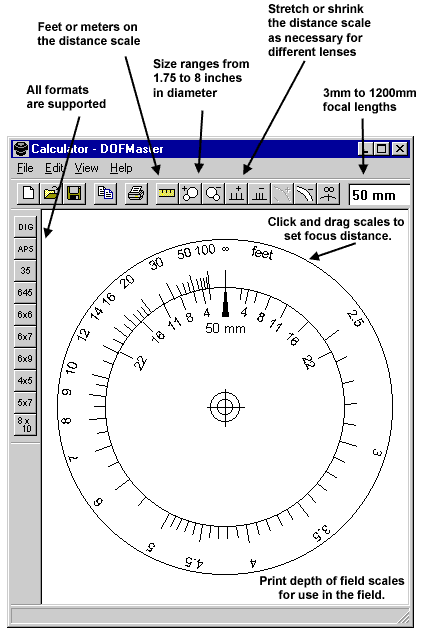
Oh, I see ....this looks like the barrel of a prime lens, with the depth of field scale on it (I'm catching up here) You must use it the same way....
HoppyUK
Suspended / Banned
- Messages
- 23,200
- Name
- Richard
- Edit My Images
- No
Why not?
Every lens has a Hyperfocal Distance for each focal length and aperture combination. So if you know the distance you want to have in focus at the nearest point, and you know the focal length you want for the shot, you only have to work out the aperture setting to achieve that focus based on the HD's of that lens which will be 2x the min focus point you need.
Sorry, yes of course. I was trying to read something into it which isn't there. It's clear now. My mistake

Richard.
Oh, I see ....this looks like the barrel of a prime lens, with the depth of field scale on it (I'm catching up here) You must use it the same way....
depends on what lens u have, one of mine looks nothing like that :0 as it doesn't have the distance scale
jerry12953
Suspended / Banned
- Messages
- 12,421
- Name
- Jeremy Moore
- Edit My Images
- No
depends on what lens u have, one of mine looks nothing like that :0 as it doesn't have the distance scale
Don't all lenses have distances engraved on them?
But anyway, this thingy must work on the same principle.
- Messages
- 26,617
- Edit My Images
- Yes
Don't all lenses have distances engraved on them?
Modern AF lenses all have the distance scale which you view through that daft little perspex window, but most of them don't have any DOF scale at all, while they usually still show IR correction marks. Even my 50mm 1.4 only has a DOF scale for f22 - really useful.... not!
It is pretty much exactly the same as the DOF scale on a lens barrel which we're all used to using pre AF. Shame you need a PC to use it, but a pocket version would be pretty good.But anyway, this thingy must work on the same principle.
jerry12953
Suspended / Banned
- Messages
- 12,421
- Name
- Jeremy Moore
- Edit My Images
- No
Shame you need a PC to use it, but a pocket version would be pretty good.
I wonder if it would need to be infinitely large?

chrisgrieve
Suspended / Banned
- Messages
- 1,137
- Name
- Chris
- Edit My Images
- No
Hi,
Thanks everyone for helping me too, I never really understood this topic before or how to go about achieving it.
I have a application on my phone that works this out, so tell me if Im wrong in thinking this is how it works ..
So focal length being 50mm with aperture of f/16 and the subject being 19 feet away.
It says the near limit is 11 2
And the far limit being 64 3
So does this mean with these settings that anything between these two values will be in focus and anything further will be out of focus?
Also it says the hyper focal distance is 26 12.. so if my subject was this distance would everything further than this be infinite?
Dont know if I have the complete wrong end of the stick..
Cheers
Chris
Thanks everyone for helping me too, I never really understood this topic before or how to go about achieving it.
I have a application on my phone that works this out, so tell me if Im wrong in thinking this is how it works ..
So focal length being 50mm with aperture of f/16 and the subject being 19 feet away.
It says the near limit is 11 2
And the far limit being 64 3
So does this mean with these settings that anything between these two values will be in focus and anything further will be out of focus?
Also it says the hyper focal distance is 26 12.. so if my subject was this distance would everything further than this be infinite?
Dont know if I have the complete wrong end of the stick..
Cheers
Chris
- Messages
- 26,617
- Edit My Images
- Yes
Hi,
Thanks everyone for helping me too, I never really understood this topic before or how to go about achieving it.
I have a application on my phone that works this out, so tell me if Im wrong in thinking this is how it works…..
So focal length being 50mm with aperture of f/16 and the subject being 19 feet away.
It says the near limit is 11’ 2”
And the far limit being 64’ 3”
So… does this mean with these settings that anything between these two values will be in focus and anything further will be out of focus?
Also it says the hyper focal distance is 26’ 12”.. so if my subject was this distance would everything further than this be infinite?
Don’t know if I have the complete wrong end of the stick..
Cheers
Chris
I think you've pretty well got it Chris. Yes everything between those two points would be acceptably sharp. In practice you'd find that infinity on a 50mm lens isn't that far away, in fact on my 50mm f1.4 it's only about 20 feet. If you look at the distance scale on your lens though, the last marked distance before the infinity mark should give you a pretty good idea where infinity lies for a particular lens. The problem with the charts and apps is they're catering for all lenses.
HoppyUK
Suspended / Banned
- Messages
- 23,200
- Name
- Richard
- Edit My Images
- No
In practice you'd find that infinity on a 50mm lens isn't that far away, in fact on my 50mm f1.4 it's only about 20 feet.
I know what you're saying CT and infinity focus isn't usually that far way in general photography with regular lenses at common apertures, so this is maybe just a technical point. But you mentioned an f/1.4 lens (50mm) which kind of skews things. Infinity on that lens at f/1.4 is almost 300ft away! (Yes, I was astonished too when I looked it up!)
Chris, yes you've got it, except that in your example sharpness will run out at 64' 3" and it will not extend to infinity. If you want sharp infinity focus at the distance and f/number you've chosen, then you have to stop the lens down further, to f/25. Try it for yourself on DoF Master http://www.dofmaster.com/dofjs.html
The other thing to say about depth of field is that sharpness doesn't just suddenly go from clear to blurred. It's a very gradual process and the sharp/unsharp point is decided by international standards. In my experience, critical landsacpe photographers find these standards a little too generous especially when it comes to hyperfocal distance and you want those mountains sharp! Hence, "give it an extra stop for luck" (close down to a higher f/number)
Richard.
- Messages
- 26,617
- Edit My Images
- Yes
I know what you're saying CT and infinity focus isn't usually that far way in general photography with regular lenses at common apertures, so this is maybe just a technical point. But you mentioned an f/1.4 lens (50mm) which kind of skews things. Infinity on that lens at f/1.4 is almost 300ft away!
Chris, yes you've got it, except that in your example sharpness will run out at 64' 3" and it will not extend to infinity. If you want sharp infinity focus at the distance and f/number you've chosen, then you have to stop the lens down further, to f/25. Try it for yourself on DoF Master www.dofmaster.com
The other thing to say about depth of field is that sharpness doesn't just suddenly go from clear to blurred. It's a very gradual process and the sharp/unsharp point is decided by international standards. In my experience, critical landsacpe photographers find these standards a little too generous especially when it comes to hyperfocal distance and you want those mountains sharp! Hence, "give it an extra stop for luck" (close down to a higher f/number)
Richard.
LOL. OK it's a fair cop, but not too many landscape shots are taken at f1.4.
I do think we need to get real in all honesty, a lot of landscape photographers would avoid going smaller with the aperture than f8 or f11 because of diffraction degrading resolution, and many fine landscape shots are produced at those apertures. Obviously due to the circle of confusion, print size, and even viewing distance of the print, will decide how acceptably sharp the image finally is.
jerry12953
Suspended / Banned
- Messages
- 12,421
- Name
- Jeremy Moore
- Edit My Images
- No

jerry12953
Suspended / Banned
- Messages
- 12,421
- Name
- Jeremy Moore
- Edit My Images
- No
Hi,
Also it says the hyper focal distance is 26 12..
Just wondering if these are earth feet or not?
chrisgrieve
Suspended / Banned
- Messages
- 1,137
- Name
- Chris
- Edit My Images
- No
thanks for clearing that up.
also.... when it says near limit 3' 6" is that from the camera or the subject?
if that makes sense.
thanks
chris.
also.... when it says near limit 3' 6" is that from the camera or the subject?
if that makes sense.
thanks
chris.
chrisgrieve
Suspended / Banned
- Messages
- 1,137
- Name
- Chris
- Edit My Images
- No
what do yo umean earth feet?
yes this is feet and inches if thats what you mean.
yes this is feet and inches if thats what you mean.
- Messages
- 26,617
- Edit My Images
- Yes
thanks for clearing that up.
also.... when it says near limit 3' 6" is that from the camera or the subject?
if that makes sense.
thanks
chris.
From the film or sensor. In fact if you want to get really pedantic about it and get the tape measure out - that little circle symbol with a line through it on the top plate of your camera marks the exact position of the sensor.
- Messages
- 26,617
- Edit My Images
- Yes
It's a reference to the fact you broke 'hyperfocal' into 2 words Chris as in hyper space.what do yo umean earth feet?
yes this is feet and inches if thats what you mean.
chrisgrieve
Suspended / Banned
- Messages
- 1,137
- Name
- Chris
- Edit My Images
- No
ah i see always wondered what that symbol meant.
and that spit of the word was due to my spell checker,
thanks again.
Chris
and that spit of the word was due to my spell checker,
thanks again.
Chris
jerry12953
Suspended / Banned
- Messages
- 12,421
- Name
- Jeremy Moore
- Edit My Images
- No
what do yo umean earth feet?
yes this is feet and inches if thats what you mean.
Twenty-six feet twelve inches, cap'n
chrisgrieve
Suspended / Banned
- Messages
- 1,137
- Name
- Chris
- Edit My Images
- No
right... i think im getting a better understanding of this now.....
next question..............
when taking a photo and have all the setting set up, what do i do next? do i use auto focus and focus on my subject, or do i switch to manual focus and set to infinity / distance scale????
thanks again everyone for the help (sorry Swag for using your thread)
Chris
next question
..............when taking a photo and have all the setting set up, what do i do next? do i use auto focus and focus on my subject, or do i switch to manual focus and set to infinity / distance scale????
thanks again everyone for the help (sorry Swag for using your thread)
Chris
OP
swag72
Suspended / Banned
- Messages
- 7,969
- Name
- Sara
- Edit My Images
- Yes
It's nice to see a thread that is so useful to so many!!
My understanding Chris is that once you have done all the calculations, then you focus on a point at the hyperfocal distance. The rest should fall into place. Either auto or manual focus - I would prefer manual, using my live view and 10x magnification just to make sure it's all in focus
I hope someone comes along soon to confirm this, then I know I've got it for sure Phew, this has been a difficult one!! You watch someone come along and totally ruin my understanding!!!
My understanding Chris is that once you have done all the calculations, then you focus on a point at the hyperfocal distance. The rest should fall into place. Either auto or manual focus - I would prefer manual, using my live view and 10x magnification just to make sure it's all in focus
I hope someone comes along soon to confirm this, then I know I've got it for sure
Phew, this has been a difficult one!! You watch someone come along and totally ruin my understanding!!!