Thanks very much for your constuctive response. This is the sort of advice I need and aimed at my level (spoon feeding

) When you say expose to the right, is that over expose a stop or so?
When shooting JPG (which I do for a longer, more casual session like a gig, and save raw for
that important shot (or shoot) like this, but let's not get into JPG v raw!), I expose so the picture looks good out of the camera. White balance and picture controls are all distilled down into a JPG that can't be changed too much without stretching the data beyond what it can cope with and giving rise to artefacts.
Because a lot more data is stored in raw, you can use a trick to maximise the image quality in the darker parts of the image by overexposing. What this means in practice is - overexpose as much as you can without clipping the whites. To explain - keep an eye on the histogram, make sure the bar on the far right doesn't go all the way to the top - this means that you've lost some information in the whites.
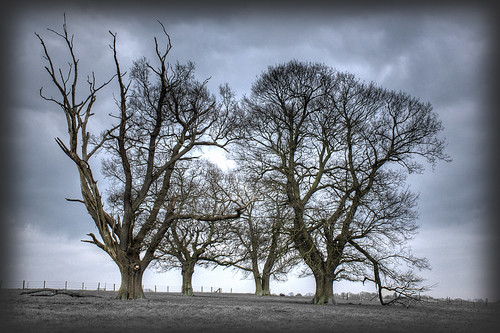
Then when you get to your raw converter, you can bring the exposure back down, but keep all the information. This gives you more information in the shadow areas so the trees in this case will keep a lot of detail. I wouldn't recommend exposing to the right with JPG - just get it right in camera.
To be honest, this is a technical issue to give that extra few % of image quality. A well-exposed camera-JPG may actually be indistinguishable from the manual raw-based JPG in the final product. I certainly wouldn't like to have to tell the two apart.
The most important thing isn't expose to the right, or raw, it's image composition and emotional impact. A nice gnarly tree with a dramatic sky behind would, exposed properly, look good out of an iPhone. You just wouldn't be able to print it very big, that's all.
The grad or polariser will darken the sky to keep the dynamic range under control - I'd much rather recommend a proper photographic technique than a quick-and-dirty HDR, because the camera technique will serve you better in the long run, especially if you use film at any point. The small aperture (large number, say f11-f16) will give good depth of field, so you can see the whole tree and the sky behind all in focus. Now we get to hyperfocal distances, which I'll skip over, suffice to say at this stage focus on infinity and bring it in a bit (probably get flamed for saying that

)




 if not take a look at the others or do some HDR and see how that turns out