How would take this shot? PIC ADDED

mac2474

Suspended / Banned
Messages
143
Edit My Images
Yes
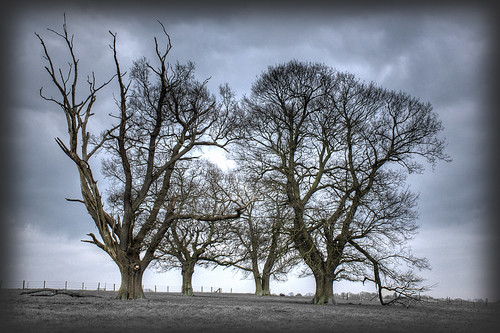
Picture the scene - it's mid to late afternoon on a cold winter’s day. A lonely south facing grassy hill rises in front of you, no horizon except the gentle sloping curve of the hill. The sky is overcast almost threatening, but not too dark. In the near distance is a group of three gnarly trees, one showing signs of a recent lightening strike with a broken bough, the other two trees are devoid of any life awaiting the axe man.

Your task is to capture an atmospheric picture that shows the roughness of the bark and scorched areas of the trees without over exposing the sky. What would you do?
 
Take a coupl eof pictures at different exposures and combine them later in PS, its cheating but it works :D
 
One thing that i find that helps is to take the picture in auto (i know thats swearing to some people) but it will give some idea of what setting to use, you can then move either to way to improve the picture.
 
Take a coupl eof pictures at different exposures and combine them later in PS, its cheating but it works :D

Better to take one, makes copies of it in PS, adjust exposures, and then combine. Follow an online tutorial if you don't know how.
 
Try a couple of different settings, see which works best and then take pics with 1 stop under and over exposed, if the original works when i see it on screen then perfect :) if not take a look at the others or do some HDR and see how that turns out
 
Would spot metering say on a tree trunk for one shot then metering on the sky for another help?
 
To do it in one shot I'd under expose the sky a touch to emphasise the broodiness, and use external flash(es) to light the trees.
 
Finally managed to get out a take a shot, well 3 actually. HDR treatment I tried to get the effect I was after, but I don't think I have managed to achieve the moodyness I was after.

What do you think?

4338090120_8964c52ab7.jpg


(Larger picture on my flickr page)
 
unfortunately there are times when the light just isn't there
 
Unfortunately, I hate the border vignette, and the lighting does look odd - bright white light in the middle of the picture, but moody grey all around? I think the HDR has worked well on the grass and trees, though.

Hate, each to their own eh?
 
Thanks for all your comments, it's good to hear your views and get some advice.

I had some difficulty getting enough information in the original unbracketed shot to bring out the textures and cloud contrast, so I was hoping to get more from PP. Looks like I was being a bit over-ambitious at my (early stage) ability. I also think that the 18-55 kit-lens may not have been the best one to use, bad workman blaming his tools I know :lol:

Given that there is now a visual and descriptive picture, any more thoughts on the thread title - How would you take this shot and perhaps PP. All help appreciated.
 
This occasion is one of the few times I would shoot raw and expose to the right. ISO 200, small aperture, circular polariser (and/or neutral density grad), tripod if necessary, expose to the right. I would personally have used a wide angle lens so we can see some detail of the tree in the foreground whilst still keeping the impact of the sky.

I'm surprised (and a little disappointed) by how many people suggest HDR as being preferable to correct camera technique. The clouds and tree branches will move between exposures thus robbing sharpness. Quite apart from this, surely issues of framing and composition are more important to give the impact the OP is looking for rather than dynamic range?
 
This occasion is one of the few times I would shoot raw and expose to the right. ISO 200, small aperture, circular polariser (and/or neutral density grad), tripod if necessary, expose to the right. I would personally have used a wide angle lens so we can see some detail of the tree in the foreground whilst still keeping the impact of the sky.

Thanks very much for your constuctive response. This is the sort of advice I need and aimed at my level (spoon feeding :dummy:) When you say expose to the right, is that over expose a stop or so?
 
Thanks very much for your constuctive response. This is the sort of advice I need and aimed at my level (spoon feeding :dummy:) When you say expose to the right, is that over expose a stop or so?

When shooting JPG (which I do for a longer, more casual session like a gig, and save raw for that important shot (or shoot) like this, but let's not get into JPG v raw!), I expose so the picture looks good out of the camera. White balance and picture controls are all distilled down into a JPG that can't be changed too much without stretching the data beyond what it can cope with and giving rise to artefacts.

Because a lot more data is stored in raw, you can use a trick to maximise the image quality in the darker parts of the image by overexposing. What this means in practice is - overexpose as much as you can without clipping the whites. To explain - keep an eye on the histogram, make sure the bar on the far right doesn't go all the way to the top - this means that you've lost some information in the whites.

Then when you get to your raw converter, you can bring the exposure back down, but keep all the information. This gives you more information in the shadow areas so the trees in this case will keep a lot of detail. I wouldn't recommend exposing to the right with JPG - just get it right in camera.

To be honest, this is a technical issue to give that extra few % of image quality. A well-exposed camera-JPG may actually be indistinguishable from the manual raw-based JPG in the final product. I certainly wouldn't like to have to tell the two apart.

The most important thing isn't expose to the right, or raw, it's image composition and emotional impact. A nice gnarly tree with a dramatic sky behind would, exposed properly, look good out of an iPhone. You just wouldn't be able to print it very big, that's all.

The grad or polariser will darken the sky to keep the dynamic range under control - I'd much rather recommend a proper photographic technique than a quick-and-dirty HDR, because the camera technique will serve you better in the long run, especially if you use film at any point. The small aperture (large number, say f11-f16) will give good depth of field, so you can see the whole tree and the sky behind all in focus. Now we get to hyperfocal distances, which I'll skip over, suffice to say at this stage focus on infinity and bring it in a bit (probably get flamed for saying that :D)
 
Looks like I'm going to have to make another visit to the trees. I have never used a filter before so I am looking forward to seeing the results when they arrive.

Looking at your other suggestions and comparing with the exif info, i wasn't too far off - f/16, 1/30 sec, ISO 200 I'd set the camera to aperture priority and evaluative metering. I was also using a tripod.

Thanks agian:)
 
Bracketing would also be rather usefull here, as although they are good the lcd screen doesnt always give a true image compared to what you will see on your monitor, this gives you a little bit more flex in terms of exposure.
 
Back
Top