How does agitation effect development?

Cluster

Suspended / Banned
Messages
770
Name
Dave
Edit My Images
Yes
I'm trying to find a way to process my Fomapan 400 35mm film exposed at 400. I have a stock of Fomapan 200 that works well for me at 200, so exposing the 400 at 200 isn't a good use for it.
So far, I have processed it in a Diafine clone and in a few variations of Rodinal dilutions. I'd like to use one of these developers as I have some in hand, although I have an interest in trying caffenol.
My latest attempt was in Rodinal 1:50 11mins. The negs are pretty thin.

I've read about several dev times and have tried a semi-stand process of 60mins at 1:100 with agitaion (inversion and back) every 20mins.
What is the long dev time doing and how does the agitation effect the outcome?
 
Last edited:
I'm trying to find a way to process my Fomapan 400 35mm film exposed at 400. I have a stock of Fomapan 200 that works well for me at 200, so exposing the 400 at 200 isn't a good use for it.
So far, I have processed it in a Diafine clone and in a few variations of Rodinal dilutions. I'd like to use one of these developers as I have some in hand, although I have an interest in trying caffenol.
My latest attempt was in Rodinal 1:50 11mins. The negs are pretty thin.

I've read about several dev times and have tried a semi-stand process of 60mins at 1:100 with agitaion (inversion and back) every 20mins.
What is the long dev time doing and how does the agitation effect the outcome?
I have just done my first Rodinal, my research led me to use a dilution of 1:100 for 90 mins. (APX100)
Agitation increases contrast. The point of stand development with rodinal, as far as I can tell, is that it increase sharpness by edge effect, improves tonality, graduation, and ensures the finest possible grain size. shaking it up reduces the likelyhood of objectives occurring.

I am sure that people who have used it for 20-40 years will be along with their expertise.
 
Here's the short answer - for the long one, you should probably consult a book.

Developer contains active ingredients that convert exposed silver halide in the film into (black) metallic silver. These ingredients are used up in the course of development.

If you don't agitate, the only way for active developer to reach the undeveloped film is by diffusion. Drop some food colouring into a glass of water and see how long it takes... Hence, you agitate.

If you think about it, a highlight next to a shadow means that more developer is used up on the highlight, and not much on the shadow area, so the active constituents are more concentrated on the shadow side of the join, making for easier diffusion. So, you can get edge effects that increase apparent sharpness. See "Mackie lines" in a recent thread.

The long development time (without agitation) simply means that highlights exhaust the developer before the shadow areas do, so you gain the appearance of a speed increase. Plus higher contrast and grain.

All the above subject to expansion - they are over simplifications.
 
Last edited:
I'll double check in the morning, but on rereading your opening post, the developing time seemed short. From memory (and I don't usually bother about commiting this to memory because I always reread my sheet on the fridge to prevent memory errors) I develop FP4, which I expose at 80 ISO, for 16 minutes. The massive dev chart has much shorter times, more like yours. Interesting...
 
I'll double check in the morning, but on rereading your opening post, the developing time seemed short. From memory (and I don't usually bother about commiting this to memory because I always reread my sheet on the fridge to prevent memory errors) I develop FP4, which I expose at 80 ISO, for 16 minutes. The massive dev chart has much shorter times, more like yours. Interesting...
Yes, That's where I got the time from. Interestingly, it also gives a second time of 15m for the same speed, without notes. I screwed up and dev'ed in Rodinal at 11 mins/1:50 for a second time (senior moment) and got similar results. I have tried a semi-stand development for 1hr and have researched suggestions for other times etc.... the thing that has puzzled me is the variation in agitation. I know that I should try some, but hoped for guidance to avoid film wasting (although my roll is so full of marks that maybe I should relegate it to "test film" and spend a little more on Kentmere 400).
 
I now have my sheet in front of me. It is an idiot's guide to make as certain as I can that I don't miss anything. And I always use 68 degrees F (it's exactly 20 degrees C if you aren't Imperial). The details are:

FP4 Rodinal
1+25 9 min
1+50 15 min

low contrast
1+100 20 min
(I used this for Tech Pan)

1 litre @1+25 = 1000/25 = 40cc Rodinal

Acros Rodinal 18 min


Then follows my agitation notes. I use a count down timer, so the time is entered at the start of the process.

Agitate 15 secs per minute for the first 3 mins then 1 inversion every 3 mins
Timer starts at 18 mins, so single inversion at 14, 11, 8, 5, 2

1+25 40cc R + 1l water
1+50 20cc R + 1l water
1+100 10c R + 1l water


Agitation at the start is to remove air bubbles and ensure even development. After that, it's less important - more important is to be consistent across films. I used to invert the tank every minute with other developers, but as an acutance developer Rodinal would be less effective with more frequent inversions.

Edited to add:

This sheet was created when I was using 5x4 film developing in a Combiplan tank. I still use them with different tanks. Consistency is more important than the finer details - inconsistency can have a larger effect than most fine details!
 
Last edited:
As StephenM say's

Temperature - I always set my temp 68 degree F or 20degree C temperature is very important

Agitation - allows the chemicals to have an even contact with the film (no air bubbles)

Time - always use manufactures instructions on time scales

Get these main elements right and you shouldn't have too many problems.
 
A good piece of advice I received decades ago:

"...on an overcast day, photograph the same subject at every aperture from wide open to closed down. Set the aperture in the middle of the scale and repeat for every shutter speed. Develop in the soup of your choice, for the manufacturer's recommended time. Contact print the lot and choose the print from each set that looks best to you. You now have a starting point for deciding how long you should keep the film in the developer."

Note that phrase "starting point". With analogue photography, everything varies and "correct" is what you like,
 
Although as I understand Andrew's post, that would help judge film speed (it reads as vary the exposure) and was the method Kodak were said to have used in determining their original speeds. Note that "overcast" implies low contrast, which is where film latitude to incorrect exposure is greatest.
 
I'm trying to find a way to process my Fomapan 400 35mm film exposed at 400. I have a stock of Fomapan 200 that works well for me at 200, so exposing the 400 at 200 isn't a good use for it.

I'd argue it still makes sense to shoot both at 200 - they are very different products with noticeably different spectral response. The 400 is much more red sensitive than the 200. The Foma 200 has a more standard panchromatic response - very similar to e.g. Tri-X, FP4+ etc. The Foma 200 will do well with portraits, because it will render red lips differently from surrounding (white European) skin complexion. Whereas Foma 400 will render red lips extremely pale, and complexion paler (it'll brighten the red in capillary veins under the skin). On the other hand Foma 400 will shine with other applications, eg landscapes, because it will render the skies much darker than Foma 200/Trix etc. Think of Foma 400 as going about with an orange filter always on.

Also, you can't really turn Foma 400 in a 400 EI film. It just doesn't reach 400 in any tested/common developer. See here


The best you can do is expose it at 320 and cook it in Microphen - it will be a 320 EI film at crazy contrast indices, which might or might not be a problem for your depending on how you scan or print.
 
Last edited:
My latest attempt was in Rodinal 1:50 11mins. The negs are pretty thin.

Sorry forgot to comment here. Rodinal 1:50 is a wonderful developer for many films but it'll eat 2/3rd to 1 stop of sensitivity. In my own tests and workflow, Foma 400 in Rodinal is -give or take - a 100 EI film.
 
Thank you all for your guidance.......

So.... now I realise why F400 is described as best exposed at lower speeds rather than exposing for 400 and messing with the dev times to compensate (as I am trying to do).

I like the notion that F400 gives a different image to F200 when both shot at 200. I like using red/orange filters in some images.
It's a nice day, I've loaded a short strip (~12exp) onto a cassette. I will go for a walk and shoot a few frames (of the same scenes) at 400, 320 and then 200. I'll dev in a Diafine subs, Bellini Duo Step (not in Rodinal, given trypdal's comments) .
 
I've heard really good things about the Bellini Duo Step. I'll be interested in your findings and if you find it a good match for Foma 400!
 
I like Bellini Duo Step for my Fomapan 200 and 100 shot at box speed, but then I may not be as technically observant as others might be. I've not really experimented with it, just been pleased with the results pretty much every time. The last time I did F400 in it, I didn't like the results, big blobby grain. I suspected that the mix was becoming exhausted and bought a new batch. I will try it on this test film at 5mins each, rather than the usual 4mins.
 
Last edited:
It's always well worth while looking at the manufacturer's data sheets (assuming they provide any, and they also disclose full information) to see how the spectral response curve looks. It could help in deciding on which colour filter to use (though to be honest, I just decide on yellow/minus blue/light green/dark green/orange/red based on the scene in front of me. That said, I don't use many different films.
 
Although as I understand Andrew's post, that would help judge film speed (it reads as vary the exposure) and was the method Kodak were said to have used in determining their original speeds. Note that "overcast" implies low contrast, which is where film latitude to incorrect exposure is greatest.
Perhaps I should have mentioned that the speaker managed the darkrooms for one of the national newspapers.

This was in the 1960s, when "natural clarity" was a big thing in Fleet Street. From what I recall, the aim was to get a print that the blockmakers could convert to a half tone with the least loss of detail and the best balance of tones and sharpness. I did try out his advice a few years later, when I had my own darkroom and it worked for me.
 
Fomapan 400 exposure tests... a bit rough and ready.

I managed to get a few shots this afternoon, three each of similar scenes at 400, 320 and 200 (figured not enough film to catch 250).
Developed in Bellini Duo Step for 5mins each part A & part B at 20'c.

I used my Dynax 5 camera as it probably has the most advanced metering of any I own... in aperture priority.

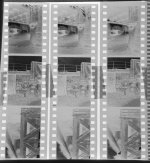
By column: 200, 320 & 400 negatives from camera: (A short burst of full sun may have affected a few exposures.)
NegTest200320400.jpg

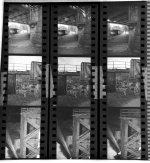
Converted to a positive and contrast adjusted: Note the shadows under the bridge.

By column: 200, 320 & 400 image levels adjusted:
PostTest200320400.jpg
 
Last edited:
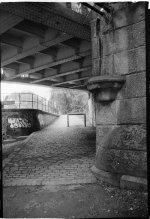
Reproduced here, a portion of one image at 100%. (@320)

pfp320.jpg

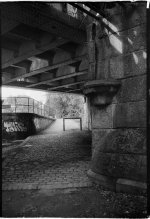
to compare with an image from F400 @400 in Rodinal 1:50 11m 100% pixel size (similar scan size).

Potes4pixel.jpg
 
Last edited:
Based on what I see on my tablet, I'd go with 200 as the simplest way to have a full range of creative possibilities for the final print.

Edit to add
If you'd like my reasoning, I can supply it after Bake Off :)
 
Last edited:
That was a good exercise. All the negatives were improvements from my last efforts with Fomapan400 @400 in Bellini Duo Step for 4 mins.
I could use all the negatives produced at 400, so is also an improvement from my Rodinal developed negs and the grain seems to be finer.
These images were made with different cameras, maybe comparisons of sharpness is not realistic.
 
Last edited:
Thanks all for your suggestions and for sharing your experience..... I guess that you all knew how they would turn out.

For me, the big takeaway is that the Bellini Duo Step will work for my tastes at 5min dev time (for each part A&B) so no need to go buy anything else, yet.
One driver for this was that I wish to use some P&S cameras that do not recognise ISO200 DX films, they see 100 and 400. They will default to 100 if no cassette, or a DX200 cassette is used, so setting 200/250/320 would not be possible... I can maybe get away with 400 for these cams.
 
Last edited:
What a great test @Cluster . The Bellini seems to be a great match for Foma 400. I agree with Mr Stephen in that the 200 seem to be the 'best/most versatile', but I'd actually be quite happy with your 320 EI images in my scanning workflow.

I personally think your 400 are too thin, and what happens, at least in my own scanning workflow, is that the scanner cranks up the gain to make an attempt to recover something, anything from those thin shadows. The result is that the positive shows a high amount of thermal noise in the shadows, which might accidentally be mistaken for grain.

So I actually find more exposure results in cleaner scanned negatives.
 
One question @Cluster - is the Bellini Duo Step what some people have been referring to the 'liquid Xtol'?

If so, that might explain the results you're seeing. I've found Foma 400 to work great in Xtol and its clones. Fine grain and full exploitation of the film's sensitivity.
 
One question @Cluster - is the Bellini Duo Step what some people have been referring to the 'liquid Xtol'?

If so, that might explain the results you're seeing. I've found Foma 400 to work great in Xtol and its clones. Fine grain and full exploitation of the film's sensitivity.
I recall that Bellini Duo Step is described as being similar to Diafine, a two part developer. I have never used Diafine, so can't comment on how close it is.

 
Back
Top