


specialman
Suspended / Banned
- Messages
- 8,193
- Name
- Pat MacInnes
- Edit My Images
- Yes
Having a mull over if I'm doing things bum-about-face when it comes to using flash outdoors and just wanted to get people's take on how they assess the situation and how they go about using their equipment.
I generally work to the sync speed to get underexposed backgrounds, depending on how moody I want it. A lot of the time the camera is dialled to 1/250sec (my max sync speed) partly out of habit, and partly because in many situation, 1/250th gives me what I want.
Of course, then I'm at the ceiling of how I can nail the ambient - my sync is maxxed out and unless I whack on ND filters - I have no room to kill the ambient further if needs be. So aperture comes into play to control the overall ration between ambient and flash. This in turn means that the aperture is now dictating to me the flash power and here comes a point when the power of a speedlight just can't cut it. Some people I've talked to do the exposure calculations against the flash setting they're using and then the shutter speed allows them to tweak the ambient.
Am I working in an insanely illogical way or and I doing what you guys do?
I talked to a guy at Focus 2011 who uses a mobile studio set-up (Bowens) and basically takes the meter of the flash exposure and then sets the ambient to suit his needs. But he has seemingly big power with that rig. But that style of working meant I had to make a speedlight act as a key light and overpower the sun - not always possible.
I don't know if this is a good example:
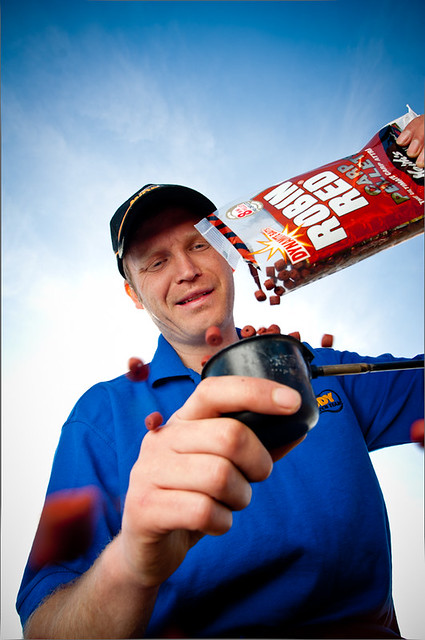
Pellets by Pat MacInnes, on Flickr
*Nikon D2x
*Sigma 14mm f/2.8
*ISO 100
*1/200th @ f/6.3
*Nikon SB800 through a 28" Westcott Apollo softbox (set to 1/2th power)
I'm at half power on the flash already, using it as the main light source for the angler. The quality of the light is good from the softbox, but that's also making me overpower the flash to cope with the diffusion. I'm nearly at max. sync speed (a third of a stop away) but I'm only getting f/6.3, which is fine for the purposes of DoF in this shot but if I want more - say f/11 - then I'm pishing in the wind aren't I?
Have I just created a clear-cut reason to buy a mobile, battery-powered solution like a Ranger or Safari? I wonder.....
Of course, ISO can be increased but then I reduces the effectiveness of the sync speed unless I turn to ND filters but then again, with NDs I need to open the aperture or pump in more power, which I haven't got....
Maybe I'm tying myself needlessly in knots here and my results are fine most of the time, but it's got me thinking if there's a better way....
I generally work to the sync speed to get underexposed backgrounds, depending on how moody I want it. A lot of the time the camera is dialled to 1/250sec (my max sync speed) partly out of habit, and partly because in many situation, 1/250th gives me what I want.
Of course, then I'm at the ceiling of how I can nail the ambient - my sync is maxxed out and unless I whack on ND filters - I have no room to kill the ambient further if needs be. So aperture comes into play to control the overall ration between ambient and flash. This in turn means that the aperture is now dictating to me the flash power and here comes a point when the power of a speedlight just can't cut it. Some people I've talked to do the exposure calculations against the flash setting they're using and then the shutter speed allows them to tweak the ambient.
Am I working in an insanely illogical way or and I doing what you guys do?
I talked to a guy at Focus 2011 who uses a mobile studio set-up (Bowens) and basically takes the meter of the flash exposure and then sets the ambient to suit his needs. But he has seemingly big power with that rig. But that style of working meant I had to make a speedlight act as a key light and overpower the sun - not always possible.
I don't know if this is a good example:
Pellets by Pat MacInnes, on Flickr
*Nikon D2x
*Sigma 14mm f/2.8
*ISO 100
*1/200th @ f/6.3
*Nikon SB800 through a 28" Westcott Apollo softbox (set to 1/2th power)
I'm at half power on the flash already, using it as the main light source for the angler. The quality of the light is good from the softbox, but that's also making me overpower the flash to cope with the diffusion. I'm nearly at max. sync speed (a third of a stop away) but I'm only getting f/6.3, which is fine for the purposes of DoF in this shot but if I want more - say f/11 - then I'm pishing in the wind aren't I?
Have I just created a clear-cut reason to buy a mobile, battery-powered solution like a Ranger or Safari? I wonder.....
Of course, ISO can be increased but then I reduces the effectiveness of the sync speed unless I turn to ND filters but then again, with NDs I need to open the aperture or pump in more power, which I haven't got....
Maybe I'm tying myself needlessly in knots here and my results are fine most of the time, but it's got me thinking if there's a better way....
Last edited:


