How do UK suppliers justify their higher prices?

You'll fimd Nikon, and presumably others, do `insist` on retailers selling at their RRP, certainly on newly launched products, regardless of whether they want to or not.
They have a `no discount` policy which will be agreed as a condition of supply.
Retailers who break the agreement will find stock harder to acquire.

Obviously prices drop as supply meets, or outstrips demand, or when a product is no longer deemed as the latest must-have, or indeed when the grey imports are advertised, but please don't tell me manufacturers don't set rules!
 
You'll fimd Nikon, and presumably others, do `insist` on retailers selling at their RRP, certainly on newly launched products, regardless of whether they want to or not.
They have a `no discount` policy which will be agreed as a condition of supply.
Retailers who break the agreement will find stock harder to acquire.

And your evidence for these illegal practices is...?
 
And your evidence for these illegal practices is...?

Just ask around. I don't want to get embroiled in an argument. Topic is about why UK suppliers have to charge higher prices.

Edit. Just done a 2 minute search & came up with this; http://nikonrumors.com/2011/10/14/the-new-nikon-us-pricing-policy-explained.aspx/


Retail Price Maintenance (price fixing) is illegal in the UK & also I think in the USA, but a manufacturer can't be FORCED to sell to a particular dealer it isn't surprising how closely aligned the prices are from suppliers.


I'm not saying you can't get a discount in your local stores, because you can, but they won't advertise a lower price.
 
Last edited:
You'll fimd Nikon, and presumably others, do `insist` on retailers selling at their RRP, certainly on newly launched products, regardless of whether they want to or not.

Just a question - how do Nikon/Canon/Whoever know what a retailer charged for a specific product?
 
Just a question - how do Nikon/Canon/Whoever know what a retailer charged for a specific product?

It is illegal for a manufacturer to insist on a retail selling price.
It can never be more than a suggestion.

Neither Canon nor Nikon know what cameras are sold for, or what incentive might be given.
 
Spoke with my local camera shop as i was pondering an upgrade. I asked for a part ex value for the kit i purchased from them 2 years ago, a d300s and a tamron 17-50 vc, both boxed in good condition. I was offered £400. My goodwill has evaporated..
 
I think you'll find how the manufacturers "peg the prices" (certainly in the case of small local shops) is by the price they'll sell to the shop in small quantities - I've often heard a local camera shop owner bemoan the fact he can often buy them cheaper from a UK "box shifter" (not grey imports, they're even cheaper) than through the official channels....:bang:

There is just insufficient profit margin for the small concerns to make camera sales of the big names viable on their own - often cameras are sold almost as "loss leaders" to bring people into the shop.
 
As I said in a previous post, Retail Price Maintenance (price fixing) is illegal in the UK & also I think in the USA, but a manufacturer can't be FORCED to sell to a particular dealer....

Manufacturers decide who will be designated `authorised` dealers & if they feel their brand is being lessened, they can take it away. Obviously then they won't work as closely or support them to the same degree, or severely limit supply.

Martin makes the point, in that dealers are at the mercy of manufacturers on both supply and prices they are charged & ultimately what profit they can make.

As an example, 2 yrs ago when the D7000 was announced, it was limited supply to dealers who were selling for around £1000 & making a small profit.
Today they are more freely available & around 40% cheaper, but the profit for dealers is about the same. This is because Nikon charge the dealers less, not that the dealers were making a killing before.

Also, I think the UK are mainly supplied via Nikon wholesalers in the EU & not directly from Nikon Japan, so there would another added cost which presumably HK/Asian online sellers don't have.
 
As I said in a previous post, Retail Price Maintenance (price fixing) is illegal in the UK & also I think in the USA, but a manufacturer can't be FORCED to sell to a particular dealer....

Manufacturers decide who will be designated `authorised` dealers & if they feel their brand is being lessened, they can take it away. Obviously then they won't work as closely or support them to the same degree, or severely limit supply.

Martin makes the point, in that dealers are at the mercy of manufacturers on both supply and prices they are charged & ultimately what profit they can make.

As an example, 2 yrs ago when the D7000 was announced, it was limited supply to dealers who were selling for around £1000 & making a small profit.
Today they are more freely available & around 40% cheaper, but the profit for dealers is about the same. This is because Nikon charge the dealers less, not that the dealers were making a killing before.

Also, I think the UK are mainly supplied via Nikon wholesalers in the EU & not directly from Nikon Japan, so there would another added cost which presumably HK/Asian online sellers don't have.
So back to my point - how do the manufacturers know what a dealer is charging? Aside from sending someone into each dealer to buy kit - they're just relying on what that dealer advertises a product for - which in almost all cases is going to be their RRP...

If a dealer has a customer who has previously purchased a lot of equipment through them, I would think that the manufacturer is not bothered whether the dealer offers them X% discount or not.

Obviously a dealer is not going to give discount to a "walk-in" they have never met before on something that was released yesterday...
 
As I posted prviously; I'm not saying you can't get a discount in your local stores, because you can, but they won't advertise a lower price.

As you've just said; they're just relying on what that dealer advertises a product for -
They don't need to go into shops anymore, or even make phone calls, it takes seconds to check websites. (probably even that can be automated?)
 
So back to my point - how do the manufacturers know what a dealer is charging? .

I can tell some of you guys are not businessmen!

eg; Canon cashback.........you need to supply the receipt.

Warranty claims...............you need to supply the receipt.

etc etc
 
Manufacturers decide who will be designated `authorised` dealers & if they feel their brand is being lessened, they can take it away. Obviously then they won't work as closely or support them to the same degree, or severely limit supply.

Absolute poppycock with zero evidence to back it up. Pure paranoid fantasy.
 
Absolute poppycock with zero evidence to back it up. Pure paranoid fantasy.

Poppycock & Paranoid? :lol:

Anyroad, what's to do with ya man, it's nothing personal. :shrug: Chill out! :wave:
 
I can tell some of you guys are not businessmen!

eg; Canon cashback.........you need to supply the receipt.

Warranty claims...............you need to supply the receipt.

etc etc

OK - but surely relying on how many failures your product has to get to know what they're selling for is also not the best business practice?

And I assume (possibly incorrectly) that cashback is offered on older/not newly released items?
 
OK - but surely relying on how many failures your product has to get to know what they're selling for is also not the best business practice?

And I assume (possibly incorrectly) that cashback is offered on older/not newly released items?

I'm now really convinced you're not a bussinesman! :lol:
 
Didn't help the UK high street when they upped the VAT
sad state of affairs when a container of goods can be shipped from Asia for a fraction of the cost that it then costs in the UK to then ship the container from the UK port to it's Uk destination
 
Either way, I decided to buy from WEX. The though of problems with tax, customs, defects or future servicing issues made me think it just was not worth the bother of saving a few quid now.

To their credit, WEX did me a deal on both the lens and the protective filter so I am well pleased. +1 to UK suppliers.
 
I'm now really convinced you're not a bussinesman! :lol:

:thinking: because I don't want my only insight into how much my products are being sold for based on the number of product failures? Yeah, that makes sense.:cuckoo:

And because I probably wouldn't offer cashback on brand new products? Again - why give money away when there are plenty of people who "must have"?
 
OldCarlos said:
As I said in a previous post, Retail Price Maintenance (price fixing) is illegal in the UK & also I think in the USA, but a manufacturer can't be FORCED to sell to a particular dealer....

Manufacturers decide who will be designated `authorised` dealers & if they feel their brand is being lessened, they can take it away. Obviously then they won't work as closely or support them to the same degree, or severely limit supply.

Which would also be illegal if its purpose were to artificially maintain high prices.

The difficulty would be for the OFT to prove that.

OFT case from 2006 over a [Retail Price Maintenace] 'culture' with Oakley sunglasses

http://www.oft.gov.uk/OFTwork/competition-act-and-cartels/ca98/closure/Oakley

Dropped in the end as they were able to show that they had taken suffice not steps to comply with he law
 
Dropped in the end as they were able to show that they had taken sufficient steps to comply with the law

Now we're getting down to it. From the Oakley link:

In allocating its limited resources, the OFT must target its resources where they can have greatest effect.

Effort expended where it will have the greatest effect.

So there are two sides to the control/management of this scenario:

  • How much it will cost to prove there is price fixing in the UK camera market
  • How much revenue is being lost to the exchequer by UK camera businesses due to them being massively undercut by grey imports.

As has been pointed out - shipping bulk long distance slowly is very cheap.

What's likely to add to the cost significantly in the UK is middlemen such as distributors, who are in the game to 'add value' when all they're doing in the prosumer internet age is just passing goods on, making a profit from it and keeping those pesky customers at arms length from the manufacturer.

Does anyone know whether Canon uses distis in the UK, or is Canon's UK operation wholely owned?
 
How much it will cost to prove there is price fixing in the UK camera market

Well, it would cost around £5 to prove that there isn't any price fixing. Just check out a few items on camerapricebuster. Here's the 7D as an example...

Cheapest is Amazon, John Lewis and Ask Direct, all at £1034. Then you have places like WEx and Park who are charging £1069. Bristol Cameras want £1119 and there are a few that go up to £1299. Finally, Tesco Direct want £1803 - which must be a mistake as the RRP is only £1699.

So, that's a range of over £250, and note that the cheap ones aren't the fly-by-night companies you've never heard of. If there's price fixing going on then they're not doing a very good job of it!
 
To be fair this camera has been out a while, so isn't new.

But then there's DigitalRev who have the Canon EOS 7D Body for £769.00 with VAT and import costs paid!

Takes the total range of prices to more than £500!!!
 
Last edited:
To be fair this camera has been out a while, so isn't new.

But then there's DigitalRev who have the Canon EOS 7D Body for £769.00 with VAT and import costs paid!

Takes the total range of prices to more than £500!!!

However, when they say VAT and import costs are paid - that's not strictly true. They pay them if customs pick it up on the way through.
 
Agree with that, but aso making the point that a 3yr old camera shouldn't be used as a comparison.
 

No it wouldn't.

All the manufacturers milk the punters for as much as they can during the initial period of an items sales. They don't do it because Canon tell them to do it - they do it because they know that there's a number of people out there who will insist on having the latest gear at any price. Each of the retailers know that this is the situation, so each of the retailers charges the RRP for as long as possible. Numbers are limited (or so the punters believe) so they can all get away with charging full-whack.

Once the early adopters have all bought sales will begin to tail off and one of the retailers will drop the price. Others will follow until they are all charging the lowest price they can get away with, while still making a decent return.

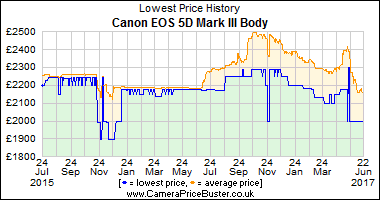
This happens with every bit of camera gear. Here's the graph for the 5D MkIII.

Canon_EOS_5D_Mark_III_Body_graph.png


You can clearly see that the price stayed near the RRP for some months after the launch - and then dropped around 20% over the next 4 months. And today there's a large variation in the price (even ignoring foreign imports).

I've explained why a brand-new camera is not a good example (because its price isn't subject to the normal market forces) and I've shown that there are similarities between the 3-year old 7D and the fairly new 5D MkIII.

There is no supplier-induced price fixing. There's just normal market forces at work.
 
The way that most electronics manufacturers manage their distribution is to set a discount structure to their wholesalers/distributors based on the recommended selling prices in a particular region. When I say 'region', this can encompass an entire continent (or two) in the case of a global brand.

So, if a product has a RSP of £1000 in the EMEA marketplace (Europe, Middle East & Africa) then the wholesale discounts can be of the order of 40%-50% off the RSP. Note that this does NOT include any countries specific VAT regime so the RSP is exclusive of VAT. Furthermore, these discounts are usually based on order quantity.

Lets take something like a Canon 7D with an RSP of say £1000 (ex-vat) which costs the wholesale market anything between £500-£600 per piece. This is then sold from wholesale to the retail market at prices ranging from 20%-40% off the RSP. Once again, quantity discounts will apply.

Therefore, our £1000 (ex-vat) product has cost the retailer something between £600-£800 per piece to buy-in. They must then decide to sell it at the RSP (not much chance of a straight sale), or to discount it to a level which is competitive in their marketplace. The big-boys who can achieve the largest purchase/sales volume will have more room to manoeuvre than the small independent shop, but at the same time, they have significantly larger overheads. So, when someone like Jessops offer £200 off, they may still be making the same profit as the small shop selling the same product without any discount at all. It's not a level playing field.

There is another aspect to pricing which I have not covered and that is the 'over-rider'. An element of additional discount applied retrospectively when a pre-determined sales target has been met over a defined period. In other words, a retailer can perhaps get 30% discount off the RSP when purchasing throughout the year, but if they reach an annual target, they will get another 5% back from the supplier at the end of the year. This is why some products can be sold at an apparent 'loss', if that single sale means that they will reach their annual target to gain back 5% of their annual sales volume. In practice however, what typically happens is that the retailer will purchase the stock regardless to achieve their target and then stack em high in the January sales.

Note that in all the above processes, there is no accounting for VAT which is additional to the cost of the product at the point of sale only and is effectively paid only by the buyer from the general public. VAT rates differ from country to country, hence a retail product can be cheaper in Germany than in the UK, whilst dearer in Belgium. The wholesale costs however haven't changed and it is only the respective governments who are netting different amounts.

Finally, the RSP in Asia may well be lower than in EMEA for whatever reason (including a perceived difference due to currency fluctuations.) Quite often, the ex-works price (from the factory) will be priced universally in an arbitrary currency like the US Dollar ($). A Japanese global manufacturer (eg Sony) will probably sell it's wares in $ despite the fact that it's home currency is the Yen. I don't know if the same goes for Canon/Nikon who may well use only Yen. If the pound is poor against the dollar (or Yen), then the cost to the UK wholesaler effectively goes up which can appear to mean that the Asia market is paying less for the same thing.

So in summary, there are very few, if any, UK retailers who are really 'coining it' here. The facts are:

  • The (UK) government is always guaranteed it's (20%) margin, even if the retailer is just breaking even.
  • It is impossible to compare like with like when you are dealing with the same product across international borders.
  • You can't include the VAT element when comparing product costs with sellers outside of the UK.

Sorry if I've wasted five minutes of your life in reading this. You are quite welcome to continue to bash the UK retail industry and believe that they are the demons of hell who are stealing from you, but I can assure you that they are not. I've been an independent retailer with a £9M turnover and I'd never, ever, ever go back to that again. Some years, my basic counter staff were making a lot more than I was!

 
Great explanation John.
I'm one who doesn't `bash` UK retailers & try whenever possible to purchase from local shops....even though they aren't as cheap.

Thanks.
 
Great explanation John.
I'm one who doesn't `bash` UK retailers & try whenever possible to purchase from local shops....even though they aren't as cheap.
Me Too
 
Sorry if I've wasted five minutes of your life in reading this. You are quite welcome to continue to bash the UK retail industry and believe that they are the demons of hell who are stealing from you, but I can assure you that they are not. I've been an independent retailer with a £9M turnover and I'd never, ever, ever go back to that again. Some years, my basic counter staff were making a lot more than I was!


No, I'm happy to read your views - it's interesting.

At no point have I suggested UK retailers are stealing.

I just don't really see the 50% extra value (or 30% extra if we exclude the VAT) I will gain from buying at the higher prices on camera equipment. These are just commoditised products, hence they can be discounted where necessary.
 
I only buy English apples as well, yeah! I don't think so.
 
Great explanation John.
I'm one who doesn't `bash` UK retailers & try whenever possible to purchase from local shops....even though they aren't as cheap.

Thanks.
I don't bash UK retailers, and I am also one of those that buy local produce and buy from the local corner shop but I have no loyalty to UK retailers when it comes to saving hundreds of pounds in a single transaction.
 
Last edited:
To be fair this camera has been out a while, so isn't new.

But then there's DigitalRev who have the Canon EOS 7D Body for £769.00 with VAT and import costs paid!

Takes the total range of prices to more than £500!!!

Surely you mean VAT and import costs evaded unless customs open the parcel..?
 
What is clear that UK retailers are not making out like bandits. Too many are going bust/closing. It's an awful sector for retailers, unless you are a specialist/pro retailer there's zero customer loyalty.
 
Everybody gave Starbucks a hard time for legally not paying UK tax. Everybody that wants to save money by buying from HK is doing exactly the same thing but actually illegally !

The MAJOR reason HK suppliers are so much cheaper is by you choosing to try to avoid UK import tax and VAT.

For me it's easy as I can claim the VAT back, I will always buy UK stock. Preferably from a high street shop I like and trust.
 
Back
Top