Highlights, blow or don't blow?

woof woof

I like a nice Chianti
Suspended / Banned
Messages
43,206
Name
Alan
Edit My Images
No
I've recently been getting rather irritated by the current move away from ISO 100 let alone 50 by some manufacturers with ISO 160 or 200 now appearing as the base ISO. My issue is that a higher base ISO leads to more use of ND's particularly if you like shooting with wide apertures and especially when a higher base ISO is coupled with a max shutter speed of 1/4000 sec, or even less. I find using ND's a pain as they need to be on for one shot and then off for another if they cause the shutter speed to fall too much or the ISO to rise too much, so all in all I'd rather not use them.

Recently when out with my G1 (base ISO 100, max shutter speed 1/4000) and a f1.7 lens 22 shots out of a total of 76 couldn't have been taken with the settings I wanted with a camera with a base ISO of 200 and a max shutter speed of 1/4000 without blowing large parts of the image. 6 were at ISO 100 and 1/4000 sec.

In my film days of course I had no choice as I didn't process my own images so I couldn't expose for the highlights and try and boost the shadows I just had to accept that in some shots I'd blow my highlights. With digital I obviously have more options. These days I expose for the highlights and boost the shadows or I intentionally let some areas blow if doing so makes the image look more like what I saw by eye.

However, I've recently been viewing blogs by Leica and Fuji X camera users and many contain shots with large areas of blown highlights. This may be a deliberate decision and style or it may just be that some people just don't care if the highlights blow.

I'm not going to provide links but what I will say is that the blogs and articles I've been looking at are not by complete amateurs like me, they're by the great and the good that we can all easily access on line. I can't say if their highlights are blown deliberately as that's their style, they may well be.

The next time I head off out I'm going to shoot normally to retain the highlights or to intentionally let some blow for a natural looking image and I'm also going to shoot a second shot letting large areas blow... just to see if I like the result.

So, what do you do?
Do you always try to retain the highlights?
Do you do as I do and let some blow for a natural looking image?
Do you blow large areas deliberately?
Or maybe you're not bothered about blowing highlights and just shoot for a perfect exposure on your subject?

Nothing is "right" of course, it's an art and what's right for one subject may not be right for another... I just wondered what other people do.
 
So, what do you do?
Do you always try to retain the highlights?
No
Do you do as I do and let some blow for a natural looking image?
Yes
Do you blow large areas deliberately?
Almost never - did do a few times with b&w film
Or maybe you're not bothered about blowing highlights and just shoot for a perfect exposure on your subject?
Yes, to an extent - sometimes I consider the blown bits too much for the rest of the shot to 'carry it'. I do sometimes (lazily) hand-hold an ND Grad in front of the lens to avoid blowing the sky.
 
Do you always try to retain the highlights?


Yes.


Do you do as I do and let some blow for a natural looking image?

No.. because it's not natural. Your eyes will dynamically adjust and your brain fills in the gaps.

Do you blow large areas deliberately?

No

Or maybe you're not bothered about blowing highlights and just shoot for a perfect exposure on your subject?

Yes

Nothing is "right" of course, it's an art and what's right for one subject may not be right for another... I just wondered what other people do.


If at all possible, I will not loose highlight, or shadow detail. If that is not possible, I will shoot multiple exposures.
 
So, what do you do?

I don't use f1.7 if it means the shots will be over exposed in the highlights with all other options maxed out. I would rather have a natural looking, correctly exposed shot taken at f3.5 than a blown shot at f1.7
 
No.. because it's not natural. Your eyes will dynamically adjust and your brain fills in the gaps.

No they don't, there are limits. Next time out on a bright sunny day I bet you won't be able to see ever detail in the clouds or in something like white flowers or butterflies wings if the sun is directly on them...

Take these two examples... I couldn't see every detail in the white flowers or in the sky in the second shot. In fact although some ares are blown in the second shot more is visible than could be seen by eye.


In these shots I've let some areas blow for a more natural looking result.
 
I suppose it depends on the subject. Night shots for example mostly can't help having some blown highlights (street lamps for example), but, personally, if it's not the main subject. I wouldn't bother about it. I used to get hung up about the histogram (shadows/highlights) not being spot on, but now I realise subject matter is far more important.
JohnyT
 
No

Yes

Almost never - did do a few times with b&w film

Yes, to an extent - sometimes I consider the blown bits too much for the rest of the shot to 'carry it'. I do sometimes (lazily) hand-hold an ND Grad in front of the lens to avoid blowing the sky.

Yes.

No.. because it's not natural. Your eyes will dynamically adjust and your brain fills in the gaps.

No

Yes

If at all possible, I will not loose highlight, or shadow detail. If that is not possible, I will shoot multiple exposures.

I love the contrast between your comments as it shows it is really down to personal preference, the way i think is not to make them to everyones tastes but your own. You will eventually learn the mid points of the pros and cons but that comes with time and practice.

my answer is more of a question, do you shoot RAW? do you use PS or other editing software? do you use grad filters, physical or on PS? if you are intent on shooting with a wide aperture like 1.7 have you tried shooting with 2.2 / 2.5 / 2.8? as you can still achieve nice bokeh.

I don't use f1.7 if it means the shots will be over exposed in the highlights with all other options maxed out. I would rather have a natural looking, correctly exposed shot taken at f3.5 than a blown shot at f1.7

i agree for landscapes i will often choose f8 over larger apertures unless i can get away with a large f stop
 
I don't use f1.7 if it means the shots will be over exposed in the highlights with all other options maxed out. I would rather have a natural looking, correctly exposed shot taken at f3.5 than a blown shot at f1.7

...my answer is more of a question, do you shoot RAW? do you use PS or other editing software? do you use grad filters, physical or on PS? if you are intent on shooting with a wide aperture like 1.7 have you tried shooting with 2.2 / 2.5 / 2.8? as you can still achieve nice bokeh.

I actualy didn't shoot any shots at f1.7, the largest aperture I used was f2.8. But I take your point(s.)

Personally I normally think of aperture and DoF first and mostly shoot in aperture priority and of course if my artistic intent is to go for shallow DoF I may be in danger of blowing significant highlights. This shot was f0.95 and required two stacked ND's and there's just small blown areas at the front of the boat.


If I'd used a smaller aperture it wouldn't have been the same shot.

BTW. RAW and process in CS5.

There've only been a few replies but it's interesting that so far no one has said that they blow significant highlights through artistic choice yet.
 
Last edited:


In these shots I've let some areas blow for a more natural looking result.


But that looks crap. Sorry.. but it does.

Besides.. capture as much as you can correctly, you can do what you want with it... but as soon as you have lost the highlights... they're gone forever... same with shadows for that matter. Carry on over-exposing if you think it looks good... but it just doesn't.
 
Last edited:
like everything in life, it depends on the circumstances. If I'm shooting events I don't care too much about blown highlights (in the sky).

If it's for personal stuff I'll try to retain them.
 
But that looks crap. Sorry.. but it does.

Besides.. capture as much as you can correctly, you can do what you want with it... but as soon as you have lost the highlights... they're gone forever... same with shadows for that matter. Carry on over-exposing if you think it looks good... but it just doesn't.

I really didn't want to post examples and maybe I shouldn't have as I didn't want this sort of comment :thumbsdown: :bang:

That image wasn't taken directly into the sun but just off a little and the lighting was very harsh, the sky being very bright and the greens too but despite that the final result looks pretty natural to me. It may be a slightly boring subject to you but that's a different matter and irrelevant to me as the place means something to me. It's via Photobucket which does tend to mangle them a little so all in all I'll forgive your little outburst and place it on the back burner for now :naughty:

My point was... oh what's the point bothering with you...

Anyone else?
 
I never blow the highlights - people on internet forums would be up in arms!

I mostly don't but as in my original post I've seen loads of Leica and Fuji X series camera shots on line with large blown areas and I wonder if it's by choice or if they just don't care.
 
Hi Alan, its an interesting question you pose.
I usually try and shoot to hold both shadows and highlights but obviously sometimes its just not possible to do both well without resorting to dare i say it HDR.
If i am happy with the end result then thats what matters (to me)

I have had some success in camera club competitions with prints that had blown highlights and blocked shadows but the judge never mentioned it.
That is more an artistic choice I believe.

I think at times we as photographers get too hung up on the technicalities of the photography rather than the artistic but that is another argument discussion.
 
Dave, just in case you are viewing this on some crappy ipone or something there are 6 small areas in my crap picture that are blown, other than those 6 small areas the sky is there...


And to repeat, there is actually more detail visible in the sky than I could see by eye but retaining all of the highlights would have meant boosting the shadows too much or blending multiple exposures/HDR. What I chose to do was allow some small areas in the sky to blow as they weren't visible by eye anyway and in doing so enable me to get away with boosting the shadows less while still ending up with an image that looks quite natural.
 
Hi Alan, its an interesting question you pose...

I have had some success in camera club competitions with prints that had blown highlights and blocked shadows but the judge never mentioned it.
That is more an artistic choice I believe.

I think at times we as photographers get too hung up on the technicalities of the photography rather than the artistic but that is another argument discussion.

In some quarters there seems to be a fashion to produce very high key images. If that's the right phrase to use.

I'm going to give it a go. It might be something I hate... but I think that retaining everything is something that I'm past.

BTW, I watched a clip on Youtube demonstrating some new processing software and the shadow recovery was simply fantastic so great things may be possible very soon. However, I think that retaining everything can lead to a result that doesn't look right or at least could look better done another way.
 
As far as I am concerned there are some highlights which are important and some which are not. For important highlights - ones which are fundamental to the subject/scene and have details to be retained then I will make sure I do not clip them. But for areas of highlight which are so far off the DR scale that they cannot be held, or simply of no interest then IF it will lead to a better overall capture and a better subject rendition why not let them blow?

Then of course there is the question of what you mean by blowing. In a raw capture and with good software you can push ETTR much harder than you can with JPEG shooting or rubbish software. I find raw + Lightroom 4 to have lots of potential to hang onto bright highlights, allowing me to ETTR aggressively and increase the amount of shadow and mid tone detail captured.

The example below shows the same white shirt exposed at 0, +1, +2, +3 and +4 stops. The top row is without adjustments, showing the ever increasing exposures. The shirt on the right looks pretty blown, and as a JPEG it would remain so, but with raw processing most of the detail can be revealed with simple raw adjustments, as the second row shows. The detail was always there in the raw file and it was only unsympathetic processing which made it disappear.

20120430_144701_.JPG


So was it blown, or wasn't it? Of course it wasn't. It just looked that way.
 
I mostly don't but as in my original post I've seen loads of Leica and Fuji X series camera shots on line with large blown areas and I wonder if it's by choice or if they just don't care.

Not sure we would even know but I would imagine it is not a deliberate choice but they are happy to accept the end result. For some reason blown highlights ruin any image for me and just draw my eye straight to them, maybe I am sensitive to bright light or something?
 
I really didn't want to post examples and maybe I shouldn't have as I didn't want this sort of comment :thumbsdown: :bang:


I'm referring to your exposure.


Capture as much as you can , as correctly as you can. You'll never get a camera to replicate exactly what you see all of the time, as it's merely a recording device, and a fairly linear one too. It has limited dynamic range compared to your eye/brain and lacks sentience, and peripheral imaging, and image persistence, and all the other tricks your brain plays on you. If you are taking a landscape image that you are taking your time over, you can experiment to get it as close as you can of course, but taking an image walking along a path, you're far better off just capturing the most accurate exposure you can, and not try to deliberately over, and under expose anything.

Shoot RAW.... exploit the dynamic range inherent in them. You could have got an image that looks exactly like that without losing anything. I'm not sure what you are using to view that image, but here, I can clearly see the areas that are blown, and a print will show it ever more most probably.
 
Last edited:
How I expose really depends on what I'm doing but I always avoid blowing highlights. If I'm doing geeky aviation stuff where I'm generally after the best technical exposure I can get then I'm very much shooting to the right and making the most of the information I can record, shooting other general stuff I might purposely underexpose if it suits what I'm doing but I never purposely push the exposure so large areas are blown. Sometimes it's unavoidable blowing bits but I always try keep it so a few nudges on Recovery in ACR will pull it back in, flat white blown areas on digital just look horrific!
 
Well, IMHO it's important to properly expose the subject. I also get a bit annoyed by blown highlights, but you need to live with the DR you can afford.
 
Then of course there is the question of what you mean by blowing.

So was it blown, or wasn't it? Of course it wasn't. It just looked that way.

I mean blow in the final image.

Good points.
 
I'm referring to your exposure.

I assume that whatever you're viewing the image on makes large arts of the sky blown? They're not.

The exposure is actually a cursor smack in the middle one and although the right hand side of the histogram gets close to the edge it doesn't pass it and very little is actually blown. Only small parts of some of the clouds and a small area visible through the branches of a tree are actually blown, a very small percentage of the image. It was just harsh lighting.

My point is that I could have brought even more detail out in the sky (and the flowers and the boat) but I chose not to. I chose to aim for a more natural looking result and capture what my eyes actually saw and another positive is that if I had exposed for the extreme highlights so that nothing blew I'd have had to boost the shadows too much.


Here's the RAW and histogram.

 
Last edited:
The issue here is the dynamic range of the camera and the dynamic range of your eye does NOT usually match the dynamic range of the real world

You can use multiple exposures (on still subjects) to help compensate or move about the goalposts. Ultimately, if you want to faithfully represent details on a bright glare filled day, you are going to struggle with one shot

I can see that cameras that auto bracket in the same exposure, and software that drecompiles the result into an image with a more representative dynamic range as the future
 
I often blow highlights. But as someone said above - only if it's unimportant highlights.

Its also very rare that something shot at f/1.6 1/8000 iso 100 is completely blown. This week we had glorious sunshine all week in cornwall and I don't ever remember having that issue. 1/4000 1.7 at iso 200 I could see there being some issues sometimes but not often andyou'd have to be really shooting into the light - the general ambient light should be ok to not overexpose the whole scene.

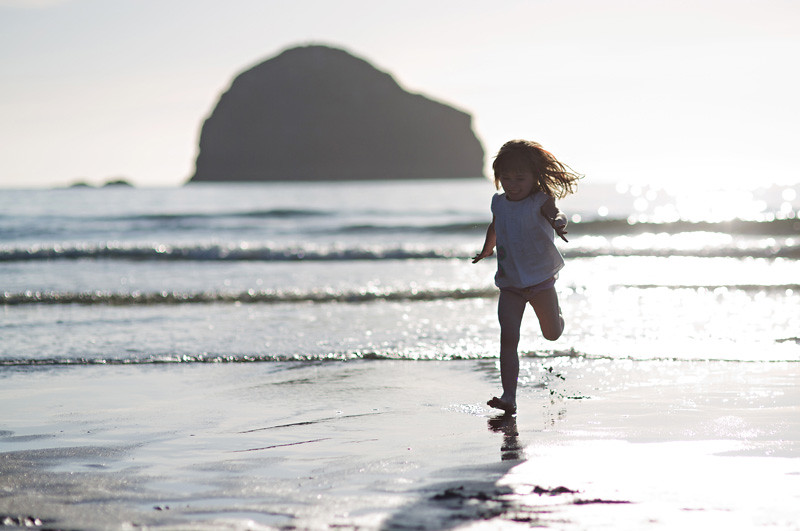
Here's an extreme example though from last week. The sky is blown to bits as I was shooting directly into a setting sun - I couldn't even balance the exposure properly due to the conditions - but I still love the shot - the glistening off the sea and the expression of freedom on my daughters face - I don't care that the exposure isn't "uniform"


236 by JoeBoyMan, on Flickr
 
I often blow highlights. But as someone said above - only if it's unimportant highlights.

Its also very rare that something shot at f/1.6 1/8000 iso 100 is completely blown. This week we had glorious sunshine all week in cornwall and I don't ever remember having that issue. 1/4000 1.7 at iso 200 I could see there being some issues sometimes but not often andyou'd have to be really shooting into the light - the general ambient light should be ok to not overexpose the whole scene...

That's a very nice shot.

I tried a little experiment last week set my G1 to ISO 200 and on that day I found that even when facing west if there was any significant sky in the shot the widest aperture I could shoot at and stay below 1/4000 was the intermediate setting between f5.6 and 8 which I think is f6.7. It obviously depends on the lighting/quality of lighting and what it's hitting and some days it just isn't an issue except when going below f2.8. Anyway, my gripe at the latest cameras not having ISO 100 is really only secondary to the question of to clip or not.

To me it's about what looks right to me and if it looks right to me with some clipping then I'll clip. The amount of clipping in my little examples is quite small and just as a little project I'm going to pursue this and push things a little further just to see if I like the result.
 
The issue here is the dynamic range of the camera and the dynamic range of your eye does NOT usually match the dynamic range of the real world

Actually I think I'm more interested in what looks right or nice rather than thinking about the limitations of the gear. I suppose the best scenario would be to have a camera with low ISO's and high shutter speeds available and very high DR so that you user is always free to choose to clip or not.
 
Alan I let highlights get blown or not depending on the scene, and how much faffing about I'm prepared to do.
I do reckon my G1 is the worst of all my cameras to take when there's bright skies and wide apertures : although the DR of the sensors are practically the same in my Olympuses, the way they handle sky colours gives me a lot nicer files to play with (Jpeg or RAW) : however it has a great switch for bracketing ...
I don't own an ND, but often take a CPL on the front of a couple of lenses to help.
My e-P1 & e-P2 are my preferred bodies for not blowing skies.

The newest Olympus is said to be coming out with 1/8000sec and possible ISO 100-ish too, so that's cooking.
 
Yes, that new Oly does look good and it's nice to see 1/8000 but I'm sure I've read that the base ISO is 200 and if so I don't really see that as a step forward from ISO 100 and 1/4000 sec, but maybe I'm not seeing an advantage that others will see.

I think it's a good looking camera too and if it had a built in VF it'd be just about perfect. I wont be buying one if not as I had a GF1 and decided that back screen shooting wasn't for me and with legacy lenses I don't think I'd get one in ten in focus.

Back to blowing highlights... I have a CP but I haven't used to for quite some time. I also have a Cokin holder plus filters but I haven't used them for even longer. I carry two screw on ND's and I do use them but here I'm actually more interested in the decision to blow highlights or not.

I think really that my view of photography has changed a lot in recent times and I'm far less interested in the gear and getting things "right." :D
 

That's a case where highlight retention would be all but impossible and still get a photograph that's worth a damn. Get no blinkies on that, and what you have essentially, is a beautifully exposed photograph of the sun... with a black shape that may, or may not be a human being in it.


I assume that whatever you're viewing the image on makes large arts of the sky blown? They're not.

re: pathway image.

I'm viewing it on a Eizo CG303W calibrated at 12bit hardware level, and there are at least 5 areas in that sky blown that added nothing to the shot whatsoever. You are aware of this yourself... you kindly pointed them out to us all earlier, so why are you arguing? :) My point was though... on a decent screen with good highlight separation, they are clearly visible. Your remit was "natural". It does not look natural. With obvious exceptions, like the one above (girl on beach), just avoid blowing highlights if you can help it if you are making a general exposure. In situations where you need to be spot metering a face against the light or something, then such a shot will probably not be harmed by a blown background as can be seen above... but a landscape? Not sure it's ever a good idea to have patches of 255, 255, 255 in the sky.
 
Last edited:
I'm viewing it on a Eizo CG303W calibrated at 12bit hardware level, and there are at least 5 areas in that sky blown that added nothing to the shot whatsoever. You are aware of this yourself... you kindly pointed them out to us all earlier, so why are you arguing? :) My point was though... on a decent screen with good highlight separation, they are clearly visible. Your remit was "natural". It does not look natural.

I'm not arguing, I was and am just irritated that you posted in the manner that you did and as I've seen you post in several threads before. A manner that is often highly predictable on the net and yet is still disappointing. My photo's are not for you to critique, I have no interest in reading that you think the image is crap as the thread was meant from the outset to be about peoples views on what should be an artistic decision for their own photography, not about your views of mine.

Anyway, moving on from that...

I think all the example shots I posted do look very natural. Your eyes presumably work the same as mine and if they do they adjust as you look around a scene like a video camera would or even a still camera when pointed directly at the different areas of the scene. Your eyes and brain do better than a camera but they don't have infinite dynamic range and can't always meter for a whole scene and in bright sunlight you are simply not going to see every small detail especially if your main interest is the less bright areas.

If you had stood where I had stood when I took those example shots there is no chance at all that you'd have seen all of the details in the flowers, clouds or boat. It simply would not have been possible. You could have looked at the flowers directly but you couldn't have seen detail in every bright area of the petals as they form such a small part of the scene, to stand a chance of seeing the detail in the brightest parts of the small petals you'd have had to put your eyes to within a few inches of them and you couldn't have looked at the sky or the front of the boat without squinting or wearing your own ND filter in the form of sun glasses.

I could have spot metered for the extreme highlights in the flowers, clouds and boat and captured detail if necessary by using filters but I chose not to for two reasons, it would have meant boosting the shadows too much and more importantly to me I wanted to capture what I saw and what I saw included areas that my eyes and brain couldn't stop from appearing white/very bright with no visible detail.

Here's another example. Looking down the slope to the garden the sky between the trees did indeed appear white to my eyes and too bright to look at directly. I could have metered for that patch of sky and/or have fitted filters and captured some colour and maybe some cloud detail not visible by eye but regardless of what that would have done to the shadows it wouldn't have been what my eyes saw.


You don't even have to go abroad to get bright sunlight and harsh lighting, you get them in the UK too.

Sometimes you may see a nice blue sky. Sometimes there'll be blue in one area which will change to lighter and/or brighter as you near the Sun or the horizon. In this shot you should see a gentle change in the blue as you move around the image. This is perfectly normal and to your eye a sky can be in different places everything from blue to "blown."


With surfaces sometimes when light hits, like sun on a petal or on the woodwork of a boat it's so bright that it prevents detail from being seen by eye. Maybe you'd see detail if you stuck your face in it, but when viewed normally a surface can appear fo the eye to be "blown."

To insist, as you seem to be doing, that you can always see detail just doesn't gel with my experience of reality and lighting here on Earth.

So, I choose to let some areas blow. Other images I've seen recently have larger blown areas and I thought it was worth a thread :D
 
Here's another example. Looking down the slope to the garden the sky between the trees did indeed appear white to my eyes and too bright to look at directly. I could have metered for that patch of sky and/or have fitted filters and captured some colour and maybe some cloud detail not visible by eye but regardless of what that would have done to the shadows it wouldn't have been what my eyes saw.

But that shot is not what you eyes would have seen either. Eyes (combined with brain) just don't work like a camera sensor or film. For a shot to look natural it needs to mimic what your brain would have done in the same situation and sometimes that just isn't possible.
 
But that shot is not what you eyes would have seen either. Eyes (combined with brain) just don't work like a camera sensor or film. For a shot to look natural it needs to mimic what your brain would have done in the same situation and sometimes that just isn't possible.

Precisely, it's not just the dynamic range but the contrast too. It's fairly straightforward to cram in the necessary amount of dynamic range, but then getting it to look natural was well is a challenge - look at HDR for example, do anybody's eyes actually see the world like that? NO, but the dynamic range is there.

My camera can do it, and negative film can too, but the results lack contrast - try and boost the contrast and you end up losing dynamic range! It's all a lovely big balancing act to try and get all the stuff you want in and to get it to look good as well.

I do quite like the deliberately blown out style, but IMO nothing looks worse than the 'my first sunset' image where there's a lovely colourful sky then a harsh white patch in the middle of it where the sun should have been and absolutely no transition between the two. I'd rather a gentle tail off into blown out, at least that gives you a much more natural sense of something being very bright.
 
I think it just really depends on what you're shooting. On Sunday I shot a wedding where the top table was in front of a wall that was nothing but glass. Outside was glorious sunshine and indoors much darker.

I used flash but at the end of the day the difference between outside and inside was just too big and it blew the highlights outside. Most were recoverable in PP but there's still a little blowing out going on.

Same with many things with weddings where exposing one thing properly like the dress means other things blow or under expose.

I think if you have loads of time to set up a shot and use fliters etc there's no real excuse, but if you're shooting quickly changing scenes then sometimes you just have to concentrate on certain areas and hope for the best elsewhere.

The reverse of this would be shooting bride and groom portraits where you can avoid blowing the sky by using a narrower aperture like f/8 instead of f/2.8... in these situations I'd say you need to keep the sky and take a hit on the DOF.
 
The reverse of this would be shooting bride and groom portraits where you can avoid blowing the sky by using a narrower aperture like f/8 instead of f/2.8... in these situations I'd say you need to keep the sky and take a hit on the DOF.

What do you mean here andy? A correctly exposed bride would result in the exact same exposure of the sky at f/2.8 or f/8

if the bride was exposed correctly but the sky was blown at f/2.8 nothing's going to change at f/8 you'll just end up with a slower shutter and/or higher ISO
 
My interpretation is that at f2.8 it's harder to adjust the light unless you have an nd of some sort coupled with fast shutter. However, if you go to f8 and get good exposure for the sky, you can then flash (light) the bride to compensate.
 
Back
Top