High shutter speeds, low light

Pinpho

Suspended / Banned
Messages
188
Name
Danny
Edit My Images
Yes
I really am struggling to shoot at high shutter speeds in low light (ie. dusk/night time). Can someone give me a few pointers on how to achieve a crisp image in low light?

The fastest shutter speed I can achieve with the flash on is 1/200 and that isn't good enough. My lens is the standard 18-55mm VR lens that comes with the D3100. If it's even possible with my lens then can someone tell me ways that I could become better in these situations?

Danny
 
Danny there has to be enough light in order to speed up the shutter. Do you understand the exposure triangle? The longer the shutter stays open the more light that will enter the camera. Just the opposite happens when you speed up the shutter. Therefore you must have adequate light in order to raise your shutter speed. With out the light you have two options, open up the lens f-stop (lower #) or increase the Iso. The iso is usually the last result because as the iso goes up the image quality goes down.

I hope that helps, let me know if you would like some links to basic exposure.
 
I really am struggling to shoot at high shutter speeds in low light (ie. dusk/night time). Can someone give me a few pointers on how to achieve a crisp image in low light?

The fastest shutter speed I can achieve with the flash on is 1/200 and that isn't good enough. My lens is the standard 18-55mm VR lens that comes with the D3100. If it's even possible with my lens then can someone tell me ways that I could become better in these situations?

Danny
Why do you need a faster shutter speed?

Your flash will burst for a lot shorter time than your shutter can operate and can 'freeze' the action when it illuminates the shot but the ambient light can still expose motion blur for the rest of the time the shutter is open.

If your subject isn't moving, use a slower shutter speed and a tripod - preferably with a cable-release and mirror lock-up - to minimise vibrations causing camera-motion-blur. Widening the aperture (lowering the f-number) will allow more light (including ambient light) in but you will lose depth of field. Raising the ISO will enable the camera to work with less light but usually at the expense of diminishing image quality - especially the introduction of noise.

p.s. - Sorry for repeating some of what Shayne has already said - time to get some sleep!
 
Last edited:
you may need a more powerful flash, tried range on my metz 48 and i could light stuff up half a field away at mid/high iso :O
if you using popup flash then they are pretty weak in comparison
 
Thanks for the info. I was trying to photograph skateboarders at Southbank last night, around 10:30pm, so I need a faster shutter speed to capture that. I had the ISO up to Hi2, and the aperture as wide as it would go.

Is there no way that I can raise the shutter speeds to be faster than 1/200 with the pop up flash?
 
You need to learn strobist photography.

Turn down ISO and get a set of much more powerful flash. Light the skateboarders with your flashgun. Just make sure when flash is off, the picture is completely black. Because flash is very fast at thousands of a second, as long as the subject is lit by the flash, it will always be crisp.

Shutter speed doesn't matter, learn about off camera lighting and strobe flashes.
 
Last edited:
You need to learn strobist photography.

Turn down ISO and get a set of much more powerful flash. Light the skateboarders with your flashgun. Just make sure when flash is off, the picture is completely black. Because flash is very fast at thousands of a second, as long as the subject is lit by the flash, it will always be crisp.

Shutter speed doesn't matter, learn about off camera lighting and strobe flashes.

Thanks, I will learn about that :) can you recommend a decent, fairly inexpensive setup?

On a side note, I used to live in Luton for 2 years until the beginning of May :)
 
Shutter speed doesn't matter, learn about off camera lighting and strobe flashes.

ahem!

You ahve hit the limitations of your equipment.. hence why the advice is extra lighting equipment... for low light dusk? personaly i would go for faster lens and higher iso getting much better pics than flash shots..


theres an old saying.... a good photogrpaher can get a picture wiht any camera ...what a load of tosh!

so then people say.. well what did they do before big fancy dslr? well the answer is simple..

try going earlier in the evening when the lights better or weekend during day.. thats your cheapest option :)
 
Assuming you're stuck with the conditions, you need to understand what works and what the limitations are.

As above, get faster lenses and use natural light - but don't believe him about natural light = good, flash = bad. That's a massive oversimplification so I'll get philosophical, good light = good, bad light = bad.

Your skateboarders might be lit by some really cool ambient light with a great sunset backdrop to balance. Fast glass will get you awesome shots. They might be under patchy trees with harsh sodium lighting, fast glass will leave you struggling to get awful shots.

The popup flash used as a primary light source, gives a very specific 'look' you can get away with in certain situations, flash generally takes a bit of thought and planning.
 
What aperture, iso and shutter speed are you using with your current lens as you can use that to calculate what difference having an f1.8 would make in the same situation. If with a 1.8 in same situation you would still have shutter speeds that are too low then you at least know you have to go down the flash route.
 
but don't believe him about natural light = good, flash = bad. That's a massive oversimplification .

haha true I suppose.. But I will always advise faster lens and natural light albiet dim.. over flash for a sports shot... but thats just me.. not saying its the only way...just in my opinion the best way.... a lot of sports dont allow flash.. a lot of people doing the sports wont like flash... so a faster lens and going down that route will give more options in the long run..
 
haha true I suppose.. But I will always advise faster lens and natural light albiet dim.. over flash for a sports shot... but thats just me.. not saying its the only way...just in my opinion the best way.... a lot of sports dont allow flash.. a lot of people doing the sports wont like flash... so a faster lens and going down that route will give more options in the long run..

I get that, but a lot of the more modern 'action sports' mountain biking, bmx, skateboarding etc use quite a lot of flash. Maybe they're a bit too fast, or maybe the old school weren't interested in shooting them, leaving the genre open to reinterpretation.

Sorry that got a bit deep, a bit quick.
 
I have come across the term "faster lens" a few times recently and I have wondered how a lens can be fast or slow.

Is it the speed at which the autofocus operates?
 
I have come across the term "faster lens" a few times recently and I have wondered how a lens can be fast or slow.

Is it the speed at which the autofocus operates?

It's a lens that will open up wide (low f-number) - allowing more light in and a faster shutter speed (than with a smaller aperture). So a 300mm f2.8 lens is fast whereas a 300mm f6.3 isn't.
 
I have come across the term "faster lens" a few times recently and I have wondered how a lens can be fast or slow.

Is it the speed at which the autofocus operates?

No, it is about the largest aperture of the lens. A lens with a max aperture of f1.8 is a fair few stops 'faster' than a lens with a max of f5.6. In the same conditions the use of f1.8 allows faster shutter speeds/lower ISO than the f5.6 lens.
 
Thanks for the explanation.

This forum really is a great way of expanding your knowledge.
 
You need to learn strobist photography.

Turn down ISO and get a set of much more powerful flash. Light the skateboarders with your flashgun. Just make sure when flash is off, the picture is completely black. Because flash is very fast at thousands of a second, as long as the subject is lit by the flash, it will always be crisp.

Shutter speed doesn't matter, learn about off camera lighting and strobe flashes.

Surprised no one else has weighed in with this.

I would be interested to see the photo's you took, but I will hazard a guess that the OP wasn't throwing enough light to make a real difference to his exposures and a camera on an auto flash mode like ttl was just exposing for the whole image.
 
Thanks for the info. I was trying to photograph skateboarders at Southbank last night, around 10:30pm, so I need a faster shutter speed to capture that. I had the ISO up to Hi2, and the aperture as wide as it would go.

Is there no way that I can raise the shutter speeds to be faster than 1/200 with the pop up flash?

If flash is the only lightsource, then shutter speed is irrelevant, as the burst of light from the flash will be very fast... even on full power, probably more than 1/1000th of a second. At lower powers, much faster than that.

Shutter speed only becomes a factor when you want to balance the flash with the available ambient lighting. If that is the case, and you want no blur on the ambient exposure, then yes, you need a faster speed. If you are already at HI2 ISO (probably ISO 12800 effective) then there's nothing you can do except maybe use a faster lens.

If you are purely using flash however... then so long as the shutter speed is fast enough to negate the ambient light, and slow enough to be below the sync speed don't worry about it.

The pop up flash is not very powerful however. So maybe the answer in a more powerful flash gun. SB800 is a good choice. It's actually more powerful than the SB900 and can be had very cheaply used on Ebay... around £160.


Post up your images.... it will help us to help you.
 
I really am struggling to shoot at high shutter speeds in low light (ie. dusk/night time). Can someone give me a few pointers on how to achieve a crisp image in low light?

The fastest shutter speed I can achieve with the flash on is 1/200 and that isn't good enough. My lens is the standard 18-55mm VR lens that comes with the D3100. If it's even possible with my lens then can someone tell me ways that I could become better in these situations?

Danny

There's a balancing act to be done here. When the flash is the dominant light source then (generally speaking) it will freeze the action because of its fast duration. The shutter speed is only controlling how much of the ambient (daylight) actually shows in the exposure.

Turn it on its head and when the sun is the dominant light source then you have to work with higher shutter speeds to make sure the shot is sharp and blur-free, but that's usually not a problem when there's a plenty of daylight. The flash just become a supplementry light in this instance, filling in shadows etc (hence the term 'fill in flash').

One of the key issues in your case is the use of a pop-up flash. Put the lack of directional control aside and you still have the flexi ability of a pop-up flash in terms of coverage, power and adjustability.

The other issue is that as you move, the flash moves with you, so the flash-to-subject distance is constantly changing. If you can hold a set position then you can make better exposure judgements; I don't know how much control uoi have over your pop-up fash but for explantion's sake, let's say you can adjust power in manual mode.

Set a flash power level that will light the subject and enough of the surrounding park and then set the aperture (with the camera in manual) to give you a correctly exposed subject. To make it easier on the flash recycling times, set the iSO to 400 or 800 to start with. Once you have this flash power/aperture set to give you an acceptable result, then you can start to adjust the shutter speed to 'burn in' as much ambient as you require. Obviously, as the light levels fall you need to input a longer shutter speed.

Here's a quick example of low light:
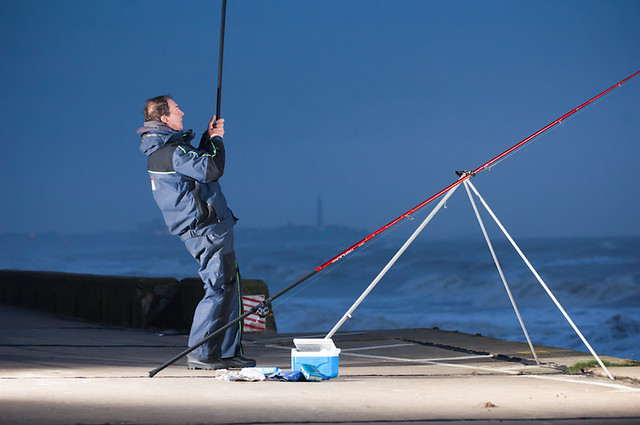

Fishing at dawn by Pat MacInnes, on Flickr

1/80th shutter speed to burn in enough ambient that there was some background detail
Aperture was f/4 so I could seperate the subject from the background (long lens used to exaggerate this)
ISO Speed was 800 - this just gave me enough room to play... if it was up to 1/200th sec it would have been very dark in the background.

Obviously in this case if I'd shot at something like f/11 - aside from requiring more flash power - then I would have either needed a really slow shutter speed (1/15th??) or an increase in ISO to 6400. It would have given the same shot in terms of overall exposure but it would have looked different and posed different problems.

If you want to understand flash a bit better then head over to www.strobist.com


 
Last edited:
Rossall Beach :)

You could have seen my house from where you took that pic.
 
What aperture, iso and shutter speed are you using with your current lens as you can use that to calculate what difference having an f1.8 would make in the same situation. If with a 1.8 in same situation you would still have shutter speeds that are too low then you at least know you have to go down the flash route.

That's what I was thinking as well. I don't have the calculations but (i think ) going from 3.5 to 2.8 is not going to give you enough light to increase the shutter by a whole lot. So that means a fast/expensive lens would not be a solution. A good flash on the other hand will do the trick.
 
Thanks for the explanation.

This forum really is a great way of expanding your knowledge.

It sure is. I am so down on my peeps. I ventured off to a local forum (u.s) and came across a tread about bbf. Goodness I have never seen so many page long wrong information replies. The poor op must of been so confused. Needless to say I came back to the experts.
 
That's what I was thinking as well. I don't have the calculations but (i think ) going from 3.5 to 2.8 is not going to give you enough light to increase the shutter by a whole lot. So that means a fast/expensive lens would not be a solution. A good flash on the other hand will do the trick.

Yes, that is assuming the 18 end but if the shot was taken at the 55 end then it would be a difference of 5.6 to 1.8 - around 3 to 4 stops, i.e. going from the current 1/200 to 1/1600+ with all other things being equal.
 
I think as some people have been hinting toward, you want to use manual settings, manual focus, a depth of field enough to capture the subject, take test shots and make sure it's almost black, then introduce flash at increasing levels until you get the right exposure.
You should eventually get a completely dark background, with the subject correctly lit.

I've done this ^^ with mountain bikers.

I recommend practising this at night, in your living room with the lights off.


You could go for a fast lens, but then if it's really dark, your going to have trouble getting the autofocus to work and at f/2 (ish) your DOF will be too shallow to pre-focus.
I'm sure your subject can tolerate a flash, but will they tolerate the focusing light?
 
Last edited:
The straight answer is a faster lens or start using an external flashgun(s).

Post an image as an example?
 
personaly i would go for faster lens and higher iso getting much better pics than flash shots..

You'd better let Dave Black know.

[YOUTUBE]xNDAINwhTWU[/YOUTUBE]

It's slow to start, so skip forward to about 3:40 onwards to see the results. He has other sports shoot videos with flash as well. Check them out.
 
So go out spend over £3k on flashes and other gubbins to get his rig and your good to go

an external flash and highspeed sync
 
No. Learn how to use flash properly, but don't dismiss it out of hand because you don't understand how to use it effectively or don't have adequate tools to do the job right.

Having a fast aperture lets more light in, and raising the ISO brightens the image, but neither of those things alters the balance of light or its direction. Flash is not just a technical solution to getting a brighter image. It is a creative tool to completely alter the appearance of your picture. Dismissing its use out of hand for "sports" photography is exceptionally narrow minded.
 
You'd better let Dave Black know.
.

had I ?

well done.. hope you wernt up all night looking for the one example of someone who uses flash...

talk basics...........
 
had I ?

well done.. hope you wernt up all night looking for the one example of someone who uses flash...

talk basics...........
Thanks for your concern. I was not up all night. I've posted that video before, and people were appreciative.

Anyway, since we are in "Talk Basics", here is a very basic illustration of the difference between throwing ISO at the problem vs flash. It's not great photography by any means, but it does illustrate the difference.

Non flash vs flash, no edits on either....

20130702_090546_.PNG


100% crop - look at IQ and definition. The on camera flash has washed out the contrast, but that can be pepped up in post...

20130702_090712_.PNG


Now, even at f/2.8 and 6400 ISO I was only able to shoot at 1/320 without flash. To go faster than that would have required a faster lens or even higher ISO, and this was shot during day time.

By adding an external on camera flash I've been able to reduce ISO by two stops, yielding much better IQ and allowing the subject to stand out from the background. Had I taken the flash off camera and added a rim light as well as a main I'm sure the results would be even better. All that a fast lens or high ISO can do is to bring all light levels up equally. It can't add any emphasis to the subject other than through shallow DOF for the lens, and nothing for the ISO option.
 
It can't add any emphasis to the subject other than through shallow DOF for the lens, and nothing for the ISO option.

A lower DOF adds quite a lot of emphasis (of course you may not want an OOF background though) but given the same shutter speed of course it does something for the ISO. Use a 1.4 lens and you would reduce from 6400 to 1600 (roughly) wouldn't you?
 
Yes, and you'd need very accurate focus precision and still you could not play with the relative brightness of subject vs background. You also couldn't create rim light, cross lighting or anything other variation on the lighting, and if you were forced to shoot against a bright background such as bright clouds, then what? Then, of course, you have the issue of colour temperature, and fluorescent lighting doing nasty things, especially at higher shutter speeds - maybe even across a single frame. So a fast lens is one solution, but far from the only one, and dismissing alternatives out of hand seems a very limited viewpoint to have. I'm not suggesting that people buy a quad or octo flash lighting kit, but that they do learn what flash can (and can't) do for them.

When people ask - "Should I buy a fast lens or a flash? - it isn't a case of one or the other as they allow you to accomplish entirely different things. Buy whichever you need, both if necessary.
 
Last edited:
Tony, you will be able to ask a linesman to put the flash guns on his flag and point them at the player on the ball.
 
Back
Top