Help with light modifiers

jwsc101

Suspended / Banned
Messages
97
Name
james
Edit My Images
No
Hi

I have been trying to perfect a basic 'white background' setup at home.

I have i white backdrop, two strobes, one softbox and one shoot through umbrella.

I aim the bare strobes at the background (pointing from the side but as direct as I can without getting them in the shot) and then use the softbox and umbrella as front lighting on the subject.

The problem I keep getting over and over again is light spilling from the backdrop lights. Try as I might I am finding it impossible to get a well exposed full length image using this setup.

What is the best way to blow out the backdrop, are strobes the wrong tool?

Thanks for you advice.

James
 
Can you post an example?
 
I have deleted them all. basically, if i turn down main lights right down I can see loads of spill coming on the subject from the strobes I am using to light the background.

I am interested to know what people use to light the background when setting up this stype of shot in a mobile setting, i.e. someone's home.

Thansk
 
I have deleted them all. basically, if i turn down main lights right down I can see loads of spill coming on the subject from the strobes I am using to light the background.

I am interested to know what people use to light the background when setting up this stype of shot in a mobile setting, i.e. someone's home.

Thansk
I'd say your subject is too close to the background. Some wrap will happen, unless you studio is enormous. Lens flare might be a problem with blown white background, so test your lenses. Also, flag your background lights - V-flats or other gobos.

I've used reflective umbrellas for a more even spread. Eats power but there are less hotspots.

edit: just noticed the "mobile setting" - woops. I think most people then resort to a Lastolite Hilite. It won't let you cheat physics though, the further your subject is from the background, the better. In a constricted space there will also be more light bouncing around, causing more fill just from the background lights.
 
Last edited:
I use the same method as the OP to blast the background with 2 flashguns, with a studio flash + softbox on the subject. Also getting some spill, but I'm restricted for space and can't get any more distance between the background and the subject. I've just invested in a couple of strap-on reflectors/snoots for the flashguns and hope this will help.

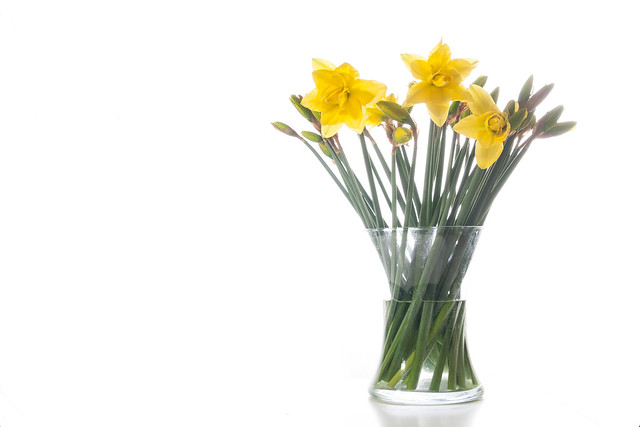
Here's an example without the flashgun reflectors/snoots...I've yet to try with...


Vase of Daffodils by BubbleDouble, on Flickr

Darren
 
I'd say your subject is too close to the background. Some wrap will happen, unless you studio is enormous. Lens flare might be a problem with blown white background, so test your lenses. Also, flag your background lights - V-flats or other gobos.

I've used reflective umbrellas for a more even spread. Eats power but there are less hotspots.

edit: just noticed the "mobile setting" - woops. I think most people then resort to a Lastolite Hilite. It won't let you cheat physics though, the further your subject is from the background, the better. In a constricted space there will also be more light bouncing around, causing more fill just from the background lights.
Yes, that's almost bound to be the problem, but that's why I asked to see an example shot, because it's easier to see a problem than to guess at it.

Chavgrounds are really better in a large studio, there will always be a quality tradeoff if shot in a small space and sometimes it's worth asking whether the shot wouldn't be better on an unlit background.
That looks good, any idea if they could be attached to an interfit flash head?
The Lencarta background reflector is S-fit. The flash heads sold under the Interfit name are made by a number of different factories and have different fittings. Some are S-fit, others are Elinchrom fit and others are a unique fitting, so it depends on which flash heads you have.
 
Ok thanks everyone.

How far away should a subject be from a lit background - in an ideal world.

I would say 3m. But I have a friend who won't do the shoot on a white background if he has less than 7m
 
I would say 3m. But I have a friend who won't do the shoot on a white background if he has less than 7m

..and therein lies my problem. I'm lucky if I can get 1m between subject and background :( Roll on the lottery win so I can move to a place with bigger rooms!
 
..and therein lies my problem. I'm lucky if I can get 1m between subject and background :( Roll on the lottery win so I can move to a place with bigger rooms!

Same here Darren, ~1m that's all I have if I set the background support and backdrop. I decided to ditch that because of the lack of space though and today's session was all done using my cream wall as the background :D
 
That's the reason I never bought a goalpost support system, just haven't got the room. In the end I went for a photosel collapsible background with additional black and white trains and it's fab!
 
I think the Lastolite Hilite is the way to go, but a small 5' x 7' version with black and white is £350 or something like this. Too expensive fo rme at the moment.
 
The problem I keep getting over and over again is light spilling from the backdrop lights.

2 things cause this.

1. Light hitting the background and bouncing off towards the camera. As everybody else has said, separation is the key here. So is running the back lights as low as you possibly can. More light on the white = more light coming back at you. You want as little as you can to make it white.

2. Light rolling off the near edge of the flash. Background reflectors work really well for this. So do lots of other things ;) Here I'm using a bit of black correx held to the light with a multiclip (http://www.manfrotto.co.uk/multiclip). You can also use gaffer tape.

HD_051.jpg


BTW for a cheap source of black correx, just buy a 12 X 18 print from DSC labs....
 
Back
Top