Help using a circular polarising filter

doublem1

Suspended / Banned
Messages
472
Name
Matt
Edit My Images
Yes
I recently bought a Hoya circular polarising filter. I have tried it out in the sunshine and didn't see much effect like I have seen in some example photos. Do I need my back to the sun? What kind of position do I need to face regarding the sun as I it is important.
 
What positions did you try?

- can't beat a sunny day for experimenting with a CPL, try rotating the polariser to vary the strength of the polarising effect and turning to face different point in the sky as you do it (sun behind, in front and at 90-degrees).
 
You want to be standing so as you look through your view finder the sun is either directly to your left or your right. Maybe try taking one with and one without to see the diff although you might not see it fully on your LCD but more so on your computer screen
 
With the sun directly in front or behind you you'll see negligible effect, with the sun to your right or left the effect will be at its strongest. Also don't forget a CPL will reduce the light coming into your camera, usually by up to 2 stops, keep an eye on your shutter speeds, it is easy to let them drop below the level you can handhold and keep sharp shots.
 
It's not as simple as having the sun to your right or left. The zone of maximum polarisation runs in an arc 90 degrees to the sun.

You find it like this. Make a 'gun' out of your forefinger and thumb at a right angle. Point your finger at the sun and rotate your hand around your finger, always pointing at the sun. You thumb will scribe an arc in the sky where the maximum zone of polarisation is, though it's usually quite wide.

Rotate the polarising filter and watch this zone in the viewfinder. You'll see it get darker/lighter.

The other angle to remember is 30-40 degrees to a reflective surface, like water or glass or paintwork. That's the optimum angle for reducing reflections. Again, rotate the polariser and reflections will come and go.
 
It's not as simple as having the sun to your right or left. The zone of maximum polarisation runs in an arc 90 degrees to the sun.

Yup.

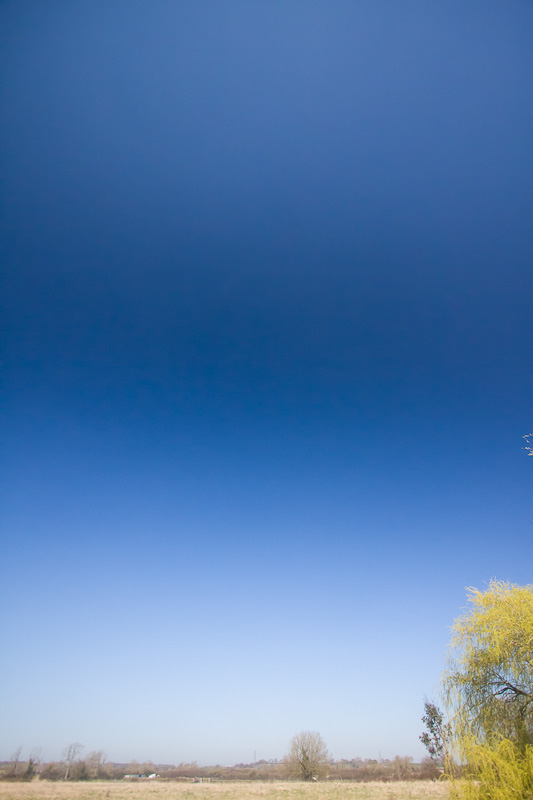
With an ultra-wide angle lens you can easily see this for yourself. Here's an image taken with the Sun directly behind me. You can easily see the band of maximum polarisation.

CPL%20North_20120326_001.jpg
 
doublem1 said:
I recently bought a Hoya circular polarising filter. I have tried it out in the sunshine and didn't see much effect like I have seen in some example photos. Do I need my back to the sun? What kind of position do I need to face regarding the sun as I it is important.

I'm a newbie and thought it would be a good idea to try one of these. One thing that I didn't realize is how much light they cut out (1-2 stops) I think. I couldn't figure out how to set it. The other post said to point it at the sky and turn it (adjust). This was the only way I found that I could see what was going on. To add to that I would say to point it at the clouds or if your near water with a reflection point it at that and adjust. You will see the glare fade in the water and the clouds become more vivid as you adjust. Frankly I think there a bit tricky to use.
 
I just twist it on the end of the lens until I get the desired effect
 
One further snippet: always turn the turny bit in the direction filters screw on, if you go the other way, it may unscrew and drop off... especially if youve got fingers like pigs tits.
 
One further snippet: always turn the turny bit in the direction filters screw on, if you go the other way, it may unscrew and drop off... especially if youve got fingers like pigs tits.

Just beware of over-tightening by accident.. been there, had the lens in the fridge overnight sorting that one out before.. :bang:
 
tdodd said:
This video will demonstrate the effect of a CPL. It is quite easy to see through the viewfinder what is happening. I am not sure why that would make it tricky to use.

http://www.youtube.com/watch?v=MNzXrTKEMWg

Its not easy to see at all. The changes are so subtle that you have to point it at an object with glare or reflection to notice anything with your adjustment. Some subjects are next to impossible to see any change wail adjusting. I have even resorted to looking at the histogram in some situations to see what was going on.
 
That video is misleading at best. That off the lens, sure its easy to see that way but it's much different on the lend.

If the light is coming on from an angle that makes use of a polariser effective then you really should be able to spot something happening through the viewfinder. If you are lined up with the light or the light is so scattered (overcast conditions) that a polariser has no effect then sure, you won't see anything happening. But if you are lined up in such a way that a polariser is able to make a marked difference the impact is quite easy to see.

Here are a couple of examples. No edits on these, SOOC. If you look at the sky you would struggle not to notice the effect of the CPL through the viewfinder, and in the case of the first image look at the difference in saturation in the colours....

20120411_160239_000.jpg


20120411_161723_000.jpg


If you really can't see any difference through the viewfinder then maybe it's because in that situation of lighting there isn't one to be seen. It's also worth noting that the effect will be subtle with only small rotations of the filter. I swing mine through a large arc (at least 90 degrees) quite quickly so that I can spot the positions of minimum and maximum effect. Then I can fine tune somewhere between those limits to get the look I need.

EDIT : and in the case of cutting through reflections in water, again this is an effect which does not go unnoticed in the viewfinder....

20120411_164313_000.jpg
 
Last edited:
Yes, you can see it through the viewfinder. If it's not immediately obvious, another way of picking it up is to watch the meter needle that will move down at max polarisation. If the filter isn't doing much, the meter won't move, but you should still fine tune it by eye.

You can hardly miss darkening like this! Canon 10-22 at 10mm. (Try doing that with a grad ;))

IMG_0253-1.jpg
 
Thanks for all the help guys. Very informative and helpful.
 
Just beware of over-tightening by accident.. been there, had the lens in the fridge overnight sorting that one out before.. :bang:

Glad I'm not the only one then! :cuckoo:
 
HoppyUK said:
Yes, you can see it through the viewfinder. If it's not immediately obvious, another way of picking it up is to watch the meter needle that will move down at max polarisation. If the filter isn't doing much, the meter won't move, but you should still fine tune it by eye.

You can hardly miss darkening like this! Canon 10-22 at 10mm. (Try doing that with a grad ;))

Not fair that's a pic that Ray Charles could dial his polarizer in on. :o lol.
I use the histogram to help see the effect. Sometimes it can be very obvious and other times it is very difficult. The times that it is hard to see I point up to the sky and find the most powerful setting then go back to the subject with a good starting point. That seems to be the most effective way for me, but I'm just a beginner.
 
Back
Top