Hi AS. I'm in the Highlands too.
About 8 years ago I was at a similar photographic fork in the road as yourself. My ultra compact point and shoot broke beyond viable repair. This encouraged me to finally get an advanced camera and lens as I desired to learn the craft and artistry of photography.
Second hand equipment is absolutely the best way to start your journey.
Ffordes in Beauly have always been good to me. It's quite the Mecca for us Highlanders.
https://www.ffordes.com/
A good retailer will warranty your kit for at least 6 months. That's peace of mind and confidence. And you'll only loose about 20% of the buying price if you want to trade it back into them and upgrade.
It always helps if you have a family member or friend experienced in photography to ride shotgun with you in the early days. Similarly if there is a photography club near you, then it might be worth your while to ask them if you could join one of their meetings to get some general guidance and hands-on experience.
When it comes to actually buying your kit, it's best to phone the shop in advance. Ask them to recommend you a quieter time in their weekly schedule so they can share 30-60 minutes of quality time with you. Tell them you'd appreciate handling a variety of their DSLR and mirrorless cameras and lenses in person. It's in their best interests to get you off to a happy start. Happy new customers are repeat customers.
Approach things with an open mind. The right kit for you will find you if you prudently encourage it to. At the end of the day we are all different in some ways and similar in others. Don't fixate on a certain brand of manufacturer. Don't insist on preferring one of DSLR or mirrorless over the other. No single brand or system will ever tick all of your boxes. The few compromises to be made here and there are tough choices for all of us.
I got off to a good start with a Nikon D610 and a nifty fifty, a versatile 50mm prime lens. Six months later I'd confidently found my feet and traded up the D610 for a D750. I loved that camera and always will. Three years and a college course later the bulk and weight of the D750 and its lenses were getting on my nerves. I switched to mirrorless cropped sensor and found my long-term niche.
Said in seriousness (and jest) I think we should be blindfolded when we choose our first camera body. It's gotta feel good, comfortable and ergonomic in our hands. Our hands are it's new home, after all.
Hand size can be an under-appreciated deciding factor for a beginner. People with large or very large hands are often not suited to small camera bodies. People with small or very small hands aren't often suited to big camera bodies.
You're looking for a camera body and a lens. Your prime lens will typically be 35mm (or perhaps 50mm) for a full frame body, that's 23mm (or 35mm) in cropped sensor lingo. Or you may well prefer the versatility of a zoom lens in the range of approximately 24mm to 85mm in full frame numbers.
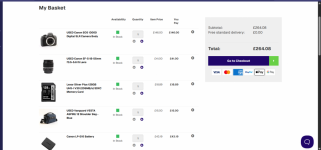
£600 - £800 is perfectly adequate to cover a good body, a good lens and essential basic accessories like a spare battery, a couple of memory cards and a carry bag. It's rare to find a bad camera or a bad lens nowadays. There's an avalanche of nonsense in the media encouraging us to buy another avalanche of fancy kit we simply don't need. Much the same can be said for pixel-peeping pfaffery and cutting edge technologies.
Nobody picks up a guitar for the first time and starts playing like a professional musician. We have to put in the graft to learn our craft. Learn what every button, dial and feature of your kit is and does. Learn the menu system inside out. Read the manual and parts of it over and over again. Fine tune your settings until you find your sweet spots. Lots of YouTube videos will help you. Get a good second hand book or two, or rummage around with the Internet Archive search engine and download some free books in PDF format.
https://archive.org/search?query=beginner+photography+pdf
I still use an ultra compact point and shoot most days. It's mostly a recce camera. I snap things that appeal to me and then get the big guns out later when the weather and light enable me to capture them in all their finery. I could use a dumb phone for the initial recce work, but I can't stand the infernal, Orwellian contraptions.
The single most important part about my (very carefully) chosen kit is that it enthuses me to pick it up, use it and
ENJOY it frequently.
All the best and good luck on your journey.