Beginner Help Me. Where to Begin??

Messages
14
Edit My Images
No
Hello, everyone,

Where do I begin?

I've used a smartphone as my only source for all things photo related, and I've been meaning to make the jump to purchasing a dedicated camera + lens to really begin my photographic journey.

Smartphones make things easy, and are very capable, but I definitely feel like I could achieve more with a proper camera system.

As a complete novice in the world of camera (DSLR/Mirrorless/Full sensor/Crop Sensor/Nikon/Canon/Sony/Fuji) I am blinded by just how many options are out there with all varying strengths and weaknesses.

Could some, kind hearted soul, point me in the direction of a great Camera+Lens mix to set my journey off on the right foot?

I'd greatly appreciate it.

Based in Scotland.
 
Firstly ....


What is your budget?

And what do you want to photograph?
Hi there.

For my first steps into photography, I was hoping to keep my budget between £6-£800.

At the moment, I don't have a specific focus on particular image types, I do tend to take Urban setting pictures, family time photos, and the occasional landscape picture.

Due to only using my Phone as my driver, It does tend to be one camera for all occasions that I would be looking for, with future plans to purchase more lenses to open up new avenues of image type.

A good overall starting platform would be my best hope.
 
I wonder if this (Panasonic TZ100) might suit well for what the OP is looking for. A good general purpose camera to see whether he wants to take it further and later get into a "system" (body and lenses)?
 
I wonder if this (Panasonic TZ100) might suit well for what the OP is looking for. A good general purpose camera to see whether he wants to take it further and later get into a "system" (body and lenses)?
I'll give it a wee Google to check it out, for sure.

Do you think it would give enough versatility, being a compact camera? or would you suggest this over looking at a bulkier set up?

I'm probably hindering suggestions, rather than helping.

I've seen some online posts pointing towards The Canon EOS 600D and EOS R50.
 
Firstly, you can’t buy the ‘wrong’ camera (you possibly could buy the wrong lens).
Secondly, though you’ve probably got this, it’s your FIRST camera, in 2 yrs time, it’ll either get used till it falls apart, be stuck at the back of a cupboard unused or you’ve traded it in.
It’s no time for thinking you’re about to start on a long term relationship with a camera.

With that in mind - second hand makes more sense, it feels more like rental.

DONT buy an entry level camera, they exist to create an upgrade path to increase revenue for camera manufacturers, NOT to make life easy for you.

A mid range model offers more flexibility, and stops you having to dive through menus to change settings.

Go to a shop to feel the difference in size between M43, crop and full frame. Even with modern mirrorless cameras a FF camera and good lens can be a chore to carry. But you might feel others are too small, it’s a personal thing.
 
I echo what others have said. Start off with almost any second-hand camera, there are no bad cameras, so the make doesn't matter.
Full-frame will, theoretically, produce higher image quality, but unless you want to make massive paper enlargements, that doesn't matter.
Smaller cameras are lighter and more convenient up to a point, but as @Phil V says, entry-level cameras - which tend to be smaller and lighter - tend to be more fiddly to operate.

My personal choice, if I was starting out, would be an old DSLR, photographers tend to always want the latest cameras with the most features, so old DSLR cameras are as cheap as chips. After a year or 2 you may well outgrow its capabilities and bin it, or re-sell it, or use it as a paperweight, but it will be a very good starting point.

A couple of suggestions, all with a standard mid-range zoom lens, as it happens they are all Nikon, that's becasue I personally use Nikon cameras.

Nikon D70S - ancient, cheap as chips, but in its day was considered to be almost a pro camera.
Nikon D700 - very old pro camera, fantastic value for money
Nikon D3 - basically the same as the D700 but more solidly built, even more capable
D7200 - very capable for pretty much all types of photography, but not if you need to use it like a machine gun - limited number of shots per second.
Nikon D3100/D3200 - entry level, dirt cheap and very similar to the D7200 but with the limitations of entry level.
 
The only extra suggestion I can add is that you start with any camera that has a full auto mode and stick with that mode.

Once you find that you've recorded pictures that you don't like, because the camera's decisions weren't the ones you'd have preferred, then start exploring the camera's other modes.
 
The best two pieces of advice above are true, go to a shop to handle various different cameras to see what feels best to you, and then buy secondhand.

Also as above, there aren't any 'bad' cameras, especially not as a starting point, so stick to your budget and see what feels the most comfortable to you (in handling/button layout/weight etc). If a camera setup isn't comfortable for you, you won't use it. Also, you don't need the best Canon L/Sony G etc lenses to learn photography, regardless of what someone in the camera shop or online might tell you. You will see just as many awful photos taken with £4k setups as you will from someone with a mid-range setup.
 
Last edited:
The best two pieces advice above are true, go to a shop to handle various different cameras to see what feels best to you, and then buy secondhand.

Also as above, there aren't any 'bad' cameras, especially not as a starting point, so stick to your budget and see what feels the most comfortable to you (in handling/button layout/weight etc). If a camera setup isn't comfortable for you, you won't use it. Also, you don't need the best Canon L/Sony G etc lenses to learn photography, regardless of what someone in the camera shop or online might tell you. You will see just as many awful photos taken with £4k setups as you will from someone with a mid-range setup.
Just to expand on the a bit - even the kit lenses that you can get bundled with the camera are perfectly capable of giving great results - camera lenses are a something where to get a 10% improvement, you can easily have to pay 50% more - start with the kit lens, and learn from that what the lenses limitations are that are stopping you getting the results you want - then upgrade to a lens that offers you what you need.
 
You will see just as many awful photos taken with £4k setups as you will from someone with a mid-range setup.

Very true, we had a presenter at our club about 12-13 years ago who'd bought herself a Hasselblad H1D and it was clear she had no idea how to use it... her framing was tragic!

I am a Pentax and Nikon User; happy with 4/5 of Garry's suggestions on the Nikons. I would steer you away from the D3*00/D5*00 series cameras for single reason that they don't fully support older (non-AFS) lenses so you lose AF functionality because they lack screw-drive. D7*00 models and FX cameras are able to use most F-mount lenses with fewer limitations. One other thing about older Nikons (and that applies to older cameras from other manufacturers) is compatibility with SD and CF cards (older specifiations), might not be available new so second hand options might have to be considered so that is another piece of expenditure to consider.

I would suggest a Pentax KP as another camera to consider, or maybe a K3ii. Avoid K30/K50/K70 as they suffer a fault in the aperture solenoid; K-5, K-3 and K-1 (and the KP) don't have this. Another attraction of the KP/K-3 is the optical viewfindinder (Pentaprism and not pentamirror) gives you a much better view for framing than the competitors.
 
What do you value in your camera? If it's size then a DSLR might not tick that box. It might be compactness you're after. In which case perhaps you should look for a decent compact, or M4/3.
 
I'd suggest a used Nikon D90 with a 18-70 or a 18-140 AF-S lens. The camera is only 12 megapixels but that is plenty. Get a flash to.

I wouldn't get a pro style camera as a first camera, even if pro DSLRs can be pretty cheap. They are too big to carry about

Get an old machine. Use it, abuse it, then decide what you are really interested in.
 
Great recommendations from everyone, and it's genuinely appreciated.

2nd hand is definitely the way to go for my first set up and I've got a few leads now to follow and see what the best mix is going to be for me.

Hopefully I can get up and running soon, as Winter is almost upon us, and living in the Highlands of Scotland gives me such an amazing choice of locations to capture.

Thank you for all the input.

I'll be popping in and out of a lot of these threads trying to pick up little tips from wherever I can.

Thanks again.
 
As most people has mentioned that 2nd / used gear is the best bang for buck, and the only way to get an inform choice is to visit a camera shop.

Not sure where abort's you are in the country I am not sure how viable this is for you. However I would strongly advise to visit one, and get hands on with cameras.
A medium entry camera is very good start, and there is lots of choice out there for you.
 
Hi AS. I'm in the Highlands too.

About 8 years ago I was at a similar photographic fork in the road as yourself. My ultra compact point and shoot broke beyond viable repair. This encouraged me to finally get an advanced camera and lens as I desired to learn the craft and artistry of photography.

Second hand equipment is absolutely the best way to start your journey.

Ffordes in Beauly have always been good to me. It's quite the Mecca for us Highlanders.

https://www.ffordes.com/

A good retailer will warranty your kit for at least 6 months. That's peace of mind and confidence. And you'll only loose about 20% of the buying price if you want to trade it back into them and upgrade.

It always helps if you have a family member or friend experienced in photography to ride shotgun with you in the early days. Similarly if there is a photography club near you, then it might be worth your while to ask them if you could join one of their meetings to get some general guidance and hands-on experience.

When it comes to actually buying your kit, it's best to phone the shop in advance. Ask them to recommend you a quieter time in their weekly schedule so they can share 30-60 minutes of quality time with you. Tell them you'd appreciate handling a variety of their DSLR and mirrorless cameras and lenses in person. It's in their best interests to get you off to a happy start. Happy new customers are repeat customers.

Approach things with an open mind. The right kit for you will find you if you prudently encourage it to. At the end of the day we are all different in some ways and similar in others. Don't fixate on a certain brand of manufacturer. Don't insist on preferring one of DSLR or mirrorless over the other. No single brand or system will ever tick all of your boxes. The few compromises to be made here and there are tough choices for all of us.

I got off to a good start with a Nikon D610 and a nifty fifty, a versatile 50mm prime lens. Six months later I'd confidently found my feet and traded up the D610 for a D750. I loved that camera and always will. Three years and a college course later the bulk and weight of the D750 and its lenses were getting on my nerves. I switched to mirrorless cropped sensor and found my long-term niche.

Said in seriousness (and jest) I think we should be blindfolded when we choose our first camera body. It's gotta feel good, comfortable and ergonomic in our hands. Our hands are it's new home, after all.

Hand size can be an under-appreciated deciding factor for a beginner. People with large or very large hands are often not suited to small camera bodies. People with small or very small hands aren't often suited to big camera bodies.

You're looking for a camera body and a lens. Your prime lens will typically be 35mm (or perhaps 50mm) for a full frame body, that's 23mm (or 35mm) in cropped sensor lingo. Or you may well prefer the versatility of a zoom lens in the range of approximately 24mm to 85mm in full frame numbers.

£600 - £800 is perfectly adequate to cover a good body, a good lens and essential basic accessories like a spare battery, a couple of memory cards and a carry bag. It's rare to find a bad camera or a bad lens nowadays. There's an avalanche of nonsense in the media encouraging us to buy another avalanche of fancy kit we simply don't need. Much the same can be said for pixel-peeping pfaffery and cutting edge technologies.

Nobody picks up a guitar for the first time and starts playing like a professional musician. We have to put in the graft to learn our craft. Learn what every button, dial and feature of your kit is and does. Learn the menu system inside out. Read the manual and parts of it over and over again. Fine tune your settings until you find your sweet spots. Lots of YouTube videos will help you. Get a good second hand book or two, or rummage around with the Internet Archive search engine and download some free books in PDF format.

https://archive.org/search?query=beginner+photography+pdf

I still use an ultra compact point and shoot most days. It's mostly a recce camera. I snap things that appeal to me and then get the big guns out later when the weather and light enable me to capture them in all their finery. I could use a dumb phone for the initial recce work, but I can't stand the infernal, Orwellian contraptions.

The single most important part about my (very carefully) chosen kit is that it enthuses me to pick it up, use it and ENJOY it frequently.

All the best and good luck on your journey.

 
Last edited:
Hello, everyone,

Where do I begin?

I've used a smartphone as my only source for all things photo related, and I've been meaning to make the jump to purchasing a dedicated camera + lens to really begin my photographic journey.

Smartphones make things easy, and are very capable, but I definitely feel like I could achieve more with a proper camera system.

As a complete novice in the world of camera (DSLR/Mirrorless/Full sensor/Crop Sensor/Nikon/Canon/Sony/Fuji) I am blinded by just how many options are out there with all varying strengths and weaknesses.

Could some, kind hearted soul, point me in the direction of a great Camera+Lens mix to set my journey off on the right foot?

I'd greatly appreciate it.

Based in Scotland.
I forgot to ask what do you mainly take photos off ! ?
 
Great recommendations from everyone, and it's genuinely appreciated.

2nd hand is definitely the way to go for my first set up and I've got a few leads now to follow and see what the best mix is going to be for me.

Hopefully I can get up and running soon, as Winter is almost upon us, and living in the Highlands of Scotland gives me such an amazing choice of locations to capture.

Thank you for all the input.

I'll be popping in and out of a lot of these threads trying to pick up little tips from wherever I can.

Thanks again.

Lucky man living up there.

We've just done the NC 500 in a VW Transporter for 2 weeks and can honestly say the scenery is the best I've seen anywhere.

Take a look at my Flickr to see what can be done with micro 4 thirds equipment.

It doesn't suit everyone but I find it perfect for my photography.

Welcome the forum.
 
I forgot to ask what do you mainly take photos off ! ?
I wasn't too sure if I could post links or images to the forum, as I'm a newcomer and didn't want to go against any rules set by admins on here.

@Iamscotmackay on Instagram.

I have 1 or 2 images that I've tried to take a bit more care with, but a lot that we're just random snaps. So please, don't expect anything less than professional lunacy on my account

I'm also a bit of a videogame nerd, so you may need to just gloss over quite a few posts on there too.
 
Last edited:
There are rules. But we all forget the odd one from time to time. If you do break one, it's usually picked up on in a more friendly way initially :)
Hiya,

That's good to know.

Just want to make sure I'm coming across as genuine and not as a spam poster, or anything like that.

I can absolutely understand the amount of moderation that goes on under the surface.
 
Hello, everyone,

Where do I begin?

I've used a smartphone as my only source for all things photo related, and I've been meaning to make the jump to purchasing a dedicated camera + lens to really begin my photographic journey.

Smartphones make things easy, and are very capable, but I definitely feel like I could achieve more with a proper camera system.

As a complete novice in the world of camera (DSLR/Mirrorless/Full sensor/Crop Sensor/Nikon/Canon/Sony/Fuji) I am blinded by just how many options are out there with all varying strengths and weaknesses.

Could some, kind hearted soul, point me in the direction of a great Camera+Lens mix to set my journey off on the right foot?

I'd greatly appreciate it.

Based in Scotland.
Hello there,
I have been into photography for about 1-2 years now, I started out with an EOS 1300d and a Canon 18-55mm kit lens, this combination works great as it allows you to find out what you like photographing and then buy more specialised lenses later on. In total I spent just under £400 for the camera, lens, bag, SD card, etc.
 
Hello there,
I have been into photography for about 1-2 years now, I started out with an EOS 1300d and a Canon 18-55mm kit lens, this combination works great as it allows you to find out what you like photographing and then buy more specialised lenses later on. In total I spent just under £400 for the camera, lens, bag, SD card, etc.
Canon definitely seems like a great direction to go. Lots of options for upgrading at a later date.

I've also been looking at the Sony A6000. It has some nice features too.

I was trying to factor in some extra accessories too (More batteries, SD cards etc).
 
Do you have a camera store near you, I would recommend Wex if possible, go there and try them out, see what you prefer. For an EOS 1300d you will have to buy used, personally speaking I only really buy used. All of my lenses, flash, and my camera are brought used from Wex. If you do go used I would go with a 9-, 9 or 9+, in my experience everything used from Wex is brilliant, also their customer service is excellent. Once I brought a Godox flash used from Wex and got home, used it for a day and then the next day it didn't work, went in store and they exchanged it for a different model (a higher end one, I did pay a bit more but they gave me a massive discount).
 
Canon definitely seems like a great direction to go. Lots of options for upgrading at a later date.

I've also been looking at the Sony A6000. It has some nice features too.

I was trying to factor in some extra accessories too (More batteries, SD cards etc).
Don't worry about accessories until you've got to know the camera really well and can't live without the extras, keep it simple.

As for spare batteries, useful if you use Live View a lot, but batteries on fairly modern cameras are more than adequate for all normal use, and memory cards now have enormous capacity too.
 
I was trying to factor in some extra accessories too (More batteries, SD cards etc).
For batteries I would either go official or a trusted brand, for example PowerExtra or DuraCell.
SD cards I have had a good experience with both Sandisk and Lexar, I would go with 128gb minimum especially if you plan to shoot RAW.
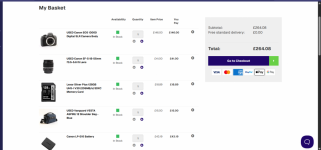
Overall I think you could do this for under £400, here is something I quickly put together in a Wex basket, :
1758902102900.png
 
For batteries I would either go official or a trusted brand, for example PowerExtra or DuraCell.
SD cards I have had a good experience with both Sandisk and Lexar, I would go with 128gb minimum especially if you plan to shoot RAW.
Overall I think you could do this for under £400, here is something I quickly put together in a Wex basket, :
View attachment 464080
This is brilliantly handy, I'll take a look. Many thanks

I'm in Inverness, in the north of Scotland so there's a limited amount of shops up here.

A previous suggestion made by @j.j about a place called ffords in Beauly, is on my visit list to get some hands on time with various setups.
 
This is brilliantly handy, I'll take a look. Many thanks

I'm in Inverness, in the north of Scotland so there's a limited amount of shops up here.

A previous suggestion made by @j.j about a place called ffords in Beauly, is on my visit list to get some hands on time with various setups.
I have brought a lens online from WEX before and they ship products really well, they package everything safely and they ship it with DPD or FedEx, which in my area are some of the best couriers.

Not sure about online but in store they will let you exchange a purchase with different gear if you aren't happy(I think this only applies to used products)
 
I'll give it a wee Google to check it out, for sure.

Do you think it would give enough versatility, being a compact camera? or would you suggest this over looking at a bulkier set up?

I'm probably hindering suggestions, rather than helping.

I've seen some online posts pointing towards The Canon EOS 600D and EOS R50.

It's my TZ100 in the link but as you're a new guy I don't think you have access to the for sale section.

Cameras like the TZ100 can have all of the controls and features of larger cameras but some would think that as they're smaller they're too fiddly, I don't think that they necessarily are.

If you are not sure which way to go I think I'd recommend a camera and two lens set up. I'd recommend a standard prime (a prime is a fixed focal length lens which doesn't zoom) and a standard range zoom. A relatively cheap option could be a used Micro Four Thirds system. You will very likely be able to find a used Panasonic or Olympus Micro Four Thirds camera and a couple of lenses within budget. I'd recommend a f1.7 or f1.8 prime in the 17 or 20mm range and a 14-45mm f3.5-5.6mm zoom.

I think a mirrorless camera is worth looking at as in my opinion they offer real advantages over traditional DSLR's.

Good luck with all this, have fun.
 
Good morning, everyone.

A wee update from my side.

After some pretty intense researching (a lot of youtube, asking questions here, etc), and a bit of canny deal shopping, I've finally ordered my camera of choice.

I'm awaiting the delivery of the Sony A6400 with the E PZ 16-50 MM F/3.5-f/5.6 OSS II Lens.

I was originally looking at the A6000 but the mixture of a good deal price, and a nice wee discount through my work made the A6400 a good option.


A big THANK YOU to everyone on here who helped with advice and pointing me in the right direction.

No doubt, you will see me in some of the other threads, pleading for more advice as I try to get to grips with things.

Again, massive thank you to everyone.

#HappySnapping
 
Last edited:
Good morning, everyone.

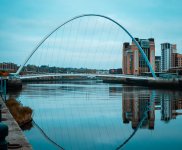
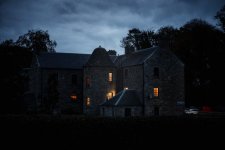
I am just back from a week in Newcastle with the family and I took my new camera for a quick spin.

I didn't have much time to get fully to grips with it (or Lightroom) but I'm enjoying the process of learning, and we all have to start somewhere.

Sony A6400 with kit lens.
Bridge1.jpgJedburgh House 1.jpg
 
Nice photos, are you shooting RAW or JPG??
Hiya, I'm shooting in both. JPG for simple social media posts, and Raw for using in Lightroom.

I'm probably not getting the most out of Lightroom at the moment, but I'll get there.

A lot more practice in composition is needed.

Currently using Aperture priority.
 
Hiya, I'm shooting in both. JPG for simple social media posts, and Raw for using in Lightroom.

I'm probably not getting the most out of Lightroom at the moment, but I'll get there.

A lot more practice in composition is needed.

Currently using Aperture priority.
Are you paying for just Lightroom, the photography plan or the full Adobe Creative Cloud? If you have Photoshop I would recommend having a look at camera RAW, it works really well and is easy to get started with.
 
Hiya, I'm shooting in both. JPG for simple social media posts, and Raw for using in Lightroom.

I'm probably not getting the most out of Lightroom at the moment, but I'll get there.

A lot more practice in composition is needed.

Currently using Aperture priority.
RAW or jpg is something that some people feel strongly about, there are advantages and disadvantages to both, but it's just a choice. My advice - right now - is to concentrate on the visual and creative aspects of your photography. Aperture priority is the right choice for almost all subjects (almost everything that doesn't require a high shutter speed) so I feel that you're approaching what can be a very complex set of techniques in the right way. Keep it simple!
 
Hiya, I'm shooting in both. JPG for simple social media posts, and Raw for using in Lightroom.

I'm probably not getting the most out of Lightroom at the moment, but I'll get there.

A lot more practice in composition is needed.

Currently using Aperture priority.
FWIw, in my experience once you start learning you'll never stop The day I stop learning is that day I stop. Photography is great in that sense. There is always something to be learned as new challenges present themselves.

Enjoy the journey!
 
Back
Top