

HDR

Last edited:
As OLED becomes prominent, I think we'll see higher brightness and larger colour gamut screens which will allow us to view HDR without tone mapping.

Surely the 'need' for HDR is due to the lower dynamic range of sensors rather than the viewing medium. People have been happy with the range available by printing for many years.

HDR is a capture technique where a range of exposures is made to cover both highlight and shadow.


Steve.
 
I thought that HDR was an attempt to recreate the dynamic range afforded by film through the use of multiple overlayed digital images of differing exposure. That said, I don't think I've ever seen a definition for the dynamic range that film offered. Current (Canon) digital sensors seem to have 14-bits of dynamic range which is 16,383 discrete levels. I don't know how that compares to film.

Some HDR images actually look better for being 'overdone' in my view. The technique itself is just another artistic tool, like solarising or posterising etc.. I don't get the snootiness about so called 'butchered' images, except in reportage of course. Artistically, I've no problem with any technique. That doesn't mean I like everything I see, but I always try to respect the work of others..
 
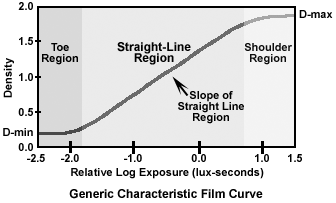
Digital works differently to film. Digital is linear and once you blow out the highlights, they are not recoverable. Negative film has a linear portion with a toe and shoulder curve. As you apply more light, the film goes into the shoulder region and gets progressively more dense but at a slower rate rather than right up to full scale as in digital.

tw0303-4.gif


Steve.
 
Thanks Steve, I appreciate the chart you posted and do understand digital vs analogue. This is a very familiar discussion for transistors vs tubes in guitar amps... I know which sound better too :)
 
Back
Top