Furniture/Woodcarving photography advice please...

tjc

Suspended / Banned
Messages
861
Edit My Images
No
Hi all...

I`m wondering if I could get some advice on the best way to photograph my woodcarvings for a new catalogue I`m putting together of my work to show clients etc...

The carvings are small and large tables, Celtic plaques and Chist`s (or Chests`s) etc, some are carved in light coloured Sycamore and some are carved in much darker Walnut or Mahogany so what would be the best kind of background to show off the items at their best?

How would you guys go about photographing this kind of thing?

I`ll hopefully be able to get a first attempt at some shots in a week (or maybe slightly longer) so I`d be very grateful for any helpful advice, tips or suggestions on the best way to go about this to achieve the best results.

I`ll be doing the photography indoors so any advice on lighting etc would be very much appreciated although I doubt if I`ll be able to get my hands on any pro lighting gear... :(

Which lens(s) would be best for this type of photography? I`d like some shots to show of the whole item and maybe some closer shots to show the detail of the carving... I have a couple of lens`s, one is a Tokina 12-24 wide boy and the other is 55-200mm but I can also borrow various sizes of lens from my brother in-law so hopefully out of that lot I`ll have something that`ll do.

I have some more questions I`d like to ask and I`m sure I`ll have more as I go through the process of doing this but for now any tips or advice on the subject would be very much appreciated...

Cheers.

tj :)
 
aww dude if you were in the SW i would have come and done it for you, my boyfriend makes wood stuff and it would have been great practise for the future :) i would reccomend possible taking stuff outside or have the curtain open and having a lamp on or something to give a bit of a second light source... Just have a play and you will be fine :P
 
Not much to go on there. I'm struggling to visualise what it is you're trying to photograph, size, shapes, angles etc.

But if I'm right in thinking there is carving on a flat surface, the the usual way of shooting that to show the relief is a very low level point light source on virtually the same plane just skimming the surface and picking out shadows. Something like a flash gun, or a small bare light bulb.

Can you post a rough pic?
 
Sounds an interesting project...
I have done a fair amount of such photography in the past.

In many ways you have to imagine it as miniature architecture, as it has many of the same problems.

You have complicated the issue somewhat by carving, which is usually brought out best by strong oblique light, However this might easily complicate the basic shapes involved.

some times it is best to show two shots, one giving overall impression, and another to show some important detail.

As far as lenses are concerned get as far away as you can and use a lens to fill the image. For instance if you are shooting a small table you either see mostly legs or mostly top, by moving away you can get a better balance between the two.
Also like shooting buildings, converging verticals become more of a problem the closer you are. It is best to keep far enough away so as to be able to do any such corrections in software. People don't like to be shown pictures of distorted furniture, you can not expect the visually illiterate to work out how some thing really looks.

Probably the best results are by making up a small roomset to give the product a sense of reality.

If you have a posh country hotel near by, they might allow you to use some of their rooms as background... in exchange for a plug in your catalogue.
 
aww dude if you were in the SW i would have come and done it for you, my boyfriend makes wood stuff and it would have been great practise for the future :) i would reccomend possible taking stuff outside or have the curtain open and having a lamp on or something to give a bit of a second light source... Just have a play and you will be fine :P

Thanks for the reply feeb...

Well I could hardly be much further away from you and still be on the British mainland :D so that`s that out the window but thanks anyway... :)


Not much to go on there. I'm struggling to visualise what it is you're trying to photograph, size, shapes, angles etc.

But if I'm right in thinking there is carving on a flat surface, the the usual way of shooting that to show the relief is a very low level point light source on virtually the same plane just skimming the surface and picking out shadows. Something like a flash gun, or a small bare light bulb.

Can you post a rough pic?

Hi Hoppy :)

Thanks for your advice...

Yeh sorry, I spose it must be quite hard to imagine the kind of thing I`m on about... I`ll see if I can get a rough pic to show but your right... the tables have carving on a flat surface but some also have carving on the legs and center bars etc...

The Celtic plaques stand up and have carving on the face. I`ll see if I can that rough pic... :)


Sounds an interesting project...
I have done a fair amount of such photography in the past.

In many ways you have to imagine it as miniature architecture, as it has many of the same problems.

You have complicated the issue somewhat by carving, which is usually brought out best by strong oblique light, However this might easily complicate the basic shapes involved.

some times it is best to show two shots, one giving overall impression, and another to show some important detail.

As far as lenses are concerned get as far away as you can and use a lens to fill the image. For instance if you are shooting a small table you either see mostly legs or mostly top, by moving away you can get a better balance between the two.
Also like shooting buildings, converging verticals become more of a problem the closer you are. It is best to keep far enough away so as to be able to do any such corrections in software. People don't like to be shown pictures of distorted furniture, you can not expect the visually illiterate to work out how some thing really looks.

Probably the best results are by making up a small roomset to give the product a sense of reality.

If you have a posh country hotel near by, they might allow you to use some of their rooms as background... in exchange for a plug in your catalogue.

Cheers for the reply. :)

First off, would there be any chance you would maybe post up a pic or two to give me an idea of how you go about it? If that`s not possible or you`d rather not for any reason then that`s cool...

Very interesting to hear that youv`e done a lot of this type of photography recently.

Thanks for the info concerning lenses/distances etc, that`s the kind of info I need.

I was thinking about trying to get a small roomset type thing sorted out too as I think that kind of setting would suit the items as that`s the type of setting they`ll be in, in-situ as it were...

Cheers for now...

I`ll be back.
 
Cheers for the reply. :)

First off, would there be any chance you would maybe post up a pic or two to give me an idea of how you go about it? If that`s not possible or you`d rather not for any reason then that`s cool...

Very interesting to hear that youv`e done a lot of this type of photography recently.

Thanks for the info concerning lenses/distances etc, that`s the kind of info I need.

I was thinking about trying to get a small roomset type thing sorted out too as I think that kind of setting would suit the items as that`s the type of setting they`ll be in, in-situ as it were...

Cheers for now...

I`ll be back.

I am afraid I have not done product photography for some years now.
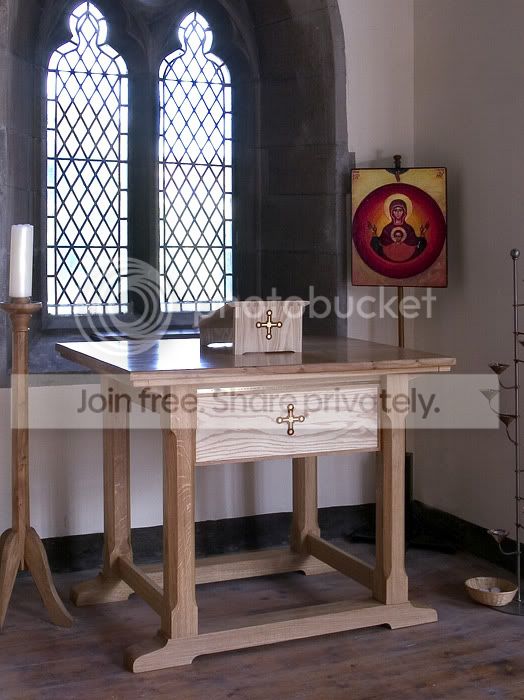
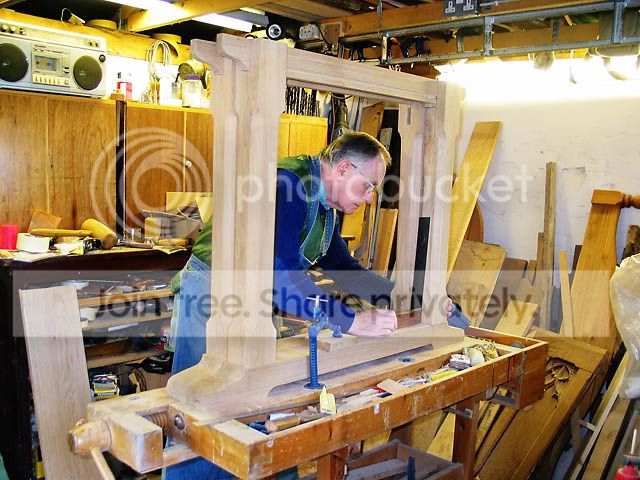
But three years ago I made a side chapel Altar in memory of my late wife.. Joinery is a hobby but i used to specialise in making spinning and weaving equipment (wheels & Looms)
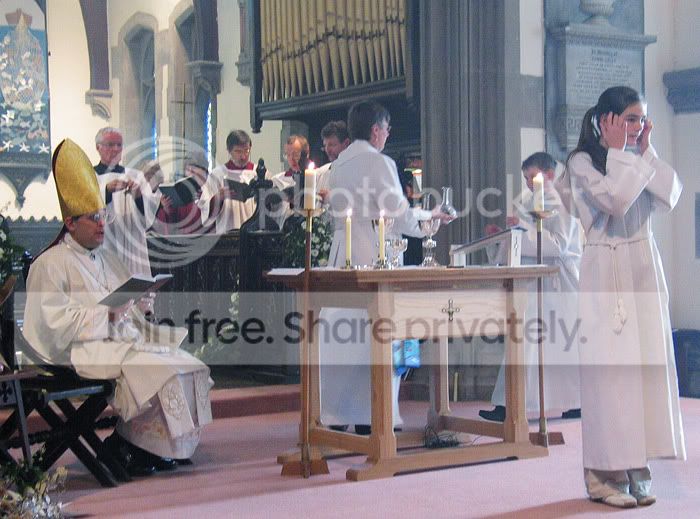
These shots were taken on my compact when I was making the Altar and during and after the dedication service by the Bishop... quality on the very low side as I could not use flash or added light.

bishop-altar.jpg

altar.jpg

AltarInmemoryofAudrey1.jpg
 
Many thanks for posting the pics. No 2 really shows off the beautiful Altar youv`e made...

Youv`e obviously got great hands on you, it`s easy to tell how well it`s made and finished... lovely. :)

What wood did you use?
 
Many thanks for posting the pics. No 2 really shows off the beautiful Altar youv`e made...

Youv`e obviously got great hands on you, it`s easy to tell how well it`s made and finished... lovely. :)

What wood did you use?

The top was made in Welsh pippy oak and the rest in well figured oak, the front panel is white ash. The crosses were hand cut veneers of walnut set with gold leaf. The bible lectern was in white ash to match the front.

Picked up the timber as sawn from a small timber yard in Wales.
 
Cheers for the info.

Now Welsh pippy oak I`ve never heard of but I`ve used all the rest.

My project might be on hold for a wee while (hollidays and actual carving to do) but I`ll be back hopefully with a rough pic or two as soon as.

:)
 
Pippy oak is the result of a tree grown in a hedge row with numerous small branches/ twigs on the trunk.
This creates the pippy effect when sawn. It is always sold at a great premium as it is not common, and the saw mills hate it as it often has bits of barbed wire and nails in it, from where farmers have put up wire fences over the years.
price per cube of a good sample is often more than twice that of normal oak.
 
Back
Top