

You are using an out of date browser. It may not display this or other websites correctly.
You should upgrade or use an alternative browser.
You should upgrade or use an alternative browser.
full frame
- Thread starter derrycity
- Start date

Pookeyhead
Suspended / Banned
- Messages
- 11,746
- Name
- David
- Edit My Images
- No
WHAT IS THE ADVANTAGE OF TYPING IN CAPITAL LETTERS? WHY ARE YOU SHOUTING AT ME?

- Messages
- 43,206
- Name
- Alan
- Edit My Images
- No
WHAT IS THE ADVANTAGE OF A FULL FRAME CAMERA I HAVE A 40D AND THINKING OF A UPGRADE .
You'll probably get better noise performance at the highest ISO's.
Your lenses will have the same field of view as they did in the film days (if you're that old
 ,) there'll be no x1.6 crop factor.
After that I'm struggling... disadvantages...
The lenses will on average be bigger and heavier making the camera and lens package as a whole a little bigger and heavier.
To get the same field of view and depth of field / look as you'll get with an equivalent APS-C camera + lens you'll possibly be shooting with a slightly higher ISO and/or lower shutter speed.
Last edited:
Pookeyhead
Suspended / Banned
- Messages
- 11,746
- Name
- David
- Edit My Images
- No
For me the advantage is quality. The larger the sensor, the less hard the lenses have to work. A lens has a finite amount of resolution available, and can resolve a single point only so far... called the circle of confusion. As this is fixed by the lens, the smaller that circle of confusion is in comparison to the sensor size, the more the perceived sharpness of the image due to less enlargement being required for any given print size.
Here's demonstration:
Below are two images. One taken with a D7000 with a standard prime lens (35mm f1.8G), and the other taken with a D800 with a standard prime lens (50mm f1.8D)
Now... before you start thinking, "Well of course the D800 is better... it's got over twice the resolution"... I've resized the D800 image to exactly the same size as the D7000 image. Both images are taken with the lenses at their optimum aperture for sharpness.
No sharpness has been applied, either in RAW conversion or in the resizing. Both images were manually focused using live view on maximum magnification, so AF accuracy has been removed from the equation. Both images were remote released with the camera on a tripod using mirror lock up.
D7000
D800
That difference in quality is due to sensor size.
(My test images are getting a good workout tonight )
)
Here's demonstration:
Below are two images. One taken with a D7000 with a standard prime lens (35mm f1.8G), and the other taken with a D800 with a standard prime lens (50mm f1.8D)
Now... before you start thinking, "Well of course the D800 is better... it's got over twice the resolution"... I've resized the D800 image to exactly the same size as the D7000 image. Both images are taken with the lenses at their optimum aperture for sharpness.
No sharpness has been applied, either in RAW conversion or in the resizing. Both images were manually focused using live view on maximum magnification, so AF accuracy has been removed from the equation. Both images were remote released with the camera on a tripod using mirror lock up.
D7000
D800
That difference in quality is due to sensor size.
(My test images are getting a good workout tonight
)
Last edited:
- Messages
- 43,206
- Name
- Alan
- Edit My Images
- No
David, at what final image size do you think it matters?
There's a discussion on LL about lens v sensor and it got me thinking... I rarely do any significant cropping and I rarely print to A3 and I usually print a lot smaller than that or view on screen and I have to be honest and say that my 5D and G1 when mated to every lens I own seem to produce images which are sharp enough for me.
The big differences that I see between FF and MFT (apart from noise at the higher ISO's) are very largely equalised by slightly different post capture processing.
There's a discussion on LL about lens v sensor and it got me thinking... I rarely do any significant cropping and I rarely print to A3 and I usually print a lot smaller than that or view on screen and I have to be honest and say that my 5D and G1 when mated to every lens I own seem to produce images which are sharp enough for me.
The big differences that I see between FF and MFT (apart from noise at the higher ISO's) are very largely equalised by slightly different post capture processing.
Pookeyhead
Suspended / Banned
- Messages
- 11,746
- Name
- David
- Edit My Images
- No
If you don't crop and you don't print larger than A3 then I'd say you probably won't see any real advantage in upgrading to full frame unless you're examining the prints so close your nose it at risk of leaving a smear of skin grease on the print
Last edited:
Pookeyhead
Suspended / Banned
- Messages
- 11,746
- Name
- David
- Edit My Images
- No
I don't have to "upgrade" as I have one already
Sorry.. I thought I was replying to the OP... half asleep... been a long day
One of the biggest frustrations I had with my 40D was with the ISO performance, which is why I've just gone FF (5Diii).
It's great for landscape, etc. But if you want to do anything with really poor light, or with action (thus want a decent shutter speed), then I found myself compromising the shot, as I knew the noise would be too bad at anything above 200 - 400 ISO. Shots I took at the paralympics were often blurred, as I was so cautious to keep the ISO down (or too noisy where I gave in).
A good friend of mine went from a 40D to a 5Dii about 2 years ago, and the difference was amazing (could shoot 1600 ISO without caring too much). The later cameras support even more. But I think you'd say the same for a later crop, say the 7d (or it's successor when that comes out) - certainly worth a serious look.
If you've made an investment in lens for crop, then you'll have to really want FF a lot, to start over again investing in a set of replacement lens for that.
Simon
It's great for landscape, etc. But if you want to do anything with really poor light, or with action (thus want a decent shutter speed), then I found myself compromising the shot, as I knew the noise would be too bad at anything above 200 - 400 ISO. Shots I took at the paralympics were often blurred, as I was so cautious to keep the ISO down (or too noisy where I gave in).
A good friend of mine went from a 40D to a 5Dii about 2 years ago, and the difference was amazing (could shoot 1600 ISO without caring too much). The later cameras support even more. But I think you'd say the same for a later crop, say the 7d (or it's successor when that comes out) - certainly worth a serious look.
If you've made an investment in lens for crop, then you'll have to really want FF a lot, to start over again investing in a set of replacement lens for that.
Simon
WHAT IS THE ADVANTAGE OF TYPING IN CAPITAL LETTERS? WHY ARE YOU SHOUTING AT ME?
He is from Londonderry thats just the way they talk.

arad85
Suspended / Banned
- Messages
- 9,438
- Name
- Andy
- Edit My Images
- Yes
Aaaannndd...The larger the sensor, the less hard the lenses have to work. A lens has a finite amount of resolution available, and can resolve a single point only so far...
The problem is the DSLR manufacturers design their top-of-the-range lenses for their full frame sensors. They design the resolving power for the full frame sensors, so the lenses are sharper on FF over crop.
However....
If you take a different format (say micro 4/3) and design lenses for the format, rather than to the largest sensor that will use them, you will find you can get equivalent resolution on a much smaller sensor.
The better micro 4/3rds lenses have MTFs that are close to 2x as good as the best Canon lenses, so when they are put on sensors 2x as small, the resultant image is as sharp.
What you don't get with the smaller sensor is the low light ability and the noise resilience as well as shallower depth of field, but sharpness is pretty much comparable if you choose the right camera and lens combination - even ones that go against the accepted norms....
- Messages
- 43,206
- Name
- Alan
- Edit My Images
- No
And to add a little to the ongoing DoF issue
It is possible to get a shallow DoF look and lovely bokeh too from MFT by using wide apertures and by altering your camera to subject distance and/or using a longer focal length.
to add a little to the ongoing DoF issue It is possible to get a shallow DoF look and lovely bokeh too from MFT by using wide apertures and by altering your camera to subject distance and/or using a longer focal length.
Pookeyhead
Suspended / Banned
- Messages
- 11,746
- Name
- David
- Edit My Images
- No
Aaaannndd...
The problem is the DSLR manufacturers design their top-of-the-range lenses for their full frame sensors. They design the resolving power for the full frame sensors, so the lenses are sharper on FF over crop.
However....
If you take a different format (say micro 4/3) and design lenses for the format, rather than to the largest sensor that will use them, you will find you can get equivalent resolution on a much smaller sensor.
Do you have a source you can link to to back that up? What you are suggesting is that the most expensive FF lenses are actually under-designed... made to be not as good as the lenses designed for APS-C or 4/3rd.
Well.. clearly Nikon aren't doing that, because that D7000 image above is taken with a DX only lens.
If what you say is true, then FX lenses when tested on DX cameras should reveal lower MTFs than DX lenses on the same camera... which they don't.
Here's a Nikkor 35mm f1.8G (DX) on a Nikon D200 (DX)

Here's a Nikkor 50mm 1.4G (FX) on a D200 (DX)

If what you say is true, then the DX lens should be outperforming the FX lens, but it's not.
If a manufacturer could design and build a lens so sharp that it could make up the difference in sensor size, then they would be implementing that into their professional gear, I promise you.
Can I just clarify what you were saying here though....
They design the resolving power for the full frame sensors, so the lenses are sharper on FF over crop
You seems to be saying here that FF lenses are sharper.... then you go on to say....
If you take a different format (say micro 4/3) and design lenses for the format, rather than to the largest sensor that will use them, you will find you can get equivalent resolution on a much smaller sensor.
Which seems to suggest that micro 4/3rd lenses are capable of resolving more detail than lenses designed for full frame... so much so that a micro 4/3rd system can deliver the same quality as a full frame system. Which A) is contradicting your first statement, and B) patently not true.
Last edited:
arad85
Suspended / Banned
- Messages
- 9,438
- Name
- Andy
- Edit My Images
- Yes
Yes - see below.Do you have a source you can link to to back that up?
No. What I am saying is that due to the larger sensor size, the lenses designed for full frame don't need to be as sharp to produce the same level of sharpness in the image. Whether a manufacturer chooses to design beyond that or not is another matter.What you are suggesting is that the most expensive FF lenses are actually under-designed... made to be not as good as the lenses designed for APS-C or 4/3rd.
No, what I am saying is that with the same lens on different format cameras, you should get the same MTF. When you then print those images to the same size, the sharpness of the smaller sensor will be lower.If what you say is true, then FX lenses when tested on DX cameras should reveal lower MTFs than DX lenses on the same camera... which they don't.
Well, lens design is all about tradeoffs. Making a lens that covers a full frame sensor is much more difficult and expensive than making one for a smaller sensor.If a manufacturer could design and build a lens so sharp that it could make up the difference in sensor size, then they would be implementing that into their professional gear, I promise you.
No. I am saying the same lens on full frame will be sharper than the same lens on crop. That is shown on a number of tests on t'interweb. The problem is that interpreting MTF values can be a little hairy at best as there isn't a standard unit of measurement....You seems to be saying here that FF lenses are sharper....
Anyway, some figures. The best (IMHO) way to compare lens MTFs across different formats is their ability to resolve line pairs per mm, not lp/ih. So, first up is the MTF of the Canon 100mm f2.8L Macro IS - which is an exceedingly sharp prime:
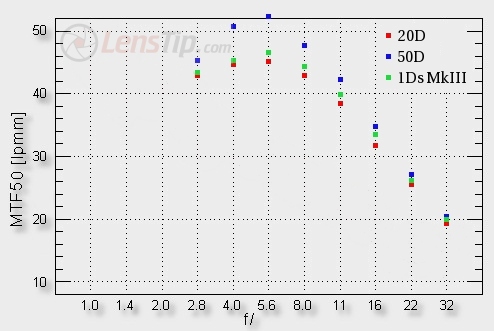
It maxes out at just over 50 lp/mm.
Here is the Oly 75mm
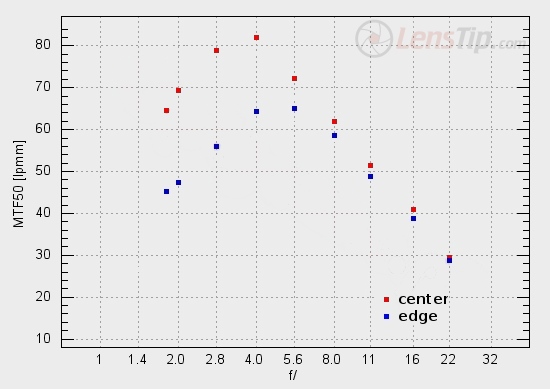
It maxes out at 82 lp/mm.
Whilst it isn't 2x as sharp, it is a whole heap sharper, so that when an image taken with the Oly is blown up 2x as large to get to the same size as an image from a full frame, you get an equivalent 41 lp/mm, so the lens will be in the same ballpark as the lens on a full frame sensor. It is close to a 70-200 f2.8 L IS II (which is in the high 40's on FF). Dividing the Canon lens by 1.6 to convert to lines on a printed image from a crop sensor, you're maxing out at 30ish equivalent lines..... So in that case, the print from the micro 4/3 should appear sharper than the print from the crop, but less sharp than the full frame image.
You're equating quality with sharpness. The micro 4/3rds system needs really fast lenses to get the same sort of shallow depth of field as a full frame, and image noise is higher on micro 4/3 as the sensor is smaller. There's a whole heap of things that go into "image quality".Which seems to suggest that micro 4/3rd lenses are capable of resolving more detail than lenses designed for full frame... so much so that a micro 4/3rd system can deliver the same quality as a full frame system. Which A) is contradicting your first statement, and B) patently not true.
What I am saying is that you can get pretty darned good images out of a micro 4/3 - far better than you would expect due to the sensor size alone (remember the "better" lenses for crop for Nikon and Canon are in fact the lenses designed for full frame sensors so perform less well on the crop cameras).
Last edited:
arad85
Suspended / Banned
- Messages
- 9,438
- Name
- Andy
- Edit My Images
- Yes
Define better.... all I was commenting on was sharpness. There are areas where micro 4/3ds falls short of larger sensors (tracking autofocus, image noise...), although there are a lot of areas where it wins size and weight being a clear one as is the ability to be spot on with focus for stationary objects (not only is the autofocus blindingly fast, it is 100% spot on every time).If micro 4/3 was the better system, we'd all be using it.
Just saying
And you know, even Pros are starting to use it exclusively.
Its only been the last two months or so that the standard pro zoom set (24-70 f2.8 and 70-200 f2.8 equivalent) has been available (Panny 12-35 and 35-100). All I'm saying is don't dismiss it as completely inferior due to it being a small sensor.... it has advantages that can actually put it as a better choice - and better "quality" (whatever that is) - than a crop DSLR.

Cagey75
Suspended / Banned
- Messages
- 17,146
- Name
- Keith
- Edit My Images
- No
I never dismissed it as anything, I just don't see it as better in any way. If I liked the format, I'd have gotten into it by now. For the price of my current dslr + lenses I could have a monster M4/3 package, it just never caught my attention. I like to know decent ISO performance is there, and the better overall image quality, when I need it. I don't think M 4/3 is better in any way, tbh. Just my opinion though.
arad85
Suspended / Banned
- Messages
- 9,438
- Name
- Andy
- Edit My Images
- Yes
I disagree. Just my opinion though.I don't think M 4/3 is better in any way, tbh. Just my opinion though.

gadgeteer
Suspended / Banned
- Messages
- 2,540
- Edit My Images
- No
If you don't know the advantages of FF, you probably don't need it.
What he said.
It's not the camera which will hurt you the most. It's the cost of decent quality FF lenses.

- Messages
- 49,339
- Name
- Nod (UK)
- Edit My Images
- Yes
For me, FF has 2 advantages. Wide angles and the expected AoV from a given focal length.
The extra pixies don't make that much difference to me - I would rather use a Dx body for the extra perceived reach than use Dx mode in my D700 - I get more pixies that way anyway! The better high ISO performance is handy on the rare occasions it's needed but not a major advantage to me (but could be for others).
The extra pixies don't make that much difference to me - I would rather use a Dx body for the extra perceived reach than use Dx mode in my D700 - I get more pixies that way anyway! The better high ISO performance is handy on the rare occasions it's needed but not a major advantage to me (but could be for others).
- Messages
- 43,206
- Name
- Alan
- Edit My Images
- No
If micro 4/3 was the better system, we'd all be using it.
Just saying
Well, some of us own MFT and FF gear and have spent time taking the same shot with each camera in turn and looking at the results at A3
Some of us have also taken shots with the same lens mounted on both systems and looked at the results at A3 IMVHO opinion you really have to get past the assumptions and misconceptions and actually look at images and prints and make your own mind up.As I've said here many times. My MFT kit at low to middling ISO settings is capable of producing images that are easily lost in a pile of 5D images. The last time I challenged anyone to differentiate between MFT and FF prints the first print I showed them was actually a MFT image and they interrupted me mid sentence, excitedly, with "I want this print!" That's what matters
- Messages
- 43,206
- Name
- Alan
- Edit My Images
- No
Whilst it isn't 2x as sharp, it is a whole heap sharper, so that when an image taken with the Oly is blown up 2x as large to get to the same size as an image from a full frame, you get an equivalent 41 lp/mm, so the lens will be in the same ballpark as the lens on a full frame sensor. It is close to a 70-200 f2.8 L IS II (which is in the high 40's on FF). Dividing the Canon lens by 1.6 to convert to lines on a printed image from a crop sensor, you're maxing out at 30ish equivalent lines..... So in that case, the print from the micro 4/3 should appear sharper than the print from the crop, but less sharp than the full frame image.
What I am saying is that you can get pretty darned good images out of a micro 4/3 - far better than you would expect due to the sensor size alone
I'm glad you said all that. Whilst I've never gone into lp/mm tec talk I have said many times that MFT (or APS-C for that matter) is perfectly capable of producing prints up to A3. To me the magnification factor to get the equiv sized image/print just doesn't matter if the system is capable of producing prints/images to the size I want and I personally think that the smaller systems can easily produce print/image sizes beyond which 99% of people will ever produce.
I think in these high mp count/resolution days we sometimes forget what's possible with even 3mp, never mind 20mp+
Cagey75
Suspended / Banned
- Messages
- 17,146
- Name
- Keith
- Edit My Images
- No
Some of us just like or want the micro 4/3 systems full stop. I don't honestly care how good it is, no offence. I just know it's not up to FF quality. No assumption, it is what it is. The sensors are much smaller, that speaks for itself.
I don't know why people are getting all defensive about a system just because they use it? Isn't this thread about full frame :shrug:
I don't know why people are getting all defensive about a system just because they use it? Isn't this thread about full frame :shrug:
- Messages
- 43,206
- Name
- Alan
- Edit My Images
- No
I don't know why people are getting all defensive about a system just because they use it? Isn't this thread about full frame :shrug:
It's not a matter of being defensive, it's a matter of expressing a view on an internet forum
My own personal view after looking at and owning MFT, APS-C and FF cameras and some decent lenses is that if you don't crop heavily and/or print larger than A3 just about any system with a sensor ranging from MFT through APS-C to FF might be good enough at low to mid ISO's, if you are half way competent and process each shot sympathetically to get the best out of it. There's no doubt that my MFT images need different settings in CS5 to my FF shots to get the best out of them but it's the final result that matters not whether the slider in PS is set to 3 or 5 or any other value, IMVHO.
Others may disagree and that's fine too
and it gets the info out there and hopefully encourages people to think for themselves about what is suitable for them.As for the thread being about FF. That's up to the OP to decide but from what I can see they've asked what the advantages are of FF over a 40D. Perhaps MFT isn't relevant but the wider discussion of if FF offers advantages over smaller systems may be.

- Messages
- 43,206
- Name
- Alan
- Edit My Images
- No
er, no. Not trying to make it a MFT thread, just talking about advantages and disadvantages between FF and APS-C and MFT systems.
Personally I'm lucky enough to be able to afford just about any camera hardware I want. I have FF and some nice lenses and I also have MFT and a nice lens or two and I've looked at the results and whilst I see advantages for FF when using the highest ISO for what I shoot and how I view images I see it as very close sub A3 print and when viewing on screen.
The "look" is another matter but is mainly down to camera to subject distance, focal length and aperture combo, initial contrast and saturation etc. Some of those things can be equalised through processing and flexible shooting and I've challenged people to pick out MFT shots from FF shots with interesting results
Another interesting little project, and my last word on this matter, is when you feel limited by your kit let Google be your friend and see the results that other people are getting with the kit that you think is limiting you. The results are often... sobering
Personally I'm lucky enough to be able to afford just about any camera hardware I want. I have FF and some nice lenses and I also have MFT and a nice lens or two and I've looked at the results and whilst I see advantages for FF when using the highest ISO for what I shoot and how I view images I see it as very close sub A3 print and when viewing on screen.
The "look" is another matter but is mainly down to camera to subject distance, focal length and aperture combo, initial contrast and saturation etc. Some of those things can be equalised through processing and flexible shooting and I've challenged people to pick out MFT shots from FF shots with interesting results
Another interesting little project, and my last word on this matter, is when you feel limited by your kit let Google be your friend and see the results that other people are getting with the kit that you think is limiting you. The results are often... sobering
Moreorless
Suspended / Banned
- Messages
- 989
- Edit My Images
- No
Yes - see below.
No. What I am saying is that due to the larger sensor size, the lenses designed for full frame don't need to be as sharp to produce the same level of sharpness in the image. Whether a manufacturer chooses to design beyond that or not is another matter.
No, what I am saying is that with the same lens on different format cameras, you should get the same MTF. When you then print those images to the same size, the sharpness of the smaller sensor will be lower.
Well, lens design is all about tradeoffs. Making a lens that covers a full frame sensor is much more difficult and expensive than making one for a smaller sensor.
No. I am saying the same lens on full frame will be sharper than the same lens on crop. That is shown on a number of tests on t'interweb. The problem is that interpreting MTF values can be a little hairy at best as there isn't a standard unit of measurement....
Anyway, some figures. The best (IMHO) way to compare lens MTFs across different formats is their ability to resolve line pairs per mm, not lp/ih. So, first up is the MTF of the Canon 100mm f2.8L Macro IS - which is an exceedingly sharp prime:
It maxes out at just over 50 lp/mm.
Here is the Oly 75mm
It maxes out at 82 lp/mm.
Whilst it isn't 2x as sharp, it is a whole heap sharper, so that when an image taken with the Oly is blown up 2x as large to get to the same size as an image from a full frame, you get an equivalent 41 lp/mm, so the lens will be in the same ballpark as the lens on a full frame sensor. It is close to a 70-200 f2.8 L IS II (which is in the high 40's on FF). Dividing the Canon lens by 1.6 to convert to lines on a printed image from a crop sensor, you're maxing out at 30ish equivalent lines..... So in that case, the print from the micro 4/3 should appear sharper than the print from the crop, but less sharp than the full frame image.
You're equating quality with sharpness. The micro 4/3rds system needs really fast lenses to get the same sort of shallow depth of field as a full frame, and image noise is higher on micro 4/3 as the sensor is smaller. There's a whole heap of things that go into "image quality".
What I am saying is that you can get pretty darned good images out of a micro 4/3 - far better than you would expect due to the sensor size alone (remember the "better" lenses for crop for Nikon and Canon are in fact the lenses designed for full frame sensors so perform less well on the crop cameras).
Isnt the fault here though that the maximum measurement you can get will depend alot on the pixel density?
The Oly lens is tested on a 12.5 MP 4/3rds camera, to get the same pixel desnity on an a Canon ASPC camera you'd need around what 19 MP? on FF around 45MP?
The 50D and even moreso the 1Ds3 don't reach those pixel densities so your potentially creating an greater upper limate on there score. Its hard to find websites that test lpmm with the D800 but I'v seen figures around 70 lpmm mentioned for lenses like the 85mm 1.8 G. Not everyone needs that level of resolution but equally those who don't seem like they'll be able to use cheaper and/or more ambitious lenses in terms of appature/zoom range on FF and to a lesser degree ASPC.
The impression I got was that the failure of Oly's 4/3rds DSLR's was based on the savings of smaller sensors did not ofset the extra cost of more advanced lenses to exploit those sensors. Micro 4/3rds sucess on the other hand seems to rest with exploiting the size advanatge of the smaller sensor more fully.
Last edited:
arad85
Suspended / Banned
- Messages
- 9,438
- Name
- Andy
- Edit My Images
- Yes
Some of us have owned 5D2s with several bits of L glass... and sold them for micro 4/3rds as the difference in quality just wasn't there unless you pixel peeped - and then it is minimal unless you are pushing ISO or need phase detect focus tracking....Some of us just like or want the micro 4/3 systems full stop. I don't honestly care how good it is, no offence. I just know it's not up to FF quality.
Pookeyhead
Suspended / Banned
- Messages
- 11,746
- Name
- David
- Edit My Images
- No
No. What I am saying is that due to the larger sensor size, the lenses designed for full frame don't need to be as sharp to produce the same level of sharpness in the image. Whether a manufacturer chooses to design beyond that or not is another matter.
Well.. they kind of do, because they can also be used on APS-C equipment. Many people use FX lenses on DX Nikon's for example. Besides, FF or not, 36x24mm is still a small format, and I'm fairly sure lens manufacturers will be eking out the maximum quality from all their lenses. I can't imagine Canon or Nikon thinking.. "Meh.. that'll do... it' only a FF lens"
Besides.. I've used DX equipment with both FX and DX lenses, and often the reverse it true as the FX lenses are from the pro range, and usually offer much higher quality than DX lenses as FX lenses are designed to have a larger image circle, so a DX lens on a FX camera usually results in much high quality images.
No, what I am saying is that with the same lens on different format cameras, you should get the same MTF. When you then print those images to the same size, the sharpness of the smaller sensor will be lower.
I'm sorry but you won't because assuming the same lens is used on both, the sharpness is lower from a smaller sensor compared to the larger and the limits of lens resolution will becomes more apparent on a smaller sensor than a large one. This is why D700 images appear crisper than D7000 images despite the D7000 being higher resolution.
It's much the same as back in the day, slower, finer grained films offered higher resolution figures with the same lens. If the lens is capable of resolving more detail then the sensor is capable of recording, then the lens under test will yield lower figures than it would mounted to a camera who's sensor can out resolve the lens.
What you are suggesting is that a lens will give the same result figures regardless of what camera it's attached to. That's is an impossibility as too many other factors come into play.. lens defect magnification due to smaller sensor size, pixel density etc.
Nikkor 50mm f.14G on a D200

Nikkor 50mm 1.4G on a D3X

It would be a similar story, but less exaggerated with a D700 too. Only if the pixel density of the FF camera drops below the crop sensor camera will the opposite be true, but even then it's not as simple as that, as you are still magnifying the lens defects more from a small sensor, regardless of actual resolution. Even with a crop sensor camera with a much higher pixel density, unless the lens is sharper, the OPTICAL defects will be the limiting factor in most cases. People are getting too carried away with pixel resolution of sensors and forgetting the optical constraints a small sensor places on the lens system.
No. I am saying the same lens on full frame will be sharper than the same lens on crop.
Of course it will.
Anyway, some figures. The best (IMHO) way to compare lens MTFs across different formats is their ability to resolve line pairs per mm, not lp/ih. So, first up is the MTF of the Canon 100mm f2.8L Macro IS - which is an exceedingly sharp prime:
It maxes out at just over 50 lp/mm.
Here is the Oly 75mm
It maxes out at 82 lp/mm.
But all this proves is that the Olympus lens is sharper then the Canon lens.. not that lenses for micro 4/3 are better as a whole. I can show you a whole slew of figures where FX lenses comfortably outperform DX lenses.
I have issues with that data you posted... in those figures, the same lens is giving higher resolution figures on a Canon EOS 50D than it does on a Canon 5D MkIII. So.. the same lens gives more lines per mm on a 15mp crop sensor camera than a 22MP full frame camera? That doesn't add up, even WITH the extra pixel density.
What I am saying is that you can get pretty darned good images out of a micro 4/3
I'm sure you can, but if you think you can even dream of getting close to what a full frame camera can deliver... dream on.
(remember the "better" lenses for crop for Nikon and Canon are in fact the lenses designed for full frame sensors so perform less well on the crop cameras).
This is nonsense. No manufacturer is going to do anything other than produce the best lenses they can in such a competitive field. I've used loads of FX lenses on crop sensor cameras as they're never worse than DX lenses... they're either comparable, or better.
If what you're saying is true, then the Schneider lenses for my large format camera must be really crap then
... my "sensor" is 5x4 inches!! Any old piece of crap will do for that then huh?
You like 4/3rds... why not.. it's a great system with many great reasons for having it... but it simply will not compare to larger sensor systems.
BTW.. I'll take up any print challenge too... whoever mentioned that. I'll pick out a small sensor shot a A3.. easy.
Last edited:
arad85
Suspended / Banned
- Messages
- 9,438
- Name
- Andy
- Edit My Images
- Yes
And that is precisely why I used a different measure as those are lp/ih - which depends on the sensor size - the bigger the image height, the more lines you can fit in! Those results cannot be compared across formats, lp/mm can...What you are suggesting is that a lens will give the same result figures regardless of what camera it's attached to. That's is an impossibility.
Nikkor 50mm f.14G on a D200
Nikkor 50mm 1.4G on a D3X
No 1DsMk3I have issues with that data you posted... in those figures, the same lens is giving higher resolution figures on a Canon EOS 50D than it does on a Canon 5D MkIII.
At a price. Everything is designed to a price. If you believe the Canon lenses are the best that can be made, regardless of price you are mistaken....This is nonsense. No manufacturer is going to do anything other than produce the best lenses they can in such a competitive field.
No. But how much did it cost.If what you're saying is true, then the Schneider lenses for my large format camera must be really crap then
Have you actually used a micro 4/3rds camera and one of the better lenses for it? As Alan has said, unless you look very closely, they can be difficult to tell apart.You like 4/3rds... why not.. it's a great system with many great reasons for having it... but it simply will not compare to larger sensor systems.
BTW.. I'll take up any print challenge too... whoever mentioned that. I'll pick out a small sensor shot a A3.. easy.
Have a look at this thread: http://forums.dpreview.com/forums/thread/3235707
Very little in it - certainly nothing you'd notice unless you knew what you were looking for.

Joeturner11
Suspended / Banned
- Messages
- 6,448
- Name
- Joe
- Edit My Images
- No
Huge View Finder, Better Quality !!
arad85
Suspended / Banned
- Messages
- 9,438
- Name
- Andy
- Edit My Images
- Yes
Heh... The viewfinder in my G5 is as big as the viewfinder in the 5D2. And it can display lots of useful graphics on it too...Huge View Finder, Better Quality !!
PS. to the OP: apologies for getting way off topic
arad85
Suspended / Banned
- Messages
- 9,438
- Name
- Andy
- Edit My Images
- Yes
Yes, but that's the way it works.Isnt the fault here though that the maximum measurement you can get will depend alot on the pixel density?
All I am saying is that micro 4/3rds as a system punches above where you would expect it based on sensor size alone to due to glass being made for the format. I am MUCH happier with the images that come from my G5 & 7-14mm than I was from the 5D2 and 17-40L for example.
Yes. It was photos like this (equivalent focal length lenses with equivalent quality):Micro 4/3rds sucess on the other hand seems to rest with exploiting the size advanatge of the smaller sensor more fully.

plus some personal comparisons when I had both full frame and micro 4/3rds taking the same pictures in my own hands that led me to ditch the FF camera.
Pookeyhead
Suspended / Banned
- Messages
- 11,746
- Name
- David
- Edit My Images
- No
And that is precisely why I used a different measure as those are lp/ih - which depends on the sensor size -
Well... yes.. which is my point. You can't use a lens without a camera, so what actually matters in the real world is the "system" in total.
At a price. Everything is designed to a price. If you believe the Canon lenses are the best that can be made, regardless of price you are mistaken....
I never suggested anything of the sort. If you think Olympus are, you're likewise mistaken
My point is, no manufacturer is going to deliberately gimp it's high end professional lenses because they're made for larger format. Any manufacturer will be eking out the most resolution they can from their top end optics. What you are suggesting is that they are deliberately holding back on full frame lenses.
No. But how much did it cost.
depends which one... I have a few Schneider lenses. On average, about the same as a top end fast zoom from Nikon... around £1500... some are more.
Have you actually used a micro 4/3rds camera and one of the better lenses for it? As Alan has said, unless you look very closely, they can be difficult to tell apart.
Yep.. had a decently long play with a Olympus OM-D EM5..... very impressive, yes. In fact, I struggled to tell the D7000 and that apart. I don't think I'd be mistaking it's output for that from a full frame camera though. Having compared the D7000 to the D800 files... they're chalk and cheese... even after resizing the D800 files to the same size as the D7000's.
Have a look at this thread: http://forums.dpreview.com/forums/thread/3235707 Very little in it - certainly nothing you'd notice unless you knew what you were looking for.
Or print big, no.. but I just don't get why people are making comparisons. They're very different cameras giving very different results. I have my suspicions about the image in that thread too. When I looked at the images from the Olympus I used and compared them to my D7000 I remember thinking they were pretty much the same. I also know that when I compare the Olympus OM-D EM5 RAW files on DPReview against those of the D800 I see a similar difference to what I get between my D7000 and my D800... which kind of makes sense. It wouldn't be hard for someone who wants to big up the Olly to downsize the D800 files, then resize them up again. Meta data will be intact either way, and it would leave very little evidence elsewhere.
OM-D crop to same size

D800 crop to same size

That pretty much seems to be in line with what I get, and that seems to be a bigger difference than the files you linked to.
Good, certainly. Go past A3 and you'll start to see a big difference though.
4/3rds is excellent... DX is excellent... but the bigger the sensor, the better the image
[edit]
I just think I'm really, really fussy perhaps. Maybe I've been spoiled by using large format all these years. My wife doesn't think the difference is a big deal either... but to me it's massive.
Last edited:
arad85
Suspended / Banned
- Messages
- 9,438
- Name
- Andy
- Edit My Images
- Yes
I don't think I have said otherwise (other than APS-C using FF lenses to show why micro 4/3rds punches higher than it shoud) - but that wasn't my point. My point is that for most people, for most of the time, the difference is negligible. And that's where I am - the big benefits of size, and cost far outweigh the small benefits to picture quality.4/3rds is excellent... DX is excellent... but the bigger the sensor, the better the image