Tutorial Food Photography — Shooting in a small home studio

Garry Edwards

Moderator
Messages
13,475
Name
Garry Edwards
Edit My Images
No
Garry Edwards submitted a new resource:

Food Photography — Shooting in a small home studio - How to get started in food photography at home

I’m probably the worst person to produce a tutorial on food photography, simply because I can’t cook. Not only am I the most incompetent cook I know, I can’t even plate food that someone else has cooked — I’m just useless.


So, I’ve chosen to photograph something I can’t burn: salad. :) It has plenty of colour and texture, which is the essence of food photography.

How Food Photography Has Evolved

Food photography has changed a lot over the years.
Traditionally, every element in the...

Read more about this resource...
 
Gary, That's pretty good, and about how I go about doing Food Photography, but mostly I just use a small square table top in the middle of my studio and one of an assortment of table cloths of different colors and patterns that I have to choose from. The chosen table cloth is always freshly ironed to remove fold lines too. For water droplets on glasses and veggies. The house kitchen downstairs makes the food serving and then it's carried upstairs to the studio for the shoot.

I found that Glycerin, applied in small droplets with an eye dropper works well on glasses to simulate cold humidity condensation and droplets on leaves like on lettuce, tomatos, and fruit, as it stays in place and doesn't evaporate before I can get the shot. The food used is never eaten after the shoot, so it doesn't really matter what is applied to enhance the desired image for the shot. If smoke or steam above the food is needed, I found that getting this just right was nearly impossible to get it just as I wanted, like over a hot beverage or soup, so I add it in Post clipped from many shots of steam and smoke that I've taken over the years. Plastic ice cubes sometimes work, but they don't float like real ice, so the glass holding the drink needs to be nearly filled with them to get a believable shot. They wash off after the shoot, so are ready to be used again for the next time. I use corn oil to add shine to meat and other foods, also usually applied with an eye dropper, but then sometimes an artist paint brush is used to spread the oil around to the desired places.

I'm not a cook either. I can make food hot, usually without burning it, but that's about my limit in cooking unless the process is really simple. I would probably live on TV Dinners or those new versions delivered fresh and unfrozen to be quickly heated in a microwave, if no one cooked meals for me. My wife or one of my adult grand daughters has always done this part for my food shoots, and they arrange everything on the plates for me for each food photo shoot that I have done. Always two servings, one to get the lights perfect, and then a freshly made serving later, with similar glycerin, oil droplets then added, along with whatever other enhancements that that it requires. Cereal has always been difficult for me to photograph. I usually spend way too much time getting the lighting right, and even then can't get the second version to look the same before it gets too saturated with the milk. I need a good milk alternative. A second is always necessary, because everything gets saturated with the milk before I'm ready to take the final shots, but then this second bowl of cereal never looks quite the same as the first did, requiring even more lighting adjustments. I have used whole large boxes of the cereal and a gallon of milk for this.

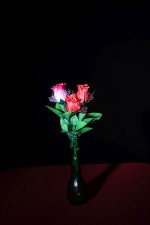
I haven't done any food photography in quite a while. It's been mostly flowers and other forms of still life lately, but I'm also set up to do portraits, small groups, and Video in the studio too. The video is usually of Health Food in product boxes, on an 8' long banquet table with talk and demonstrations in the center of the table and 1-2 adults sitting or standing around the table. The video lighting is 8 (soon to be 10) LED light panels, arranged in a sort-of wide leg "U" shape on the ceiling of my studio and attached to a DIY ceiling lighting grid at as close to the ceiling as possible spaced about 2' apart. This produces a relatively even shadow free light over the viewing area that appears much like a TV Newsroom lighting. With them close to the ceiling, I have enough room below them to allow leaving them in place when I do still shooting below using large soft boxes, stands, and other lighting setups. This allows changing from one form of photography to another rather quickly, since I can leave the LED constant lighting in place for videos while I use the space below for anything else. The studio is a conversion from a former 2nd unused 19' X 26' master bedroom suite so it has 8' ceilings, with a double bathroom and walk-in gear closet. The hair, make-up, and break area is in the large hallway at the top of the stairs and adjacent to my shooting room. Attached is one of the flower shots that I've done recently.

Charley
 

Attachments

  • IMG_0002 LoRes.jpg
    IMG_0002 LoRes.jpg
    31.7 KB · Views: 17
Thanks for that Charley, I'll even forgive YOU for spelling my name the American way as we're separated by language, it's Garry as in Marry, not Gary as in Mary:)

I agree with most of what you say. My approach for this tutorial was basically to forget about the pro approach and to limit myself to what an ordinary person can easily achieve in a small home studio, without expert knowledge, lots of gear and almost unlimited resources, but at the same time to point out that there are other ways of doing things too.

I do have access to a large shooting space - a warehouse owned by friends who sell lighting gear, but I deliberately limit myself to my very small flat, on the basis that if a shot can be done there then it can be done anywhere.

I think that cereal is a problem for most of us, when I did it for a living I always used white paint, the type that's used for ceilings etc, I did use thick cream once but then I discovered paint and found it both better and easier. Real milk can be used, the trick is to virtually fill the container with pebbles, ball bearings or similar, add a tiny bit of red food colouring to the milk (to get rid of the built-in green tinge) and then put a very thin layer of the coloured milk on top, the whole thing is then too shallow for the cereal to sink without trace.

Yes, Glycerin can be great, and a tiny amount mixed with water and sprayed where necessary is also very useful.

As for smoke and steam, I agree that it's a lot easier and often better to add it in post but - and I accept that I'm very unusual in this and probably a bit odd - but when I write tutorials on lighting I do absolutely zero PP work, I try to show people what they can achieve without software, I don't want to deceive people with PP. I crop to shape, reduce size for the web, and that's the limit. PP is of course an essential tool, but I won't use it in a tutorial on lighting. So, when and if I get around to doing the half-planned one on a hot food item, I'll be using smoke or steam, not PP.
 
And my name is Charley, not Charlie. But you got that right while many others don't. I'll get it right next time, I promise. Our languages are mostly the same or I wouldn't be a member here. Many of the USA photo websites are hard to use and full of those who are "gear hoarders", so for one reason or another I am only on a couple of them. Another started teaching posts written only by the self proclaimed "Expert" and dropped the Forum capability from his website when he redesigned it. So I'll stay here as long as all of you will let me. I like it here, and I promise to learn the language differences as fast as I can.

Charley
 
Last edited:
:) When I was on a very large USA-based forum I was (jokingly I think) given the job of USA to English translator, because I'd worked in NYC. Terms such as trash bags, grids, minivan spring to mind, not just the spelling differences. The site I was on was excellent, until it changed hands and became a marketing site, with the content moderated to suit their advertisers:(
 
Thanks Garry, a great resource for the forum.
Thanks for that, I'm happy to help.

My skills, such as they are, are specialised and of limited value to most of the members here. Everyone has knowledge that's worth sharing and I think it's a great pity that so few people create these resources and share their knowledge.

Landscapes, macro photography, bird photography in particular are, I feel, subjects that would interest and help a lot of people.

It isn't difficult, I've started to make it more difficult and time-consuming by including videos, but that isn't actually necessary and I'm not even sure that they help - I think that my motivation for the videos is that I find them a challenge to do, and I'm failing miserably with the editing and especially with the audio, but hey ho, it's a new interest, it's just one of many things that I enjoy doing and learning about but struggle with:)
 
Hi Garry the first photo reminds me of a Fanny Craddock cook book, the second Heston Blumenthall.

I know that you intention was to highlight the prawns but the difference in the egg is remarkable also.

Do you have an equation or ratio for the rear light or are you adjusting to what "looks" best
 
Hi Garry the first photo reminds me of a Fanny Craddock cook book, the second Heston Blumenthall.

I know that you intention was to highlight the prawns but the difference in the egg is remarkable also.

Do you have an equation or ratio for the rear light or are you adjusting to what "looks" best
No, I don't do "lighting ratios", too complicated for me and about as creative as painting by numbers . . .

My approach is that if it looks OK, it is OK, so I just mess about with both power settings and positioning until the effect looks OK to me.
 
Thankyou for explaining!
 
Hi Garry the first photo reminds me of a Fanny Craddock cook book, the second Heston Blumenthall.

I know that you intention was to highlight the prawns but the difference in the egg is remarkable also.

Do you have an equation or ratio for the rear light or are you adjusting to what "looks" best
Barney, a more complete reply, now that I have more time. . .

Yes, effect lights are essential, there's always a key light, doing around 80-90% of the work, but it's the dedicated effect lights that bring life to the shot - perhaps a hairlight or another type of backlight for portrait shots, but still-life shots have exactly the same need. Still-life is easier, just because it keeps still!

This was just a very simple "this is what can be done in a small home studio" type of tutorial. My living room is tiny, not only do I need to do all of the usual shot planning and find space to do the shot, I also complicate matters by having a second and sometimes third camera for the video. plus a video light, which I normally bounce off the ceiling. If I wanted to, I could always pop into the Lencarta warehouse and use their much bigger space, but that would kind of defeat the object of pointing out that anyone can do this at home.

But, there are limitations. If this was a pro shot, done to much higher standards, I would use any number of extra lights, usually honeycombs, focussing spots or fresnel spots, normally pretty much from above, each would need its own boom arm for position, and this of course would need a large pro studio. I no longer have all that gear, nor do I have the space, and even if I did, the vast majority of people who might be tempted to do it themselves wouldn't be able to anyway.
Video is a strange media, it has the effect of compressing time, something that takes 4 hours to do in real time and which can be a bit fiddly is shown in just a few minutes, and the viewers don't see the failures, it did take a bit of trial and error to get the light position and exposure right.

I used my very specialised honeycomb because I have one, although I did suggest workarounds for people who don't have one. It was aimed specifically at the prawns because it was obvious to me that the prawns are the only expensive ingredient and so a pro shot would probably be about the prawns. Because lack of space dictated that the honeyombed light needed to be a long way away (about 5' from memory) the light spread out further than was ideal for just the prawns, so I sort of accidentally lit the egg as well, which worked - serendipity:) - although I could of course have reduced the spread with cinefoil https://www.ebay.co.uk/itm/285991219591 or similar flags.

These extra lights involve money as well as space, but for non-pro shots there are alternatives, The cheap focussing LED torches available on-line are useful, https://www.ebay.co.uk/itm/405197532907 because they can produce a very controlled light that can be fixed in place with rubber bands or sticky tape. All that's then needed is to increase the shutter speed to the point where they have the required effect. If I'd done something like that I might have lit the prawns, egg, radishes and cucumber separately. Mixing light sources is generally not a great idea because of colour temperature differences, , plus uneven light patterns, but with this type of home studio shot I doubt whether anyone except the photographer would notice, so would be good enough.

 
No, I don't do "lighting ratios", too complicated for me and about as creative as painting by numbers . . .

My approach is that if it looks OK, it is OK, so I just mess about with both power settings and positioning until the effect looks OK to me.
Sorry to resurrect this, I understand that your trying to encourage us to play and experiment, but with the lettuce light at the back do you start out at roughly the same height and go up or start high and come down? Or does it matter?
 
Sorry to resurrect this, I understand that your trying to encourage us to play and experiment, but with the lettuce light at the back do you start out at roughly the same height and go up or start high and come down? Or does it matter?
Don't overthink it:)

Given that space was very tight, and that the ISL dictated that the honeycombed light had to be a long way away in order to ensure that the light didn't fall off to a noticeable level between back and front, I just stuck the flash head where it could go without getting in the way. It was a bit high because it had to be, if it had been too low then of course the light would have been blocked by the lettuce.

I could explain that I used my years of studying physics and my ability to calculate the effect of light fall-off over distance in my head at lightning speed, but the reality is that I just mess around and see what actually works. I really do believe that pretty much everyone does the same, whether they admit it or not:)
 
Last edited:
Hi Garry.

I've just watched the video the difference that second light made was astonishing.

Thanks for posting.

Gaz
 
Really helpful tutorial — the point about food styling being just as important as the lighting setup resonates strongly.

For anyone thinking about transitioning this kind of work to restaurant clients, one thing worth adding: restaurants often have very little time between service and prep. Working quickly with a pre-set lighting rig and tethering to a laptop so the client can approve shots in real-time makes a huge difference. Most chefs will give you a 15–20 minute window per dish.

The biggest challenge when moving from a home studio to shooting on location in restaurants is controlling ambient light — kitchen environments often have very mixed colour temperatures. A combination of daylight-balanced flash with gels to match any tungsten ambient works better than trying to fix it in post.
 
Back
Top