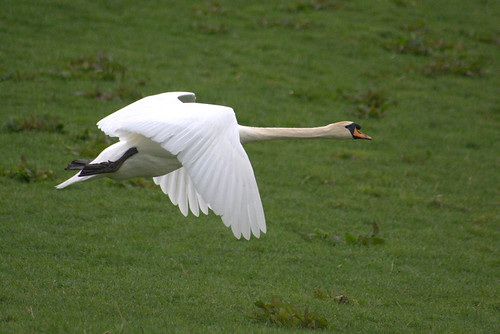
Focusing On Birds In Flight

milster

Suspended / Banned
Messages
2,438
Name
Gary
Edit My Images
Yes
I've been having a bit of a play trying to photograph birds in flight but not to much success, do you guys use manual or auto focus? I seem to be having a bit more success with manual but it's still not great.

On the plus side I'm really enjoying trying and I think as a photography newbie I think this could well be one direction I might be leaning towards :D
 
Hi, in my experience i have found that its pratice ,practice and practice,and obviously get to know your camera ,iv'e been trying for ages and i have now found that a lot is down to conditions surroundings and choosing the right settings for those conditions,i have just aquired a 7d which as custom settings which i set as a starting point and i leave,,,,seagulls are good for practice , i found that in auto focus at a shutter speed of 1/1600 and over i don't need IS and the higher the shutter speed gives me the option of what aperture i can use ,i also find i get better shots if i don't panic and wait for the bird to come to me,i have blindly shot before and i didn't get a pic worth keeping ,i now find that if i take my time and try and predict were the bird is going and then pan slowly i am getting more keepers , this works or is starting to work for me so i feel a bit more confident now.Hope this helps a bit
 
If your camera has the facility, centre focus point with assist points, and try and pick the bird up early. I have mine set on Servo Focus and back button, so can start and stop focus easily if I lose the bird. This was a quick shot taken from a small boat.

IMG_4316.jpg
 
Cheers guys. I'm finding I've calmed down a bit now, rather than at first when I could barely get anything in my viewfinder :D you don't realise how fast these little beggers can be until you try to track them in a camera viewfinder :)

Yeah, I've hd my camera set to center point focus but I don't think I've come across assist points, had servo focus on but I always forget about back button focus. I'll have to remember that for next time.

:thumbs:
 
Seagulls are good for practicing on, as Dennis said. They're a fair size, bold, and tend to fly in slow, predictable, patterns.
 
Ion the 7d I've found that if you have anything in the background centre point is essential, if it's a clear sky then opening up all the focus points help :)
 
Do you birders shoot in AV or TV all the time. I've tried both and have had more success with TV but sometimes not all the bird is in focus. With AV I find I'm getting some motion blur, and too much blur in poor light (as the sun seems to have vanished this week).
I get a lot of success with my Sigma 150-500 OS though as wide open at the long end it's f6.3 which seems to give a big enough DOF to get them.
 
I'm really leaning towards saving up a bit more and going for the Sigma 150-500, I had my mind made up on replacing my kit lens, but now I'm really enjoying the wildlife stuff so I may go for the Sigma instead. Keep my kit lens for now and use my flash more :)
 
Modchild - I'm not aware of Tv or Av making any difference to focussing speed. I would suggest using Av, probably wide open with your sigma most of the time, which will give you the fastest shutter speed possible for your given ISO. Use spot metering to concentrate on the subject, then your next consideration will be the colour of the bird and adjust the EV compensation accordingly.

Tv is great if there is loads of light, and on a bright day I would happily use it, but Av is best for getting the fastest speed available whilst getting a good exposure.

Milster - if you're looking to track the birds through the air then you'll be better off using continuous AF. If you can predict the flight path/landing area, something like the edge of a feeding table, then you could consider switching to manual focus, pre-focussing and tripping the shutter just before the bird hits the actual focus point to allow for the slight shutter lag. You'll probably miss loads, but when you get it right it'll be worth it, and thats the beauty of digital - no film costs!

Also, check the sigma 150-500 will AF with your D3100. It may well work, I'm not 100% sure, but it would be a nightmare if it didn't.

Mike
 
Yeah, cheers Mike. The AF does work on the d3100 as I tried one out in my local shop a couple of weeks ago :)
 
Soft shots, assuming that to be the problem, might be due to focus issues, or blur issues, or DOF issues, or maybe a bit of each. If ISO is high you might have softening through aggressive NR. Or maybe your lens is not quite as sharp as you would like or the focus is miscalibrated. If you are distant from the subject and need to crop then that will emphasise any flaws in the image. If you have the wrong VR mode engaged, or VR on when it should be off, or vice versa, then your results could suffer. In other words there are all sorts of factors which can contribute to poor IQ. Maybe it is the focusing, or maybe something else.

When the light dims or is very flat the more challenging BIF photography becomes on several fronts as it places greater demands on the equipment. Regardless of the conditions the photographer's skills also have a part to play in tracking the subject accurately and smoothly, giving the AF a chance to lock on properly and releasing the shutter without jabbing at it.

I'm not a very good BIF photographer. My keeper rate is quite low. Good equipment can certainly help, but practice, practice, practice is crucial to good results (and maybe a little luck ;)). When it all comes together it can be very satisfying.

20090424_105147_6128_LR.jpg


When it doesn't..... try, try and try again.
 
I have a d3100 and also looked at this lens. Would the body be ok to put a large lens on like this. I can either upgrade the body or invest in this lens.
 
Can't see a problem in physically putting that lens in the d3100. If you use a tripod or monopod then that will go on the lens rather than the body.

I would suggest your sensor is good enough not to need upgrading. Unless you can get the lens and a d300/d7000 then go for lens first.
 
I have a Canon 7D with 70-300 IS L zoom and have been trying BIF for months! I go to a local marsh where you're guaranteed a chance at a heron, egret or geese flying past you.

I've not yet found a setting that works best however. I currently have continuous tracking set and hoped that by focusing on the bird before it took off, the camera would then keep track as it flew up. But it doesn't - it locks onto whatever is behind him.:'(

I also found that at the 300mm end, the field of view is so tight it makes tracking harder so I get loads of empty frames. But using a wider setting means having to crop tighter later.

I also go to a local bird sanctuary where eagles and hawks etc are flown in a small field. I have the same problems there - the camera just can't track moving subjects.

There must be a setting that locks onto the subject regardless of a complicated background or loosing framing a little??
 
Shooting BIF takes practice, the 7D is very capable in this respect. My setting are centre point with expansion, to help if the bird moves off focus, the tracking sensitibity is set a t one below centre so that the camera doesn't try to refocus too quickly if I lose the bird for a moment. I also use back button focus, seperating the actual shooting from the shutter button. If required I can just quickly release the AF button to prevent focusing on any spurious object, else just keep it pressed to allow the AI Servo to follow focus. Back button focusing also means I can just give it a quick dab if I'm in a one shot situation. A 300mm lens will give you a narrow field of view, 500mm is even narrower! so it is just a case of practice.
 
I was playing with this myself today funny enough
Taken with a sigma 70-300, on the d3100
I'm going to have to devote a bit of time to this kind of shot, practice makes perfect, but a nice long f2.8 lens would be perfecter, still, it's what \i've got just now and it's fun trying

Swan flight by Bruce Mo, on Flickr
 
Back
Top