Focal lenths

Carpy2001

Suspended / Banned
Messages
520
Name
Andrew
Edit My Images
Yes
Hi all, I have been out again today with my M43 camera and the Olympus 14-42 ez lens, I took a few images of various things like, trees, a few of the lake and wildlife in my local park, a few images of the ducks and swans etc.
Out of all the images I took, none of them really appealed to me, it is not that they were bad images (i posted one of a squirrel in the pics you took today section), they just did not seem to make me say "yes I like that".
So my question would be, is it possible to just not get on with certain focal lengths??. I have seen many a fantastic landscape, seascape and some great images taken in woodland or forrest settings, that I really like, and would be proud of taking.
I have used the 14-42 with the olympus mcon-po2 close up filter, and around the garden for flowers or larger bugs etc I find it works fine.
As a general walkabout lens though, I always seem to use the olympus 40-150 kit lens.

Not being as knowledgable as a lot of people on here, I would just like to know if this is normal?.

cheers Andy
 
Hi all, I have been out again today with my M43 camera and the Olympus 14-42 ez lens, I took a few images of various things like, trees, a few of the lake and wildlife in my local park, a few images of the ducks and swans etc.
Out of all the images I took, none of them really appealed to me, it is not that they were bad images (i posted one of a squirrel in the pics you took today section), they just did not seem to make me say "yes I like that".
So my question would be, is it possible to just not get on with certain focal lengths??. I have seen many a fantastic landscape, seascape and some great images taken in woodland or forrest settings, that I really like, and would be proud of taking.
I have used the 14-42 with the olympus mcon-po2 close up filter, and around the garden for flowers or larger bugs etc I find it works fine.
As a general walkabout lens though, I always seem to use the olympus 40-150 kit lens.

Not being as knowledgable as a lot of people on here, I would just like to know if this is normal?.

cheers Andy
There's no right and wrong focal length, you should use whichever you prefer. You have certain lenses that are regarded as general walkabout lenses such as the 24-70mm (12-35mm on m4/3) but that doesn't mean that's right for everyone. Sometimes I'll go out with a 16-35mm (8-17.5mm on m4/3), sometimes just a 35mm, sometimes 20-70mm (10-35mm on m4/3).

All that being said there's no reason that you can't take really good images with the 14-42mm so maybe address what you don't like about the images your getting and seeing if you can improve on that.
 
Last edited:
Hi all, I have been out again today with my M43 camera and the Olympus 14-42 ez lens, I took a few images of various things like, trees, a few of the lake and wildlife in my local park, a few images of the ducks and swans etc.
Out of all the images I took, none of them really appealed to me, it is not that they were bad images (i posted one of a squirrel in the pics you took today section), they just did not seem to make me say "yes I like that".
So my question would be, is it possible to just not get on with certain focal lengths??. I have seen many a fantastic landscape, seascape and some great images taken in woodland or forrest settings, that I really like, and would be proud of taking.
I have used the 14-42 with the olympus mcon-po2 close up filter, and around the garden for flowers or larger bugs etc I find it works fine.
As a general walkabout lens though, I always seem to use the olympus 40-150 kit lens.

Not being as knowledgable as a lot of people on here, I would just like to know if this is normal?.

cheers Andy
The 14-42 zoom on m43 is roughly the equivalent of a 28mm to 85mm range on FF, which is probably the range that the vast majority of photographs are taken with. If you aren't getting pictures you appeal to you, it's unlikely to be down to the lens.

Having said that, there are a few things beyond this to think about. The 40-150 is probably easier to make pictures with because it's easier to isolate the subject both in angle of view and reduced depth of field when compared to a wider angle of view. The wider angle of view, where the subject and surroundings are likely to be more complex presents a greater challenge in terms of composition.

I still think it's possible to just not get on with a focal length, but I think this applies more to prime lenses than zooms. When I used 5x4, roll film and 35mm cameras, I could never get on with the 50mm on 35mm cameras. This, I think was because the "standard" focal length of lenses of 5x4 and roll film cameras closely matches the perspective of the human eye: a 50mm lens on a 35mm camera is slightly telephoto.

Now a days, except for extremes e.g. wildlife, I find I tend to adapt to whatever focal length I have on the camera, 26mm, 28mm, 35mm, 40mm or 50/55mm. I may well change a lens during the day if I really need something longer or wider than the one I start with, but I tend to then stick with that lens for the rest of the day.

Outside this range, 20mm and 24mm at the wide angle end or longer than 85mm at the tele end, I only switch to for specific purposes, and then change back to something in the 26mm to 50/55mm range. For me, I'm not. fond of pictures with an obvious "lens effect" ie looking like it’s a wide angle or telephoto shot. This of course can work for some photographs, but I tend to prefer pictures without an obvious "photographic" perspective.

Everyone has their own views on lens preferences, and a good number only ever use a single focal length for everything (normally 28mm, 35mm, 40mm or 50mm), so there is no right or wrong about this.

I suspect, that as you make more photographs, and the more you look at other peoples photographs, your preferences may change, but it's not something to worry about; you just need to use what works for you, and take lots of pictures.
 
I find that if I am disappointed with shots I have taken from one day to the next, it's usually the shooting (weather), conditions that make certain subjects less attractive versus the same subject when the weather conditions are more suitable..........

Obviously you can make good images in the rain, when it's overcast, etc., etc., but the "right" light is really important.

Bird photography is a specialised area needing specialised kit which is expensive ......... I've got a cupboard full as I got "hooked" a few years ago
 
I think I had similar experience, I had a 14-42ED lens when I got my first M43 camera, and wasn't until I got 12-40 pro lens that I was impressed.
 
Thanks for all your comments, they are most welcomed. I feel I must say that it is not the lens that is the issue, it is the images from the wider angles.
I find the images I take in the 14 to say 20mm range, especially landscape style images that include trees and hedges etc, to my eyes, look like everything blends together.
That is to say, I find it hard to define where one tree ends and the next one begins, I hope that makes sense?. This may well be my eyesight, but to me there is no defenition of depth in the images I take that are like this.
Here are a couple of examples to try and help show what I mean (although all this may just be the perspective of an idiot).

This was taken at 28mm,
_A060001.JPG

This was taken at 25mm (shows the lens works fine lol)
P8050003.JPG
 
Last edited:
I think our "favorite" focual length can change over time. Back in my film days my top favorite was 35mm. Not too long ago I thought I'd go primes only for a bit. Looking at the photos I found nearly everything I shot was on the 85mm.
After experimenting a bit it seems , I'm now leaning towards longer lens.
It seems my tastes have changed over the years, and I now shoot differently. Is it better? Probably not, but it's not worse either.
 
This is the beginning of your photographic journey.
When we start, we think that it’s all about what kit we need or even what ‘settings’.

The reality is that making pictures is about composition and light.

You can’t just wander out in the world and hope to just happen on a great image. That’s the truth of it. If you want to shoot interesting photos, lesson one is point your camera at interesting subjects.

The amazing images you see here will have involved some amount of planning and probably previous failed attempts.

On the subject of focal lengths, I realised last weekend (after 40 + yrs) something I’d considered years ago. I prefer the view of a longer lens, I like to isolate parts of what’s before me, I think in all these years I’ve taken one vista I was happy with, and it was on a crap phone camera and I no longer have it. And it may be better in memory than it was in reality.
 
The reality is that making pictures is about composition and light.

You can’t just wander out in the world and hope to just happen on a great image.

I think composition may be the issue on not finding the "wow" factor, particularly on the smaller focal length lens, under 50mm.

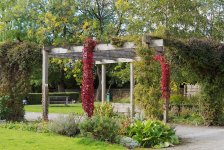
There's a Aussie woman I follow on insta and one thing that has stuck with me is "find the star in your picture" the picture in the park with the pagoda, for me the star is the middle pillar covered in red leaves, there seem to be a few "leading lines" around I think if you went back with the intention of making that pillar the "star" the result would be more pleasing. I have been trying to incorporate this into my landscape and now and again I take a pic and thin "Oooh that's nice"
 
... one thing that has stuck with me is "find the star in your picture"
I think that may be another version of "concentrate on the centre", which has nothing to do with geometry.

It's about identifying the main thing you want to show: an object, a person or whatever, and then showing that object in such a way that it dominates the image and makes your point.
 
Also for me, its about looking for and eliminating distractions in the frame, there's part of a women presumably who also owns the dog on the right nr the hedge, so by waiting a few minutes, she could have moved away and maybe the bin could have either been hidden behind the gazebo upright by changing your shooting angle or removed in post processing ?
 
Thanks for all your comments, they are most welcomed. I feel I must say that it is not the lens that is the issue, it is the images from the wider angles.
I find the images I take in the 14 to say 20mm range, especially landscape style images that include trees and hedges etc, to my eyes, look like everything blends together.
That is to say, I find it hard to define where one tree ends and the next one begins, I hope that makes sense?. This may well be my eyesight, but to me there is no defenition of depth in the images I take that are like this.
Here are a couple of examples to try and help show what I mean (although all this may just be the perspective of an idiot).

This was taken at 28mm,
View attachment 465352

This was taken at 25mm (shows the lens works fine lol)
View attachment 465353
"...it is the images from the wider angles."
This was the point I was making when I suggested it's easier to compose with longer lenses. The wider the lens, the harder you need work with the composition. Not just where things are positioned in the frame, but also how the lighting, textures and shapes affect how the eye moves within the frame. You need to think that much harder about what the picture is about and how the secondary subjects are going to affect the viewers response to the primary purpose of the photograph.

I would spend time studying photographs you like (taken on normal or wide angle lenses) and work out what makes those photographs successful.

Although, it's compositionally a bit simplistic, a good start with a complex composition, is to decide what has attracted you to the scene and decide on a main subject. Then work out the framing and viewpoint that allows some secondary subjects to complement the main subject, or/and how you might need to tweak the viewpoint, or the timing of pressing the shutter to minimise the effects of secondary subjects that distract from the main subjects.

Don't dismiss "improving things" during the processing. Adding a little bit of vignetting or a bit of judicious dodging and burning to lead the eye towards the interesting and away from the less interesting can do wonders for a picture.

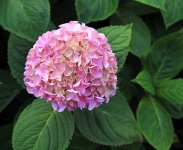
As an aside, my wife (keen gardener and lapsed, but one time professional, photographer) looked over my shoulder while reading your post and remarked on the "lovely photograph of a mop-head hydrangea"
 
So my question would be, is it possible to just not get on with certain focal lengths??
Yes, because we all 'see' photos differently. :)

There's a lot of love for 70-200mm zooms on full frame cameras among photographers in many genres. I have one. I hardly ever use it because I find it too long at 70mm and too short at 200mm. Give me a 24-120, 70-300 or 100-400 and I'm a happy bunny. Mostly I'm using a 35-150 these days as it does 90% of what I like.
 
I think composition may be the issue on not finding the "wow" factor, particularly on the smaller focal length lens, under 50mm.

There's a Aussie woman I follow on insta and one thing that has stuck with me is "find the star in your picture" the picture in the park with the pagoda, for me the star is the middle pillar covered in red leaves, there seem to be a few "leading lines" around I think if you went back with the intention of making that pillar the "star" the result would be more pleasing. I have been trying to incorporate this into my landscape and now and again I take a pic and thin "Oooh that's nice"
The first rule of composition is surely ‘what am I taking a picture of’ then the rest of the rules are about how to do that.
Remove distracting elements? Camera position, focal length, depth of field
How could I lead the viewer in? Leading lines, rule of thirds, lighting, colour theory

All that sounds simple, and in essence it is. But the devil is in the details, is the light just flat? Come back later, etc
 
Thanks every one, I will revisit the site of the first image and try to compose it a bit better, and take a few shots from different angles and distances, then see if any of the images appeal to me and why, what is different.
In the first Image it was the red leaves on the post that first caught my attention.
Next time I will try to hide the green bin behind the post with the red leaves, and maybe try to hide the bench aswell lol.

Cheers Andy.
 
The reality is that making pictures is about composition and light.


And subject matter........

And in response to this post above :

"I think I had similar experience, I had a 14-42ED lens when I got my first M43 camera, and wasn't until I got 12-40 pro lens that I was impressed."

This may be controversial but I fail to see how a photograph taken with a cheap lens can be worse than one with an expensive lens of almost identical focal lengths can be that much "better" unless all you are looking at is sharpness. Yes, technical quality is important but there is a lot more to an image than that.
 
Last edited:
The first rule of composition is surely ‘what am I taking a picture of’ then the rest of the rules are about how to do that.
Remove distracting elements? Camera position, focal length, depth of field
How could I lead the viewer in? Leading lines, rule of thirds, lighting, colour theory

All that sounds simple, and in essence it is. But the devil is in the details, is the light just flat? Come back later, etc

This made me smile, if I could have a £ for everytime I got all of these elements in except one or two I could hire a photographer to take my pics for me .....:p
 
A couple of different perspectives:

Inspiration. I can get bored by the same old things, and when that happens I stop 'seeing' images that are eye-catching. Some of my favourite pictures are of things seen while walking past, and often the first picture where the scene is fresh is the best, with subsequent images gradually losing life as inspiration seeps away.

Light you can go out in dull conditions really wanting to make a photo, but the results are almost always going to be miserable unless there's something else happening. Pretty garden in bright overcast - detail flower shots will be tolerable, but wider views will be flat and 'record shots' only.

Subject isolation. It's difficult to do with a widish consumer grade lens, doubly so with a small sensor like M43. one of the drivers for me to use fast primes is they can be used to separate the subject. I note comments from others here too, preferring longer lenses, which can also help. Better lenses can also give an image a greater sense of depth and '3D-ness', although we're all different and some cannot see this in a picture. I used a zeiss 16-80 with a sony camera for a while, and although it wasn'especially sharp, it did give a sense of depth to an inage hhat most other lenses could not.

So if I can offer advice, go photograph something inspiring on a day with good light, and spend your dull days processing the images you took in better conditions.
 
Inspiration. I can get bored by the same old things, and when that happens I stop 'seeing' images that are eye-catching. Some of my favourite pictures are of things seen while walking past, and often the first picture where the scene is fresh is the best, with subsequent images gradually losing life as inspiration seeps away.
This is me lol. I only take photos in either my garden, or the local park when taking the dog for a walk with the wife, she is the woman on the left in the first image, along with the dog lol.
This is due to a number of personal factors that I wont bore people with.
When I am in my local park, I find it hard to be inspired, this I think is due to everything being so familiar, something I see just about every day.
I had wondered about a prime lens (Olympus 45mm or Lumix 25mm, but alas just a dream), and just using that, trying to force myself to use my feet instead of just using a zoom lens.
But then again it has been suggested that I should just use the kit lens that I have, and use the camera until it dies, then just give up lol. This would be down to me worrying about anything going wrong with the camera, and the inability to pay for anykind of repair.
Well it looks like we are taking the dog out shortly, so I will take my camera (olympus em10 ii and 14-42 ez) and try again lol.
Cheers Andy.
 
So if I can offer advice, go photograph something inspiring on a day with good light, and spend your dull days processing the images you took in better conditions.
When I produced pictures for local newspapers, at £5 or £10 a pop, I quickly learned that there's no such thing as bad light.

You work with whatever you've got. At the end of the day, there is no more sincere appreciation of your pictures than a nice cheque and no more justified criticism than the absence thereof!
 
The need for 'good' light is overstated IMO. Light shouldn't be seen as additional, or requisite, to all the other elements that make for interesting/good photos. For some subjects the dreaded 'flat' light can actually be the best., and an interesting subject, well framed, in 'crap' light can still make a good picture.

Just my contrary opinion. ;)
 
I think I had similar experience, I had a 14-42ED lens when I got my first M43 camera, and wasn't until I got 12-40 pro lens that I was impressed.

The need for 'good' light is overstated IMO. Light shouldn't be seen as additional, or requisite, to all the other elements that make for interesting/good photos. For some subjects the dreaded 'flat' light can actually be the best., and an interesting subject, well framed, in 'crap' light can still make a good picture.

Just my contrary opinion. ;)


I agree about "good" light. I'm not sure everyone agrees about what good light actually is and as you say flat light can be absolutely perfect for some subjects.
 
For me, good light is one of the things that gives objects and features shape and structure in an image. It's not necessarily bright sunshine (which can be difficult to manage).

When I produced pictures for local newspapers, at £5 or £10 a pop, I quickly learned that there's no such thing as bad light.

If the thing you need is a record shot then absolutely, and getting paid to shoot it, even better. We have different criteria for our photos, and the point of this is not to tell Andrew to go take pictures, but to help him feel a bit more inspired.
 
  • Like
Reactions: Nod
Ask yourself is this the best position for the photo or would moving a few steps to the left or right make a better picture from a different angle.
 
Last edited:
Ask yourself is this the best position for the photo or would moving a few steps to the left or right make a better picture from a different angle.
Looking at it now, I would probably step to the left, and hide the bin behind the post with the red leaves, and maybe try to hide the bench/table behind the trailing plant on the left of the image.
 
Tried again today, was not happy with any image taken of the same scene I took yesterday, this is down to me having left c-af+tracking on for some strange reason, I will carry on trying.
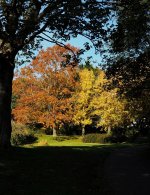
I did manage to capture this image though, which I quite liked. I like the colour of the trees in the light, against the darker surrounding created by more trees blocking the light.
But it still looks a bit fuzzy to me though, it might be my eyes lol.

Into the Light.JPG
 
Last edited:
Tried again today, was not happy with any image taken of the same scene I took yesterday, this is down to me having left c-af+tracking on for some strange reason, I will carry on trying.
I did manage to capture this image though, which I quite liked. I like the colour of the trees in the light, against the darker surrounding created by more trees blocking the light.
But it still looks a bit fuzzy to me though, it might be my eyes lol.

View attachment 465402
What do you mean by fuzzy? What aperture/shutter speed and ISO are you using, and how are you processing the picture?

There is potentially a lot of fine detail in the leaves which might be difficult to resolve, or they might simply be blowing in the wind

I think this could be improved by getting a bit lower down, or moving a bit closer, maybe with a wider angle lens so the main subject (the distant trees) isn't disrupted by the foreground tree branches. This would let the branches frame the trees rather than break them up.

A change of vewpoint would also reduce the extent of the black shadow in the foreground, which although helping with the framing, is also dominating the picture.
 
What do you mean by fuzzy? What aperture/shutter speed and ISO are you using, and how are you processing the picture?

There is potentially a lot of fine detail in the leaves which might be difficult to resolve, or they might simply be blowing in the wind

I think this could be improved by getting a bit lower down, or moving a bit closer, maybe with a wider angle lens so the main subject (the distant trees) isn't disrupted by the foreground tree branches. This would let the branches frame the trees rather than break them up.

A change of vewpoint would also reduce the extent of the black shadow in the foreground, which although helping with the framing, is also dominating the picture.
Exif says, taken at 24mm, f8, 1/250sec, iso 200.
By fuzzy I mean unclear, not sharp, but that is beause the coloured trees are in the distance I think??, plus this monitor and pc play a part also.
I use Photoscape X for my PP, it is a free program. As i have onboard graphics, not a seperate graphics card, this seems to limit what I can do in PP .
 
Can I offer a slightly different thought?

You seem to be wanting your images to "pop" more than they do currently, if so,

1. Colour balance: your M43 camera will have plenty of in-built facilities, image styles, dial settings and what have you. Have a try with a different colour balance possibly? I tend to favour "vivid".

2. Depth of field/subject separation: We know what focal length you've had your lens at but have you experimented with different aperture settings? I think your lens runs from F3.5 to F5.6 so though it's not like having F1.8 to F8 but it's worth trying them all I'd suggest. Think about the dog and the litterbin: do you need them to be in focus?

3: Getting past "Full frame": I'm a little wary of mentioning this here because the camera you've got is what you've got and I want to believe that you have scope within your camera's menus to make a difference. I've always liked the images that full frame cameras produce when compared to "crop sensor" cameras. I don't think that I could do this now but there was a time when I could look at a bunch of photos and pick out the ones taken with FF.
 
I think maybe don't look at others people's photos and look at some of the classic artists (painters). Look at still life paintings, see how an artist makes something that's rather mundane, fruit in a bowl, flowers in a vase etc, look attractive or how they draw you in to study the objects in the painting. They use light, composition and to some extent colour to make you look at what they want you to see and what they don't want you to see.
As regards to focal lengths, I tend to prefer longer lenses (zoom range) 24-105mm on my apsc camera for a general walk about lens. Where as other photographers would think this is not wider enough at the short end (on a crop sensor camera), but I've never really found it to be a problem.
 
Exif says, taken at 24mm, f8, 1/250sec, iso 200.
By fuzzy I mean unclear, not sharp, but that is beause the coloured trees are in the distance I think??, plus this monitor and pc play a part also.
I use Photoscape X for my PP, it is a free program. As i have onboard graphics, not a seperate graphics card, this seems to limit what I can do in PP .
There is a limit on how much detail is obtainable as things get smaller and further away from the camera.

Just forcing the light to punch through more atmosphere will reduce the detail you can get. You may also be losing some resolution at f8, on a 24mm lens, due to diffraction. The M43 sensor, won't be helping either, as it's easier to retain detail as sensor sizes get bigger, but for everyday photographs this is normally a minor issue.

You may be able to get rid of some of this perceived fuzziness by adding a little bit of sharpening at the processing stage. But, unless you are careful, sharpness that looks good when viewed at 100%, can look over sharpened and gritty at normal viewing. You could also try using a bigger aperture: f5.6 rather than f8, which should reduce any diffraction effect. Images that look unsharp when enlarged on a computer screen can look perfectly fine when printed.

How noticeable is this fuzziness at normal image sizes, and normal viewing distances: is it detracting from the picture when viewed as an "entire" picture?

Sharpness and resolution are largely overrated.

I used a Mac Mini with a relatively poor quality onboard graphics card, and the impacts seemed to be more about speed of doing things than capability. I think now a days the graphics card limits are more to do with AI features rather than any of the important processing tools.
 
This made me smile, if I could have a £ for everytime I got all of these elements in except one or two I could hire a photographer to take my pics for me .....:p
I was listing alternatives rather than requirements.

The reason there’s loads of compositional ‘rules’ or techniques is that there’s no one size fits all, and that there’s usually ‘something’ to use to help your viewer. It’s just a matter of finding it
 
This is me lol. I only take photos in either my garden, or the local park when taking the dog for a walk with the wife, she is the woman on the left in the first image, along with the dog lol.
This is probably more likely the problem than anything else, if there’s nothing inspiring then you’re unlikely to take a photo of something that wows you. We overlook a park, great for dog walks but pretty rubbish when it comes to taking photos of something interesting hence why I only have a handful of photos from there, and none of them are anything interesting.

You need to take a photo of a subject that engages you and/or has something interesting about it.
 
The need for 'good' light is overstated IMO. Light shouldn't be seen as additional, or requisite, to all the other elements that make for interesting/good photos. For some subjects the dreaded 'flat' light can actually be the best., and an interesting subject, well framed, in 'crap' light can still make a good picture.

Just my contrary opinion. ;)
Like clothing re weather, there’s no such thing as ‘bad’ light, but it can be inappropriate.

Isn’t the controversially most expensive photo a shot of a boring scene in ‘terrible’ light.

I’m no landscape photographer, I mostly shoot people so boring flat light is often desirable.
 
Back
Top