

You are using an out of date browser. It may not display this or other websites correctly.
You should upgrade or use an alternative browser.
You should upgrade or use an alternative browser.
Focal lengths
- Thread starter Nick Kon
- Start date

desantnik
Suspended / Banned
- Messages
- 9,848
- Name
- Vlad
- Edit My Images
- Yes
Arrrgh.
Common question, my response is a common answer
Focal length is focal length. Digital crop sensors just narrow the effective field of view. The focal length remains the same.
Consider it like cropping the centre out of a photo - which is exactly why they are called "crop"
Common question, my response is a common answer
Focal length is focal length. Digital crop sensors just narrow the effective field of view. The focal length remains the same.
Consider it like cropping the centre out of a photo - which is exactly why they are called "crop"
desantnik
Suspended / Banned
- Messages
- 9,848
- Name
- Vlad
- Edit My Images
- Yes
I want to appear intelligent and say I understand what you mean but I dont.
Ok, using borrowed text:
The focal length of a camera lens is the distance between the center of the lens and the film when an in-focus image is formed of an object very far away.
Thats the focal length of the lens. Whatever camera you put it onto it remains the same, your lens cannot magically change.
Normally though, when we talk about focal lengths we are talking about what we can see in the frame - but thats not actually "focal length", that is "field of view". Using longer focal lengths gives you a smaller field of view. If you take your zoom lens, zoom it out, point it at something then zoom in your see less of the subject yes?
If you take that photo and chop the middle out of it with photoshop, you see even less yes?
What people mean when they say a digital crop camera has a 1.5 times crop, it means that the field of view you get for example with a 100mm lens is the same field of view you would see with a 150mm lens on a 35mm (full frame) camera. Thats true, but the focal length of your 100mm lens is the same on both - its a 100mm lens!
The crop bit is because the sensor is not 35mm - its smaller than that, so the same as cutting the middle out of a photo in photoshop.
Get it?

Dogfish_magnet
Suspended / Banned
- Messages
- 4,613
- Name
- Paul
- Edit My Images
- Yes
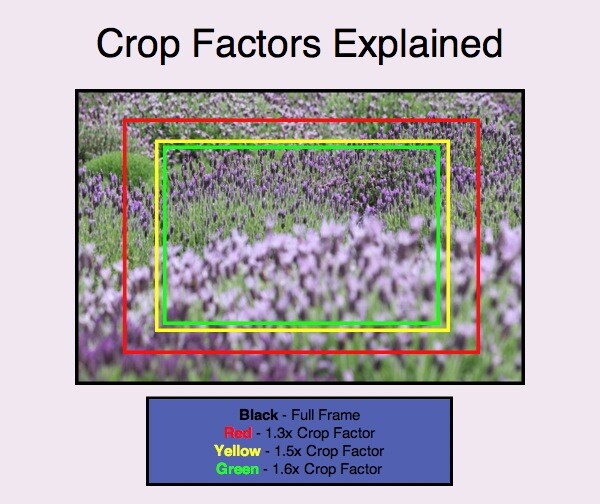
The focal length will always be the same, its the field of view that changes - the image below shows the different fov for different sensor sizes with the same lens

MatBin
Suspended / Banned
- Messages
- 5,334
- Name
- matt
- Edit My Images
- Yes
When people talk about crop factor they mean the sensor on some digital cameras is a lot smaller than a what is now called a full frame (which was the old 35mm neg size 36x24mm if memory serves). Some crop sensors are for instance 23x18 but the lens still sees exactly the same regardless of which body its mounted on, BUT, the bit outside the 23x18 is 'lost' i.e. it doesnt get recoorded on anything, consequently people say the lens has an effective length of 1.6 x focal length (assuming a 1.6 crop).
So a 200mm focal length lens sees the same image as it would if the lens was 320mm (comparing 35mm to 1.6 digital crop).
There are full frame, 1.3, 1.5 and 1.6 crop sensors depending on model and/or manufacturer and that without talking about 4/3rd cameras or point&shoots either.
Matt
So a 200mm focal length lens sees the same image as it would if the lens was 320mm (comparing 35mm to 1.6 digital crop).
There are full frame, 1.3, 1.5 and 1.6 crop sensors depending on model and/or manufacturer and that without talking about 4/3rd cameras or point&shoots either.
Matt

boyfalldown
Suspended / Banned
- Messages
- 17,486
- Name
- Hugh
- Edit My Images
- No
it may also be worth looking at this link http://www.luminous-landscape.com/tutorials/understanding-series/dslr-mag.shtml
Ok I dont think I explained myself correctly.
Take an old 35-70mm lens for a 35mm Camera and a 18-55mm for digital.
If I zoom right in with the digital lens,will I see the same picture through the viewfinder
as I would setting the 35mm Camera lens to 35mm and the same setting it to 55mm and 70mm?
Take an old 35-70mm lens for a 35mm Camera and a 18-55mm for digital.
If I zoom right in with the digital lens,will I see the same picture through the viewfinder
as I would setting the 35mm Camera lens to 35mm and the same setting it to 55mm and 70mm?

chilliz
Suspended / Banned
- Messages
- 1,782
- Name
- Ian
- Edit My Images
- No
Ok I dont think I explained myself correctly.
Take an old 35-70mm lens for a 35mm Camera and a 18-55mm for digital.
If I zoom right in with the digital lens,will I see the same picture through the viewfinder
as I would setting the 35mm Camera lens to 35mm and the same setting it to 55mm and 70mm?
Only if your digital SLR has an APS-C sized sensor ifit`s full frame it will be the same as 35mm.


scottthehat
Suspended / Banned
- Messages
- 6,290
- Name
- scott
- Edit My Images
- Yes
if you have a 50mm lens on a 1.5x crop dslr ie (d90,d300,d300s), to get the same field of viev on a 35mm(full frame camera)ie(d3, d3x) you would need a 75mm lens.
so thats why people use crop sensor cameras for bird photography.
so thats why people use crop sensor cameras for bird photography.

StewartR
Suspended / Banned
- Messages
- 11,513
- Name
- Stewart
- Edit My Images
- Yes
No it isn't. This is another popular misconception.if you have a 50mm lens on a 1.5x crop dslr ie (d90,d300,d300s), to get the same field of viev on a 35mm(full frame camera)ie(d3, d3x) you would need a 75mm lens.
so thats why people use crop sensor cameras for bird photography.
The reason people use crop sensors for bird photography is that, at any point in time, state-of-the-art crop sensors offer a higher pixel density than full-frame sensors. It's the pixel density which counts, because that means more pixels on your target.
A 24.5MP full-frame D3X is better for birding than a 2.6MP crop-sensor D1, because it has higher pixel density.
scottthehat
Suspended / Banned
- Messages
- 6,290
- Name
- scott
- Edit My Images
- Yes
didnt want to go that technical in to things, as i didnt feel the need.No it isn't. This is another popular misconception.
The reason people use crop sensors for bird photography is that, at any point in time, state-of-the-art crop sensors offer a higher pixel density than full-frame sensors. It's the pixel density which counts, because that means more pixels on your target.
A 24.5MP full-frame D3X is better for birding than a 2.6MP crop-sensor D1, because it has higher pixel density.
which will give more reach with a 500mm lens,crop camera d300 or full frame d3.
StewartR
Suspended / Banned
- Messages
- 11,513
- Name
- Stewart
- Edit My Images
- Yes
The D300 will. But NOT because it's a crop-sensor camera. It has more "reach" because it has a higher pixel density. That's my point.which will give more reach with a 500mm lens,crop camera d300 or full frame d3.

AndyElliott
Suspended / Banned
- Messages
- 500
- Name
- Andy
- Edit My Images
- Yes
The D300 will. But NOT because it's a crop-sensor camera. It has more "reach" because it has a higher pixel density. That's my point.
Indeed. Over the same part of the frame that the D300 sensor would cover on the D3, the D3 only has 5.4 million pixels versus the D300's 12 million. The D3X would have 10.8 million in the same area.
So you could crop the full-frame, but it would be less detailed - hence less 'reach'. One must also consider the anti-alias filter on the sensor, which will reduce the effective resolving power of the sensor and are weaker or stronger on different cameras. The other important thing - sorry to bang on again - is how much resolution your lenses can give the sensor. Probably not an issue with Nikon, with their biggest crop sensors 'only' having 12MP, but it is a bigger issue with the 18MP Canon 7D and 550D - where some of their lenses will not be able to give sufficient resolution.
Andy
AndyElliott
Suspended / Banned
- Messages
- 500
- Name
- Andy
- Edit My Images
- Yes
The focal length will always be the same, its the field of view that changes - the image below shows the different fov for different sensor sizes with the same lens
Worth actually pointing out that the aspect ratios of all of these sensors is 3:2 (i.e. 1.5x wider than they are tall). For convenience, the crop 'factor' is the ratio of the diagonals of each of the sensors i.e. a linear ratio rather than a ratio of the areas.
To confuse matters, Fourthirds (the crop format not shown) has a crop factor of 2.0. However, the aspect ratio is 4:3 on most of the sensors (all but the GH1), so it has a vertical crop of 1.83 and a horizontal crop of 2.08. The idea that the fourthirds sensor is 'lots smaller' is a bit bogus - it is a tiny bit less tall than the APS-C formats and a different aspect ratio. The 3:2 aspect of the APS-C formats is an accident of 35mm film - itself an accident of the movie industry.
Andy
Indeed. Over the same part of the frame that the D300 sensor would cover on the D3, the D3 only has 5.4 million pixels versus the D300's 12 million. The D3X would have 10.8 million in the same area.
So you could crop the full-frame, but it would be less detailed - hence less 'reach'. One must also consider the anti-alias filter on the sensor, which will reduce the effective resolving power of the sensor and are weaker or stronger on different cameras. The other important thing - sorry to bang on again - is how much resolution your lenses can give the sensor. Probably not an issue with Nikon, with their biggest crop sensors 'only' having 12MP, but it is a bigger issue with the 18MP Canon 7D and 550D - where some of their lenses will not be able to give sufficient resolution.
Andy
Interesting reading here.
I understand what the crop means to the field of view, but had been mulling over a thought I had a while back.
In the past I have been on safari with my film slr and a 75-300mm lens, and have found 300mm to be fine on the whole. I currently have a 40D and a 70-200mm lens.
In theory, with this combo, I have a smaller (if that is the right word?) field of view now, than I had in the past - ie 320mm instead of 300mm - will a shot taken of a lion say, taken with the crop camera and 70-200 pick up more detail than the film camera with 75-300 when pixel density etc is taken into consideration? (assuming settings are the same)
I am confusing myself whether taking a shot on a 1.6 crop with a 200mm is actually the same as taking a shot on film / FF at 200mm and cropping, hence a loss of detail (eg too far away to get nice detail). Or would the detail be equivalent to that taken on film / FF at 300mm as the field of view is virtually the same.
The more I try to figure it out, the more confused I get! :bonk:

HoppyUK
Suspended / Banned
- Messages
- 23,200
- Name
- Richard
- Edit My Images
- No
Ok I dont think I explained myself correctly.
Take an old 35-70mm lens for a 35mm Camera and a 18-55mm for digital.
If I zoom right in with the digital lens,will I see the same picture through the viewfinder
as I would setting the 35mm Camera lens to 35mm and the same setting it to 55mm and 70mm?
To answer your question directly, you are on the right lines but you need to be specific with what cameras you are comparing.
DSLRs come in two common formats - crop format which is similar to the old film format called APS-C, and full frame which is the same as 35mm film.
The common crop format DSLRs are Nikon and Canon, which have very slightly different sized sensors and hence different crop factors, ie 1.5x and 1.6x.
Assuming a crop format Nikon camera, then if you fit an 18-55mm lens, what you get in the picture will be equivalent to 18-55 x 1.5, which is about the same as a 27-82mm lens on full frame/35mm film.

EOS_JD
Suspended / Banned
- Messages
- 6,729
- Name
- Jim
- Edit My Images
- Yes
Assuming a crop format Nikon camera, then if you fit an 18-55mm lens, what you get in the picture will be equivalent to 18-55 x 1.5, which is about the same as a 27-82mm lens on full frame/35mm film.
As stated above the focal length does not change. All that changes is the field of view
HoppyUK
Suspended / Banned
- Messages
- 23,200
- Name
- Richard
- Edit My Images
- No
Interesting reading here.
I understand what the crop means to the field of view, but had been mulling over a thought I had a while back.
In the past I have been on safari with my film slr and a 75-300mm lens, and have found 300mm to be fine on the whole. I currently have a 40D and a 70-200mm lens.
In theory, with this combo, I have a smaller (if that is the right word?) field of view now, than I had in the past - ie 320mm instead of 300mm - will a shot taken of a lion say, taken with the crop camera and 70-200 pick up more detail than the film camera with 75-300 when pixel density etc is taken into consideration? (assuming settings are the same)
I am confusing myself whether taking a shot on a 1.6 crop with a 200mm is actually the same as taking a shot on film / FF at 200mm and cropping, hence a loss of detail (eg too far away to get nice detail). Or would the detail be equivalent to that taken on film / FF at 300mm as the field of view is virtually the same.
The more I try to figure it out, the more confused I get! :bonk:
In terms of framing, using a 200mm lens on a Canon 40D 1.6x crop format camera is the equivalent of a 320mm lens on full frame, as you say. Likewise, if you use a 200mm lens on a full frame camera and enlarge the image in post processing by a factor of 1.6x, you will get the same framing as the 40D.
The main difference will be in the pixel density. The full frame Canon 5D has about 13mp which when enlarged to give the same framing as a crop camera, is reduced to approx 5mp (full frame is 2.6x the area, ie crop factor squared 1.6 x 1.6 = 2.6). By the same measure, the 5D2's 21mp go down to about 8mp, which is roughly similar to your 40D's 10mp.
It's not quite that simple though, as while the 5D would only have 5mp, each one is 2.6x the size of the 40D's 10mp, so that is a factor in favour of the 5D. On balance though, for things like long lens birding, or lions, pixel density wins (if your lenses are sharp enough to resolve that level of detail).
AndyElliott
Suspended / Banned
- Messages
- 500
- Name
- Andy
- Edit My Images
- Yes
The film question is an interesting one. Very much depends on the film as to what resolution you will get - generally the slower ones - e.g. Velvia 50 is rated at 160 lines per mm (80lpmm). But then I doubt your 75-300 would be able to give enough resolution to match that capability, based on results I've seen for other lenses, few zoom lenses can.
Andy
Andy
EOS_JD
Suspended / Banned
- Messages
- 6,729
- Name
- Jim
- Edit My Images
- Yes
In terms of framing, using a 200mm lens on a Canon 40D 1.6x crop format camera is the equivalent of a 320mm lens on full frame, as you say. Likewise, if you use a 200mm lens on a full frame camera and enlarge the image in post processing by a factor of 1.6x, you will get the same framing as the 40D.
Hoppy
That seems incorrect. If the camera is in the same position, the FF image will show more of the scene than the crop image. You cannot "enlarge" a FF image to match a crop sensor image - you need to CROP it.
I know you know.....

incapete
Suspended / Banned
- Messages
- 1,149
- Name
- Peter
- Edit My Images
- Yes
Hoppy
That seems incorrect. If the camera is in the same position, the FF image will show more of the scene than the crop image. You cannot "enlarge" a FF image to match a crop sensor image - you need to CROP it.
I know you know.....
I think he knows too.... how about cropping it and then enlarging it to the same size as the full frame image?
EOS_JD
Suspended / Banned
- Messages
- 6,729
- Name
- Jim
- Edit My Images
- Yes
I think he knows too.... how about cropping it and then enlarging it to the same size as the full frame image?
No..... you crop the FF image so it shows the same scene as the crop image
The FF is the outer rectangle so clearly shows a lot more than the cropped sensor image so to show the same FOV with the same lens, you need to crop the FF image (the balack line) to match the crop sensor image (saythe yellow/green or red line depending on the camera you have).

King_Boru
Suspended / Banned
- Messages
- 2,097
- Edit My Images
- No
I would just like to ask where the term Full Frame comes from? What exactly is Full Frame and why is it associated with the correct term 35mm? Would a Full Frame system not represent whether or not the sensor and lenses cover the desired image area? Full Frame is a term to describe the relationship between lenses and sensor size (DX, EFS, 4/3rds + DX, EFS, 4/3rds lens = Full Frame). The term Full Frame has been taken out of context to describe a mythical elitism surround the use of 35mm sized digital sensors.
AndyElliott
Suspended / Banned
- Messages
- 500
- Name
- Andy
- Edit My Images
- Yes
Yeah, that bugs me too. Is Medium-Format "Really, Really Full-Frame" and Large-Format "Big Fat Super-Size-Me Full Frame"?
The whole issue of cropping to get a desirable picture in post processing often results in 3:2 aspect ratio shooters (most DSLRs) chopping the ends off. The 3:2 was a legacy from film, which was used by Leica in their cameras as early as 1913, re-using a readily available film-stock from cinematograph cameras (that was about 20 years earlier that this format was invented).
I find it interesting that we have this legacy dating back nearly 120 years being applied in current technology. You've got to be amazed (in good and bad ways) by that...
Andy
The whole issue of cropping to get a desirable picture in post processing often results in 3:2 aspect ratio shooters (most DSLRs) chopping the ends off. The 3:2 was a legacy from film, which was used by Leica in their cameras as early as 1913, re-using a readily available film-stock from cinematograph cameras (that was about 20 years earlier that this format was invented).
I find it interesting that we have this legacy dating back nearly 120 years being applied in current technology. You've got to be amazed (in good and bad ways) by that...
Andy
HoppyUK
Suspended / Banned
- Messages
- 23,200
- Name
- Richard
- Edit My Images
- No
Hoppy
That seems incorrect. If the camera is in the same position, the FF image will show more of the scene than the crop image. You cannot "enlarge" a FF image to match a crop sensor image - you need to CROP it.
I know you know.....
I think he knows too.... how about cropping it and then enlarging it to the same size as the full frame image?
Cheers Pete
We used to talk about enlarging (the negative) but now we call it cropping (the sensor). You could also refer to them both as changing the magnification, but since there is more enlargement required when you crop... Erm, I mean...


HoppyUK
Suspended / Banned
- Messages
- 23,200
- Name
- Richard
- Edit My Images
- No
I would just like to ask where the term Full Frame comes from? What exactly is Full Frame and why is it associated with the correct term 35mm? Would a Full Frame system not represent whether or not the sensor and lenses cover the desired image area? Full Frame is a term to describe the relationship between lenses and sensor size (DX, EFS, 4/3rds + DX, EFS, 4/3rds lens = Full Frame). The term Full Frame has been taken out of context to describe a mythical elitism surround the use of 35mm sized digital sensors.
'Full Frame' is short for 'Full Frame 35mm Film' as opposed to Half Frame. The 35mm bit is the full width of the film, including sprocket holes, and the image area is 24 x 36mm.
Over 150-plus years, photography is full of old jargon that has been used and abused, to the point where the original meaning is either lost or misconstrued. Full frame, half frame, crop format, APS-C, APS-H, 4/3rds (of what?), 1.6x, 1.5x, 1.3x, medium format (can mean anything) etc etc.
What is 'a stop'? That's a strange one.
It would be a good start is people would stop referring to a small aperture when they mean a low f/number, but I see no chance of that happening either.
EOS_JD
Suspended / Banned
- Messages
- 6,729
- Name
- Jim
- Edit My Images
- Yes
I know what you mewan but you are not enlarging really? Lets say you take a straight 300ppi print and get your size of image. Now crop it so that the image is smaller.... the image isn't enlarged. All you've done is remove part of it (removing pixels if done on the PC)
HoppyUK
Suspended / Banned
- Messages
- 23,200
- Name
- Richard
- Edit My Images
- No
I know what you mewan but you are not enlarging really? Lets say you take a straight 300ppi print and get your size of image. Now crop it so that the image is smaller.... the image isn't enlarged. All you've done is remove part of it (removing pixels if done on the PC)
What Peter said earlier. Semantics basically

It's all just short-hand jargon, and needs to be qualified with a lengthy definition if you want to be technically accurate.
As I said, photography is full of it and you'd need to rewrite everything to arrive at clear, unambiguous and accurate terms. With the likely result that nobody would understand anything.
If you've been around a bit, it's easy enough to pick up what is actually meant, from the context as much as anything. I do feel sorry for newcomers though.
AndyElliott
Suspended / Banned
- Messages
- 500
- Name
- Andy
- Edit My Images
- Yes
4/3rds (of what?).
...of an inch - the imaging area of a Four Thirds sensor is equal to that of a video camera tube of 4/3" diameter. It is a common misconception that it refers to the aspect ratio (4:3) - that's a happy (?!) coincidence. The Panasonic GH1's fourthirds sensor covers multiple aspect ratios, but all with the same image circle (22.5mm).
Andy
AndyElliott
Suspended / Banned
- Messages
- 500
- Name
- Andy
- Edit My Images
- Yes
I know what you mewan but you are not enlarging really? Lets say you take a straight 300ppi print and get your size of image. Now crop it so that the image is smaller.... the image isn't enlarged. All you've done is remove part of it (removing pixels if done on the PC)
That's like a 'digital zoom'

EOS_JD
Suspended / Banned
- Messages
- 6,729
- Name
- Jim
- Edit My Images
- Yes
That's like a 'digital zoom'
Digital zoom basically enlarges the image. So no not quite.
EOS_JD
Suspended / Banned
- Messages
- 6,729
- Name
- Jim
- Edit My Images
- Yes
I do feel sorry for newcomers though.
Yes because we all have our own takes and ways of explaining trying to make things easy and then being corrected and it goes round and round

King_Boru
Suspended / Banned
- Messages
- 2,097
- Edit My Images
- No
Well, I bet you guys have thoroughly confused the OP now.........
Probably
So, anyone volunteering to do the re-write and send it to the internet?
HoppyUK
Suspended / Banned
- Messages
- 23,200
- Name
- Richard
- Edit My Images
- No
...of an inch - the imaging area of a Four Thirds sensor is equal to that of a video camera tube of 4/3" diameter. It is a common misconception that it refers to the aspect ratio (4:3) - that's a happy (?!) coincidence. The Panasonic GH1's fourthirds sensor covers multiple aspect ratios, but all with the same image circle (22.5mm).
Andy
4/3rds of an inch then! Which it clearly is nowhere near, but in 'compact' format parlance (which nobody understands) maybe it makes some sense.
And then the 4/3rds format, which has a 2x crop factor is further 'cropped' again to create other formats.
That's all clear then