Focal lengths of small sensor cameras ?

BADGER.BRAD

Suspended / Banned
Messages
4,252
Edit My Images
Yes
Hello all,

I have a cheap Kodak Pixpro AZ401 I haven't used this camera much but when I took a few bird photos with it today I noticed it seemed to be reporting an odd focal length is this something to do with the small sensor ? This one reports about 55mm but it was zoomed quite away and the camera quotes 24 to 960mm equivalent. I'd guess at 700mm (ish) if that is the range.

BIRD3.JPG
 
Very possibly. Maybe you can google your way to somewhere that'll tell you the crop factor of this camera?

I have a Panasonic TZ100 and it's confusing as it reports focal length in FF terms on the screen and evf but in the exif it reports the focal length as it is before applying the crop factor.
 
You're confusing real focal length with equivalent focal length.

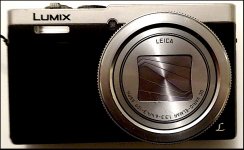
On the Panasonic TZ70 (below) the real focal length, marked on the front ring, is 4.3mm to 129mm. The equivalent focal length, in full frame 35mm terms, is 28mm to 720mm. Thus the conversion factor, in this case, is 5.58.

Camera Panasonic TZ70 HX90 DSC00050.JPG
 
Last edited:
Agreed Panasonic does the same with there bridge cameras
 
I get a crop factor of 5.6 according to this website https://shuttermuse.com/calculate-cameras-crop-factor/ but does this mean I divide or times the equivalent focal length ie: 960mm deviding it gives me a focal lenght of 171.5mm which still in no way seems to match my 135mm len on a crop sensor (200mm) but then times it gives me 5376mm neither of which seem right ?
 
The 960mm is the eqivalent focal length and the 171.5mm is the real focal length.

The only way you can compare focal lengths which are used with different format sensors is by converting both to the eqivalent focal lengths, by using the conversion factor for each lens/format.
 
I get a crop factor of 5.6 according to this website https://shuttermuse.com/calculate-cameras-crop-factor/ but does this mean I divide or times the equivalent focal length ie: 960mm deviding it gives me a focal lenght of 171.5mm which still in no way seems to match my 135mm len on a crop sensor (200mm) but then times it gives me 5376mm neither of which seem right ?
The manual gives the real focal length of the zoom as running from 4.3mm to 172mm, so your calculation of 171.5mm is correct.

 
Going to jump in here with a fruitless plea for lens & camera manufacturers (and photographers!) to ditch the ridiculous measurement of focal length when describing field of view. With Medium Format cameras becoming more affordable we now have 4 main sensor sizes of 'pro' camera (M43, crop, full frame, medium format) all with their own interpretation of focal length/field of view.

Just call it what it is then no one has to worry about converting 'equivalent focal lengths'!

Rant over :LOL:
 
Going to jump in here with a fruitless plea for lens & camera manufacturers (and photographers!) to ditch the ridiculous measurement of focal length when describing field of view. With Medium Format cameras becoming more affordable we now have 4 main sensor sizes of 'pro' camera (M43, crop, full frame, medium format) all with their own interpretation of focal length/field of view.

Just call it what it is then no one has to worry about converting 'equivalent focal lengths'!

Rant over :LOL:

That could be a problem for me as fov means next to nothing to me and would need learning and afaik isn't marked on any of my lenses. I grew up with film and 35mm and it would be difficult for me to fully understand what, for example, a 9-18mm lens for MFT is like to use whereas converting that to 18-36mm in ff speak makes a lot more sense to me. It's even worse with smaller sensor compacts when they're 6mm or so.
 
Going to jump in here with a fruitless plea for lens & camera manufacturers (and photographers!) to ditch the ridiculous measurement of focal length when describing field of view.
Just count yourself lucky if you weren't photographing in the 1960s. Then we had...
  1. 10x8
  2. whole plate
  3. half plate
  4. 5x4
  5. 6x9 (cut film)
  6. 116 roll film
  7. 620 roll film
  8. 120 roll film
  9. 220 roll film
  10. 127 roll film
  11. 35mm film
  12. 828 roll film
  13. 126 cartridge film
  14. 16mm film
  15. 9.5mm film
On top of which, 116, 620, 120 and 220 were used with different formats of film gate, as was 35mm film.

Some publications did their best to provide angle of view information for lenses on various formats but it was a minefield! :banghead: :naughty:
 
remember them days well Andrew , even worse when you added film types and different developing chemicals .. and spools and drum sizes etc only one lasting memory though the smell of fixer in a darkroom LOL
 
The "problem" (if you want to call it that) is that the focal length of a lens is a fixed physical property of the optics and bears no relation to the sensor or film size. So a 50mm focal length lens is 50mm whether it's on a medium format camera, a "full-frame" film/digital camera or any one of the smaller sensor digital cameras. If you were to take a photo using that lens (or any other lens of the same focal length) on a range of different cameras and print them to the same size-ratio as the film/sensors, they would all show the same subject magnification. But clearly the larger the format, the more subject would be on the print.
 
Going to jump in here with a fruitless plea for lens & camera manufacturers (and photographers!) to ditch the ridiculous measurement of focal length when describing field of view. With Medium Format cameras becoming more affordable we now have 4 main sensor sizes of 'pro' camera (M43, crop, full frame, medium format) all with their own interpretation of focal length/field of view.

Just call it what it is then no one has to worry about converting 'equivalent focal lengths'!

Rant over :LOL:
I fairly regularly use interchangable lens digital cameras with 5.6x, 2x, 1.7x, 1.5x & 1x crops & I might actually use the same lens on all of them. I think another 8 frame sizes are included among my film cameras.
I find both actual & equivalent focal lengths useful, and don't have a great deal of difficulty calculating them (close enough) just in my head. All that's needed is a clear distinction as to which is being used. If the camera knows what the lens is (often not the case if adapting) the EXIF should contain both equivalents & real focal lengths.
FWIW I also have several fisheye lenses where the focal length doesn't correlate well with FOV, actually getting a bigger FOV (& image circle) from my 10mm APSC fisheye than from my older 7mm M42 (FF) one!
 
I hung on to film when people around me were going digital and when I eventually decided to get a DSLR I didn't do any research (my fault.) I was happy enough with my Canon 300D apart from it being bigger and heavier than my film camera and lens combinations but what phased me the most was that 28mm's didn't seem like 28mm any more. I went back to the shop and I think the assistant was equally ignorant as when I asked if he had a wider lens he said something like "Not really. Once you go wider than 28mm you're getting into fisheye." I didn't want a fisheye so I left it there. I wasn't on line at the time and I think it was only after all this that I bought some magazines and eventually found out all about APS-C and crop factors.

These days I have a FF camera and MFT ones too and I still convert everything to FF speak as it makes it all easier for me. TBH I wouldn't know were to start if FoV became the norm, not if looking to buy a new lens. I'd have to learn I suppose or at least convert all my most used focal lengths and print out a little guide.
 
actually getting a bigger FOV (& image circle) from my 10mm APSC fisheye than from my older 7mm M42 (FF) one!
That's down to the design of the lens system, if I recall my optics correctly.

As I understand it, there have been very few true fisheye designs. The original Hill and Beck design in the 1920s and the Nikon 8mm fisheye in the early 1960s were true wide angles, so the rear element very nearly touched the film. Later lenses, like most wide angle lenses for SLRs, were inverted telephoto designs, in order to clear the mirror. It's that construction which means that the focal length and the angle of view aren't necessarily related,

Kirsten fisheye.jpg
 
That's down to the design of the lens system, if I recall my optics correctly.

As I understand it, there have been very few true fisheye designs. The original Hill and Beck design in the 1920s and the Nikon 8mm fisheye in the early 1960s were true wide angles, so the rear element very nearly touched the film. Later lenses, like most wide angle lenses for SLRs, were inverted telephoto designs, in order to clear the mirror. It's that construction which means that the focal length and the angle of view aren't necessarily related,
I've not heard people refer to 'true fisheye' before. Could you share your definition of what makes a true fisheye?
I've always understood a fisheye to be a non rectilinear lens of extremely wide angle FOV. Which can use one of four basic mapping functions, orthographic, equidistant, equisolid angle & stereographic, though real lenses don't usually quite conform to any of these.
Each of these designs requires a different focal length to get a given angle of view at a given displacement & each produces a very different look.

The two lenses I was talking about both have the same rear focal distance. From the images I would suspect the M42 one is close to an orthographic design, cramming much of the scene into the outer portion of it's image, while the APSC one looks more like an equidistant, but this doesn't tie in with the focal lengths needed a 12mm orthographic should give a 180degree circular image on FF, while the other types need shorter focal lengths.
It seems Entaniya are now making fisheyes with a FOV of 250degrees (even wider than the rare Nikon 220 degree monster) but at over £2000 each I think I'll resist temptation!

I'm a bit peeved the M42 fisheye is so far from using the full height of the 35mm image frame.
 
Last edited:
Each of these designs requires a different focal length to get a given angle of view at a given displacement & each produces a very different look.
You've explained the subject better than I could. :)
 
What tends to peeve me as a pedant, though I accept and use it myself, is the term “full frame”. In reality, as we know, it refers to uncropped 35mm format. But surely there is no thing as full frame. It could be 4x5, 10x8, or whatever as long as it’s uncropped.
 
It could be 4x5, 10x8, or whatever as long as it’s uncropped.
See rabbit hole, follow rabbit... :naughty:

Like so many terms in so many speciality subjects, it more or less works for those in the know.
 
What tends to peeve me as a pedant, though I accept and use it myself, is the term “full frame”. In reality, as we know, it refers to uncropped 35mm format. But surely there is no thing as full frame. It could be 4x5, 10x8, or whatever as long as it’s uncropped.
With fisheye lenses full frame is usually used to mean one that is cropped to give a full rectangular image. It was certainly a very poor choice of term to refer to the uncropped standard 35mm film. Unfortunately it's somewhat late in the day to come up with a better term :(

When I use my 4x5 monorail it may be with a FF digital camera instead of the dark slides & film. So my 'full frame' images will be heavily cropped to make them FF.
The normal usage of large format cameras is to use movements that require the image circle to be significantly bigger than the sensor/film so they are nearly always cropped, despite the large negatives...
 
Last edited:
What tends to peeve me as a pedant, though I accept and use it myself, is the term “full frame”. In reality, as we know, it refers to uncropped 35mm format. But surely there is no thing as full frame. It could be 4x5, 10x8, or whatever as long as it’s uncropped.
Agree and it ties into my comment on field of view vs focal length...it is a completely arbitrary description for something very specific. A bit like referring to 1080p as "full HD" lol
 
See rabbit hole, follow rabbit... :naughty:

Like so many terms in so many speciality subjects, it more or less works for those in the know.
As I said, I use the term myself. An example of how languages develop. Doesn’t mean I can’t query it.
 
Isn't 'full frame' a reverse reference from the 'half frame' instanced in the original Pen cameras ...?
It's all very murky - and that's just for 135 (35mm) cine film.

After lots of experimenting, the standard gate size for 35mm width cine film was agreed as 16mm high and 22mm wide, where the sprockets ran vertically through the camera and projector. When people came to make still cameras using the new standard 35mm film, many different formats were tried out and, due to a combination of clever marketing and better engineering, the Leica's 24mm high by 36mm wide format, with the sprockets travelling horizontally across the film gate, won out. In the 1960s, the 24mm high by 18mm wide "half frame" format, again with the sprockets travelling horizontally and thus providing a vertically oriented image frame, enjoyed a vogue for a while.

When we get to the digital age, sensors started small because smaller chips tend to provide greater yields and are therefor much cheaper but there was a race to provide sensors that could make use of the vast range of lenses for 35mm SLRs.

Early "full frame" sensors were expensive and not very effective, so the obsolete "APS" film format was seen as a better target for early dSLRs. This came in various flavours...
  • Canon came up with "APS-H" (19mm high by 28.7mm wide) which was vaguely similar to the film based APS HighDef format of 16.7mm high by 30.2mm wide,
  • Canon then went for "APS-C" (14.8mm high by 22.2mm wide) supposedly the same as the APS Classic format of 16.7mm high by 25.1mm wide.
  • Sony, Nikon and other manufacturers disagreed with Canon (and why not?) and all of them went for a different version of APS-C which was 15.7mm high by 23.6mm wide.
Is it any wonder we poor photographers are permanently confused? :thinking:
 
Last edited:
It's all very murky - and that's just for 135 (35mm) cine film.

After lots of experimenting, the standard gate size for 35mm width cine film was agreed as 16mm high and 22mm wide, where the sprockets ran vertically through the camera and projector. When people came to make still cameras using the new standard 35mm film, many different formats were tried out and, due to a combination of clever marketing and better engineering, the Leica's 24mm high by 36mm wide format, with the sprockets travelling horizontally across the film gate, won out. In the 1960s, the 24mm high by 18mm wide "half frame" format, again with the sprockets travelling horizontally and thus providing a vertically oriented image frame, enjoyed a vogue for a while.

When we get to the digital age, sensors started small because smaller chips tend to provide greater yields and are therefor much cheaper but there was a race to provide sensors that could make use of the vast range of lenses for 35mm SLRs.

Early "full frame" sensors were expensive and not very effective, so the obsolete "APS" film format was seen as a better target for early dSLRs. This came in various flavours...
  • Canon came up with "APS-H" (19mm high by 28.7mm wide) which was vaguely similar to the film based APS HighDef format of 16.7mm high by 30.2mm wide,
  • Canon then went for "APS-C" (14.8mm high by 22.2mm wide) supposedly the same as the APS Classic format of 16.7mm high by 25.1mm wide.
  • Sony, Nikon and other manufacturers disagreed with Canon (and why not?) and all of them went for a different version of APS-C which was 15.7mm high by 23.6mm wide.
Is it any wonder we poor photographers are permanently confused? :thinking:
That's a very limited selection, my Photographic reference spreadsheet has over 200 format sizes from combined film & digital (sticking with nominal sizes for digital, no point getting wound up by the fractional differences between 'full frame' sensors). Despite this I'm sure I've missed some!
So far I doubt I've used much more than about a dozen of them (not too sure which of the smallest digital sizes I might have used in a phone/tablet...) I do know of 5 digital sensor sizes & 4 film sizes I've used - this would jump noticeably if I used all my old medium format cameras, but I wouldn't expect to reach 10% of the sizes available historically.
 
Last edited:
That's a very limited selection,
Can you imagine how long that list would have been if I'd put every image frame size in to it, let alone including all the cross references? :wideyed:

As someone once (reportedly) said of a motorised Nikon FTN: "it would be too great a burden for one man to bear alone"!
 
Can you imagine how long that list would have been if I'd put every image frame size in to it, let alone including all the cross references? :wideyed:

As someone once (reportedly) said of a motorised Nikon FTN: "it would be too great a burden for one man to bear alone"!
I can, (after all I entered those I found into my spreadsheet) and wasn't suggesting for a second you list them all. Just pointing out that it's got even more variation than you'd shown.
 
Last edited:
Just call it what it is
I'm interested in what you mean by this. It "is" what is written on the lens, that is the focal length of the lens, a 50mm lens on crop or FF always has a focal length of 50mm but you get a different field of view because on a smaller sensor the usable image is ... well ... cropped compared to a larger sensor. Field of view is also affected by the sensor aspect ratio.
 
I'm interested in what you mean by this. It "is" what is written on the lens, that is the focal length of the lens, a 50mm lens on crop or FF always has a focal length of 50mm but you get a different field of view because on a smaller sensor the usable image is ... well ... cropped compared to a larger sensor. Field of view is also affected by the sensor aspect ratio.
Except, when it isn't :)

My Lumix TZ100 certainly has 9.1mm - 91mm on the front of the lens, but on top of the lens it has 25mm - 250mm, and when you set the focal length using the zoom lever, the scale in the viewfinder and on the rear screen runs from 25mm - 250mm. It was also advertised as having a 25-250 zoom.

The OPs camera for example, has "24mm-960mm (equivalent)" on the lens and you need to go to the manual to find out the actual focal lengths.

Olympus have advertised their lenses in the past (and maybe still do) as being, e.g. "a 600mm f4 *" and you need to look for what the asterisk means to find out that the lens is actually a 300mm f4. Some Olympus wildlife photographers on youtube also do this and refer to using their 600mm (when they mean their 300mm). And more than once I have seen photographs showing a 300mm f4 lens alongside a Nikon 600mm f4 lens to show how much smaller the Olympus lenses are.

I am also familiar to people referring to using a "35mm" lens, when they are using a Fuji x100, which has 23mm written on it.

You also regularly hear or read people saying that their Nikon or Canon or Sony 400mm "becomes" a 600mm when put it onto a crop sensor body.

I once answered a forum question from someone who owned a 70-300mm "crop" sensor zoom and had bought a 70-300mm "FF" zoom, to get extra reach because he had read, in multiple places, that a 300mm FF lens "becomes" a 450mm lens on a cropped sensor. He couldn't understand why he was getting exactly the same magnification from both lenses.

During my lengthy series of posts where I tried to explain why this was he was adamant I had to be wrong because everyone else said that FF lenses on cropped sensors increased their focal length by x 1.5.

In the olden days, we used to refer to the focal length and the format e.g. a 65mm on 6x7, unless the format was obvious, but there is a lot of confusion now a days when both users and manufacturers refer to focal lengths in terms of their real focal lengths and their FF equivalents.

Hence the desire to just refer to focal length as actual focal length (call it what it is) and not "some of the time" to it's FF equivalent focal length.

Actually, having said all that, I find it rather convenient with my Lumix as I mainly use it as a viewfinder for my Nikon to explore a scene before deciding on which focal length I'm going to use, and where I’m going to set up my tripod :-)

 
I'm interested in what you mean by this. It "is" what is written on the lens, that is the focal length of the lens, a 50mm lens on crop or FF always has a focal length of 50mm but you get a different field of view because on a smaller sensor the usable image is ... well ... cropped compared to a larger sensor. Field of view is also affected by the sensor aspect ratio.
When the lens is permanently fixed to a camera it can show effective focal length rather than the actual focal length. This allows people to judge the FOV without knowing what a severe crop factor the sensor has, so can be effective marketing.
I think I've got at least ten lenses with no mention of focal length anywhere on them. If I get round to determining the focal length with any accuracy I might well label them.
 
Going to jump in here with a fruitless plea for lens & camera manufacturers (and photographers!) to ditch the ridiculous measurement of focal length when describing field of view. With Medium Format cameras becoming more affordable we now have 4 main sensor sizes of 'pro' camera (M43, crop, full frame, medium format) all with their own interpretation of focal length/field of view.

Just call it what it is then no one has to worry about converting 'equivalent focal lengths'!

Rant over :LOL:
I shoot three different frame sizes of 120, 35 mm, APS-C digital, M43 digital, and what ever my Panasonic TZ 80 is.

Only one of my 120 cameras has a changeable lens (Bronica ETRs) and I only have two lenses for that so I either use the wide angle lens or the telephoto lens — I have no need to convert them to 35 mm terms. The rest of my 120 cameras only have the one fixed lens so I use that one.

My APS-C camera, I either use my wide angle lens, insect lens or bird lens. Without stopping to think, I do not actually know what focal lengths they are and I certainly do not convert them to 35 mm terms. I define them by their use.

My M43 camera — I have a macro lens and a landscape lens — again, without stopping to think, I do not know their focal lengths and do not care.

I cannot understand why someone who is about to take a photograph asks themselves what focal length they would use if this was a 35 mm film camera. Surely, we all just use the lenses we have?
 
Last edited:
I cannot understand why someone who is about to take a photograph asks themselves what focal length they would use if this was a 35 mm film camera. Surely, we all just use the lenses we have?
Being very fond of "super zooms", I usually have no idea what focal length I'm using.

If I really want to know I'll check in the image editor later. :naughty:
 
I cannot understand why someone who is about to take a photograph asks themselves what focal length they would use if this was a 35 mm film camera. Surely, we all just use the lenses we have?
Precisely! You use the lens you have and know at whatever focal length give you the field of view you want. The difficult comes when comparing technical specifications from different camera systems where focal length does not mean the field of view you know you want. In fact it becomes completely arbitrary and you need to do some calculation in your head based on the crop factor of the sensor.

Of course if you never compare against other systems or read/watch tutorials from people using different systems it's all irrelevant anyway but for a huge number of people comparing between different systems is useful.
 
I'm interested in what you mean by this. It "is" what is written on the lens, that is the focal length of the lens, a 50mm lens on crop or FF always has a focal length of 50mm but you get a different field of view because on a smaller sensor the usable image is ... well ... cropped compared to a larger sensor. Field of view is also affected by the sensor aspect ratio.
Exactly, but whenever anyone uses the term focal length they are 99% of the time using it to describe a field of view on a particular system. Everyone 'knows' that 50mm on a full frame camera is a standard 'eye' type field of view. Everyone 'knows' that 50mm on a crop sensor is more of a mid-telephoto. Without the reference points of what FOV the focal length gives, the measurement is completely arbitrary.

With regards to your second point, using FOV instead would have no impact when comparing between different sensor aspect ratios assuming you just used the horizontal number of degrees based on the sensor in landscape orientation. The only thing that would be affected by the aspect ratio would be how much vertical FOV you would get.
 
Last edited:
Exactly, but whenever anyone uses the term focal length they are 99% of the time using it to describe a field of view on a particular system. Everyone 'knows' that 50mm on a full frame camera is a standard 'eye' type field of view. Everyone 'knows' that 50mm on a crop sensor is more of a mid-telephoto. Without the reference points of what FOV the focal length gives, the measurement is completely arbitrary.

With regards to your second point, using FOV instead would have no impact when comparing between different sensor aspect ratios assuming you just used the horizontal number of degrees based on the sensor in landscape orientation. The only thing that would be affected by the aspect ratio would be how much vertical FOV you would get.
The O/P of this thread proves this is not true.
 
With regards to your second point, using FOV instead would have no impact when comparing between different sensor aspect ratios assuming you just used the horizontal number of degrees based on the sensor in landscape orientation. The only thing that would be affected by the aspect ratio would be how much vertical FOV you would get.

But the lens manufacturer doesn't necessarily know what sensor size a lens will be used on so can't put the FOV on the lens
 
But the lens manufacturer doesn't necessarily know what sensor size a lens will be used on so can't put the FOV on the lens
Exactly.

I wonder if the next "unique selling point" will be an automatic width of field readout...

...or people could just put the lens on their camera and look through the viewfinder... :thinking:
 
Exactly.

I wonder if the next "unique selling point" will be an automatic width of field readout...

...or people could just put the lens on their camera and look through the viewfinder... :thinking:
What!!! You mean, actually take a photo??
 
Back
Top