Flash shots coming out very dark

Halflap

Suspended / Banned
Messages
291
Name
Steve
Edit My Images
Yes
Bought a Jessops dedicated Canon flashgun for my 450D to take some pictures of a family christening. I was intending to use it to give some fill in to outside shots. Before the event I shot approx. 150 pictures of my wife in the garden using mixture of Av & Tv modes trying all different combinations of flash exposure compensation. These all came out as I would have expected.

When I got to the christening it was raining heavily which meant me having to take all the shots inside the church. As I had only been able to test indoors using P mode I decided to use this so that I did not have to worry about the camera or flash settings (or so I thought). Approx. 50% of the shots have come out very dark (2 - 4 stops underexposed). The metadata shows that the flash fired. Most of the shots are a little under exposed but some have come out almost black. Took some more shots at the party afterwards and these are the same. Switched over to using the inbuilt flash and these seem ok.

Not sure if it is something that I am doing wrong or a problem with the flash or camera. Can anyone suggest what may have gone wrong?
 
flat batteries? what batteries are you using? did you give it enough time to charge in between shots?
 
Batteries were fresh that morning. Also tried changing the batteries (I took 6 complete fresh unused sets for the flashgun). Every shot I checked that the charge light was on as well as the light that shows that the flash and camera are communicating correctly.
 
P mode doesn't always work very well indoors. There is a link on here somewhere explaining it better than I can
 
so i take it your using normal, non rechargeable batteries? these arent all that powerfull, try some uniross rechargeables at 2500ma/2700ma or higher and they will keep going longer. not that expensive either(bout a £15 on amazon with a charger)

does the flashgun support ettl?
 
Batteries shouldn't affect the ouput of the flash only it's recycle times so long as you wait for the ready light to come back on (which you said you did. My guess would be that the scene has confused the camera in P mode or the guide number is too low for what you were asking the flash to do.

Some examples might help to see what went wrong, but I wouldn't bother with the completely black ones, we know what they'll look like ;)
 
fletch5.
Thanks for the suggestions. I was using non rechargeable batteries but had not put it down to this as if I reshot a few times it would eventually work. This was ok for setup shots but no good for candids. Even with the setup shots they were starting to get bored after 3 or 4 attempts. I ended up getting stressed over it and not able to concentrate on getting good shots (this is one of the reasons why i could never go pro).

The flashgun does support eTTL and has a light that comes on to confirm eTTL working.

Admirable.
I have looked at the link and it seems to be saying that with P mode the background could be dark, this was not the case, the whole frame was under exposed foreground and background. Will take a longer look at that site when I get home from work.


I think I will order a couple of sets of rechargeable batteries for next time and see if this makes any difference.

There was another guy taking pictures of the other kiddies being christened at the same time and he had exactly the same flash kit as me. Shame I can't get to look at his shots :)
 
Could it simply be that the flash wasn't powerful enough for the situation? What kind of distance was the subject from the camera? What ISO/Aperture were you using?

An example shot with the EXIF intact would help answer to shed some light (groan, sorry).
 
It sounds as though the f number selected was too much for the flash power and the shooting distance, that is the only reason flash does not illuminate the subject hit by it.

If you were doing posed portraits with a standard lens, something in the order of 35-70, then I would have thought the Canon speedlight would be powerful enough at the kind of distance you would shoot from. However, I have heard that the last generation of Canon flash was not that good on auto everything....getting itslef in a muddle.

Flash is easy to use in manual. Dead easy - so easy that people get frightened by it.

Two ways. You can either go fully manual in that you select the ISO/film speed (I would have thought 200 would be fine) shutter speed (1/60 would be a good start in this case) and the f number for what you are doing - f5.6 a reasonable start, maybe f8, but that is starting to get too much in focus and I would sooner shoot on f4.

With the camera set (takes longer to read the above paragraph than do it) you then set the flash for what you have set on the camera. IF you decide to put the flashgun in Manual you have strengths to work with. 1/1 which is full power, 1/2 = half power. 1/4 = quarter power..........down to 1/128 which is a fraction of full power! Now this is meaningless on its own I now - but when you set the power setting the f-number you are working with should appear on the flash LCD and so will a working distance. You simply use a power setting suitable for your working distance.

Right an example. You are shooting with a standard zoom (35-70, or 24-70 that kind of thing). You decide that f5.6 will suit you fine and get all the faces sharp(ish). Your working distance for mum, dad, young'un and God parents is 8 feet (sorry, I am Cornish - convert to foreign units yourselves) because it looks right from there. You set the power on the flash down from 1/1 until the distance it calculates for f5.6 is about 8 feet (all you need to watch is the shooting range that shows up and when it is about 8 feet, that is the power you need.) It really is that simple.

If you move and the flash to subject distance changes, you simply change the power setting to match your new working distance. The LCD on the back of the flash simply becomes a quick calculator for you - calculating the f-stop and power output into a distance that the light will give a "correct" exposure for.

The second way of using the flash easily yourself is to set it to A (or AV possibly). You then simply match the aperture set on the flash to the one you have set on your camera - many modern flash guns will do it automatically, in that as you change the camera f stop, so the flash is adjusted because the two talk to each other through the electronics.....damned clever these Nips.

So next time, do not be afraid of the flash gun. It is simply a controllable light - and it does what you tell it to. All P does is guess what you wanted, and if it gets it wrong you blame the camera....well as you didn't give it a clue as to what you wanted how the hell could it guess? It is clever, but it isn't a mind reader!
 
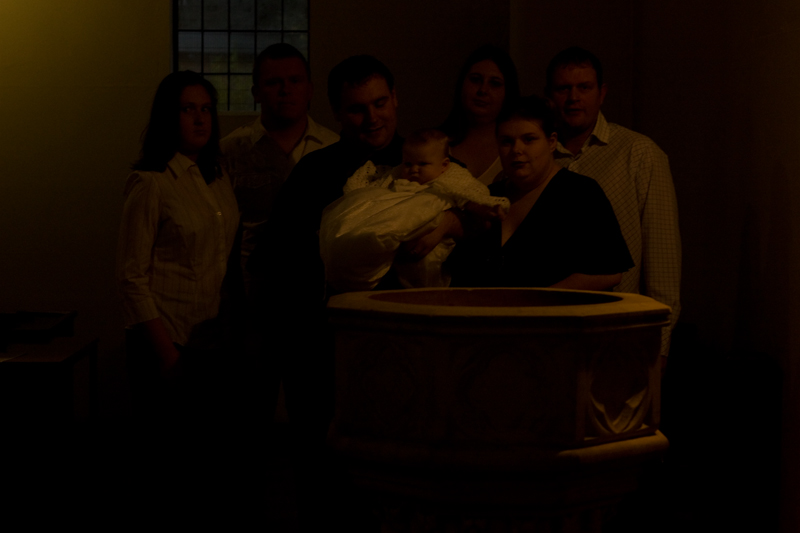
Here you go. An example. The light that you can just about see coming from the right is a small wall lamp that was illuminating a picture above the font.

I think the EXIF is still intact. This is an export to jpeg from the orginal RAW file. Just resized to 800 pixels

1/60 @f4.0
ISO 400
50mm f1.8 Lens

This was taken 1min 1 sec after the previous shot (which came out OK ish) according to the exif data
3038882494_262c48c2e2_o.jpg


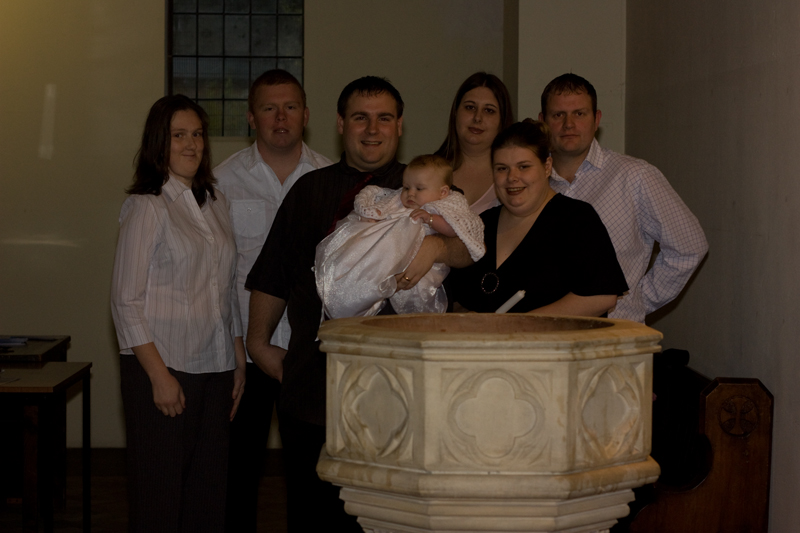
This was taken 4 seconds later (the flash ready light was on again).
Still not spot on but a lot better.
3038078453_83b4ae0efb_o.jpg
 
try setting your flash sync speed in custon settings on my canon i set from auto to 200 and i've never looked back.
 
I can't see any obvious reason for such poor results from the flash, in those shots even the onboard unit would have coped. I would suggest taking the unit back and comparing it to another unit as I think you've got a duff one :(
 
It doesn't look as if the flash fired on the dark shot...or if it did with VERY little power. You won't notice the power difference by eye unless you are looking for it (at time of shooting).

If those two were 4 seconds apart, then the flash might not have fully recharged....possibly a dirty contact causing intermittent firing. At least that last shot is salvagable.
 
I think I will try a couple of test shoots with the flash and camera in manual mode.

I have experience of manual flash a few years back with a Metz 45CT4 hammerhead on a Bronica ETRS but this flash is a lot more complicated with all its buttons than the Metz with a simple dial. Seems to me that sometimes things are getting more difficult if you dont want to hand over control to the electronics.


Thanks to all the people who have replied the help is most appreciated.
 
Back
Top