

Flash Bracket Recommendation

Fortkentdad

Suspended / Banned
Messages
18
Name
David
Edit My Images
Yes
Been thinking of getting a flash bracket to raise my flash off of my camera.

I read that being able to flip the flash or rotate the camera is a good idea so that the flash is on top of the camera regardless of orientation.
I also have read that all you need to do is always shoot landscape and just crop if you want vertical portrait image and spend your money on something else. (see Phil V's comments at
http://www.talkphotography.co.uk/threads/flash-brackets-for-wedddings-events.507542/#post-5832975 ) Yet there are many who recommend getting the flash up off of the camera.

Based on what I've read it would seem best to get the flash up more than just a few inches off the camera so I'm inclined to look at units that offer up to about 18" (the Morris even goes to 28").

I found B&H a good source for these items, all the links go to their website.

They offer a Manfrotto 233B for $81 US$
http://www.bhphotovideo.com/c/produ...3B_233B_Telescoping_Camera_Flash_Bracket.html
I'm confident that Manfrotto quality would be good. It does look well machined. It does allow the user to keep the flash overhead but apparently not as smooth and easy as the other's in this category.

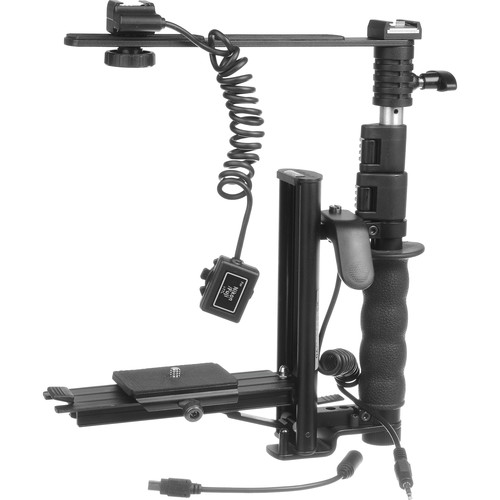
RPS Studio offers a Dot Line RS-0420 kit that comes complete with cables (iTTL & shutter trigger). They have a good demo video on their website. $108 see
http://www.bhphotovideo.com/c/product/632477-REG/Dot_Line_RS_0420_D90_RPS_Digital_Flash_Bracket.html There are two models, this one and for $20 more you get one where the flash bar rotates (called Bounce Control). B&H also offers a Morris version that look identical to this one, but it does not come with the same cables. (Cables would cost about $20-$40 depending on quality).
http://www.bhphotovideo.com/c/product/635027-REG/Morris_32301_Vertical_Horizontal_Flip.html

My inclination is to go with one of these:
632477.jpg


I do read many recommendations for Custom Bracket products but they are considerably more costly (closer to $200) - I could buy an older version for about $100 but then still need to buy adaptors and plates as these are not included, plus the cables. Seems there cheap ones that just raise the flash a few inches above for $20-$70 then the ones like those above, then the professional grade ones for $200-$400. Custom Brackets does offer a less expensive Junior kit for $105 at http://www.bhphotovideo.com/c/produ...ets_CBJUNIORKIT_CB_Junior_Flash_Rotating.html I suppose one could mount an extension on top of this unit if you really wanted the flash higher - but then you could not 'flip it" properly. It has many good reviews.


Any thoughts on the idea of a Flash Bracket - and which type / model to you recommend?


To be frank, your recent Gary Fong purchase and this look like you've discovered a portal to the internet from 10 years ago.

They both have limited uses which can be overcome with simpler cards and good bounce technique. Most of us over a certain age have a flash bracket knocking around somewhere. (I now use mine to help with the tilting of my soft box). And as you've heard before, we consider a Fong Dong to be the tax we paid learning to light.

Flash brackets are really useful for straight on flash (but straight on flash is ugly so we don't use it if we can help it), but only slightly useful once you're bouncing flash or using modifiers.

In 2014, the general rule is bounced flash with or without modifiers, or getting it off camera whenever practicable, wireless is cheap and reliable nowadays, particularly compared to a Fong Dong, ETTL cord and flash bracket.

You have the opportunity of benefitting from our hard won experience, or chuckling that it's no big deal and copying our mistakes.
 
If you were not in Canada I'd be happy to give you an old bracket.... But as Phil has said.. Wireless is cheap & REALLY YOU WANT to MOVE your flash OFF camera...
The brackets were designed for a time when this wasn't an option.
 
I'll just add, crap light isn't something you can buy your way out of. You need to learn your way out of it. There's no magic bullet, you can buy everything up to and including a Profoto B1 air, and without practice reading and knowledge you'll still end up with crap light.

Start with 'The speedlighters handbook' by Syl Arena, then have a read at 'the hot shoe diaries' and if you really want to learn everything; 'Light Science and Magic'.

Meanwhile you can test how useful a bracket will be if you already have a cord, holding the flash in your hand. Unfortunately you can't get a feel for how unwieldy a rig it creates without wasting spending the cash.
 
Agree with Phil - it's about quality of light. As a starting point, that generally means softer light (ie, from a larger light source) and from above. Indoors, that's usually achieved by bouncing off the ceiling, which then becomes your much larger light source, and having the gun on-camera is fine for that. This often leaves shadows under eyes/nose/chin, for which a fill-in light is required, and actually having that on-axis (on-camera) is the best place for it.

Add these things together, and you'll see why a simple bounce-card (see Gary's link above) is just the job for basic indoor flash lighting. You can vary the size of the bounce card and/or zoom the flash head and/or angle the head to moderate bounce/fill ratio, and adjust overall exposure to balance with the ambient, gel the flash to balance colour etc etc. There's a lot of control there, at zero cost, but it takes a bit of know-how and practice. BTW, this is exactly how your Fong works - same principle. I like the Lumiquest QuikBounce best for this, for a number of reasons http://store.lumiquest.com/lumiquest-quik-bounce/ Have a go with a bounce card, you'll learn quickly, and I also recommend Syl Arena's book Speedliter's Handbook. It's Canon centric, but just change the name and everything applies the same. Also check out Strobist 101 - start here http://strobist.blogspot.co.uk/2006/02/welcome-to-strobist.html

I have that Manfrotto bracket (don't use it any more) and also the one illustrated, but it's highly modified - only using the grip and extension - not really relevant here. Note that for shooting verticals it rotates the camera clockwise, putting the shutter release at the bottom, which is not where you want it.
 
Last edited:
Been thinking of getting a flash bracket to raise my flash off of my camera.

I read that being able to flip the flash or rotate the camera is a good idea so that the flash is on top of the camera regardless of orientation.
I also have read that all you need to do is always shoot landscape and just crop if you want vertical portrait image and spend your money on something else. (see Phil V's comments at
http://www.talkphotography.co.uk/threads/flash-brackets-for-wedddings-events.507542/#post-5832975 ) Yet there are many who recommend getting the flash up off of the camera.
I missed the (mis) quoting of me in your opening post. Prior to mentioning brackets and cropping, my advice was to bounce the flash. As it still is.

Like a few of us have said, flash brackets were de rigeur 'back in the day' but are rarely recommended nowadays.
 
also, check out the Tangents blog and the B&H tutorials by Neil Vanniekerk......see what he creates with bounce flash and a cheap bit of rubber foam....Impressive. I spent $1 on some rubber foam, learnt his technique and instantly saw results that had eluded me for years...

Coupled with things like the flashbender, or even a large reflector held up to bounce the flash off in the advent of no ceilings and you will have saved yorself a fortune, be far more portable, much more verstile and not have a huge bracket thingy. Im no expert but from listening to the people on here that are, i really feel that the simplicity has made it easier for me to improve vastly.
 
Well, thanks for the input, and I do recognize that equipment is just stuff, what is needed is knowledge and skill, with a good dose of artistic vision to get the right pic and to learn how to manage the light (created or captured).

Nevertheless I must confess to being a bit of a gizmo junkie and I found an eBay deal I did not let go - I bought a Newton Di100CR http://www.newtoncamerabrackets.com/new_page_5.htm

It retails for $269 - my eBay buy included a Nikon SC-28 and the bracket for $72. Yes wireless is the way to go, but given it was included for now I'll take the SC-28 (which retails for $64). So dollar wise a great deal - now will it improve my photography? We will see. I like the craftsmanship in this bracket, Newton is a one man company in the USA. When I researched it I found it is a very small co. but those who like it, like it a lot. It is well made. I'd never part with $269 for it, but for $72 with the Nikon cord I think it was well worth it.

Still playing with my new Fong toy too - the "whale tale" is aptly named as it is a big attachment for my speedlights but seems to soften the image. For $20 I got two of them - when I saw the full retail I nearly choked - people paid that much for those - ouch. But at $10 each with gels and chrome reflectors et al. I'm good. Will they make the light that much better than the $ .50 hand made foam reflector? Hmmm good question. I had made one from some unexposed photo-paper and an elastic band. Figured the 5x7 semi-gloss photo paper would reflect light well and radically increased the size of the mini bounce card that pulled out of my flash head. And it packs so much easier than the whales.

But I have so much to learn about lighting - for example how to take a picture of a flash, flashing into a mirror.

I do enjoy that articulated screen on my D5100 for shots like this though. Kinda like the old Brownie mom had when I was a kid - held it down in front and looked down.

1452261_10152091019466051_38775236_n.jpg
 
Not seen those Newton brackets before, so thanks for that :thumbs: Looks like the flash caught fire LOL :eek:

As you say, learning is the key. Fong Whale Tail works for sure, same principle as a large bounce-card in effect (use non-glossy paper for that). In fact it's almost identical to the Lumiquest QuikBounce I linked above, except the LQ wastes less light and folds flat.

Three key flash facts for you:
- The larger the light source, the softer the shadows. Size is relative to distance, eg the sun is very big, but a long way off so the light is hard. Your Fong WT will soften the forward portion of the light usefully at close range, say around 2m, but at greater distances it gets harder, in line with the inverse square law - double the distance and the light area is effectively reduced to one quarter.
- Inverse square law says brightness reduces rapidly with distance - double the distance equals one quarter the brightness (two stops drop).
- Angle of incidence equals angle of reflection, ie light bounces off a surface at the same angle it strikes, like a pool/snooker ball off the cushion.

Those three fundamentals apply to every flash picture taken, and are vital considerations for every set-up. Don't try to fight them as you'll lose, but use them to your advantage :)
 
Back
Top