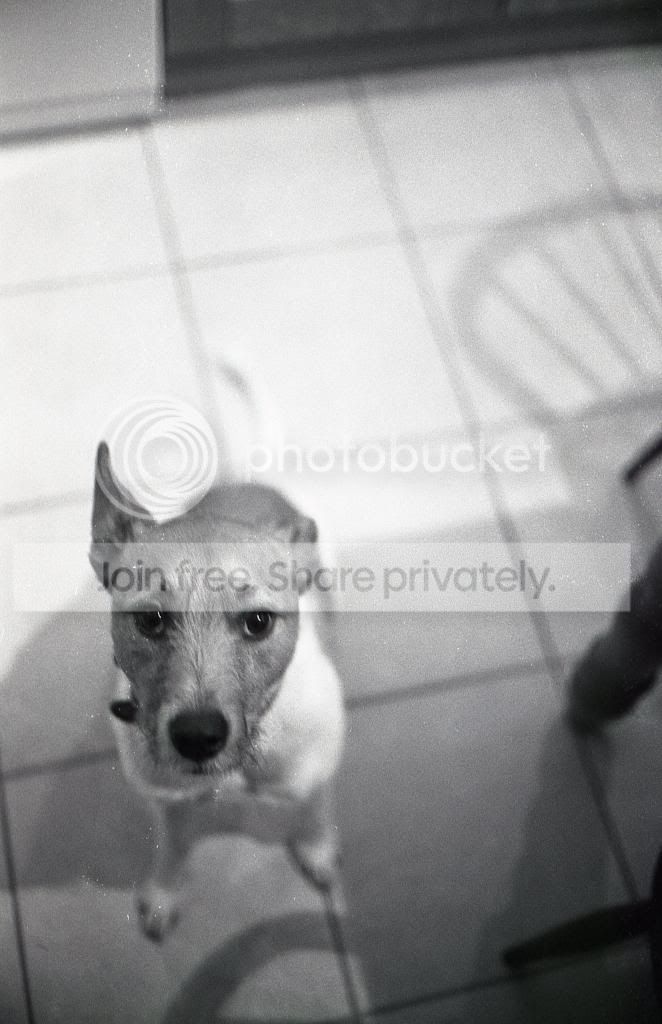
First time developing, alot of grain..

richboyphoto

Suspended / Banned
Messages
316
Name
Rich
Edit My Images
No
Hey guys so i went down to AG photographics today and bought a ruck of gear to get started. chemicals used were D76, kodak stop bath & some ilfofix.

HP5+ 400

I developed for 9 minutes at 24 degrees, i stop bathed for 3 minutes and fixed for 3 minutes. Washed in tap water for 5 minutes then hung up to dry for a few hours, they weren't fully dry when i scanned, my patientce got the better of me.

There is ALOT of grain, how would i get less grain? develop longer? fix longer? help me out if you can.


(Don't worry, those marks are the effect i was going for with the falling snow, they're not water marks.)

582347_10151354305847591_572874548_n.jpg


530806_10151354305802591_393657460_n.jpg


Not looking for critique on the photos, just tips for developing! Thanks
 
What was your agitation steps like - how often, how many, inversions/rotations?

My main recommendation for reducing grain? Don't use HP5! It's not a particularly fine grained film. Many people shoot it because they like the look, but the grain can be rather apparent.
 
The time is perhaps too long and your temperature is a little high which results in you push processing the film and getting more obvious grain.

Ilford recommend stock D76 for 7 1/2 minutes at 20 degrees for HP5 exposed at 400 ISO.

Mike
 
Rockman said:
The time is perhaps too long and your temperature is a little high which results in you push processing the film and getting more obvious grain.

Ilford recommend stock D76 for 7 1/2 minutes at 20 degrees for HP5 exposed at 400 ISO.

Mike

Forgot to say that it's the development that gives the grain, bit the other steps.
 
Ilford recommend stock D76 for 7 1/2 minutes at 20 degrees for HP5 exposed at 400 ISO.

Yikes, just had a look at the Ilford time compensation chart - that would be 5:15 minutes at 24 degrees. Definite overdevelopment then (although HP5 is still unbelievably grainy).
 
The HP5 box reads: @ 24 degrees, d76 at 1 + 1 (which i did) 400 ISO 9 minutes. This stuff doesn't go off til 2016 so it's not old stock. :S

As for agitation, i did 3 lots of 10 seconds in the first minute, then 10 seconds every minute after that. It was just rotations, using the patterson tank and didn't want to tip upside down as the rubberised lid wouldn't even go on in the first place, i figured it'd be better to play it safe and swivel from side to side with the tool.
 
Last edited:
TBH I'm surprised an Ilford box would give a time for Kodak developer but even so, I've just checked the massive dev chart and it says at 1+1 it's 13 minutes at 20degC and around 4.5-5 minutes at 24degC.

Are the negatives quite dense?
 
Yep, got a box in front of me...the HP5 box shows D76 1:1 @24 deg for 9 mins
 
There are a number of things that can enhance grain
Relatively high developing temperature - check
Lots of agitation - not really
High developer concentration - check (From the kodak D76 tech sheet "For greater
sharpness, but with a slight increase in graininess, you can use a 1:1 dilution of this developer.")
 
what counts as lots of agitation?

I agitate constantly for the first minute then once every 30 seconds for the duration. Too much? By agitate i mean i just turn it back and forth rather than shake like a maracca.
 
As for agitation, i did 3 lots of 10 seconds in the first minute, then 10 seconds every minute after that. It was just rotations, using the patterson tank and didn't want to tip upside down as the rubberised lid wouldn't even go on in the first place, i figured it'd be better to play it safe and swivel from side to side with the tool.

I tried just twirling the stick and it didn't work for me compared with inverting the tank; if you can't invert it then you could try the method that Kodak recommend which is just literally moving the tank rapidly sideways over an about 30cm distance.
 
what counts as lots of agitation?

I agitate constantly for the first minute then once every 30 seconds for the duration. Too much? By agitate i mean i just turn it back and forth rather than shake like a maracca.

Shaking it hard for every agitation step would be a lot, gentle inversion or twirling would be fine
 
Does anyone use the patterson super system 4(i think) tank? does your lid fit on properly? is this tank designed to be inverted?
 
I usually give mine 4 inversions at first and then 1-2 every minute through the duration. The fewer the better, especially with HP5+. Mind you the grain will always be there with this traditional film. If you want something less grainy then go for one of the T grained films.
 
Does anyone use the patterson super system 4(i think) tank? does your lid fit on properly? is this tank designed to be inverted?

Mine inverts fine and is the least leaky tank I have used.

Mine inverts fine too with next to no leakage although I always take care when inverting just in case!!!!
 
Last edited:
Mine inverts fine too with next to no leakage although I always take care when inverting just in case!!!!

Fine here as well - the Super System 4 tanks are much better agitated with inversion, the little stick could cause surge marks. Inversion is a much better way of agitating.

what counts as lots of agitation?

There is no set answer to this at all - different films have different recommended agitation steps, so obviously a 'lot of agitation' is going to vary between emulsions.

For example:
Ilford Delta 400 (Fact Sheet) - "invert the tank four times during the first 10 seconds, then invert the tank four times again during the first 10 seconds of each further minute"

Kodak Tri-X 400 (Fact Sheet)- "Provide initial agitation of 5 to 7 inversion cycles in 5 seconds; i.e., extend your arm and vigorously twist your wrist 180 degrees. Then repeat this agitation procedure at 30-second intervals for the rest of the development time."

TBH I'm surprised an Ilford box would give a time for Kodak developer

Ilford are quite good in this respect - they offer times for a wide range of non-Ilford developers, which is quite useful (and very realistic). Additionally, D76 is considered to be a standard of sorts, and it is a common belief that all film is designed to perform well in D76.
 
richboyphoto said:
How do you do it? put the rubberised lid on? any special way to actually get that lid on?

Big lid screws on and smaller rubber lid is stuck on the top. Nothing special at all!
 
richboyphoto said:
The funnel bit clicks in fine but the rubber lid is too small to go on over the top on mine :S

There should be a bigger black lid that fits very nicely! Show us a picture.
 
The funnel bit clicks in fine but the rubber lid is too small to go on over the top on mine :S

Mine was like that too when it was new. Just persevere with it for the first few goes and then it should just push on easily after that.
 
Hey guys so i went down to AG photographics today and bought a ruck of gear to get started. chemicals used were D76, kodak stop bath & some ilfofix.

HP5+ 400

I developed for 9 minutes at 24 degrees, i stop bathed for 3 minutes and fixed for 3 minutes. Washed in tap water for 5 minutes then hung up to dry for a few hours, they weren't fully dry when i scanned, my patientce got the better of me.

There is ALOT of grain, how would i get less grain? develop longer? fix longer? help me out if you can.

24 degrees for the developer.But what were the temperatures of the stop bath, fixer AND tap water when it's freezing outside?
 
24 degrees for the developer.But what were the temperatures of the stop bath, fixer AND tap water when it's freezing outside?

stop bath and fixer were around 24 degrees too. obviously tap water was colder..

photo of tank on the way
 
If the tap water was cold that can and most likely is what caused the reticulation (grain). The washing temp should be lowered slowly.You have developed at a high temp for some reason? The normal is 20 degrees(average room temp).24 degrees is harder to maintain then 20 degrees.In winter months I used to develop at 18 degrees.If you have gone from 24 degrees to cold tap water at 15 degrees that is what can cause the grain.:thumbs:
 
You have developed at a high temp for some reason? The normal is 20 degrees(average room temp).

As the OP pointed out 24 degrees is what it says on the box, I was surprised as well but without any experience I'd follow the instructions on the box as well.
 
It may say 24 degrees on the box but I use ID11 same as D76 and it gave s a range of temps and times on the box including 20 degrees.I have not seen a D76 for many years being an Ilford user.But It would be the first developer I had ever seen in almost 40 yrs of Photography that did not give times for 20 degree process.I await the OP observations.:naughty:
 
Yeah, i originally over-estimated 20 degrees, used hot water then had to cool it in the fridge, didn't have too long so when it got to 24 degrees i got stuck in (due to thinking it'd be fine from the 24 degree calculations being on the ilford box). I'm picking up my new oly SP 35 from the sorting office tommorow so will shoot a test roll in the day then have another go at developing tommorow night!

Strangely, after a wash the rubber lid now fits on! So will invert as well as turning.

out of interest, how do people achieve 20 degrees? just warm water? kettle water then cooled in fridge?

hp5 400

I plan to do:
11 minutes developer @ 20 degrees
3 minutes stop bath @ 20 degrees
3 minutes fixer @ 20 degrees
wash in luke-warm tap water 5 minutes

agitation: tap of the tank at first, 10 inversions in first minute, 5 inversions every 30 seconds after.

How does this sound? should i just invert and not bother using the tool to spin the reel?

thanks!
 
Last edited:
Hi, I've only dev'd a few films up to now so there is definitely more experienced people on here but I use;

- Mix hot/cold tap water (mixer tap) until its at 22 degrees (with a thermometer under the running water) to allow for cooling during the process then fill a jug so I've got enough for all 3 stages.

I currently use ID11, Rapid Fixer and HP5 so my timings are;

- 10 minutes Dev (that's with stock dev so longer with a dev+water mix according to ilford times). I then do 4 inversions over 10 seconds at the start of every minute and tap the tank on the sink after the 4 inversions to remove bubbles.

- Pour out the dev in the last 15 seconds.

- Pour in my Stop (500ml tap water plus a few drops of vinegar) and leave in for 12 seconds with 4 inversions.

- Pour out the Stop and pour in the Fixer (1+4 mix e.g 100ml fixer+400ml water). Leave the fixer for 3 minutes with 4 inversions over 10 seconds per minute.

- Pour out the Fixer and then use a rubber hose attached to the tap at around 20 degrees and leave tap running for 10 minutes as a wash.

- After 10 minutes, take out the negatives (with a gasp of amazement that it worked...!) and hang with a clip at the top and bottom to straighten and use a squeegee to remove most of the water.

This has worked for me so far :0)

Cheers
Steve
 
Last edited:
I also forgot to add that I use an app on my IPhone called Labtimers and setup the times for each stage separately before I start. I can then just start the timer as I finish pouring in the mix.

Cheers
Steve
 
If the tap water was cold that can and most likely is what caused the reticulation (grain). The washing temp should be lowered slowly.You have developed at a high temp for some reason? The normal is 20 degrees(average room temp).24 degrees is harder to maintain then 20 degrees.In winter months I used to develop at 18 degrees.If you have gone from 24 degrees to cold tap water at 15 degrees that is what can cause the grain.:thumbs:

Agree with the comments about water temperature. At the moment our cold water supply is at 9 degrees C.

I seem to remember trying not to go more than 5 degrees per step when cooling to get to the wash step.

David
 
So, i developed a test roll form the 35sp last night.

Less grain, More damage. I'm pretty sure this wasn't at the scanning stage, i don't have a neg viewer/magnifying glass so can't be 100%. Anyone know why they came out like this with the white spots?

img064_zps6dd261a0.jpg


img072_zpsbc564e2e.jpg
 
The white spots are just dust, either on the scanner or on the film itself.
 
is the inside of the camera clean, did you use anything to wipe the film to help dry it, did you use a hairdryer to dry the film, where did you hang the film to dry?
 
to add to the processes previously mentioned to reduce the riskof drying marks i would do a final rinse with deionised water with some drying agent in.
 
Back
Top