First Mirrorless Camera Set Up

Zadro

Suspended / Banned
Messages
31
Name
Nicola
Edit My Images
Yes
Hi there,

I'm looking to buy my first mirrorless camera / lenses. I am an absolute beginner and whilst I owned a DSLR some c.15 years ago I never really got the camera off Auto mode. Now looking to learn how to use a camera and start my photography journey including joining a short course at my local university.

Haven't a clue what kit to buy and my first choice of camera is based on pure aesthetics: the Nikon Zf. I also like the tactility of the adjustment wheels on top of the camera rather than having to go through endless menus. I love tactile tech and am quite driven by both aesthetics and functionality - sounds shallow but I am more likely to use and want to learn about the equipment if I like it from both a function and looks point of view. I have also looked at the Zfc but that seems to have more mixed reviews and is a more basic camera which I appreciate may be better to start, I don't particularly want to have to be upgrading my gear after 5 minutes and I believe the lenses are slightly different between the two cameras / sensor sizes.

Cost is a consideration but I am in a fortunate position that I can legitimately buy my kit through my business (I'm a Chartered Surveyor by profession and have to take a lot of photographs).

I'd love a 'kit list' and set up suggestions, please.
 
Hi and welcome to TP

Just some thoughts.,.....

Do you have a camera shop or shops that have the likes of Canon, Nikon, Sony, OM system, to handle and get the feel of each in your hands?

What do you like to (or expect to) take photographs of? Apart from of course, architecture and the built environment.

Budget is important but don't forget photography is or can be an expensive hobby. If you intend to use the kit for your work then (in future) a tilt & shift lens might be on your future shopping list and that potential lens alone might affect your choice of full frame or crop body purchase?

Edit~ don't forget editing software and a suitable PC or Mac to run it on.
 
Last edited:
If you like the ZF then go for it. Why not?

What I did want to mention is that I can't think of a camera with which you need to go through menus to change basic settings. There are some cameras these days which feature dedicated and marked top of camera controls, these are often considered to be of a more retro design. Other cameras may lack dedicated marked controls for these functions but they likely still exist as unmarked and often assignable dials either at or near the top of the camera. For example it is quite typical to have a control wheel on the front of the grip near the shutter button and one at the back near the top of the camera which you operate using your thumb. These dials are typically used to set the aperture and shutter speed. There is often a third dial which is used to set exposure compensation. ISO is another function which is often set by the user although most cameras these days have an auto ISO function. Some cameras do have a dedicated dial for ISO whilst others have dials which can be assigned this function. Others have no ISO dial but the function can probably be entered onto a custom menu and on that subject...

Menu functions can normally be saved into a custom menu which avoids you diving into the cameras main menus but keep in mind that once you've set your camera up and assigned uses to the various dials and buttons your use of the main camera menu system may be very minimal. For example the most common reasons for me to use my cameras menu are to format the card (I do this often) and to set the clock (I do this twice a year.)

Also some more modern lenses have buttons on them which can be assigned various functions adding to the degree to which you can customise your kit.

As BB suggests above, maybe your first action could be to visit a shop and see what's on offer and what you like.
 
Last edited:
@Box Brownie thank you for your message, I have a London Camera Exchange and a Wex Photo shop nearby both of which I am planning to visit over the coming week.

I will definitely be taking photographs of architecture / built environment, cars and motorbikes (likely stills rather than motorsports). I am also interested in street photography and people / events as well. Appreciate my interests are quite broad, I will most likely find what I am most interested in as I develop my craft and technique.

Can you tell me a little more about the tilt and shift lens - is it of particular use when shooting the built environment?

@woof woof thank you! I love the look of the Zf and am likely just looking for a bit of reassurance as much as anything!

That's great to know that you don't need to go through menus to change functions; I think not being able to see the marked controls on other models have given me the wrong impression.
 
Nicola,

There's a comparison site here which lets you select various cameras and lenses. It's quite easy to use and you might enjoy playing with it to see how different cameras look and how they compare size wise.


Many people do like the more retro design cameras and one thing which does add to their appeal is that when you look at them their settings can be seen. With other cameras you need to look at the back screen or EVF to see the settings although some cameras also have a small top of camera display too.
 
Re:Tilt & shift lens and usage

Can I suggest you have a read here .... keith cooper is a commercial photographer.

 
The Zf and Zfc use the same lenses, it’s just that the Zfc has a smaller sensor which means that lenses on the Zfc have a different field of view to the same lens on a Zf. They are both very capable cameras with very similar functionality . Depending on whether you intend to pursue your hobby long-term, and if you like the Zf (a larger, heavier, camera, then, as @woof woof says, go for it. You shouldn’t have to upgrade from that for a long while.
 
Last edited:
Going by your initial post, it sounds like a Fuji body or the Nikon Zf look like the sort of thing you are after.

As Alan says though, you shouldn't have to go into any menu to change basic exposure settings. It's just that most cameras have these on a plain dial/wheel that you can allocate yourself rather than dedicated, marked lenses like old film camera, the Zf & the Fuji stuff.
 
Actually I've just thought of something that could well matter Nicola.

I think it's worth thinking what lenses you want and if they are available for the cameras you're looking at. For example if you are interested in any more specialist lenses such as tilt/shift are they available to fit the camera you're looking at? And at what price? The lens choice and the cost of them could affect the camera system you end up going for.

I think in the mirrorless world Sony arguably has the most extensive lens line up and there are third party lenses too but the Sony camera range doesn't have a retro style body with dedicated labelled dials but some Sony lenses do have an aperture ring.

I suppose another thing to think about is do you want a Full Frame 35mm equivalent camera system or a smaller sensor system such as APS-C or even Micro Four Thirds? In your place I think I'd decide the system sensor size first and then look at the main options available and then check the lenses available for that system. Sorry to add to the confusion but there is a lot to think about when getting into this and I suppose it is well worth thinking about what system fits your wants and needs best.

Good luck choosing.
 
I've just found out my local branch of Wex Photo Video (Nottingham) has an event on Friday. That's my office day, so I think I'll be taking an hour or so to have a walk up there.

@Stephen L thank you! I am a little confused by the APS-C v full frame sensors as to which would work best for the type of photography I want to do.

@LeeRatters thank you, much appreciated. I had not looked into Fuji, (why? see below) so will do before making a commitment.

@woof woof thank you, I have been down the rabbit hole of looking at Keith's website this evening. He's only based in Leicester too.

Another person (someone I know who is interested in photography) mentioned Sony to me earlier this evening, it wasn't a brand I even considered as I thought you wanted a good camera set up with a wide range of lens options you had the two choices of Canon or Nikon.

Ultimately I want to make an informed choice rather than spending a lot of money on a set up that isn't going to well suit me. If it takes a while, it doesn't matter, I'm not in any rush.
 
Another person (someone I know who is interested in photography) mentioned Sony to me earlier this evening, it wasn't a brand I even considered as I thought you wanted a good camera set up with a wide range of lens options you had the two choices of Canon or Nikon.

Ultimately I want to make an informed choice rather than spending a lot of money on a set up that isn't going to well suit me. If it takes a while, it doesn't matter, I'm not in any rush.

Good :D

Panasonic and Olympus were the first to introduce true mirrorless interchangeable lens cameras as we know them today. They use a smaller than Full Frame format called Micro Four Thirds. I have this system including three cameras and too many lenses. Panasonic now also make full frame mirrorless cameras too. Sony came along after Panasonic and Olympus with what is now their APS-C A6000 range of mirrorless cameras and then brought out the first "Full Frame" mirrorless camera, the Sony A7. I've had one for 11 years now. The original is a bit primitive by todays standards but of course they have introduced newer models over the years and they are considered market leader in sensors and arguably in camera bodies too. It was (again) arguably the success of Sony mirrorless cameras which persuaded Nikon and Canon to go mirrorless too. As Sony were early entries into mirrorless they've had longer to increase the range of lenses available and there are quite a few to choose from. Nikon and Canon have been in the market less time and so have fewer mirrorless lenses but their legacy DSLR lenses can be used on their mirrorless cameras via an adapter. By the way, you can use almost any lens on mirrorless cameras if you can find an adapter. I use adapted manual film era lenses quite a bit and I have far too many of them.

Sony seem to have a good range of cameras including the "everyday" (my choice of wording) A7 series, the high resolution A7r series, the low mp count low light and maybe more video orientated A7s series, the professionally targeted speed orientated A9 series and the do almost everything flagship A1. Sony have also recently introduced the first global shutter consumer camera, the A9III.

The Sony APS-C range are all range finder style cameras with their EVF in the top left corner when looking at the back of the camera. Their Full Frame range includes the SLR style cameras with the EVF in the middle, the A7/A7r/A7s, A9 and A1 ranges and the A7c RF style range. Unfortunately Sony don't do a retro ZF style camera with dedicated and labelled controls.

Sony cameras and their range of lenses are IMO well worth looking at. Lens wise they have their "everyday" range, the slightly more upmarket G range and the even more upmarket GM range. GM standing for (AFAIK) Grand Master. Third party manufacturers like Sigma and Tamron also make lenses for the Sony APS-C and FF range. They also make lenses for Nikon mirrorless but Canon are a bit more resistant to third party makers and therefore the third party choices for Canon mirrorless are more limited.

There's a big Sony thread on this forum and you'd be more than welcome to ask any questions in it.


There are also big Canon, Nikon, Fuji, Panasonic and Olympus threads.

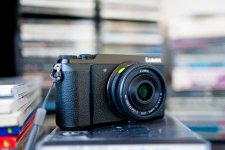
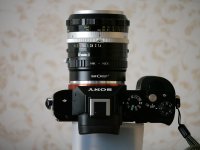
Just to confuse you further (haha, only joking) or to show you some possibilities... This first picture is of my quite tiny Panasonic MFT GX80 with a 14mm f2.5 (equivalent to a 28mm in Full Frame terms) lens. The second picture is of my Sony A7 (original 11 year old model) with a Nippon Kogaku 50mm f2 lens I think made sometime between 1964 and 1972 and used here via a cheap adapter.

DSC09796.jpg

P1020150.JPG
 
Last edited:
Thank you all so far for your opinions, advice and help. It is very much appreciated.

I went to my local branch of London Camera Exchange today. They didn't have the two retro Nikons but I got chance to have a look at a Sony option. The staff were very friendly and knowledgable.
I was really impressed with the Sony A7iii I was shown although I don't think I'd appreciated how much decent lenses cost(!) and as such I am questioning buying a £2k+ camera body as I would like a couple of lenses to get me started. I also found the controls relatively intuitive, so I'm really not sure my reasoning for the retros were so justified. LCE have a deal currently on the Sony of the body for £1299 (+ £300 cash back from Sony), making it £999 for the body. A kit with a Sony 24-70mm lens for, I think, £200 more or a kit with a Sony 24-105mm F/4 lens for £2099 with an additional £500 cash back from Sony. The salesman considers the 24-105 lens to be vastly superior to the 24-70mm kit, is the 24-105 any good in the grand scheme of things or am I better buying the body and another lens separately? He did have a 24-105 used for £579 which gave me a bit of confidence it is likely a decent lens (as it wasn't pennies used, no other frame of reference). He also showed me a Sigma wide angle 16-28mm F/2.8 lens for £749 as a recommended wide angle option.
 
Thank you all so far for your opinions, advice and help. It is very much appreciated.

I went to my local branch of London Camera Exchange today. They didn't have the two retro Nikons but I got chance to have a look at a Sony option. The staff were very friendly and knowledgable.
I was really impressed with the Sony A7iii I was shown although I don't think I'd appreciated how much decent lenses cost(!) and as such I am questioning buying a £2k+ camera body as I would like a couple of lenses to get me started. I also found the controls relatively intuitive, so I'm really not sure my reasoning for the retros were so justified. LCE have a deal currently on the Sony of the body for £1299 (+ £300 cash back from Sony), making it £999 for the body. A kit with a Sony 24-70mm lens for, I think, £200 more or a kit with a Sony 24-105mm F/4 lens for £2099 with an additional £500 cash back from Sony. The salesman considers the 24-105 lens to be vastly superior to the 24-70mm kit, is the 24-105 any good in the grand scheme of things or am I better buying the body and another lens separately? He did have a 24-105 used for £579 which gave me a bit of confidence it is likely a decent lens (as it wasn't pennies used, no other frame of reference). He also showed me a Sigma wide angle 16-28mm F/2.8 lens for £749 as a recommended wide angle option.
In all honesty, the best way to choose a camera is to find one which sits comfortably in your hands. I don't think there are any bad cameras (main-stream that is) on the market these days.
 
If you like the look of the Zf (and why shouldn't the look of the gear be important)but want to save some money so your budget will get some decent lenses.

The Fuji mirrorless are fantastic, very nice to use.

And the Olympus M4/3 offerings are great too.

I'd probably go for Fuji - I've said before that if I'd started from scratch when they were available, that's what I'd have bought.
 
Back
Top